SUBSCRIBE TO OUR FREE NEWSLETTER
Daily news & progressive opinion—funded by the people, not the corporations—delivered straight to your inbox.
5
#000000
#FFFFFF
To donate by check, phone, or other method, see our More Ways to Give page.
Daily news & progressive opinion—funded by the people, not the corporations—delivered straight to your inbox.
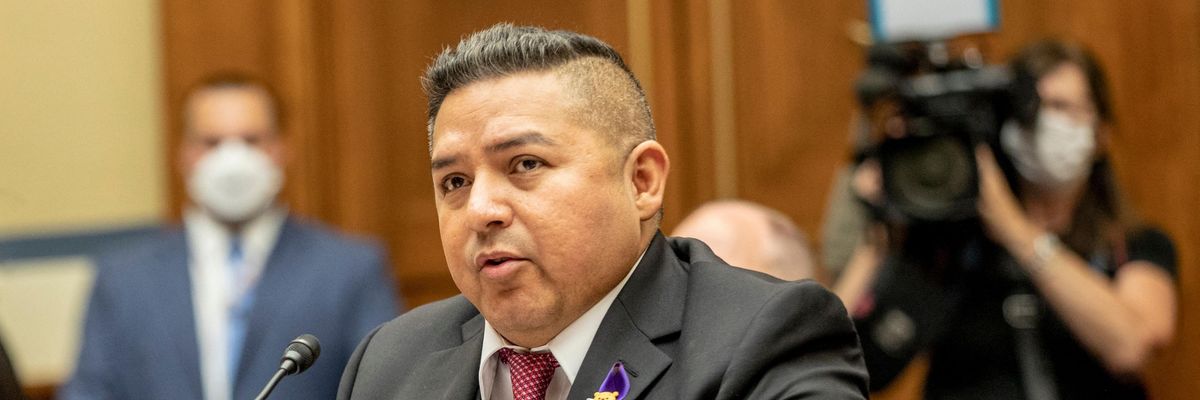
Dr. Roy Guerrero, a pediatrician from Uvalde, Texas, speaks during a House Committee on Oversight and Reform hearing on gun violence on Capitol Hill in Washington, D.C. on June 8, 2022. (Photo: Jason Andrew/ Pool/ AFP via Getty Images)
A local pediatrician who rushed to Uvalde Memorial Hospital after the massacre of 19 children and two teachers at Robb Elementary School in Texas last month testified Wednesday during a congressional hearing on gun violence.
"The thing I can't figure out is whether our politicians are failing us out of stubbornness, passivity, or both."
"I was called here today as a witness," Dr. Roy Guerrero told members of the House Oversight Committee. "But I showed up because I am a doctor. Because... many years ago I swore an oath--an oath to do no harm."
"After witnessing first-hand the carnage in my hometown of Uvalde, to stay silent would have betrayed that oath," said Guerrero, a Robb Elementary alumnus.
The physician recounted how the day "started like any typical Tuesday" at his pediatric clinic until half past noon, "when business as usual stopped and with it my heart."
"I raced to the hospital to find parents outside yelling children's names in desperation and sobbing as they begged for any news related to their child," he said. "Those mother's cries I will never get out of my head."
"As I entered the chaos of the ER, the first casualty I came across was Miah Cerrillo," recalled Guerrero. "She was sitting in the hallway. Her face was still, still clearly in shock, but her whole body was shaking from the adrenaline coursing through it. The white Lilo and Stitch shirt she wore was covered in blood and her shoulder was bleeding from a shrapnel injury."
Cerrillo, who also testified at the hearing, was a lucky survivor. Guerrero said he next saw "two children whose bodies had been so pulverized by the bullets fired at them, decapitated, whose flesh had been so ripped apart, that the only clue as to their identities was the blood-spattered cartoon clothes still clinging to them."
Guerrero continued:
I'll tell you why I became a pediatrician. Because I knew that children were the best patients. They accept the situation as it's explained to them. You don't have to coax them into changing their lifestyles in order to get better or plead [with] them to modify their behavior as you do with adults. No matter how hard you try to help an adult, their path to healing is always determined by how willing they are to take action. Adults are stubborn. We're resistant to change even when the change will make things better for ourselves. But especially when we think we're immune to the fallout.
Why else would there have been such little progress made in Congress to stop gun violence?The thing I can't figure out is whether our politicians are failing us out of stubbornness, passivity, or both.
"I chose to be a pediatrician. I chose to take care of children," said Guerrero. "Keeping them safe from preventable diseases I can do. Keeping them safe from bacteria and brittle bones I can do. But making sure our children are safe from guns, that's the job of our politicians and leaders."
"In this case, you are the doctors and our country is the patient," he continued. "We are lying on the operating table, riddled with bullets like the children of Robb Elementary and so many other schools. We are bleeding out and you are not there."
"My oath as a doctor means that I signed up to save lives," he added. "I do my job. And I guess it turns out that I am here to plead. To beg. To please, please do yours."
Dear Common Dreams reader, It’s been nearly 30 years since I co-founded Common Dreams with my late wife, Lina Newhouser. We had the radical notion that journalism should serve the public good, not corporate profits. It was clear to us from the outset what it would take to build such a project. No paid advertisements. No corporate sponsors. No millionaire publisher telling us what to think or do. Many people said we wouldn't last a year, but we proved those doubters wrong. Together with a tremendous team of journalists and dedicated staff, we built an independent media outlet free from the constraints of profits and corporate control. Our mission has always been simple: To inform. To inspire. To ignite change for the common good. Building Common Dreams was not easy. Our survival was never guaranteed. When you take on the most powerful forces—Wall Street greed, fossil fuel industry destruction, Big Tech lobbyists, and uber-rich oligarchs who have spent billions upon billions rigging the economy and democracy in their favor—the only bulwark you have is supporters who believe in your work. But here’s the urgent message from me today. It's never been this bad out there. And it's never been this hard to keep us going. At the very moment Common Dreams is most needed, the threats we face are intensifying. We need your support now more than ever. We don't accept corporate advertising and never will. We don't have a paywall because we don't think people should be blocked from critical news based on their ability to pay. Everything we do is funded by the donations of readers like you. When everyone does the little they can afford, we are strong. But if that support retreats or dries up, so do we. Will you donate now to make sure Common Dreams not only survives but thrives? —Craig Brown, Co-founder |
A local pediatrician who rushed to Uvalde Memorial Hospital after the massacre of 19 children and two teachers at Robb Elementary School in Texas last month testified Wednesday during a congressional hearing on gun violence.
"The thing I can't figure out is whether our politicians are failing us out of stubbornness, passivity, or both."
"I was called here today as a witness," Dr. Roy Guerrero told members of the House Oversight Committee. "But I showed up because I am a doctor. Because... many years ago I swore an oath--an oath to do no harm."
"After witnessing first-hand the carnage in my hometown of Uvalde, to stay silent would have betrayed that oath," said Guerrero, a Robb Elementary alumnus.
The physician recounted how the day "started like any typical Tuesday" at his pediatric clinic until half past noon, "when business as usual stopped and with it my heart."
"I raced to the hospital to find parents outside yelling children's names in desperation and sobbing as they begged for any news related to their child," he said. "Those mother's cries I will never get out of my head."
"As I entered the chaos of the ER, the first casualty I came across was Miah Cerrillo," recalled Guerrero. "She was sitting in the hallway. Her face was still, still clearly in shock, but her whole body was shaking from the adrenaline coursing through it. The white Lilo and Stitch shirt she wore was covered in blood and her shoulder was bleeding from a shrapnel injury."
Cerrillo, who also testified at the hearing, was a lucky survivor. Guerrero said he next saw "two children whose bodies had been so pulverized by the bullets fired at them, decapitated, whose flesh had been so ripped apart, that the only clue as to their identities was the blood-spattered cartoon clothes still clinging to them."
Guerrero continued:
I'll tell you why I became a pediatrician. Because I knew that children were the best patients. They accept the situation as it's explained to them. You don't have to coax them into changing their lifestyles in order to get better or plead [with] them to modify their behavior as you do with adults. No matter how hard you try to help an adult, their path to healing is always determined by how willing they are to take action. Adults are stubborn. We're resistant to change even when the change will make things better for ourselves. But especially when we think we're immune to the fallout.
Why else would there have been such little progress made in Congress to stop gun violence?The thing I can't figure out is whether our politicians are failing us out of stubbornness, passivity, or both.
"I chose to be a pediatrician. I chose to take care of children," said Guerrero. "Keeping them safe from preventable diseases I can do. Keeping them safe from bacteria and brittle bones I can do. But making sure our children are safe from guns, that's the job of our politicians and leaders."
"In this case, you are the doctors and our country is the patient," he continued. "We are lying on the operating table, riddled with bullets like the children of Robb Elementary and so many other schools. We are bleeding out and you are not there."
"My oath as a doctor means that I signed up to save lives," he added. "I do my job. And I guess it turns out that I am here to plead. To beg. To please, please do yours."
A local pediatrician who rushed to Uvalde Memorial Hospital after the massacre of 19 children and two teachers at Robb Elementary School in Texas last month testified Wednesday during a congressional hearing on gun violence.
"The thing I can't figure out is whether our politicians are failing us out of stubbornness, passivity, or both."
"I was called here today as a witness," Dr. Roy Guerrero told members of the House Oversight Committee. "But I showed up because I am a doctor. Because... many years ago I swore an oath--an oath to do no harm."
"After witnessing first-hand the carnage in my hometown of Uvalde, to stay silent would have betrayed that oath," said Guerrero, a Robb Elementary alumnus.
The physician recounted how the day "started like any typical Tuesday" at his pediatric clinic until half past noon, "when business as usual stopped and with it my heart."
"I raced to the hospital to find parents outside yelling children's names in desperation and sobbing as they begged for any news related to their child," he said. "Those mother's cries I will never get out of my head."
"As I entered the chaos of the ER, the first casualty I came across was Miah Cerrillo," recalled Guerrero. "She was sitting in the hallway. Her face was still, still clearly in shock, but her whole body was shaking from the adrenaline coursing through it. The white Lilo and Stitch shirt she wore was covered in blood and her shoulder was bleeding from a shrapnel injury."
Cerrillo, who also testified at the hearing, was a lucky survivor. Guerrero said he next saw "two children whose bodies had been so pulverized by the bullets fired at them, decapitated, whose flesh had been so ripped apart, that the only clue as to their identities was the blood-spattered cartoon clothes still clinging to them."
Guerrero continued:
I'll tell you why I became a pediatrician. Because I knew that children were the best patients. They accept the situation as it's explained to them. You don't have to coax them into changing their lifestyles in order to get better or plead [with] them to modify their behavior as you do with adults. No matter how hard you try to help an adult, their path to healing is always determined by how willing they are to take action. Adults are stubborn. We're resistant to change even when the change will make things better for ourselves. But especially when we think we're immune to the fallout.
Why else would there have been such little progress made in Congress to stop gun violence?The thing I can't figure out is whether our politicians are failing us out of stubbornness, passivity, or both.
"I chose to be a pediatrician. I chose to take care of children," said Guerrero. "Keeping them safe from preventable diseases I can do. Keeping them safe from bacteria and brittle bones I can do. But making sure our children are safe from guns, that's the job of our politicians and leaders."
"In this case, you are the doctors and our country is the patient," he continued. "We are lying on the operating table, riddled with bullets like the children of Robb Elementary and so many other schools. We are bleeding out and you are not there."
"My oath as a doctor means that I signed up to save lives," he added. "I do my job. And I guess it turns out that I am here to plead. To beg. To please, please do yours."