

SUBSCRIBE TO OUR FREE NEWSLETTER
Daily news & progressive opinion—funded by the people, not the corporations—delivered straight to your inbox.
5
#000000
#FFFFFF
To donate by check, phone, or other method, see our More Ways to Give page.
Daily news & progressive opinion—funded by the people, not the corporations—delivered straight to your inbox.
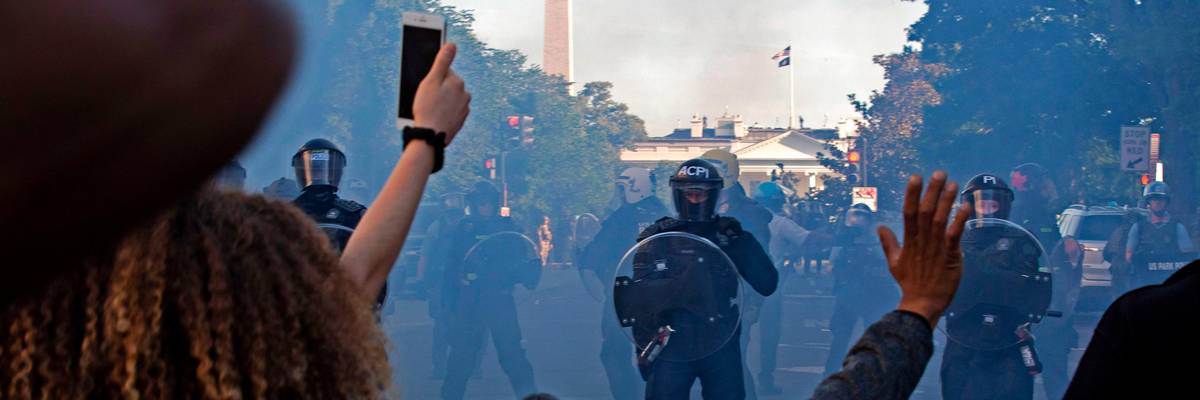
Police officers wearing riot gear push back demonstrators outside of the White House on June 1, 2020 in Washington D.C. during a protest over the police killing of George Floyd, an unarmed black man, in Minneapolis.
Exactly two years after the police killing of George Floyd in Minneapolis, President Joe Biden on Wednesday is expected to unveil an executive order aimed at reforming federal policing standards and pushing state and local law enforcement agencies to improve their policies as well.
"We have seen jurisdictions with strong standards where officers still resort to the use of deadly force, so just having these words on paper will not be enough."
Civil rights groups on Tuesday expressed cautious optimism regarding the upcoming order, which has reportedly changed since a draft document was leaked earlier this year and garnered criticism from police groups.
According to the New York Times, the order will direct federal agencies to revise their use-of-force policies, create a national registry of officers who have been fired for misconduct, restrict the transfer of military equipment to law enforcement agencies, and use grants to incentivize police departments to reform their chokehold and no-knock warrant policies.
The expected signing of the executive order will follow the first update to the U.S. Department of Justice's use-of-force policy in 18 years, which was announced Monday and requires federal agents to intervene if they see their colleagues using excessive force.
"The devil is in the details" regarding implementation of Biden's order, Udi Ofer, deputy national political director of the ACLU, said Tuesday.
"We have seen jurisdictions with strong standards where officers still resort to the use of deadly force, so just having these words on paper will not be enough," Ofer told the Times. "The entire culture and mentality needs to change to bring these words to life, and to save lives."
Ofer noted that the president is taking executive action eight months after the U.S. Senate failed to pass a sweeping police reform bill which would have banned police chokeholds and eliminated qualified immunity--which protects police from liability in misconduct lawsuits--among other reforms.
The draft order which was leaked earlier this year included language allowing federal agents to use deadly force "as a last resort when there is no reasonable alternative, in other words only when necessary to prevent imminent and serious bodily injury or death" and using grants to encourage state and local police to adopt the same reform.
The White House worked closely with the DOJ and police groups following the draft leak, which had prompted police to threaten to end their support for the executive action.
Since the leak, the president has garnered criticism from civil liberties and civil rights groups for his approach to the national debate over redirecting police funding to other spending on education, housing, and other community needs that have been shown to increase public safety.
In his State of the Union address in March, Biden said lawmakers must "fund the police," even though most U.S. cities increased the percentage of their budgets which went to policing in 2021 following protests over Floyd's murder.
Earlier this month, Biden also outraged police reform advocates when he urged states to spend unused Covid-19 relief funds on policing.
On Tuesday, NAACP President Derrick Johnson said that while Biden's executive order "cannot address America's policing crisis the same way Congress has the ability to... we've got to do everything we can."
"Tomorrow will mark two years since George Floyd's cruel murder at the hands of police officers," Johnson said. "There's no better way to honor George Floyd's legacy than for President Biden to take action by signing a police reform executive order."
Dear Common Dreams reader, It’s been nearly 30 years since I co-founded Common Dreams with my late wife, Lina Newhouser. We had the radical notion that journalism should serve the public good, not corporate profits. It was clear to us from the outset what it would take to build such a project. No paid advertisements. No corporate sponsors. No millionaire publisher telling us what to think or do. Many people said we wouldn't last a year, but we proved those doubters wrong. Together with a tremendous team of journalists and dedicated staff, we built an independent media outlet free from the constraints of profits and corporate control. Our mission has always been simple: To inform. To inspire. To ignite change for the common good. Building Common Dreams was not easy. Our survival was never guaranteed. When you take on the most powerful forces—Wall Street greed, fossil fuel industry destruction, Big Tech lobbyists, and uber-rich oligarchs who have spent billions upon billions rigging the economy and democracy in their favor—the only bulwark you have is supporters who believe in your work. But here’s the urgent message from me today. It's never been this bad out there. And it's never been this hard to keep us going. At the very moment Common Dreams is most needed, the threats we face are intensifying. We need your support now more than ever. We don't accept corporate advertising and never will. We don't have a paywall because we don't think people should be blocked from critical news based on their ability to pay. Everything we do is funded by the donations of readers like you. When everyone does the little they can afford, we are strong. But if that support retreats or dries up, so do we. Will you donate now to make sure Common Dreams not only survives but thrives? —Craig Brown, Co-founder |
Exactly two years after the police killing of George Floyd in Minneapolis, President Joe Biden on Wednesday is expected to unveil an executive order aimed at reforming federal policing standards and pushing state and local law enforcement agencies to improve their policies as well.
"We have seen jurisdictions with strong standards where officers still resort to the use of deadly force, so just having these words on paper will not be enough."
Civil rights groups on Tuesday expressed cautious optimism regarding the upcoming order, which has reportedly changed since a draft document was leaked earlier this year and garnered criticism from police groups.
According to the New York Times, the order will direct federal agencies to revise their use-of-force policies, create a national registry of officers who have been fired for misconduct, restrict the transfer of military equipment to law enforcement agencies, and use grants to incentivize police departments to reform their chokehold and no-knock warrant policies.
The expected signing of the executive order will follow the first update to the U.S. Department of Justice's use-of-force policy in 18 years, which was announced Monday and requires federal agents to intervene if they see their colleagues using excessive force.
"The devil is in the details" regarding implementation of Biden's order, Udi Ofer, deputy national political director of the ACLU, said Tuesday.
"We have seen jurisdictions with strong standards where officers still resort to the use of deadly force, so just having these words on paper will not be enough," Ofer told the Times. "The entire culture and mentality needs to change to bring these words to life, and to save lives."
Ofer noted that the president is taking executive action eight months after the U.S. Senate failed to pass a sweeping police reform bill which would have banned police chokeholds and eliminated qualified immunity--which protects police from liability in misconduct lawsuits--among other reforms.
The draft order which was leaked earlier this year included language allowing federal agents to use deadly force "as a last resort when there is no reasonable alternative, in other words only when necessary to prevent imminent and serious bodily injury or death" and using grants to encourage state and local police to adopt the same reform.
The White House worked closely with the DOJ and police groups following the draft leak, which had prompted police to threaten to end their support for the executive action.
Since the leak, the president has garnered criticism from civil liberties and civil rights groups for his approach to the national debate over redirecting police funding to other spending on education, housing, and other community needs that have been shown to increase public safety.
In his State of the Union address in March, Biden said lawmakers must "fund the police," even though most U.S. cities increased the percentage of their budgets which went to policing in 2021 following protests over Floyd's murder.
Earlier this month, Biden also outraged police reform advocates when he urged states to spend unused Covid-19 relief funds on policing.
On Tuesday, NAACP President Derrick Johnson said that while Biden's executive order "cannot address America's policing crisis the same way Congress has the ability to... we've got to do everything we can."
"Tomorrow will mark two years since George Floyd's cruel murder at the hands of police officers," Johnson said. "There's no better way to honor George Floyd's legacy than for President Biden to take action by signing a police reform executive order."
Exactly two years after the police killing of George Floyd in Minneapolis, President Joe Biden on Wednesday is expected to unveil an executive order aimed at reforming federal policing standards and pushing state and local law enforcement agencies to improve their policies as well.
"We have seen jurisdictions with strong standards where officers still resort to the use of deadly force, so just having these words on paper will not be enough."
Civil rights groups on Tuesday expressed cautious optimism regarding the upcoming order, which has reportedly changed since a draft document was leaked earlier this year and garnered criticism from police groups.
According to the New York Times, the order will direct federal agencies to revise their use-of-force policies, create a national registry of officers who have been fired for misconduct, restrict the transfer of military equipment to law enforcement agencies, and use grants to incentivize police departments to reform their chokehold and no-knock warrant policies.
The expected signing of the executive order will follow the first update to the U.S. Department of Justice's use-of-force policy in 18 years, which was announced Monday and requires federal agents to intervene if they see their colleagues using excessive force.
"The devil is in the details" regarding implementation of Biden's order, Udi Ofer, deputy national political director of the ACLU, said Tuesday.
"We have seen jurisdictions with strong standards where officers still resort to the use of deadly force, so just having these words on paper will not be enough," Ofer told the Times. "The entire culture and mentality needs to change to bring these words to life, and to save lives."
Ofer noted that the president is taking executive action eight months after the U.S. Senate failed to pass a sweeping police reform bill which would have banned police chokeholds and eliminated qualified immunity--which protects police from liability in misconduct lawsuits--among other reforms.
The draft order which was leaked earlier this year included language allowing federal agents to use deadly force "as a last resort when there is no reasonable alternative, in other words only when necessary to prevent imminent and serious bodily injury or death" and using grants to encourage state and local police to adopt the same reform.
The White House worked closely with the DOJ and police groups following the draft leak, which had prompted police to threaten to end their support for the executive action.
Since the leak, the president has garnered criticism from civil liberties and civil rights groups for his approach to the national debate over redirecting police funding to other spending on education, housing, and other community needs that have been shown to increase public safety.
In his State of the Union address in March, Biden said lawmakers must "fund the police," even though most U.S. cities increased the percentage of their budgets which went to policing in 2021 following protests over Floyd's murder.
Earlier this month, Biden also outraged police reform advocates when he urged states to spend unused Covid-19 relief funds on policing.
On Tuesday, NAACP President Derrick Johnson said that while Biden's executive order "cannot address America's policing crisis the same way Congress has the ability to... we've got to do everything we can."
"Tomorrow will mark two years since George Floyd's cruel murder at the hands of police officers," Johnson said. "There's no better way to honor George Floyd's legacy than for President Biden to take action by signing a police reform executive order."

