

SUBSCRIBE TO OUR FREE NEWSLETTER
Daily news & progressive opinion—funded by the people, not the corporations—delivered straight to your inbox.
5
#000000
#FFFFFF
To donate by check, phone, or other method, see our More Ways to Give page.
Daily news & progressive opinion—funded by the people, not the corporations—delivered straight to your inbox.
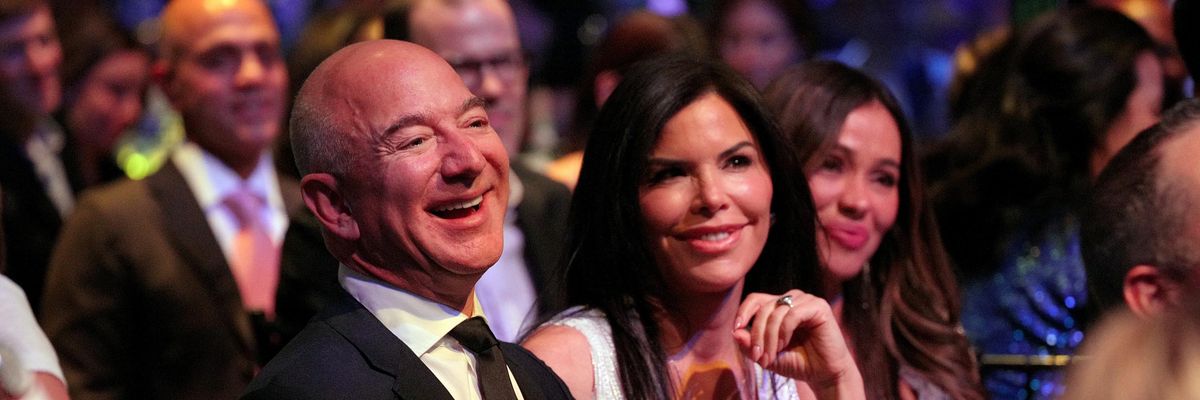
Amazon executive chair Jeff Bezos and his girlfriend Lauren Sanchez attend an event on May 9, 2022 in New York City. (Photo: Kevin Mazur/Getty Images for Robin Hood)
When their astronomical wealth gains are taken into account, dozens of the top billionaires in the United States paid an average federal tax rate of just 4.8% from 2013 to 2018--a significantly lower rate than the nation's average taxpayer.
"As long as we fail to tax their main source of income--the growth in their fortunes--many billionaires will continue to live largely tax-free lives."
That's according to a new analysis released Thursday by Americans for Tax Fairness (ATF), a progressive group that has been tracking the explosion of billionaire wealth over the past several years, particularly during the coronavirus pandemic.
Under current U.S. law, unrealized capital gains from stocks and other assets are not taxed, allowing billionaires such as Amazon executive chairman Jeff Bezos and Tesla CEO Elon Musk to accumulate massive fortunes tax-free. And even when assets are sold and gains are "realized," the long-term capital gains tax rate is significantly lower than the top marginal tax rate of 37%.
Drawing on Forbes figures on billionaire wealth and recent Internal Revenue Service data leaked to ProPublica, ATF estimates that 26 of the richest people in the U.S. paid an average federal income tax rate of 4.8% between 2013 and 2018 when wealth gains are counted as income.
Some prominent billionaires--including Berkshire Hathaway CEO Warren Buffett, Facebook CEO Mark Zuckerberg, and Bezos--paid tax rates of less than 2% during the six-year period, ATF found.
On Twitter, ATF pointed out that the average U.S. taxpayer pays a 13.3% tax rate on their income.
"Teachers, plumbers, firefighters, and other working Americans can already pay higher tax rates than billionaires--and that's just counting the small part of billionaire income that is now taxed," Frank Clemente, ATF's executive director, said in a statement. "When you include their untaxed wealth growth in the calculation, many billionaires pay almost nothing."
ATF argues that it's reasonable to count billionaires' unrealized wealth gains as income because the ultra-rich can borrow against their assets, securing "low-interest loans that fund lavish lifestyles without owing income tax."
"At the scale enjoyed by billionaires, growth in the value of assets--even if those assets are not sold--can be as good as money in the bank, which Elon Musk is putting to good effect in his purchase of Twitter," the group said.
In October, Sen. Ron Wyden (D-Ore.)--the chair of the Senate Finance Committee--introduced legislation that would impose an annual tax on unrealized gains that the wealthy accumulate from tradable assets, a proposal that ATF has applauded.
At present, the bill has no path to passage in the Senate, largely because of Sen. Joe Manchin's (D-W.Va.) opposition.
"As long as we fail to tax their main source of income--the growth in their fortunes--many billionaires will continue to live largely tax-free lives," Clemente said Thursday.
Correction: An earlier version of this article mistakenly stated the tax rate detailed in the analysis was higher than the average rate, but that error has been fixed. It's lower.
Dear Common Dreams reader, It’s been nearly 30 years since I co-founded Common Dreams with my late wife, Lina Newhouser. We had the radical notion that journalism should serve the public good, not corporate profits. It was clear to us from the outset what it would take to build such a project. No paid advertisements. No corporate sponsors. No millionaire publisher telling us what to think or do. Many people said we wouldn't last a year, but we proved those doubters wrong. Together with a tremendous team of journalists and dedicated staff, we built an independent media outlet free from the constraints of profits and corporate control. Our mission has always been simple: To inform. To inspire. To ignite change for the common good. Building Common Dreams was not easy. Our survival was never guaranteed. When you take on the most powerful forces—Wall Street greed, fossil fuel industry destruction, Big Tech lobbyists, and uber-rich oligarchs who have spent billions upon billions rigging the economy and democracy in their favor—the only bulwark you have is supporters who believe in your work. But here’s the urgent message from me today. It's never been this bad out there. And it's never been this hard to keep us going. At the very moment Common Dreams is most needed, the threats we face are intensifying. We need your support now more than ever. We don't accept corporate advertising and never will. We don't have a paywall because we don't think people should be blocked from critical news based on their ability to pay. Everything we do is funded by the donations of readers like you. When everyone does the little they can afford, we are strong. But if that support retreats or dries up, so do we. Will you donate now to make sure Common Dreams not only survives but thrives? —Craig Brown, Co-founder |
When their astronomical wealth gains are taken into account, dozens of the top billionaires in the United States paid an average federal tax rate of just 4.8% from 2013 to 2018--a significantly lower rate than the nation's average taxpayer.
"As long as we fail to tax their main source of income--the growth in their fortunes--many billionaires will continue to live largely tax-free lives."
That's according to a new analysis released Thursday by Americans for Tax Fairness (ATF), a progressive group that has been tracking the explosion of billionaire wealth over the past several years, particularly during the coronavirus pandemic.
Under current U.S. law, unrealized capital gains from stocks and other assets are not taxed, allowing billionaires such as Amazon executive chairman Jeff Bezos and Tesla CEO Elon Musk to accumulate massive fortunes tax-free. And even when assets are sold and gains are "realized," the long-term capital gains tax rate is significantly lower than the top marginal tax rate of 37%.
Drawing on Forbes figures on billionaire wealth and recent Internal Revenue Service data leaked to ProPublica, ATF estimates that 26 of the richest people in the U.S. paid an average federal income tax rate of 4.8% between 2013 and 2018 when wealth gains are counted as income.
Some prominent billionaires--including Berkshire Hathaway CEO Warren Buffett, Facebook CEO Mark Zuckerberg, and Bezos--paid tax rates of less than 2% during the six-year period, ATF found.
On Twitter, ATF pointed out that the average U.S. taxpayer pays a 13.3% tax rate on their income.
"Teachers, plumbers, firefighters, and other working Americans can already pay higher tax rates than billionaires--and that's just counting the small part of billionaire income that is now taxed," Frank Clemente, ATF's executive director, said in a statement. "When you include their untaxed wealth growth in the calculation, many billionaires pay almost nothing."
ATF argues that it's reasonable to count billionaires' unrealized wealth gains as income because the ultra-rich can borrow against their assets, securing "low-interest loans that fund lavish lifestyles without owing income tax."
"At the scale enjoyed by billionaires, growth in the value of assets--even if those assets are not sold--can be as good as money in the bank, which Elon Musk is putting to good effect in his purchase of Twitter," the group said.
In October, Sen. Ron Wyden (D-Ore.)--the chair of the Senate Finance Committee--introduced legislation that would impose an annual tax on unrealized gains that the wealthy accumulate from tradable assets, a proposal that ATF has applauded.
At present, the bill has no path to passage in the Senate, largely because of Sen. Joe Manchin's (D-W.Va.) opposition.
"As long as we fail to tax their main source of income--the growth in their fortunes--many billionaires will continue to live largely tax-free lives," Clemente said Thursday.
Correction: An earlier version of this article mistakenly stated the tax rate detailed in the analysis was higher than the average rate, but that error has been fixed. It's lower.
When their astronomical wealth gains are taken into account, dozens of the top billionaires in the United States paid an average federal tax rate of just 4.8% from 2013 to 2018--a significantly lower rate than the nation's average taxpayer.
"As long as we fail to tax their main source of income--the growth in their fortunes--many billionaires will continue to live largely tax-free lives."
That's according to a new analysis released Thursday by Americans for Tax Fairness (ATF), a progressive group that has been tracking the explosion of billionaire wealth over the past several years, particularly during the coronavirus pandemic.
Under current U.S. law, unrealized capital gains from stocks and other assets are not taxed, allowing billionaires such as Amazon executive chairman Jeff Bezos and Tesla CEO Elon Musk to accumulate massive fortunes tax-free. And even when assets are sold and gains are "realized," the long-term capital gains tax rate is significantly lower than the top marginal tax rate of 37%.
Drawing on Forbes figures on billionaire wealth and recent Internal Revenue Service data leaked to ProPublica, ATF estimates that 26 of the richest people in the U.S. paid an average federal income tax rate of 4.8% between 2013 and 2018 when wealth gains are counted as income.
Some prominent billionaires--including Berkshire Hathaway CEO Warren Buffett, Facebook CEO Mark Zuckerberg, and Bezos--paid tax rates of less than 2% during the six-year period, ATF found.
On Twitter, ATF pointed out that the average U.S. taxpayer pays a 13.3% tax rate on their income.
"Teachers, plumbers, firefighters, and other working Americans can already pay higher tax rates than billionaires--and that's just counting the small part of billionaire income that is now taxed," Frank Clemente, ATF's executive director, said in a statement. "When you include their untaxed wealth growth in the calculation, many billionaires pay almost nothing."
ATF argues that it's reasonable to count billionaires' unrealized wealth gains as income because the ultra-rich can borrow against their assets, securing "low-interest loans that fund lavish lifestyles without owing income tax."
"At the scale enjoyed by billionaires, growth in the value of assets--even if those assets are not sold--can be as good as money in the bank, which Elon Musk is putting to good effect in his purchase of Twitter," the group said.
In October, Sen. Ron Wyden (D-Ore.)--the chair of the Senate Finance Committee--introduced legislation that would impose an annual tax on unrealized gains that the wealthy accumulate from tradable assets, a proposal that ATF has applauded.
At present, the bill has no path to passage in the Senate, largely because of Sen. Joe Manchin's (D-W.Va.) opposition.
"As long as we fail to tax their main source of income--the growth in their fortunes--many billionaires will continue to live largely tax-free lives," Clemente said Thursday.
Correction: An earlier version of this article mistakenly stated the tax rate detailed in the analysis was higher than the average rate, but that error has been fixed. It's lower.

