SUBSCRIBE TO OUR FREE NEWSLETTER
Daily news & progressive opinion—funded by the people, not the corporations—delivered straight to your inbox.
5
#000000
#FFFFFF
To donate by check, phone, or other method, see our More Ways to Give page.
Daily news & progressive opinion—funded by the people, not the corporations—delivered straight to your inbox.
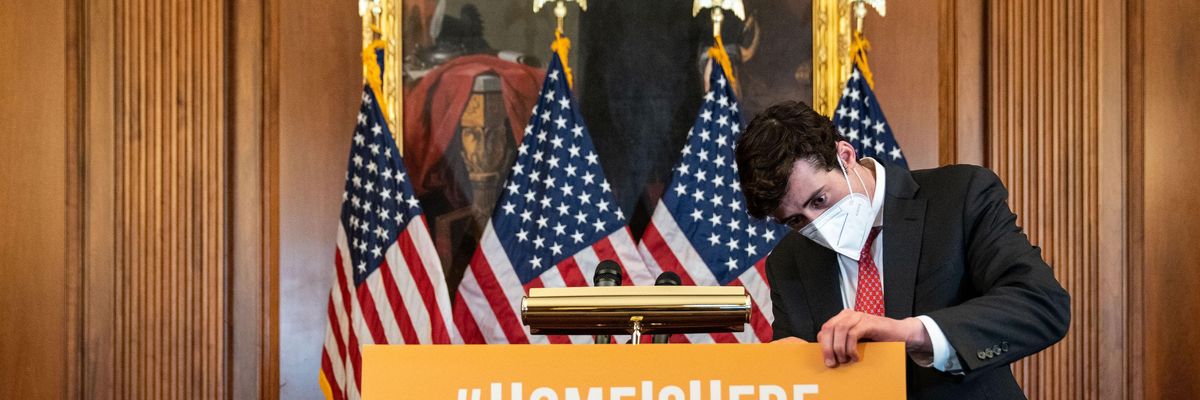
A congressional staffer adjusts a sign before the start of a press conference on Immigration with Speaker of the House Nancy Pelosi (D-Calif.) and members of the Congressional Hispanic Caucus on Capitol Hill on Thursday, March 18, 2021 in Washington, D.C. (Photo: Kent Nishimura/Los Angeles Times via Getty Images)
The U.S. House of Representatives on Tuesday passed a measure recognizing congressional workers' right to form a union.
House Resolution 915 was adopted after a 217-202 vote along party lines, with no Republicans voting in favor.
The resolution was introduced in February by Rep. Andy Levin (D-Mich.), a former union organizer, who welcomed its passage as "a major highlight" in the labor movement and put the development in the context of the recent organizing wins such as those by Amazon and Starbucks workers.
"After 26 years," he said, "the House has finally provided its workers the fundamental human right to form a union without fear of retaliation."
"Congressional staff are joining a broader movement of workers in our society who are organizing, bargaining collectively, and stepping up to make clear that they want more of a voice in their workplaces," he added. "We cannot stop fighting until every worker in the country can form a union without interference."
Politico reported that the labor protections would apply to roughly 10,000 House employees. "And a flurry of organizing, at least in Democratic offices, is already expected in the coming days and weeks," the outlet added, "even before the Office of Congressional Workplace Rights issues official guidance on a hugely complicated process."
The Congressional Workers Union, launched in February, called the vote "a historic moment for thousands of congressional workers who have won basic labor protections to organize and bargain collectively without fear of retaliation."
The vote also serves as "a reminder of the power of collective action and what the freedom to form a union truly means--democracy not just in our elections, but in our workplaces too," the group added. "To our fellow congressional workers: today belongs to us. Tomorrow, we continue the fight--solidarity forever and onwards!"
Congressional Progressive Caucus Chair Rep. Pramila Jayapal (D-Wash.) also welcomed the resolution's passage, calling congressional workers "essential both to the functioning of the legislative branch and to ensuring that Congress well represents the communities we serve."
Jayapal said the measure would "make critical progress toward staff retention, ensuring that those with institutional knowledge, deep expertise, and a commitment to public service can continue to work on the Hill."
The vote came days after House Speaker Nancy Pelosi's Friday announcement that the minimum salary for House staff would be set at $45,000.
Dear Common Dreams reader, It’s been nearly 30 years since I co-founded Common Dreams with my late wife, Lina Newhouser. We had the radical notion that journalism should serve the public good, not corporate profits. It was clear to us from the outset what it would take to build such a project. No paid advertisements. No corporate sponsors. No millionaire publisher telling us what to think or do. Many people said we wouldn't last a year, but we proved those doubters wrong. Together with a tremendous team of journalists and dedicated staff, we built an independent media outlet free from the constraints of profits and corporate control. Our mission has always been simple: To inform. To inspire. To ignite change for the common good. Building Common Dreams was not easy. Our survival was never guaranteed. When you take on the most powerful forces—Wall Street greed, fossil fuel industry destruction, Big Tech lobbyists, and uber-rich oligarchs who have spent billions upon billions rigging the economy and democracy in their favor—the only bulwark you have is supporters who believe in your work. But here’s the urgent message from me today. It's never been this bad out there. And it's never been this hard to keep us going. At the very moment Common Dreams is most needed, the threats we face are intensifying. We need your support now more than ever. We don't accept corporate advertising and never will. We don't have a paywall because we don't think people should be blocked from critical news based on their ability to pay. Everything we do is funded by the donations of readers like you. When everyone does the little they can afford, we are strong. But if that support retreats or dries up, so do we. Will you donate now to make sure Common Dreams not only survives but thrives? —Craig Brown, Co-founder |
The U.S. House of Representatives on Tuesday passed a measure recognizing congressional workers' right to form a union.
House Resolution 915 was adopted after a 217-202 vote along party lines, with no Republicans voting in favor.
The resolution was introduced in February by Rep. Andy Levin (D-Mich.), a former union organizer, who welcomed its passage as "a major highlight" in the labor movement and put the development in the context of the recent organizing wins such as those by Amazon and Starbucks workers.
"After 26 years," he said, "the House has finally provided its workers the fundamental human right to form a union without fear of retaliation."
"Congressional staff are joining a broader movement of workers in our society who are organizing, bargaining collectively, and stepping up to make clear that they want more of a voice in their workplaces," he added. "We cannot stop fighting until every worker in the country can form a union without interference."
Politico reported that the labor protections would apply to roughly 10,000 House employees. "And a flurry of organizing, at least in Democratic offices, is already expected in the coming days and weeks," the outlet added, "even before the Office of Congressional Workplace Rights issues official guidance on a hugely complicated process."
The Congressional Workers Union, launched in February, called the vote "a historic moment for thousands of congressional workers who have won basic labor protections to organize and bargain collectively without fear of retaliation."
The vote also serves as "a reminder of the power of collective action and what the freedom to form a union truly means--democracy not just in our elections, but in our workplaces too," the group added. "To our fellow congressional workers: today belongs to us. Tomorrow, we continue the fight--solidarity forever and onwards!"
Congressional Progressive Caucus Chair Rep. Pramila Jayapal (D-Wash.) also welcomed the resolution's passage, calling congressional workers "essential both to the functioning of the legislative branch and to ensuring that Congress well represents the communities we serve."
Jayapal said the measure would "make critical progress toward staff retention, ensuring that those with institutional knowledge, deep expertise, and a commitment to public service can continue to work on the Hill."
The vote came days after House Speaker Nancy Pelosi's Friday announcement that the minimum salary for House staff would be set at $45,000.
The U.S. House of Representatives on Tuesday passed a measure recognizing congressional workers' right to form a union.
House Resolution 915 was adopted after a 217-202 vote along party lines, with no Republicans voting in favor.
The resolution was introduced in February by Rep. Andy Levin (D-Mich.), a former union organizer, who welcomed its passage as "a major highlight" in the labor movement and put the development in the context of the recent organizing wins such as those by Amazon and Starbucks workers.
"After 26 years," he said, "the House has finally provided its workers the fundamental human right to form a union without fear of retaliation."
"Congressional staff are joining a broader movement of workers in our society who are organizing, bargaining collectively, and stepping up to make clear that they want more of a voice in their workplaces," he added. "We cannot stop fighting until every worker in the country can form a union without interference."
Politico reported that the labor protections would apply to roughly 10,000 House employees. "And a flurry of organizing, at least in Democratic offices, is already expected in the coming days and weeks," the outlet added, "even before the Office of Congressional Workplace Rights issues official guidance on a hugely complicated process."
The Congressional Workers Union, launched in February, called the vote "a historic moment for thousands of congressional workers who have won basic labor protections to organize and bargain collectively without fear of retaliation."
The vote also serves as "a reminder of the power of collective action and what the freedom to form a union truly means--democracy not just in our elections, but in our workplaces too," the group added. "To our fellow congressional workers: today belongs to us. Tomorrow, we continue the fight--solidarity forever and onwards!"
Congressional Progressive Caucus Chair Rep. Pramila Jayapal (D-Wash.) also welcomed the resolution's passage, calling congressional workers "essential both to the functioning of the legislative branch and to ensuring that Congress well represents the communities we serve."
Jayapal said the measure would "make critical progress toward staff retention, ensuring that those with institutional knowledge, deep expertise, and a commitment to public service can continue to work on the Hill."
The vote came days after House Speaker Nancy Pelosi's Friday announcement that the minimum salary for House staff would be set at $45,000.