SUBSCRIBE TO OUR FREE NEWSLETTER
Daily news & progressive opinion—funded by the people, not the corporations—delivered straight to your inbox.
5
#000000
#FFFFFF
To donate by check, phone, or other method, see our More Ways to Give page.
Daily news & progressive opinion—funded by the people, not the corporations—delivered straight to your inbox.
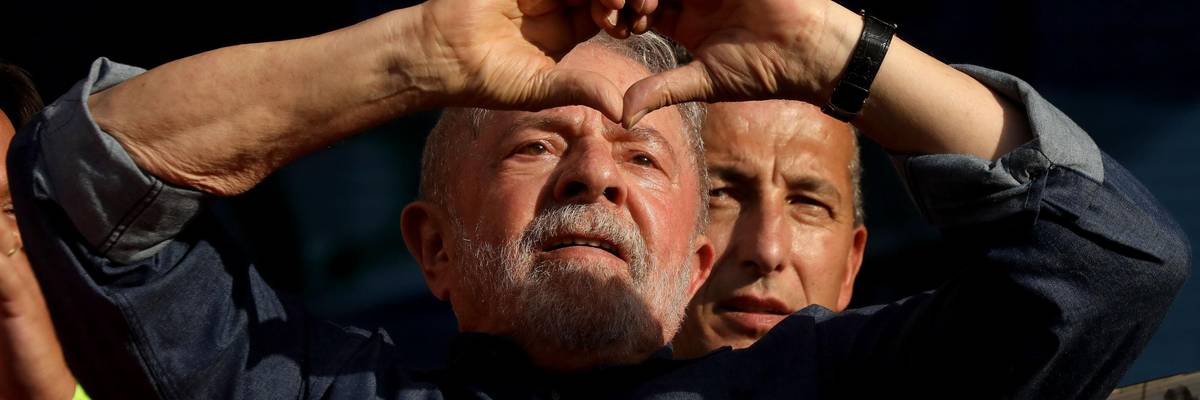
Brazilian presidential frontrunner Luiz Inacio Lula da Silva gestures during a demonstration on May 1, 2022 in Sao Paulo, Brazil. (Photo: Rodrigo Paiva/Getty Images)
Brazilian presidential frontrunner Luiz Inacio Lula da Silva argued in an interview published Wednesday that world leaders, including U.S. President Joe Biden, are not doing nearly enough to help secure a peaceful resolution to Russia's deadly war on Ukraine, which has dragged on for more than two months with no end in sight.
"I don't think anyone is trying to help create peace," Lula, a globally popular leftist running to unseat far-right President Jair Bolsonaro and return to the post he held from 2003 to 2010, told TIME magazine in an interview conducted in late March.
"He's giving voice to the Global South's skepticism toward rallying calls from great powers who ignore rules whenever they want."
Lula will appear on the cover of TIME's May 23-30 issue.
While acknowledging that Russian President Vladimir Putin "shouldn't have invaded Ukraine," Lula contended that Western powers such as the U.S. and the E.U.--which are pumping massive quantities of heavy weaponry into the war zone--are "also guilty" for not urgently pursuing diplomatic talks before Moscow launched its full-scale attack in late February.
"What was the reason for the Ukraine invasion? NATO? Then the U.S. and Europe should have said: 'Ukraine won't join NATO,'" Lula said. "The conversations were very few. If you want peace, you have to have patience. They could have sat at a negotiating table for 10, 15, 20 days, a whole month, trying to find a solution. I think dialogue only works when it is taken seriously."
Lula, who was freed in 2019 after spending more than a year in prison on politically motivated corruption charges, also attacked Ukrainian President Volodymyr Zelenskyy, claiming he is "as responsible as Putin for the war"--a remark that drew backlash and generated no shortage of headlines for the Brazilian politician in the western press.
"Huge respect for Lula, disagree with this take, there is not equal blame to go around for Russia's war," tweeted Matt Duss, foreign policy adviser for U.S. Sen. Bernie Sanders (I-Vt.).
"But," Duss added, "it would be foolish not to recognize that he's giving voice to the Global South's skepticism toward rallying calls from great powers who ignore rules whenever they want."
Brazil is among the number of Latin American, Middle Eastern, and African countries that have opted not to align with either Russia or Ukraine and the West during the war, which has sparked a far-reaching humanitarian disaster and heightened fears of a broader--and potentially nuclear--conflict with global implications.
As American University professor Amitav Acharya observed in a March column for Responsible Statecraft, "it is not entirely inconsistent for the 'Global South' to both condemn the Russian invasion on principle and express criticisms of Western 'internationalism' and its double standards."
"The sweeping sanctions on Russia, which were criticized by Brazil despite having voted for the resolution, remind developing nations of the coercive economic power of the West, which may be--and has been--used against them if they fail to protect or uphold Western interests and expectations," Acharya wrote.
"The attempts by Western policymakers and analysts to reject any moral equivalence between Russian and U.S./NATO interventions are not entirely convincing to the non-Western world," he continued. "A war at the heart of Europe that has already taken a terrible toll in human lives and inflicted major damage on both Ukraine and Russia is not a glowing advertisement for the approach to regional and international order that the West had envisaged."
This country and this world are at a monumental crossroads. US voters have an opportunity to beat back the forces of fascism and confront the billionaires who are rigging the economy, our media system, and our democracy, making it increasingly impossible for ordinary people to get by. We’re not just talking about the election. We’re talking about what must be done once these fascist elements are vanquished from power. We need a bolder set of solutions than what either major party has so far been willing to offer and a working-class movement ready to fight like hell for it. Trump didn't emerge from nowhere. The conditions that fueled MAGA authoritarianism were created by decades of radical neoliberal economic policies and a corrupt political system dominated by corporate interests. They slashed taxes on the super-rich, promising that the benefits would trickle down. They said giveaways to the corporate titans would make life more affordable for the rest of us. It was all bullshit. And when a bitter, betrayed populace searches for someone to blame, right-wing demagogues have little trouble finding scapegoats. People know when they're being lied to, but you won't hear any of this from the corporate media. Only independent journalism—powered and funded by people who believe in building a better world—can deliver truly trustworthy daily news. If you share our vision, please contribute whatever you can to sustain our work. |
Brazilian presidential frontrunner Luiz Inacio Lula da Silva argued in an interview published Wednesday that world leaders, including U.S. President Joe Biden, are not doing nearly enough to help secure a peaceful resolution to Russia's deadly war on Ukraine, which has dragged on for more than two months with no end in sight.
"I don't think anyone is trying to help create peace," Lula, a globally popular leftist running to unseat far-right President Jair Bolsonaro and return to the post he held from 2003 to 2010, told TIME magazine in an interview conducted in late March.
"He's giving voice to the Global South's skepticism toward rallying calls from great powers who ignore rules whenever they want."
Lula will appear on the cover of TIME's May 23-30 issue.
While acknowledging that Russian President Vladimir Putin "shouldn't have invaded Ukraine," Lula contended that Western powers such as the U.S. and the E.U.--which are pumping massive quantities of heavy weaponry into the war zone--are "also guilty" for not urgently pursuing diplomatic talks before Moscow launched its full-scale attack in late February.
"What was the reason for the Ukraine invasion? NATO? Then the U.S. and Europe should have said: 'Ukraine won't join NATO,'" Lula said. "The conversations were very few. If you want peace, you have to have patience. They could have sat at a negotiating table for 10, 15, 20 days, a whole month, trying to find a solution. I think dialogue only works when it is taken seriously."
Lula, who was freed in 2019 after spending more than a year in prison on politically motivated corruption charges, also attacked Ukrainian President Volodymyr Zelenskyy, claiming he is "as responsible as Putin for the war"--a remark that drew backlash and generated no shortage of headlines for the Brazilian politician in the western press.
"Huge respect for Lula, disagree with this take, there is not equal blame to go around for Russia's war," tweeted Matt Duss, foreign policy adviser for U.S. Sen. Bernie Sanders (I-Vt.).
"But," Duss added, "it would be foolish not to recognize that he's giving voice to the Global South's skepticism toward rallying calls from great powers who ignore rules whenever they want."
Brazil is among the number of Latin American, Middle Eastern, and African countries that have opted not to align with either Russia or Ukraine and the West during the war, which has sparked a far-reaching humanitarian disaster and heightened fears of a broader--and potentially nuclear--conflict with global implications.
As American University professor Amitav Acharya observed in a March column for Responsible Statecraft, "it is not entirely inconsistent for the 'Global South' to both condemn the Russian invasion on principle and express criticisms of Western 'internationalism' and its double standards."
"The sweeping sanctions on Russia, which were criticized by Brazil despite having voted for the resolution, remind developing nations of the coercive economic power of the West, which may be--and has been--used against them if they fail to protect or uphold Western interests and expectations," Acharya wrote.
"The attempts by Western policymakers and analysts to reject any moral equivalence between Russian and U.S./NATO interventions are not entirely convincing to the non-Western world," he continued. "A war at the heart of Europe that has already taken a terrible toll in human lives and inflicted major damage on both Ukraine and Russia is not a glowing advertisement for the approach to regional and international order that the West had envisaged."