SUBSCRIBE TO OUR FREE NEWSLETTER
Daily news & progressive opinion—funded by the people, not the corporations—delivered straight to your inbox.
5
#000000
#FFFFFF
To donate by check, phone, or other method, see our More Ways to Give page.
Daily news & progressive opinion—funded by the people, not the corporations—delivered straight to your inbox.
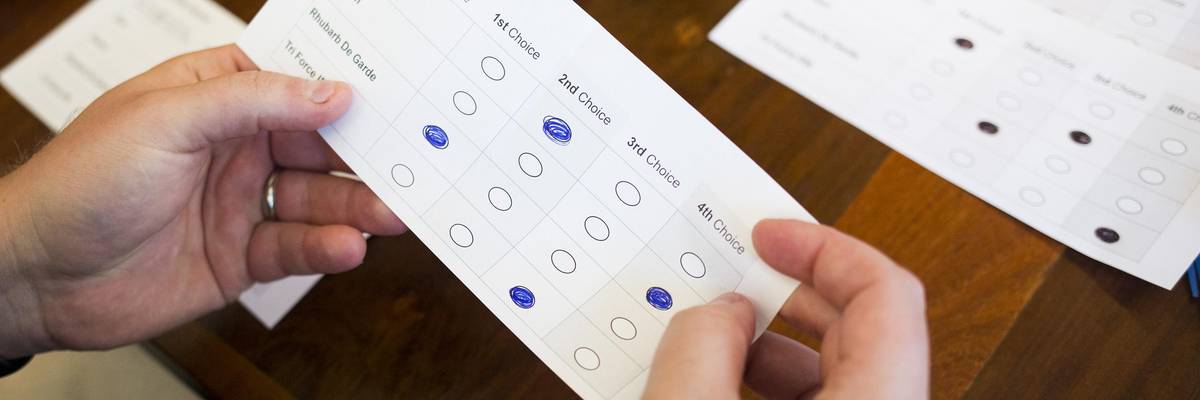
Kyle Bailey, campaign manager for the Committee for Ranked Choice Voting, counts up the votes in a demonstration at Foulmouthed Brewing in South Portland, Maine on August 23, 2016. (Photo: Brianna Soukup/Portland Portland Press Herald via Getty Images)
Buried in a bill signed into law by Republican Gov. Ron DeSantis of Florida this week is a provision that will eliminate Floridians' ability to use ranked-choice voting to decide their elections--as people in at least two cities there have voted to do--making DeSantis the latest GOP leader to ban the broadly popular voting reform.
As Common Dreams reported in March, Senate Bill 524 has been condemned by voting rights groups for creating a first-of-its-kind police force dedicated to investigating so-called "voter fraud" in the state. The law's attack on ranked-choice voting (RCV) has garnered less nationwide attention.
The law prohibits "the use of ranked-choice voting to determine election or nomination to elective office" and voids "existing or future local ordinances authorizing the use of ranked choice voting."
"There are a number of reasons Memphians voted multiple times to try RCV... Yet, the governor and legislature have chosen to tell Memphis voters: 'We don't care what you think, we know best.'"
Voters in the city of Clearwater had been set to vote on whether to use RCV in November, and 77% of Sarasota residents approved the use of the system for local elections in 2007--but those voters will now be forced to choose just one candidate in all elections unless S.B. 524 is repealed.
RCV is favored by six in 10 Americans, according to a recent poll by University of Maryland's Program for Public Consultation and Voice of the People. Nearly half of Republicans support the system, sometimes known as "instant runoff" voting, as well as 73% of Democrats and 55% of independents.
In a ranked-choice election, voters can rank all the candidates in order of their preference instead of choosing just one. If a candidate gets more than 50% of the vote in the first round, the election is over. If no one gets a majority of the first-round votes, the lowest-ranked candidate is eliminated and people who ranked that contender first have their votes redistributed to their second choice. The process continues until there is a winner with a clear majority.
Proponents of the system say it increases voter enthusiasm and turnout because it eliminates so-called "spoilers" and the pressure some voters feel to reject candidates who align with their ideology, for fear that the candidate can't win.
"If you want to keep voting for one person like you always have, that's totally fine!" explained nonpartisan election reform group Fair Vote on Thursday. "RCV just gives you backup choices in case your favorite can't win."
DeSantis' move comes nearly two months after Tennessee Gov. Bill Lee, also a Republican, signed Senate Bill 1820, which also bans RCV, following a party-line vote on the measure.
The law was pushed by the GOP in response to two referendum votes in Memphis, where voters first approved RCV in 2008. The city council introduced another referendum in 2018 asking voters to repeal the system, but 62% of residents reaffirmed that they wanted to use RCV.
Republican lawmakers like state Sen. Brian Kelsey, who sponsored S.B. 1820, claimed the ban was a victory of "election integrity and ensuring voter clarity," while Steve Mulroy, a law professor at University of Memphis and author of Rethinking U.S. Election Law, called the law "deeply disappointing."
"Memphis voters chose two times to try this reform," Mulroy told The Well. "There are a number of reasons Memphians voted multiple times to try RCV... Yet, the governor and legislature have chosen to tell Memphis voters: 'We don't care what you think, we know best.'"
Maine and Alaska both use RCV for state-wide elections and more than 50 cities across the U.S. use the system for local elections.
"It's almost as if they don't care what voters think," Joshua Graham Lynn, co-founder of grassroots group Represent.Us, said of Republicans' efforts to stop voters from reforming their election systems.
Dear Common Dreams reader, It’s been nearly 30 years since I co-founded Common Dreams with my late wife, Lina Newhouser. We had the radical notion that journalism should serve the public good, not corporate profits. It was clear to us from the outset what it would take to build such a project. No paid advertisements. No corporate sponsors. No millionaire publisher telling us what to think or do. Many people said we wouldn't last a year, but we proved those doubters wrong. Together with a tremendous team of journalists and dedicated staff, we built an independent media outlet free from the constraints of profits and corporate control. Our mission has always been simple: To inform. To inspire. To ignite change for the common good. Building Common Dreams was not easy. Our survival was never guaranteed. When you take on the most powerful forces—Wall Street greed, fossil fuel industry destruction, Big Tech lobbyists, and uber-rich oligarchs who have spent billions upon billions rigging the economy and democracy in their favor—the only bulwark you have is supporters who believe in your work. But here’s the urgent message from me today. It's never been this bad out there. And it's never been this hard to keep us going. At the very moment Common Dreams is most needed, the threats we face are intensifying. We need your support now more than ever. We don't accept corporate advertising and never will. We don't have a paywall because we don't think people should be blocked from critical news based on their ability to pay. Everything we do is funded by the donations of readers like you. When everyone does the little they can afford, we are strong. But if that support retreats or dries up, so do we. Will you donate now to make sure Common Dreams not only survives but thrives? —Craig Brown, Co-founder |
Buried in a bill signed into law by Republican Gov. Ron DeSantis of Florida this week is a provision that will eliminate Floridians' ability to use ranked-choice voting to decide their elections--as people in at least two cities there have voted to do--making DeSantis the latest GOP leader to ban the broadly popular voting reform.
As Common Dreams reported in March, Senate Bill 524 has been condemned by voting rights groups for creating a first-of-its-kind police force dedicated to investigating so-called "voter fraud" in the state. The law's attack on ranked-choice voting (RCV) has garnered less nationwide attention.
The law prohibits "the use of ranked-choice voting to determine election or nomination to elective office" and voids "existing or future local ordinances authorizing the use of ranked choice voting."
"There are a number of reasons Memphians voted multiple times to try RCV... Yet, the governor and legislature have chosen to tell Memphis voters: 'We don't care what you think, we know best.'"
Voters in the city of Clearwater had been set to vote on whether to use RCV in November, and 77% of Sarasota residents approved the use of the system for local elections in 2007--but those voters will now be forced to choose just one candidate in all elections unless S.B. 524 is repealed.
RCV is favored by six in 10 Americans, according to a recent poll by University of Maryland's Program for Public Consultation and Voice of the People. Nearly half of Republicans support the system, sometimes known as "instant runoff" voting, as well as 73% of Democrats and 55% of independents.
In a ranked-choice election, voters can rank all the candidates in order of their preference instead of choosing just one. If a candidate gets more than 50% of the vote in the first round, the election is over. If no one gets a majority of the first-round votes, the lowest-ranked candidate is eliminated and people who ranked that contender first have their votes redistributed to their second choice. The process continues until there is a winner with a clear majority.
Proponents of the system say it increases voter enthusiasm and turnout because it eliminates so-called "spoilers" and the pressure some voters feel to reject candidates who align with their ideology, for fear that the candidate can't win.
"If you want to keep voting for one person like you always have, that's totally fine!" explained nonpartisan election reform group Fair Vote on Thursday. "RCV just gives you backup choices in case your favorite can't win."
DeSantis' move comes nearly two months after Tennessee Gov. Bill Lee, also a Republican, signed Senate Bill 1820, which also bans RCV, following a party-line vote on the measure.
The law was pushed by the GOP in response to two referendum votes in Memphis, where voters first approved RCV in 2008. The city council introduced another referendum in 2018 asking voters to repeal the system, but 62% of residents reaffirmed that they wanted to use RCV.
Republican lawmakers like state Sen. Brian Kelsey, who sponsored S.B. 1820, claimed the ban was a victory of "election integrity and ensuring voter clarity," while Steve Mulroy, a law professor at University of Memphis and author of Rethinking U.S. Election Law, called the law "deeply disappointing."
"Memphis voters chose two times to try this reform," Mulroy told The Well. "There are a number of reasons Memphians voted multiple times to try RCV... Yet, the governor and legislature have chosen to tell Memphis voters: 'We don't care what you think, we know best.'"
Maine and Alaska both use RCV for state-wide elections and more than 50 cities across the U.S. use the system for local elections.
"It's almost as if they don't care what voters think," Joshua Graham Lynn, co-founder of grassroots group Represent.Us, said of Republicans' efforts to stop voters from reforming their election systems.
Buried in a bill signed into law by Republican Gov. Ron DeSantis of Florida this week is a provision that will eliminate Floridians' ability to use ranked-choice voting to decide their elections--as people in at least two cities there have voted to do--making DeSantis the latest GOP leader to ban the broadly popular voting reform.
As Common Dreams reported in March, Senate Bill 524 has been condemned by voting rights groups for creating a first-of-its-kind police force dedicated to investigating so-called "voter fraud" in the state. The law's attack on ranked-choice voting (RCV) has garnered less nationwide attention.
The law prohibits "the use of ranked-choice voting to determine election or nomination to elective office" and voids "existing or future local ordinances authorizing the use of ranked choice voting."
"There are a number of reasons Memphians voted multiple times to try RCV... Yet, the governor and legislature have chosen to tell Memphis voters: 'We don't care what you think, we know best.'"
Voters in the city of Clearwater had been set to vote on whether to use RCV in November, and 77% of Sarasota residents approved the use of the system for local elections in 2007--but those voters will now be forced to choose just one candidate in all elections unless S.B. 524 is repealed.
RCV is favored by six in 10 Americans, according to a recent poll by University of Maryland's Program for Public Consultation and Voice of the People. Nearly half of Republicans support the system, sometimes known as "instant runoff" voting, as well as 73% of Democrats and 55% of independents.
In a ranked-choice election, voters can rank all the candidates in order of their preference instead of choosing just one. If a candidate gets more than 50% of the vote in the first round, the election is over. If no one gets a majority of the first-round votes, the lowest-ranked candidate is eliminated and people who ranked that contender first have their votes redistributed to their second choice. The process continues until there is a winner with a clear majority.
Proponents of the system say it increases voter enthusiasm and turnout because it eliminates so-called "spoilers" and the pressure some voters feel to reject candidates who align with their ideology, for fear that the candidate can't win.
"If you want to keep voting for one person like you always have, that's totally fine!" explained nonpartisan election reform group Fair Vote on Thursday. "RCV just gives you backup choices in case your favorite can't win."
DeSantis' move comes nearly two months after Tennessee Gov. Bill Lee, also a Republican, signed Senate Bill 1820, which also bans RCV, following a party-line vote on the measure.
The law was pushed by the GOP in response to two referendum votes in Memphis, where voters first approved RCV in 2008. The city council introduced another referendum in 2018 asking voters to repeal the system, but 62% of residents reaffirmed that they wanted to use RCV.
Republican lawmakers like state Sen. Brian Kelsey, who sponsored S.B. 1820, claimed the ban was a victory of "election integrity and ensuring voter clarity," while Steve Mulroy, a law professor at University of Memphis and author of Rethinking U.S. Election Law, called the law "deeply disappointing."
"Memphis voters chose two times to try this reform," Mulroy told The Well. "There are a number of reasons Memphians voted multiple times to try RCV... Yet, the governor and legislature have chosen to tell Memphis voters: 'We don't care what you think, we know best.'"
Maine and Alaska both use RCV for state-wide elections and more than 50 cities across the U.S. use the system for local elections.
"It's almost as if they don't care what voters think," Joshua Graham Lynn, co-founder of grassroots group Represent.Us, said of Republicans' efforts to stop voters from reforming their election systems.