SUBSCRIBE TO OUR FREE NEWSLETTER
Daily news & progressive opinion—funded by the people, not the corporations—delivered straight to your inbox.
5
#000000
#FFFFFF
To donate by check, phone, or other method, see our More Ways to Give page.
Daily news & progressive opinion—funded by the people, not the corporations—delivered straight to your inbox.
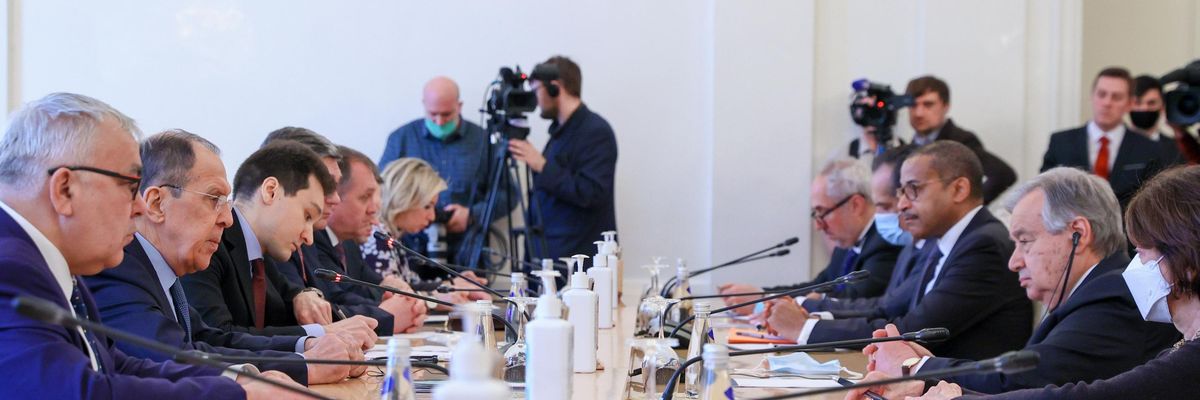
Russian Foreign Minister Sergei Lavrov (2nd L) meets United Nations Secretary-General Antonio Guterres (2nd R) in Moscow on April 26, 2021. (Photo: Russian Foreign Ministry/Handout/Anadolu Agency via Getty Images)
Amid ongoing concerns that Russia's ongoing invasion of Ukraine could lead to far broader and possibly nuclear warfare, high-level demands for a diplomatic resolution to the conflict hit a critical moment Tuesday with the United Nations chief in Moscow for an in-person meeting with Russian President Vladimir Putin and other officials.
Ahead of his meeting with Putin, Secretary-General Antonio Guterres held a press conference with Russian Foreign Minister Sergey Lavrov--who said Tuesday that NATO nations were risking "World War III" by continuing to flow arms into Ukraine.
Guterres said that he came to Moscow as a "messenger of peace" to try to "save lives and to reduce suffering."
Following a "very frank discussion" with Lavrov, said Guterres, "it is clear that there are two different positions on what is happening in Ukraine."
On the one side, he said, Russia continues to believe that "what is taking place is a 'special military operation' with the objectives that were announced."
In stark contrast, Guterres added, "according to the U.N., in line with the resolutions passed by the General Assembly, Russia's invasion of Ukraine is a violation of its territorial integrity and against the Charter of the United Nations."
"It is my deep conviction that the sooner we end this war, the better," he added, "for the people of Ukraine, for the people of the Russian Federation, and those far beyond."
The U.N. chief expressed concern about "repeated reports of violations of international humanitarian and human rights law and possible war crimes" and stressed an urgent need for humanitarian corridors.
Pointing also to "shock waves around the world" unleashed by the invasion, Guterres said that "the sooner peace is established, the better--for the sake of Ukraine, Russia, and for the world."
The foreign ministry of China, a country that has not yet condemned the invasion, also on Tuesday stressed a need for a diplomatic resolution and addressed Lavrov's comments regarding the threat of another world war.
"No one wants to see the outbreak of a third world war," said foreign ministry spokesperson Wang Wenbin, who expressed hope "relevant parties can keep cool-headed and exercise restraint, prevent escalation of tension, realize peace as soon as possible, and avoid inflicting a heavier price on Europe and the world."
As a first step, Wenbin called on all parties to "support dialogue and negotiation to prevent the expansion and prolongation of conflicts."
Dear Common Dreams reader, It’s been nearly 30 years since I co-founded Common Dreams with my late wife, Lina Newhouser. We had the radical notion that journalism should serve the public good, not corporate profits. It was clear to us from the outset what it would take to build such a project. No paid advertisements. No corporate sponsors. No millionaire publisher telling us what to think or do. Many people said we wouldn't last a year, but we proved those doubters wrong. Together with a tremendous team of journalists and dedicated staff, we built an independent media outlet free from the constraints of profits and corporate control. Our mission has always been simple: To inform. To inspire. To ignite change for the common good. Building Common Dreams was not easy. Our survival was never guaranteed. When you take on the most powerful forces—Wall Street greed, fossil fuel industry destruction, Big Tech lobbyists, and uber-rich oligarchs who have spent billions upon billions rigging the economy and democracy in their favor—the only bulwark you have is supporters who believe in your work. But here’s the urgent message from me today. It's never been this bad out there. And it's never been this hard to keep us going. At the very moment Common Dreams is most needed, the threats we face are intensifying. We need your support now more than ever. We don't accept corporate advertising and never will. We don't have a paywall because we don't think people should be blocked from critical news based on their ability to pay. Everything we do is funded by the donations of readers like you. When everyone does the little they can afford, we are strong. But if that support retreats or dries up, so do we. Will you donate now to make sure Common Dreams not only survives but thrives? —Craig Brown, Co-founder |
Amid ongoing concerns that Russia's ongoing invasion of Ukraine could lead to far broader and possibly nuclear warfare, high-level demands for a diplomatic resolution to the conflict hit a critical moment Tuesday with the United Nations chief in Moscow for an in-person meeting with Russian President Vladimir Putin and other officials.
Ahead of his meeting with Putin, Secretary-General Antonio Guterres held a press conference with Russian Foreign Minister Sergey Lavrov--who said Tuesday that NATO nations were risking "World War III" by continuing to flow arms into Ukraine.
Guterres said that he came to Moscow as a "messenger of peace" to try to "save lives and to reduce suffering."
Following a "very frank discussion" with Lavrov, said Guterres, "it is clear that there are two different positions on what is happening in Ukraine."
On the one side, he said, Russia continues to believe that "what is taking place is a 'special military operation' with the objectives that were announced."
In stark contrast, Guterres added, "according to the U.N., in line with the resolutions passed by the General Assembly, Russia's invasion of Ukraine is a violation of its territorial integrity and against the Charter of the United Nations."
"It is my deep conviction that the sooner we end this war, the better," he added, "for the people of Ukraine, for the people of the Russian Federation, and those far beyond."
The U.N. chief expressed concern about "repeated reports of violations of international humanitarian and human rights law and possible war crimes" and stressed an urgent need for humanitarian corridors.
Pointing also to "shock waves around the world" unleashed by the invasion, Guterres said that "the sooner peace is established, the better--for the sake of Ukraine, Russia, and for the world."
The foreign ministry of China, a country that has not yet condemned the invasion, also on Tuesday stressed a need for a diplomatic resolution and addressed Lavrov's comments regarding the threat of another world war.
"No one wants to see the outbreak of a third world war," said foreign ministry spokesperson Wang Wenbin, who expressed hope "relevant parties can keep cool-headed and exercise restraint, prevent escalation of tension, realize peace as soon as possible, and avoid inflicting a heavier price on Europe and the world."
As a first step, Wenbin called on all parties to "support dialogue and negotiation to prevent the expansion and prolongation of conflicts."
Amid ongoing concerns that Russia's ongoing invasion of Ukraine could lead to far broader and possibly nuclear warfare, high-level demands for a diplomatic resolution to the conflict hit a critical moment Tuesday with the United Nations chief in Moscow for an in-person meeting with Russian President Vladimir Putin and other officials.
Ahead of his meeting with Putin, Secretary-General Antonio Guterres held a press conference with Russian Foreign Minister Sergey Lavrov--who said Tuesday that NATO nations were risking "World War III" by continuing to flow arms into Ukraine.
Guterres said that he came to Moscow as a "messenger of peace" to try to "save lives and to reduce suffering."
Following a "very frank discussion" with Lavrov, said Guterres, "it is clear that there are two different positions on what is happening in Ukraine."
On the one side, he said, Russia continues to believe that "what is taking place is a 'special military operation' with the objectives that were announced."
In stark contrast, Guterres added, "according to the U.N., in line with the resolutions passed by the General Assembly, Russia's invasion of Ukraine is a violation of its territorial integrity and against the Charter of the United Nations."
"It is my deep conviction that the sooner we end this war, the better," he added, "for the people of Ukraine, for the people of the Russian Federation, and those far beyond."
The U.N. chief expressed concern about "repeated reports of violations of international humanitarian and human rights law and possible war crimes" and stressed an urgent need for humanitarian corridors.
Pointing also to "shock waves around the world" unleashed by the invasion, Guterres said that "the sooner peace is established, the better--for the sake of Ukraine, Russia, and for the world."
The foreign ministry of China, a country that has not yet condemned the invasion, also on Tuesday stressed a need for a diplomatic resolution and addressed Lavrov's comments regarding the threat of another world war.
"No one wants to see the outbreak of a third world war," said foreign ministry spokesperson Wang Wenbin, who expressed hope "relevant parties can keep cool-headed and exercise restraint, prevent escalation of tension, realize peace as soon as possible, and avoid inflicting a heavier price on Europe and the world."
As a first step, Wenbin called on all parties to "support dialogue and negotiation to prevent the expansion and prolongation of conflicts."