

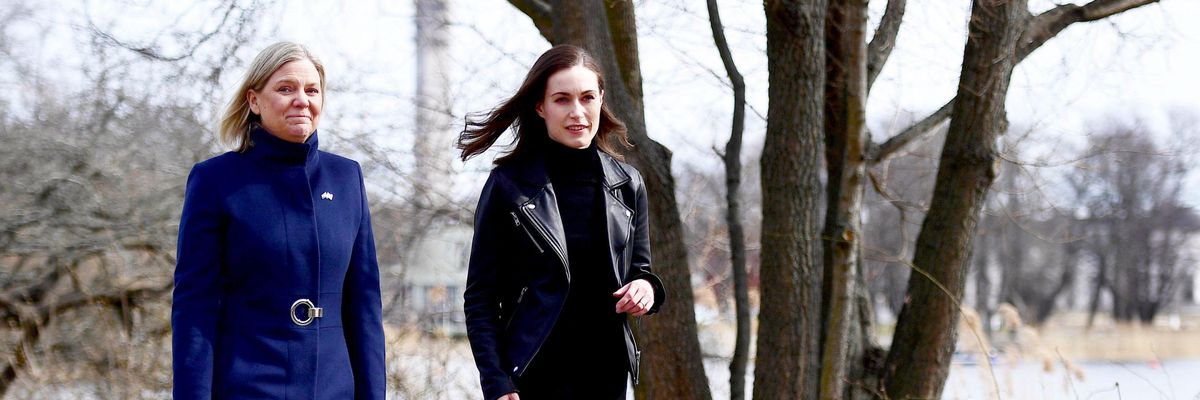
Swedish Prime Minister Magdalena Andersson (left) walks with Finnish Prime Minister Sanna Marin (right) prior to an April 13, 2022 meeting in Stockholm on whether to seek NATO membership. (Photo: Paul Wennerholm/TT News Agency/AFP via Getty Images)
Sweden and Finland Will Simultaneously Apply to Join NATO: Reports
As recently as last month, Sweden's center-left prime minister rejected calls to join the transatlantic alliance, saying that doing so would "further destabilize this area of Europe and increase tensions" with Russia.
Officials in the traditionally neutral Nordic nations of Sweden and Finland confirmed Monday that the countries will simultaneously apply to join the North Atlantic Treaty Organization amid increased public support for the move as Russia continues its brutal invasion of Ukraine.
Two newspapers--Finland's Iltalehti and Sweden's Expressen--reported that the countries' applications could occur as soon as the middle of next month. The Swedish daily Aftonbladet reported that Sweden has received concrete promises from the United States and the United Kingdom regarding protection and political support during the NATO application process.
According to The Guardian:
Finland's prime minister, Sanna Marin, said then that her country, which shares a 1,300km (810 mile) border with Russia, would decide whether to apply to join the alliance "quite fast, in weeks not months," despite the risk of infuriating Moscow.
Her Swedish counterpart, Magdalena Andersson, said Sweden had to be "prepared for all kinds of actions from Russia" and that "everything had changed" when Moscow attacked Ukraine.
As recently as last month, the center-left Andersson rejected opposition calls to join NATO, saying that doing so would "further destabilize this area of Europe and increase tensions."
According to recent polling, just over half of Swedes and more than six in 10 Finns support their respective countries joining NATO.
However, peace activists in both countries have spoken out against NATO membership, with Agnes Hellstrom of the Swedish Peace and Arbitration Society saying "we don't think it would make us safer or the world more secure."
"It would make us part of a nuclear doctrine, and our possibility to be a voice for democracy, prevention, and disarmament would decrease," she told Democracy Now! earlier this month.
Anti-war activists and experts have long argued that NATO enlargement--and especially its expansion into former Soviet and Warsaw Pact nations--is highly provocative toward Russia. Moscow has warned that further NATO expansion would force Russia to bolster its military capabilities--including by deploying more nuclear weapons--along its borders with alliance members.
We are at a crossroads
This country and this world are at a monumental crossroads. In a few short weeks, US voters will have an opportunity to beat back the forces of fascism and confront the billionaires who are rigging the economy, our media system, and our democracy, making it increasingly impossible for ordinary people to get by. We’re not just talking about the election. We’re talking about what must be done once these fascist elements are vanquished from power. We need a bolder set of solutions than what either major party has so far been willing to offer and a working-class movement ready to fight like hell for it. Trump didn't emerge from nowhere. The conditions that fueled MAGA authoritarianism were created by decades of radical neoliberal economic policies and a corrupt political system dominated by corporate interests. They slashed taxes on the super-rich, promising that the benefits would trickle down. They said giveaways to the corporate titans would make life more affordable for the rest of us. It was all bullshit. And when a bitter, betrayed populace searches for someone to blame, right-wing demagogues have little trouble finding scapegoats. People know when they're being lied to, but you won't hear any of this from the corporate media. Only independent journalism—powered and funded by people who believe in building a better world—can deliver truly trustworthy daily news. Our Fall Campaign is underway, and we need your help. To power our newsroom through the rest of the year, we need to raise $125,000 by midnight on October 31. So if you share our vision, please contribute whatever you can to sustain our work. |
Officials in the traditionally neutral Nordic nations of Sweden and Finland confirmed Monday that the countries will simultaneously apply to join the North Atlantic Treaty Organization amid increased public support for the move as Russia continues its brutal invasion of Ukraine.
Two newspapers--Finland's Iltalehti and Sweden's Expressen--reported that the countries' applications could occur as soon as the middle of next month. The Swedish daily Aftonbladet reported that Sweden has received concrete promises from the United States and the United Kingdom regarding protection and political support during the NATO application process.
According to The Guardian:
Finland's prime minister, Sanna Marin, said then that her country, which shares a 1,300km (810 mile) border with Russia, would decide whether to apply to join the alliance "quite fast, in weeks not months," despite the risk of infuriating Moscow.
Her Swedish counterpart, Magdalena Andersson, said Sweden had to be "prepared for all kinds of actions from Russia" and that "everything had changed" when Moscow attacked Ukraine.
As recently as last month, the center-left Andersson rejected opposition calls to join NATO, saying that doing so would "further destabilize this area of Europe and increase tensions."
According to recent polling, just over half of Swedes and more than six in 10 Finns support their respective countries joining NATO.
However, peace activists in both countries have spoken out against NATO membership, with Agnes Hellstrom of the Swedish Peace and Arbitration Society saying "we don't think it would make us safer or the world more secure."
"It would make us part of a nuclear doctrine, and our possibility to be a voice for democracy, prevention, and disarmament would decrease," she told Democracy Now! earlier this month.
Anti-war activists and experts have long argued that NATO enlargement--and especially its expansion into former Soviet and Warsaw Pact nations--is highly provocative toward Russia. Moscow has warned that further NATO expansion would force Russia to bolster its military capabilities--including by deploying more nuclear weapons--along its borders with alliance members.
Officials in the traditionally neutral Nordic nations of Sweden and Finland confirmed Monday that the countries will simultaneously apply to join the North Atlantic Treaty Organization amid increased public support for the move as Russia continues its brutal invasion of Ukraine.
Two newspapers--Finland's Iltalehti and Sweden's Expressen--reported that the countries' applications could occur as soon as the middle of next month. The Swedish daily Aftonbladet reported that Sweden has received concrete promises from the United States and the United Kingdom regarding protection and political support during the NATO application process.
According to The Guardian:
Finland's prime minister, Sanna Marin, said then that her country, which shares a 1,300km (810 mile) border with Russia, would decide whether to apply to join the alliance "quite fast, in weeks not months," despite the risk of infuriating Moscow.
Her Swedish counterpart, Magdalena Andersson, said Sweden had to be "prepared for all kinds of actions from Russia" and that "everything had changed" when Moscow attacked Ukraine.
As recently as last month, the center-left Andersson rejected opposition calls to join NATO, saying that doing so would "further destabilize this area of Europe and increase tensions."
According to recent polling, just over half of Swedes and more than six in 10 Finns support their respective countries joining NATO.
However, peace activists in both countries have spoken out against NATO membership, with Agnes Hellstrom of the Swedish Peace and Arbitration Society saying "we don't think it would make us safer or the world more secure."
"It would make us part of a nuclear doctrine, and our possibility to be a voice for democracy, prevention, and disarmament would decrease," she told Democracy Now! earlier this month.
Anti-war activists and experts have long argued that NATO enlargement--and especially its expansion into former Soviet and Warsaw Pact nations--is highly provocative toward Russia. Moscow has warned that further NATO expansion would force Russia to bolster its military capabilities--including by deploying more nuclear weapons--along its borders with alliance members.