SUBSCRIBE TO OUR FREE NEWSLETTER
Daily news & progressive opinion—funded by the people, not the corporations—delivered straight to your inbox.
5
#000000
#FFFFFF
To donate by check, phone, or other method, see our More Ways to Give page.
Daily news & progressive opinion—funded by the people, not the corporations—delivered straight to your inbox.
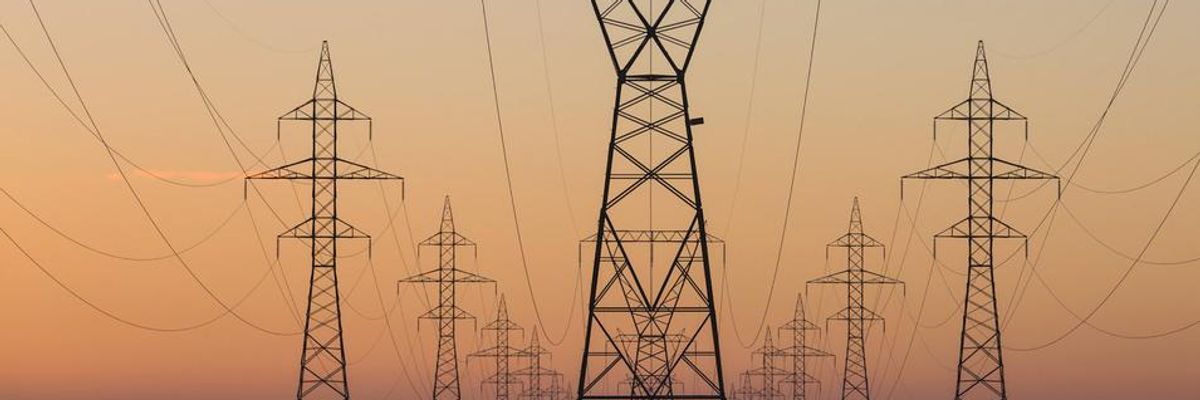
A new report states that publicly and cooperatively owned utilities offer a better transition path to a fossil-free power grid than their corporate-owned counterparts--as long as they are properly reformed and regulated. (Photo: Matt Wiebe/Flickr/cc)
Publicly and cooperatively owned utilities offer a better transition path to a fossil-free power grid than their corporate-owned counterparts--as long as they are properly reformed and regulated--the authors of a report published Monday argue.
"It is time to reignite the radical history of community utilities to herald the transition to a genuinely democratic, equitable, and clean energy system."
The report--by Thomas Hanna, Johanna Bozuwa, and Raj Rao of the Democracy Collaborative and Climate and Community Project--found that community utilities "are better suited for a 'Green New Deal'-style transition than for-profit corporate utilities."
However, the authors also contend that "many community utilities as they currently exist must be significantly reformed to fulfill their full potential."
"The United States urgently needs to transition off of fossil fuels and onto clean sources of energy (especially renewable energy) to maintain a livable climate," they assert, noting that "as of 2020, only around 20% of U.S. electricity generation is from renewable energy sources."
"Energy utilities--the companies that run our power systems--have enormous control over the scope and scale of the transition, but have often dragged their feet or even fought against clean energy," the report continues. "Not only does their inaction imperil the very future of humanity, but it directly harms families--often Black, Indigenous, low-income, or otherwise marginalized--who live in the shadow of toxic power plants."
"The current U.S. energy system is dirty and expensive," the publication states. "Thirty-one percent of households in the country have to make the choice between buying groceries or paying their energy bills. In response, communities across the country are beginning to mobilize to demand an energy transition."
The authors stress that "we have a powerful tool to accelerate the energy transition in a way that builds community wealth and energy justice in our communities: publicly and cooperatively owned utilities."
According to the report, around 30% of U.S. households are currently powered by community utilities, whose historical roots the authors call "radical."
"In the early days of electrification 100 years ago, residents across the country rose up against profiteering private utilities who provided poor (or nonexistent) service at high prices by creating their own publicly and cooperatively owned utilities," they note. "In the state of Nebraska, for instance, they kicked all private utilities out of the state for good. To this day, there are no private utilities providing electricity to Nebraskans' homes."
The report also cites the Franklin D. Roosevelt administration's Rural Electrification Administration, a New Deal program that boosted the electrification rate from 10% to 90% in a decade as farmers united to start their own electric cooperatives.
"It is time to reignite the radical history of community utilities to herald the transition to a genuinely democratic, equitable, and clean energy system," the report's authors assert.
The report lays out a nine-point plan for community utilities to realize their full potential. Blocking privatization, setting incentives and mandates for renewable energy, establishing public banks and financing, and boosting democratic governance are some of the steps the authors say are crucial for success.
"Community utilities are much better suited to support a just and equitable clean energy transition than for-profit corporate utilities," said Hanna.
"However, many must be reformed and democratized to fulfill their potential," he added. "Alongside (and integrated with) larger public interventions and institutions in the energy system (such as regional public power producers), community utilities can play a prominent role in the clean energy future we desperately need."
Dear Common Dreams reader, It’s been nearly 30 years since I co-founded Common Dreams with my late wife, Lina Newhouser. We had the radical notion that journalism should serve the public good, not corporate profits. It was clear to us from the outset what it would take to build such a project. No paid advertisements. No corporate sponsors. No millionaire publisher telling us what to think or do. Many people said we wouldn't last a year, but we proved those doubters wrong. Together with a tremendous team of journalists and dedicated staff, we built an independent media outlet free from the constraints of profits and corporate control. Our mission has always been simple: To inform. To inspire. To ignite change for the common good. Building Common Dreams was not easy. Our survival was never guaranteed. When you take on the most powerful forces—Wall Street greed, fossil fuel industry destruction, Big Tech lobbyists, and uber-rich oligarchs who have spent billions upon billions rigging the economy and democracy in their favor—the only bulwark you have is supporters who believe in your work. But here’s the urgent message from me today. It's never been this bad out there. And it's never been this hard to keep us going. At the very moment Common Dreams is most needed, the threats we face are intensifying. We need your support now more than ever. We don't accept corporate advertising and never will. We don't have a paywall because we don't think people should be blocked from critical news based on their ability to pay. Everything we do is funded by the donations of readers like you. When everyone does the little they can afford, we are strong. But if that support retreats or dries up, so do we. Will you donate now to make sure Common Dreams not only survives but thrives? —Craig Brown, Co-founder |
Publicly and cooperatively owned utilities offer a better transition path to a fossil-free power grid than their corporate-owned counterparts--as long as they are properly reformed and regulated--the authors of a report published Monday argue.
"It is time to reignite the radical history of community utilities to herald the transition to a genuinely democratic, equitable, and clean energy system."
The report--by Thomas Hanna, Johanna Bozuwa, and Raj Rao of the Democracy Collaborative and Climate and Community Project--found that community utilities "are better suited for a 'Green New Deal'-style transition than for-profit corporate utilities."
However, the authors also contend that "many community utilities as they currently exist must be significantly reformed to fulfill their full potential."
"The United States urgently needs to transition off of fossil fuels and onto clean sources of energy (especially renewable energy) to maintain a livable climate," they assert, noting that "as of 2020, only around 20% of U.S. electricity generation is from renewable energy sources."
"Energy utilities--the companies that run our power systems--have enormous control over the scope and scale of the transition, but have often dragged their feet or even fought against clean energy," the report continues. "Not only does their inaction imperil the very future of humanity, but it directly harms families--often Black, Indigenous, low-income, or otherwise marginalized--who live in the shadow of toxic power plants."
"The current U.S. energy system is dirty and expensive," the publication states. "Thirty-one percent of households in the country have to make the choice between buying groceries or paying their energy bills. In response, communities across the country are beginning to mobilize to demand an energy transition."
The authors stress that "we have a powerful tool to accelerate the energy transition in a way that builds community wealth and energy justice in our communities: publicly and cooperatively owned utilities."
According to the report, around 30% of U.S. households are currently powered by community utilities, whose historical roots the authors call "radical."
"In the early days of electrification 100 years ago, residents across the country rose up against profiteering private utilities who provided poor (or nonexistent) service at high prices by creating their own publicly and cooperatively owned utilities," they note. "In the state of Nebraska, for instance, they kicked all private utilities out of the state for good. To this day, there are no private utilities providing electricity to Nebraskans' homes."
The report also cites the Franklin D. Roosevelt administration's Rural Electrification Administration, a New Deal program that boosted the electrification rate from 10% to 90% in a decade as farmers united to start their own electric cooperatives.
"It is time to reignite the radical history of community utilities to herald the transition to a genuinely democratic, equitable, and clean energy system," the report's authors assert.
The report lays out a nine-point plan for community utilities to realize their full potential. Blocking privatization, setting incentives and mandates for renewable energy, establishing public banks and financing, and boosting democratic governance are some of the steps the authors say are crucial for success.
"Community utilities are much better suited to support a just and equitable clean energy transition than for-profit corporate utilities," said Hanna.
"However, many must be reformed and democratized to fulfill their potential," he added. "Alongside (and integrated with) larger public interventions and institutions in the energy system (such as regional public power producers), community utilities can play a prominent role in the clean energy future we desperately need."
Publicly and cooperatively owned utilities offer a better transition path to a fossil-free power grid than their corporate-owned counterparts--as long as they are properly reformed and regulated--the authors of a report published Monday argue.
"It is time to reignite the radical history of community utilities to herald the transition to a genuinely democratic, equitable, and clean energy system."
The report--by Thomas Hanna, Johanna Bozuwa, and Raj Rao of the Democracy Collaborative and Climate and Community Project--found that community utilities "are better suited for a 'Green New Deal'-style transition than for-profit corporate utilities."
However, the authors also contend that "many community utilities as they currently exist must be significantly reformed to fulfill their full potential."
"The United States urgently needs to transition off of fossil fuels and onto clean sources of energy (especially renewable energy) to maintain a livable climate," they assert, noting that "as of 2020, only around 20% of U.S. electricity generation is from renewable energy sources."
"Energy utilities--the companies that run our power systems--have enormous control over the scope and scale of the transition, but have often dragged their feet or even fought against clean energy," the report continues. "Not only does their inaction imperil the very future of humanity, but it directly harms families--often Black, Indigenous, low-income, or otherwise marginalized--who live in the shadow of toxic power plants."
"The current U.S. energy system is dirty and expensive," the publication states. "Thirty-one percent of households in the country have to make the choice between buying groceries or paying their energy bills. In response, communities across the country are beginning to mobilize to demand an energy transition."
The authors stress that "we have a powerful tool to accelerate the energy transition in a way that builds community wealth and energy justice in our communities: publicly and cooperatively owned utilities."
According to the report, around 30% of U.S. households are currently powered by community utilities, whose historical roots the authors call "radical."
"In the early days of electrification 100 years ago, residents across the country rose up against profiteering private utilities who provided poor (or nonexistent) service at high prices by creating their own publicly and cooperatively owned utilities," they note. "In the state of Nebraska, for instance, they kicked all private utilities out of the state for good. To this day, there are no private utilities providing electricity to Nebraskans' homes."
The report also cites the Franklin D. Roosevelt administration's Rural Electrification Administration, a New Deal program that boosted the electrification rate from 10% to 90% in a decade as farmers united to start their own electric cooperatives.
"It is time to reignite the radical history of community utilities to herald the transition to a genuinely democratic, equitable, and clean energy system," the report's authors assert.
The report lays out a nine-point plan for community utilities to realize their full potential. Blocking privatization, setting incentives and mandates for renewable energy, establishing public banks and financing, and boosting democratic governance are some of the steps the authors say are crucial for success.
"Community utilities are much better suited to support a just and equitable clean energy transition than for-profit corporate utilities," said Hanna.
"However, many must be reformed and democratized to fulfill their potential," he added. "Alongside (and integrated with) larger public interventions and institutions in the energy system (such as regional public power producers), community utilities can play a prominent role in the clean energy future we desperately need."