SUBSCRIBE TO OUR FREE NEWSLETTER
Daily news & progressive opinion—funded by the people, not the corporations—delivered straight to your inbox.
5
#000000
#FFFFFF
To donate by check, phone, or other method, see our More Ways to Give page.
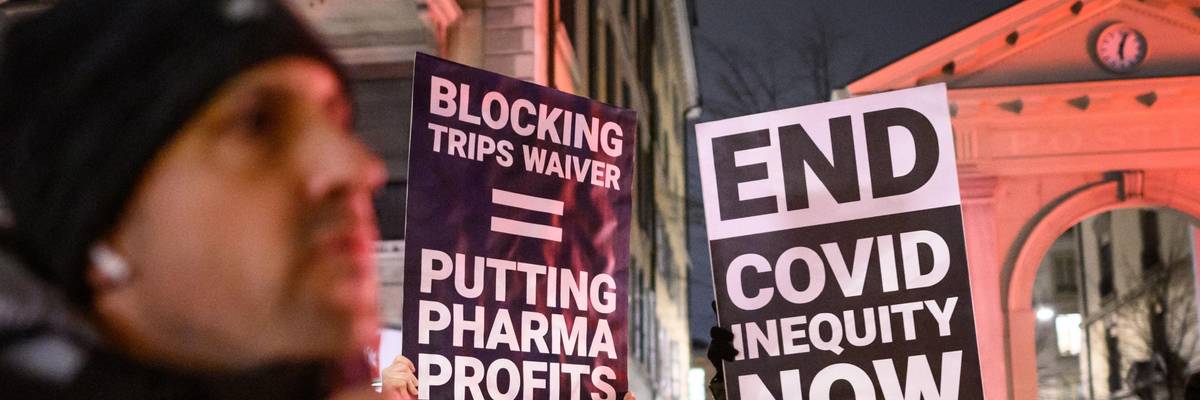
A pair of leading economists and the pan-Africa director at Oxfam sent a letter Monday calling on South African President Cyril Ramaphosa to reject a "compromise" on a long-awaited Covid-19 intellectual property waiver.
"This text reflects the interests of multinational pharmaceutical companies in preserving the deadly status quo."
Debates have dragged on at the World Trade Organization (WTO) since South Africa and India proposed an IP waiver in October 2020. Global justice campaigners responded with alarm last week to reporting on a limited deal that would only cover vaccines, not tests and treatments.
In their new letter, economists Jayati Ghosh and Joseph Stiglitz along with Oxfam's Peter Kamalingin praised Ramaphosa's "tireless leadership" on advancing a waiver for parts of the Agreement on Trade-Related Aspects of Intellectual Property Rights (TRIPS) to combat the ongoing pandemic.
Addressing the leaked deal, they wrote that "we support you fully in rejecting this misleading and ineffectual proposal, which represents the European Union's belligerent blockade of any actual waiver of IP barriers and the United States' insistence that the IP waiver it supports be limited to vaccines."
Following the reports last week, Ngozi Okonjo-Iweala, the WTO's director-general, called the potential compromise "a major step forward" while also emphasizing that as for a final agreement, "we are not there yet."
Related Content

Ghosh, Stiglitz, and Kamalingin on Monday highlighted that "developing countries have experienced the worst effects of Covid-19" and "the crisis is far from over as infections and deaths continue all over the world."
While Covid-19 vaccines and boosters are widely available in rich nations, less than 15% of people in low-income countries have received at least one dose, according to Our World in Data. Residents of the Global South face similar difficulties accessing tests and treatments.
"New variants are also expected to emerge, with the potential to further devastate countries socially and economically," the letter notes. "A meaningful outcome on the TRIPS waiver proposal holds the key to promoting equitable access to the Covid-19 medical tools that can facilitate and sustain socioeconomic recovery and protect the lives and livelihoods in South Africa, India, and many other developing countries."
"In contrast to your inspiring leadership for a meaningful waiver of IP barriers," the trio wrote to Ramaphosa, "this text reflects the interests of multinational pharmaceutical companies in preserving the deadly status quo."
Along with excluding tests and treatments, the pending deal "largely restates the existing limited flexibilities to overcome only patent barriers that already exist in Article 31 of the TRIPS text. This has proved unfit for boosting production of Covid-19 vaccines," the letter points out. "And this text adds new burdensome conditions not now required by WTO rules that would impose additional limits on countries using non-voluntary licensing."
The compromise "continues to require product-by-product authorization, meaning no simplified pathway for follow-on manufacturers to produce and enter the market," the letter adds. "The leaked text also does not waive other forms of IP barriers that thwart Covid vaccine production, including protection of undisclosed information (Article 39). This is essential for the production of Covid-19 vaccines."
"We strongly support South Africa not agreeing to this proposal," Ghosh, Stiglitz, and Kamalingin wrote. "We are keen to work with you as you lead the world to obtain a useful and meaningful outcome that facilitates diversification and expanded production and supply."
"Like civil society groups around the world, we believe a bad deal is worse than no deal," they concluded. "We want to work with you to support an outcome at WTO that will make a difference in battling Covid. The leaked text fails that test."
A pair of leading economists and the pan-Africa director at Oxfam sent a letter Monday calling on South African President Cyril Ramaphosa to reject a "compromise" on a long-awaited Covid-19 intellectual property waiver.
"This text reflects the interests of multinational pharmaceutical companies in preserving the deadly status quo."
Debates have dragged on at the World Trade Organization (WTO) since South Africa and India proposed an IP waiver in October 2020. Global justice campaigners responded with alarm last week to reporting on a limited deal that would only cover vaccines, not tests and treatments.
In their new letter, economists Jayati Ghosh and Joseph Stiglitz along with Oxfam's Peter Kamalingin praised Ramaphosa's "tireless leadership" on advancing a waiver for parts of the Agreement on Trade-Related Aspects of Intellectual Property Rights (TRIPS) to combat the ongoing pandemic.
Addressing the leaked deal, they wrote that "we support you fully in rejecting this misleading and ineffectual proposal, which represents the European Union's belligerent blockade of any actual waiver of IP barriers and the United States' insistence that the IP waiver it supports be limited to vaccines."
Following the reports last week, Ngozi Okonjo-Iweala, the WTO's director-general, called the potential compromise "a major step forward" while also emphasizing that as for a final agreement, "we are not there yet."
Related Content
Ghosh, Stiglitz, and Kamalingin on Monday highlighted that "developing countries have experienced the worst effects of Covid-19" and "the crisis is far from over as infections and deaths continue all over the world."
While Covid-19 vaccines and boosters are widely available in rich nations, less than 15% of people in low-income countries have received at least one dose, according to Our World in Data. Residents of the Global South face similar difficulties accessing tests and treatments.
"New variants are also expected to emerge, with the potential to further devastate countries socially and economically," the letter notes. "A meaningful outcome on the TRIPS waiver proposal holds the key to promoting equitable access to the Covid-19 medical tools that can facilitate and sustain socioeconomic recovery and protect the lives and livelihoods in South Africa, India, and many other developing countries."
"In contrast to your inspiring leadership for a meaningful waiver of IP barriers," the trio wrote to Ramaphosa, "this text reflects the interests of multinational pharmaceutical companies in preserving the deadly status quo."
Along with excluding tests and treatments, the pending deal "largely restates the existing limited flexibilities to overcome only patent barriers that already exist in Article 31 of the TRIPS text. This has proved unfit for boosting production of Covid-19 vaccines," the letter points out. "And this text adds new burdensome conditions not now required by WTO rules that would impose additional limits on countries using non-voluntary licensing."
The compromise "continues to require product-by-product authorization, meaning no simplified pathway for follow-on manufacturers to produce and enter the market," the letter adds. "The leaked text also does not waive other forms of IP barriers that thwart Covid vaccine production, including protection of undisclosed information (Article 39). This is essential for the production of Covid-19 vaccines."
"We strongly support South Africa not agreeing to this proposal," Ghosh, Stiglitz, and Kamalingin wrote. "We are keen to work with you as you lead the world to obtain a useful and meaningful outcome that facilitates diversification and expanded production and supply."
"Like civil society groups around the world, we believe a bad deal is worse than no deal," they concluded. "We want to work with you to support an outcome at WTO that will make a difference in battling Covid. The leaked text fails that test."
A pair of leading economists and the pan-Africa director at Oxfam sent a letter Monday calling on South African President Cyril Ramaphosa to reject a "compromise" on a long-awaited Covid-19 intellectual property waiver.
"This text reflects the interests of multinational pharmaceutical companies in preserving the deadly status quo."
Debates have dragged on at the World Trade Organization (WTO) since South Africa and India proposed an IP waiver in October 2020. Global justice campaigners responded with alarm last week to reporting on a limited deal that would only cover vaccines, not tests and treatments.
In their new letter, economists Jayati Ghosh and Joseph Stiglitz along with Oxfam's Peter Kamalingin praised Ramaphosa's "tireless leadership" on advancing a waiver for parts of the Agreement on Trade-Related Aspects of Intellectual Property Rights (TRIPS) to combat the ongoing pandemic.
Addressing the leaked deal, they wrote that "we support you fully in rejecting this misleading and ineffectual proposal, which represents the European Union's belligerent blockade of any actual waiver of IP barriers and the United States' insistence that the IP waiver it supports be limited to vaccines."
Following the reports last week, Ngozi Okonjo-Iweala, the WTO's director-general, called the potential compromise "a major step forward" while also emphasizing that as for a final agreement, "we are not there yet."
Related Content
Ghosh, Stiglitz, and Kamalingin on Monday highlighted that "developing countries have experienced the worst effects of Covid-19" and "the crisis is far from over as infections and deaths continue all over the world."
While Covid-19 vaccines and boosters are widely available in rich nations, less than 15% of people in low-income countries have received at least one dose, according to Our World in Data. Residents of the Global South face similar difficulties accessing tests and treatments.
"New variants are also expected to emerge, with the potential to further devastate countries socially and economically," the letter notes. "A meaningful outcome on the TRIPS waiver proposal holds the key to promoting equitable access to the Covid-19 medical tools that can facilitate and sustain socioeconomic recovery and protect the lives and livelihoods in South Africa, India, and many other developing countries."
"In contrast to your inspiring leadership for a meaningful waiver of IP barriers," the trio wrote to Ramaphosa, "this text reflects the interests of multinational pharmaceutical companies in preserving the deadly status quo."
Along with excluding tests and treatments, the pending deal "largely restates the existing limited flexibilities to overcome only patent barriers that already exist in Article 31 of the TRIPS text. This has proved unfit for boosting production of Covid-19 vaccines," the letter points out. "And this text adds new burdensome conditions not now required by WTO rules that would impose additional limits on countries using non-voluntary licensing."
The compromise "continues to require product-by-product authorization, meaning no simplified pathway for follow-on manufacturers to produce and enter the market," the letter adds. "The leaked text also does not waive other forms of IP barriers that thwart Covid vaccine production, including protection of undisclosed information (Article 39). This is essential for the production of Covid-19 vaccines."
"We strongly support South Africa not agreeing to this proposal," Ghosh, Stiglitz, and Kamalingin wrote. "We are keen to work with you as you lead the world to obtain a useful and meaningful outcome that facilitates diversification and expanded production and supply."
"Like civil society groups around the world, we believe a bad deal is worse than no deal," they concluded. "We want to work with you to support an outcome at WTO that will make a difference in battling Covid. The leaked text fails that test."