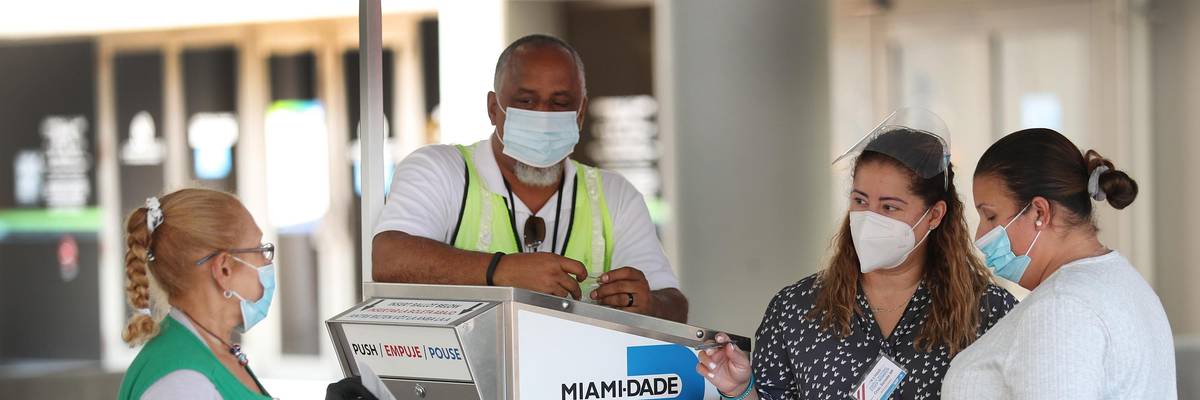
Poll workers help a voter put their mail-in ballot in an official Miami-Dade County ballot drop box on August 11, 2020 in Miami, Florida. (Photo: Joe Raedle/Getty Images)
Critics Warn Florida GOP Bill Designed to 'Criminalize' the Voting Process
"American exceptionalism and denial means that no one will admit it, but between book burning, abortion bans, criminalizing trans kids, the Supreme Court's attack on voting rights, and now this, we are truly veering on fascism."
Florida is poised to establish a first-of-its-kind police force dedicated to stopping and investigating so-called "voter fraud" following the passage on Wednesday of a bill further overhauling the state's voting system, a year after sweeping changes to election laws sparked outcry among voting rights advocates.
"So now we're criminalizing certain acts around the elections process that most folks, particularly in the Black community, have long held as a way to assist those in need."
The Republican-led state House passed the new legislation, S.B. 524 in a vote of 76-41 on Wednesday, days after the state Senate approved the bill in a vote of 24-14. Republican Gov. Ron DeSantis, who had requested even more spending on an election police force than that $3.7 million plan that was passed, is expected to sign the bill.
The legislation will create an Office of Election Crimes and Security with a staff of 25 people to pursue charges against Floridians who are accused of fraudulent voting. The office will operate under the Florida State Department.
The measure was passed nearly a year after DeSantis signed S.B. 90, a law that bars advocacy groups from handing out food or water to voters waiting in long lines; imposes strict voter ID requirements; and made so-called "ballot harvesting," or collecting multiple ballots, a misdemeanor.
Under the new bill, people who are found to have more than two ballots could be found guilty of a felony and face fines of up to $50,000 and five years in prison.
The measure is likely to target churches and community groups which help elderly voters and people with disabilities to cast votes, critics said, and to have a disproportionate effect on communities of color.
"So now we're criminalizing certain acts around the elections process that most folks, particularly in the Black community, have long held as a way to assist those in need," Genesis Robinson, political director of voting rights group Equal Ground, told The Washington Post. "To spend time in jail for simply trying to be a good neighbor, that's a problem."
In addition to the newly-created election police force, up to 10 officers in the Florida Department of Law Enforcement will be appointed to investigate alleged election crimes.
Election supervisors will be required to purge voter rolls every year instead of every two years, screening the registration lists for voters who may have moved. The practice has been used more frequently in recent years by states with a history of discriminatory voting laws, with a 33% increase in voter purges between 2008 and 2016, according to the Brennan Center for Justice.
The bill sparked accusations from political observers and organizers on social media that the Florida Republican Party was sliding toward "fascism."
" American exceptionalism and denial means that no one will admit it, but between book burning, abortion bans, criminalizing trans kids, the Supreme Court's attack on voting rights, and now this, we are truly veering on fascism," said Jordan Zakarin, a reporter for More Perfect Union, a progressive media outlet focused on labor rights.
Out of 11 million ballots cast in the 2020 presidential election in Florida, officials received 262 complaints of fraudulent ballots--a "voter fraud" rate of 0.002%. Out of those, 75 were referred to prosecutors or law enforcement.
In Georgia, former Republican senator and gubernatorial candidate David Purdue has called for an Election Law Enforcement Division similar to the force DeSantis plans to create, but as Barrett Holmes Pitner wrote at The Daily Beast in January, Republicans "aren't breaking new ground, but joining a long tradition of dressing up efforts to suppress and intimidate Black voters as somehow protecting the integrity of our American democracy."
We are at a crossroads
This country and this world are at a monumental crossroads. In a few short weeks, US voters will have an opportunity to beat back the forces of fascism and confront the billionaires who are rigging the economy, our media system, and our democracy, making it increasingly impossible for ordinary people to get by. We’re not just talking about the election. We’re talking about what must be done once these fascist elements are vanquished from power. We need a bolder set of solutions than what either major party has so far been willing to offer and a working-class movement ready to fight like hell for it. Trump didn't emerge from nowhere. The conditions that fueled MAGA authoritarianism were created by decades of radical neoliberal economic policies and a corrupt political system dominated by corporate interests. They slashed taxes on the super-rich, promising that the benefits would trickle down. They said giveaways to the corporate titans would make life more affordable for the rest of us. It was all bullshit. And when a bitter, betrayed populace searches for someone to blame, right-wing demagogues have little trouble finding scapegoats. People know when they're being lied to, but you won't hear any of this from the corporate media. Only independent journalism—powered and funded by people who believe in building a better world—can deliver truly trustworthy daily news. Our Fall Campaign is underway, and we need your help. To power our newsroom through the rest of the year, we need to raise $125,000 by midnight on October 31. So if you share our vision, please contribute whatever you can to sustain our work. |
Florida is poised to establish a first-of-its-kind police force dedicated to stopping and investigating so-called "voter fraud" following the passage on Wednesday of a bill further overhauling the state's voting system, a year after sweeping changes to election laws sparked outcry among voting rights advocates.
"So now we're criminalizing certain acts around the elections process that most folks, particularly in the Black community, have long held as a way to assist those in need."
The Republican-led state House passed the new legislation, S.B. 524 in a vote of 76-41 on Wednesday, days after the state Senate approved the bill in a vote of 24-14. Republican Gov. Ron DeSantis, who had requested even more spending on an election police force than that $3.7 million plan that was passed, is expected to sign the bill.
The legislation will create an Office of Election Crimes and Security with a staff of 25 people to pursue charges against Floridians who are accused of fraudulent voting. The office will operate under the Florida State Department.
The measure was passed nearly a year after DeSantis signed S.B. 90, a law that bars advocacy groups from handing out food or water to voters waiting in long lines; imposes strict voter ID requirements; and made so-called "ballot harvesting," or collecting multiple ballots, a misdemeanor.
Under the new bill, people who are found to have more than two ballots could be found guilty of a felony and face fines of up to $50,000 and five years in prison.
The measure is likely to target churches and community groups which help elderly voters and people with disabilities to cast votes, critics said, and to have a disproportionate effect on communities of color.
"So now we're criminalizing certain acts around the elections process that most folks, particularly in the Black community, have long held as a way to assist those in need," Genesis Robinson, political director of voting rights group Equal Ground, told The Washington Post. "To spend time in jail for simply trying to be a good neighbor, that's a problem."
In addition to the newly-created election police force, up to 10 officers in the Florida Department of Law Enforcement will be appointed to investigate alleged election crimes.
Election supervisors will be required to purge voter rolls every year instead of every two years, screening the registration lists for voters who may have moved. The practice has been used more frequently in recent years by states with a history of discriminatory voting laws, with a 33% increase in voter purges between 2008 and 2016, according to the Brennan Center for Justice.
The bill sparked accusations from political observers and organizers on social media that the Florida Republican Party was sliding toward "fascism."
" American exceptionalism and denial means that no one will admit it, but between book burning, abortion bans, criminalizing trans kids, the Supreme Court's attack on voting rights, and now this, we are truly veering on fascism," said Jordan Zakarin, a reporter for More Perfect Union, a progressive media outlet focused on labor rights.
Out of 11 million ballots cast in the 2020 presidential election in Florida, officials received 262 complaints of fraudulent ballots--a "voter fraud" rate of 0.002%. Out of those, 75 were referred to prosecutors or law enforcement.
In Georgia, former Republican senator and gubernatorial candidate David Purdue has called for an Election Law Enforcement Division similar to the force DeSantis plans to create, but as Barrett Holmes Pitner wrote at The Daily Beast in January, Republicans "aren't breaking new ground, but joining a long tradition of dressing up efforts to suppress and intimidate Black voters as somehow protecting the integrity of our American democracy."
Florida is poised to establish a first-of-its-kind police force dedicated to stopping and investigating so-called "voter fraud" following the passage on Wednesday of a bill further overhauling the state's voting system, a year after sweeping changes to election laws sparked outcry among voting rights advocates.
"So now we're criminalizing certain acts around the elections process that most folks, particularly in the Black community, have long held as a way to assist those in need."
The Republican-led state House passed the new legislation, S.B. 524 in a vote of 76-41 on Wednesday, days after the state Senate approved the bill in a vote of 24-14. Republican Gov. Ron DeSantis, who had requested even more spending on an election police force than that $3.7 million plan that was passed, is expected to sign the bill.
The legislation will create an Office of Election Crimes and Security with a staff of 25 people to pursue charges against Floridians who are accused of fraudulent voting. The office will operate under the Florida State Department.
The measure was passed nearly a year after DeSantis signed S.B. 90, a law that bars advocacy groups from handing out food or water to voters waiting in long lines; imposes strict voter ID requirements; and made so-called "ballot harvesting," or collecting multiple ballots, a misdemeanor.
Under the new bill, people who are found to have more than two ballots could be found guilty of a felony and face fines of up to $50,000 and five years in prison.
The measure is likely to target churches and community groups which help elderly voters and people with disabilities to cast votes, critics said, and to have a disproportionate effect on communities of color.
"So now we're criminalizing certain acts around the elections process that most folks, particularly in the Black community, have long held as a way to assist those in need," Genesis Robinson, political director of voting rights group Equal Ground, told The Washington Post. "To spend time in jail for simply trying to be a good neighbor, that's a problem."
In addition to the newly-created election police force, up to 10 officers in the Florida Department of Law Enforcement will be appointed to investigate alleged election crimes.
Election supervisors will be required to purge voter rolls every year instead of every two years, screening the registration lists for voters who may have moved. The practice has been used more frequently in recent years by states with a history of discriminatory voting laws, with a 33% increase in voter purges between 2008 and 2016, according to the Brennan Center for Justice.
The bill sparked accusations from political observers and organizers on social media that the Florida Republican Party was sliding toward "fascism."
" American exceptionalism and denial means that no one will admit it, but between book burning, abortion bans, criminalizing trans kids, the Supreme Court's attack on voting rights, and now this, we are truly veering on fascism," said Jordan Zakarin, a reporter for More Perfect Union, a progressive media outlet focused on labor rights.
Out of 11 million ballots cast in the 2020 presidential election in Florida, officials received 262 complaints of fraudulent ballots--a "voter fraud" rate of 0.002%. Out of those, 75 were referred to prosecutors or law enforcement.
In Georgia, former Republican senator and gubernatorial candidate David Purdue has called for an Election Law Enforcement Division similar to the force DeSantis plans to create, but as Barrett Holmes Pitner wrote at The Daily Beast in January, Republicans "aren't breaking new ground, but joining a long tradition of dressing up efforts to suppress and intimidate Black voters as somehow protecting the integrity of our American democracy."