
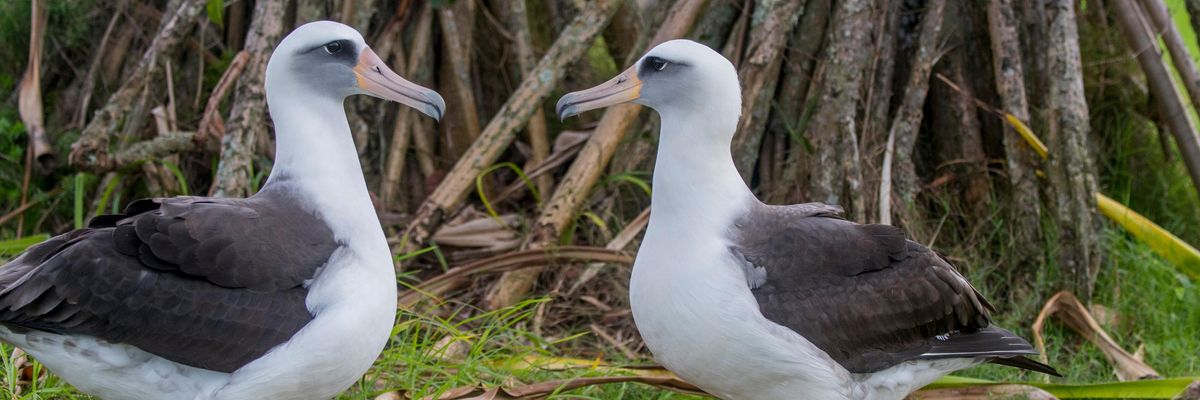
A couple of Moli, or Laysan albatrosses (P. immutabilis) displaying courtship behavior on the Princeville Makai Golf Club on the Hawaiian Island of Kauai. (Photo: Wolfgang Kaehler/LightRocket via Getty Images)
Conservationists Say Congress Underfunding Species Protection by Hundreds of Millions Despite Biodiversity Crisis
"During a global extinction crisis, it's heartbreaking that Congress continues to underfund this critical work."
More than 150 environmental groups on Thursday urged federal lawmakers to make "bold investments" to stem the biodiversity crisis by increasing the U.S. Fish and Wildlife Service's budget for endangered species conservation by more than $400 million in the 2023 fiscal year.
"Tragically, hundreds of species are being left at the brink of extinction simply because there isn't enough money to recover them."
The plea for more funding comes a day after the Democratic-controlled House passed a $1.5 trillion omnibus spending bill--now likely to pass in the U.S. Senate--in which funding for the recovery of the nation's 1,800 endangered species was increased by just $3 million, totaling a $300 million budget--a number the conservationists say is grossly insufficient.
"Sadly, the majority of extinctions are entirely preventable, so when we lose a species to extinction it represents an unforgivable moral failure," said the groups in the letter. "The U.S. has one of the most powerful tools to end extinction--the Endangered Species Act--yet decades of underfunding [have] kept it from realizing its full potential."
In order to meet the current needs of the most vulnerable animals and plants, the groups say scientific data shows endangered species conservation requires a budget of $704.05 million--distributed across five programs--and are demanding those funding needs be met in FY2023.
"Congress needs to do more than the bare minimum if it truly wants to stop extinction, and that starts with fully funding the Endangered Species Act," said Stephanie Kurose, a senior policy specialist at the Center for Biological Diversity in a statement. "We've already lost too many unique animals and plants to extinction. During a global extinction crisis, it's heartbreaking that Congress continues to underfund this critical work."
In 2021, the U.S. Fish and Wildlife Service announced 22 animals and one plant had been added to the extinction list--joining 650 other species in the U.S. that have likely been lost to extinction. Worldwide, one million animal and plant species are in danger of extinction in the coming decades and "millions more are declining as habitat loss, climate change, wildlife exploitation, pollution, and other human activities continue to threaten their survival," the letter states.
The groups also called for greater funding for the endangered species listing program--at least $15 million per year for at least the next three years--to ensure imperiled animals and plants can receive requisite protections.
"Nearly 50 unlisted species have been declared extinct while waiting for protections because of these funding shortfalls. This is unacceptable," said the groups.
The environmental defenders said the $500 million for conservation funding included in the Build Back Better Act would have been a lifeboat in restoring healthy ecosystems, rebuilding abundant wildlife populations, and addressing the threat of climate change to biodiversity. However, because the Build Back Better Act remains stalled in Congress, the groups are now directing their focus on increased funding through the appropriations process.
"Tragically, hundreds of species are being left at the brink of extinction simply because there isn't enough money to recover them," said Mary Beth Beetham, legislative affairs director for Defenders of Wildlife. "Next year's appropriations must reflect the dire straits of the crisis we face."
We are at a crossroads
This country and this world are at a monumental crossroads. In a few short weeks, US voters will have an opportunity to beat back the forces of fascism and confront the billionaires who are rigging the economy, our media system, and our democracy, making it increasingly impossible for ordinary people to get by. We’re not just talking about the election. We’re talking about what must be done once these fascist elements are vanquished from power. We need a bolder set of solutions than what either major party has so far been willing to offer and a working-class movement ready to fight like hell for it. Trump didn't emerge from nowhere. The conditions that fueled MAGA authoritarianism were created by decades of radical neoliberal economic policies and a corrupt political system dominated by corporate interests. They slashed taxes on the super-rich, promising that the benefits would trickle down. They said giveaways to the corporate titans would make life more affordable for the rest of us. It was all bullshit. And when a bitter, betrayed populace searches for someone to blame, right-wing demagogues have little trouble finding scapegoats. People know when they're being lied to, but you won't hear any of this from the corporate media. Only independent journalism—powered and funded by people who believe in building a better world—can deliver truly trustworthy daily news. Our Fall Campaign is underway, and we need your help. To power our newsroom through the rest of the year, we need to raise $125,000 by midnight on October 31. So if you share our vision, please contribute whatever you can to sustain our work. |
More than 150 environmental groups on Thursday urged federal lawmakers to make "bold investments" to stem the biodiversity crisis by increasing the U.S. Fish and Wildlife Service's budget for endangered species conservation by more than $400 million in the 2023 fiscal year.
"Tragically, hundreds of species are being left at the brink of extinction simply because there isn't enough money to recover them."
The plea for more funding comes a day after the Democratic-controlled House passed a $1.5 trillion omnibus spending bill--now likely to pass in the U.S. Senate--in which funding for the recovery of the nation's 1,800 endangered species was increased by just $3 million, totaling a $300 million budget--a number the conservationists say is grossly insufficient.
"Sadly, the majority of extinctions are entirely preventable, so when we lose a species to extinction it represents an unforgivable moral failure," said the groups in the letter. "The U.S. has one of the most powerful tools to end extinction--the Endangered Species Act--yet decades of underfunding [have] kept it from realizing its full potential."
In order to meet the current needs of the most vulnerable animals and plants, the groups say scientific data shows endangered species conservation requires a budget of $704.05 million--distributed across five programs--and are demanding those funding needs be met in FY2023.
"Congress needs to do more than the bare minimum if it truly wants to stop extinction, and that starts with fully funding the Endangered Species Act," said Stephanie Kurose, a senior policy specialist at the Center for Biological Diversity in a statement. "We've already lost too many unique animals and plants to extinction. During a global extinction crisis, it's heartbreaking that Congress continues to underfund this critical work."
In 2021, the U.S. Fish and Wildlife Service announced 22 animals and one plant had been added to the extinction list--joining 650 other species in the U.S. that have likely been lost to extinction. Worldwide, one million animal and plant species are in danger of extinction in the coming decades and "millions more are declining as habitat loss, climate change, wildlife exploitation, pollution, and other human activities continue to threaten their survival," the letter states.
The groups also called for greater funding for the endangered species listing program--at least $15 million per year for at least the next three years--to ensure imperiled animals and plants can receive requisite protections.
"Nearly 50 unlisted species have been declared extinct while waiting for protections because of these funding shortfalls. This is unacceptable," said the groups.
The environmental defenders said the $500 million for conservation funding included in the Build Back Better Act would have been a lifeboat in restoring healthy ecosystems, rebuilding abundant wildlife populations, and addressing the threat of climate change to biodiversity. However, because the Build Back Better Act remains stalled in Congress, the groups are now directing their focus on increased funding through the appropriations process.
"Tragically, hundreds of species are being left at the brink of extinction simply because there isn't enough money to recover them," said Mary Beth Beetham, legislative affairs director for Defenders of Wildlife. "Next year's appropriations must reflect the dire straits of the crisis we face."
More than 150 environmental groups on Thursday urged federal lawmakers to make "bold investments" to stem the biodiversity crisis by increasing the U.S. Fish and Wildlife Service's budget for endangered species conservation by more than $400 million in the 2023 fiscal year.
"Tragically, hundreds of species are being left at the brink of extinction simply because there isn't enough money to recover them."
The plea for more funding comes a day after the Democratic-controlled House passed a $1.5 trillion omnibus spending bill--now likely to pass in the U.S. Senate--in which funding for the recovery of the nation's 1,800 endangered species was increased by just $3 million, totaling a $300 million budget--a number the conservationists say is grossly insufficient.
"Sadly, the majority of extinctions are entirely preventable, so when we lose a species to extinction it represents an unforgivable moral failure," said the groups in the letter. "The U.S. has one of the most powerful tools to end extinction--the Endangered Species Act--yet decades of underfunding [have] kept it from realizing its full potential."
In order to meet the current needs of the most vulnerable animals and plants, the groups say scientific data shows endangered species conservation requires a budget of $704.05 million--distributed across five programs--and are demanding those funding needs be met in FY2023.
"Congress needs to do more than the bare minimum if it truly wants to stop extinction, and that starts with fully funding the Endangered Species Act," said Stephanie Kurose, a senior policy specialist at the Center for Biological Diversity in a statement. "We've already lost too many unique animals and plants to extinction. During a global extinction crisis, it's heartbreaking that Congress continues to underfund this critical work."
In 2021, the U.S. Fish and Wildlife Service announced 22 animals and one plant had been added to the extinction list--joining 650 other species in the U.S. that have likely been lost to extinction. Worldwide, one million animal and plant species are in danger of extinction in the coming decades and "millions more are declining as habitat loss, climate change, wildlife exploitation, pollution, and other human activities continue to threaten their survival," the letter states.
The groups also called for greater funding for the endangered species listing program--at least $15 million per year for at least the next three years--to ensure imperiled animals and plants can receive requisite protections.
"Nearly 50 unlisted species have been declared extinct while waiting for protections because of these funding shortfalls. This is unacceptable," said the groups.
The environmental defenders said the $500 million for conservation funding included in the Build Back Better Act would have been a lifeboat in restoring healthy ecosystems, rebuilding abundant wildlife populations, and addressing the threat of climate change to biodiversity. However, because the Build Back Better Act remains stalled in Congress, the groups are now directing their focus on increased funding through the appropriations process.
"Tragically, hundreds of species are being left at the brink of extinction simply because there isn't enough money to recover them," said Mary Beth Beetham, legislative affairs director for Defenders of Wildlife. "Next year's appropriations must reflect the dire straits of the crisis we face."