

SUBSCRIBE TO OUR FREE NEWSLETTER
Daily news & progressive opinion—funded by the people, not the corporations—delivered straight to your inbox.
5
#000000
#FFFFFF
To donate by check, phone, or other method, see our More Ways to Give page.
Daily news & progressive opinion—funded by the people, not the corporations—delivered straight to your inbox.
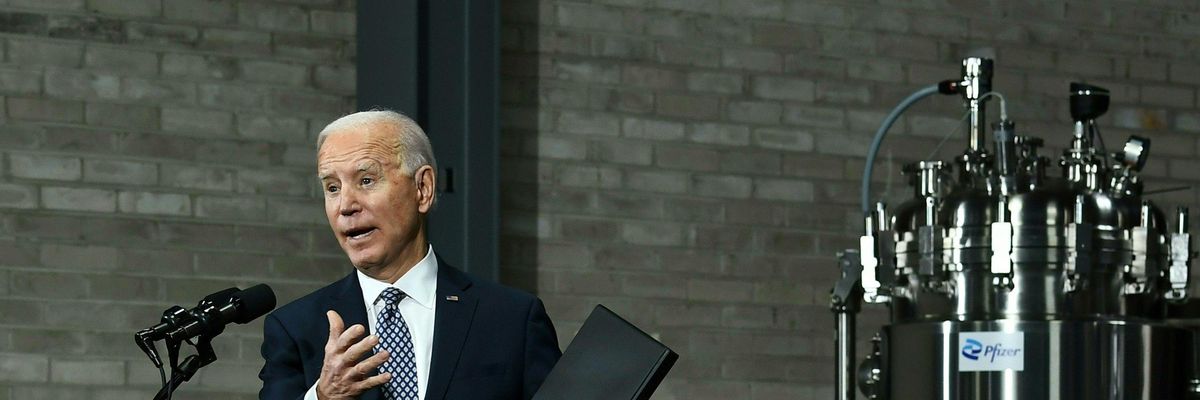
President Joe Biden speaks at the Pfizer Kalamazoo Manufacturing Site on February 19, 2021 in Portage, Michigan. (Photo: Brendan Smialowski/AFP via Getty Images)
Instead of fully handing the production of taxpayer-funded coronavirus vaccines over to private companies motivated by profit--an approach that experts say has failed disastrously thus far--the Biden administration should keep all new domestic manufacturing capacity under government ownership to ensure that public health needs are prioritized over corporate interests.
"A public facility would give the government freedom to make decisions regarding supply, price, and global cooperation."
That's the central argument of a report published Tuesday by PrEP4All, Public Citizen, and Partners In Health, advocacy groups that for months have been pressuring President Joe Biden to retain public control of mRNA vaccine manufacturing.
Last week, the White House outlined a new plan to expand U.S. vaccine production capacity in order to make an additional billion vaccine doses each year--a proposal that gave the progressive trio a fresh opportunity to double down on its demand for public ownership.
"The U.S. has lost trillions of dollars and nearly a million lives to a pandemic, but still does not have the capacity to rapidly respond to new threats with new technologies," Peter Maybarduk, access to medicines director at Public Citizen, said in a statement Tuesday. "A public facility would give the government freedom to make decisions regarding supply, price, and global cooperation."
"The alternative," added Maybarduk, "is to repeat early pandemic mistakes and allow pharmaceutical corporations to make these life-and-death decisions, controlling in secrecy the publicly-funded medical tools needed to end pandemics."
In their new report, PrEP4All, Public Citizen, and Partners In Health make the case for organizing all future coronavirus vaccine manufacturing under the so-called government-owned, contractor-operated (GOCO) model, an alternative to an approach under which production facilities are both contractor-owned and contractor-operated.
"GOCOs have historically been used to manufacture some of the most complex technology ever produced. For example, America's arsenal of nuclear weapons are produced completely by GOCOs," the groups note. "The U.S. government even uses the GOCO model already to produce vaccines."
The fact that the GOCO model is already widely used by the federal government, the groups argue, "reflects its inherent structural advantages over other models of public-private cooperation, especially in the context of manufacturing technologies."
"Scale-up of manufacturing for complex technologies is necessarily capital intensive and requires hundreds of millions of taxpayer dollars. Often, the federal government does not have the skills required to operate manufacturing facilities," the report notes. "However, simply giving away taxpayer money to a private corporation to build a capital asset that the government does not own or control necessarily leaves the government in a vulnerable position. In such a scenario, the private corporation then owns the asset funded with taxpayer dollars, and can use this asset for other purposes or even leave the business entirely."
"The Biden administration's current approach to building additional mRNA vaccine capacity... is deeply flawed."
"The GOCO model," the report continues, "ensures that the taxpayer-funded capital asset will be operated for the purposes the government intends while simultaneously leveraging skillsets of private industry to ensure rapid, efficient, and cost-effective achievement of the government's goals."
The new report was released as experts continue to raise concerns that Covid-19 vaccine manufacturing--which is currently monopolized by private companies such as Pfizer and Moderna--is lagging well behind global needs as the virus continues to spread and kill thousands of people across the globe each day.
Some experts estimate that the world needs 22 billion additional mRNA vaccine doses to overcome the pandemic, which has killed at least 6 million people over a two-year span.
James Krellenstein, executive director of PrEP4All, said Tuesday that "the Biden administration's current approach to building additional mRNA vaccine capacity--critical to this nation's biosecurity--is deeply flawed."
"Simply investing taxpayer dollars into facilities that government neither owns nor can directly oversee will repeat the same mistakes that have plagued the U.S. government's pandemic preparedness efforts for 30 years," Krellenstein added. "It didn't work when the Obama administration invested hundreds of millions of dollars in Emergent, and it didn't work when the Biden administration invested over $100 million in Merck. How much taxpayer money does this administration need to waste before it learns its lesson?"
Dear Common Dreams reader, It’s been nearly 30 years since I co-founded Common Dreams with my late wife, Lina Newhouser. We had the radical notion that journalism should serve the public good, not corporate profits. It was clear to us from the outset what it would take to build such a project. No paid advertisements. No corporate sponsors. No millionaire publisher telling us what to think or do. Many people said we wouldn't last a year, but we proved those doubters wrong. Together with a tremendous team of journalists and dedicated staff, we built an independent media outlet free from the constraints of profits and corporate control. Our mission has always been simple: To inform. To inspire. To ignite change for the common good. Building Common Dreams was not easy. Our survival was never guaranteed. When you take on the most powerful forces—Wall Street greed, fossil fuel industry destruction, Big Tech lobbyists, and uber-rich oligarchs who have spent billions upon billions rigging the economy and democracy in their favor—the only bulwark you have is supporters who believe in your work. But here’s the urgent message from me today. It's never been this bad out there. And it's never been this hard to keep us going. At the very moment Common Dreams is most needed, the threats we face are intensifying. We need your support now more than ever. We don't accept corporate advertising and never will. We don't have a paywall because we don't think people should be blocked from critical news based on their ability to pay. Everything we do is funded by the donations of readers like you. When everyone does the little they can afford, we are strong. But if that support retreats or dries up, so do we. Will you donate now to make sure Common Dreams not only survives but thrives? —Craig Brown, Co-founder |
Instead of fully handing the production of taxpayer-funded coronavirus vaccines over to private companies motivated by profit--an approach that experts say has failed disastrously thus far--the Biden administration should keep all new domestic manufacturing capacity under government ownership to ensure that public health needs are prioritized over corporate interests.
"A public facility would give the government freedom to make decisions regarding supply, price, and global cooperation."
That's the central argument of a report published Tuesday by PrEP4All, Public Citizen, and Partners In Health, advocacy groups that for months have been pressuring President Joe Biden to retain public control of mRNA vaccine manufacturing.
Last week, the White House outlined a new plan to expand U.S. vaccine production capacity in order to make an additional billion vaccine doses each year--a proposal that gave the progressive trio a fresh opportunity to double down on its demand for public ownership.
"The U.S. has lost trillions of dollars and nearly a million lives to a pandemic, but still does not have the capacity to rapidly respond to new threats with new technologies," Peter Maybarduk, access to medicines director at Public Citizen, said in a statement Tuesday. "A public facility would give the government freedom to make decisions regarding supply, price, and global cooperation."
"The alternative," added Maybarduk, "is to repeat early pandemic mistakes and allow pharmaceutical corporations to make these life-and-death decisions, controlling in secrecy the publicly-funded medical tools needed to end pandemics."
In their new report, PrEP4All, Public Citizen, and Partners In Health make the case for organizing all future coronavirus vaccine manufacturing under the so-called government-owned, contractor-operated (GOCO) model, an alternative to an approach under which production facilities are both contractor-owned and contractor-operated.
"GOCOs have historically been used to manufacture some of the most complex technology ever produced. For example, America's arsenal of nuclear weapons are produced completely by GOCOs," the groups note. "The U.S. government even uses the GOCO model already to produce vaccines."
The fact that the GOCO model is already widely used by the federal government, the groups argue, "reflects its inherent structural advantages over other models of public-private cooperation, especially in the context of manufacturing technologies."
"Scale-up of manufacturing for complex technologies is necessarily capital intensive and requires hundreds of millions of taxpayer dollars. Often, the federal government does not have the skills required to operate manufacturing facilities," the report notes. "However, simply giving away taxpayer money to a private corporation to build a capital asset that the government does not own or control necessarily leaves the government in a vulnerable position. In such a scenario, the private corporation then owns the asset funded with taxpayer dollars, and can use this asset for other purposes or even leave the business entirely."
"The Biden administration's current approach to building additional mRNA vaccine capacity... is deeply flawed."
"The GOCO model," the report continues, "ensures that the taxpayer-funded capital asset will be operated for the purposes the government intends while simultaneously leveraging skillsets of private industry to ensure rapid, efficient, and cost-effective achievement of the government's goals."
The new report was released as experts continue to raise concerns that Covid-19 vaccine manufacturing--which is currently monopolized by private companies such as Pfizer and Moderna--is lagging well behind global needs as the virus continues to spread and kill thousands of people across the globe each day.
Some experts estimate that the world needs 22 billion additional mRNA vaccine doses to overcome the pandemic, which has killed at least 6 million people over a two-year span.
James Krellenstein, executive director of PrEP4All, said Tuesday that "the Biden administration's current approach to building additional mRNA vaccine capacity--critical to this nation's biosecurity--is deeply flawed."
"Simply investing taxpayer dollars into facilities that government neither owns nor can directly oversee will repeat the same mistakes that have plagued the U.S. government's pandemic preparedness efforts for 30 years," Krellenstein added. "It didn't work when the Obama administration invested hundreds of millions of dollars in Emergent, and it didn't work when the Biden administration invested over $100 million in Merck. How much taxpayer money does this administration need to waste before it learns its lesson?"
Instead of fully handing the production of taxpayer-funded coronavirus vaccines over to private companies motivated by profit--an approach that experts say has failed disastrously thus far--the Biden administration should keep all new domestic manufacturing capacity under government ownership to ensure that public health needs are prioritized over corporate interests.
"A public facility would give the government freedom to make decisions regarding supply, price, and global cooperation."
That's the central argument of a report published Tuesday by PrEP4All, Public Citizen, and Partners In Health, advocacy groups that for months have been pressuring President Joe Biden to retain public control of mRNA vaccine manufacturing.
Last week, the White House outlined a new plan to expand U.S. vaccine production capacity in order to make an additional billion vaccine doses each year--a proposal that gave the progressive trio a fresh opportunity to double down on its demand for public ownership.
"The U.S. has lost trillions of dollars and nearly a million lives to a pandemic, but still does not have the capacity to rapidly respond to new threats with new technologies," Peter Maybarduk, access to medicines director at Public Citizen, said in a statement Tuesday. "A public facility would give the government freedom to make decisions regarding supply, price, and global cooperation."
"The alternative," added Maybarduk, "is to repeat early pandemic mistakes and allow pharmaceutical corporations to make these life-and-death decisions, controlling in secrecy the publicly-funded medical tools needed to end pandemics."
In their new report, PrEP4All, Public Citizen, and Partners In Health make the case for organizing all future coronavirus vaccine manufacturing under the so-called government-owned, contractor-operated (GOCO) model, an alternative to an approach under which production facilities are both contractor-owned and contractor-operated.
"GOCOs have historically been used to manufacture some of the most complex technology ever produced. For example, America's arsenal of nuclear weapons are produced completely by GOCOs," the groups note. "The U.S. government even uses the GOCO model already to produce vaccines."
The fact that the GOCO model is already widely used by the federal government, the groups argue, "reflects its inherent structural advantages over other models of public-private cooperation, especially in the context of manufacturing technologies."
"Scale-up of manufacturing for complex technologies is necessarily capital intensive and requires hundreds of millions of taxpayer dollars. Often, the federal government does not have the skills required to operate manufacturing facilities," the report notes. "However, simply giving away taxpayer money to a private corporation to build a capital asset that the government does not own or control necessarily leaves the government in a vulnerable position. In such a scenario, the private corporation then owns the asset funded with taxpayer dollars, and can use this asset for other purposes or even leave the business entirely."
"The Biden administration's current approach to building additional mRNA vaccine capacity... is deeply flawed."
"The GOCO model," the report continues, "ensures that the taxpayer-funded capital asset will be operated for the purposes the government intends while simultaneously leveraging skillsets of private industry to ensure rapid, efficient, and cost-effective achievement of the government's goals."
The new report was released as experts continue to raise concerns that Covid-19 vaccine manufacturing--which is currently monopolized by private companies such as Pfizer and Moderna--is lagging well behind global needs as the virus continues to spread and kill thousands of people across the globe each day.
Some experts estimate that the world needs 22 billion additional mRNA vaccine doses to overcome the pandemic, which has killed at least 6 million people over a two-year span.
James Krellenstein, executive director of PrEP4All, said Tuesday that "the Biden administration's current approach to building additional mRNA vaccine capacity--critical to this nation's biosecurity--is deeply flawed."
"Simply investing taxpayer dollars into facilities that government neither owns nor can directly oversee will repeat the same mistakes that have plagued the U.S. government's pandemic preparedness efforts for 30 years," Krellenstein added. "It didn't work when the Obama administration invested hundreds of millions of dollars in Emergent, and it didn't work when the Biden administration invested over $100 million in Merck. How much taxpayer money does this administration need to waste before it learns its lesson?"

