SUBSCRIBE TO OUR FREE NEWSLETTER
Daily news & progressive opinion—funded by the people, not the corporations—delivered straight to your inbox.
5
#000000
#FFFFFF
To donate by check, phone, or other method, see our More Ways to Give page.
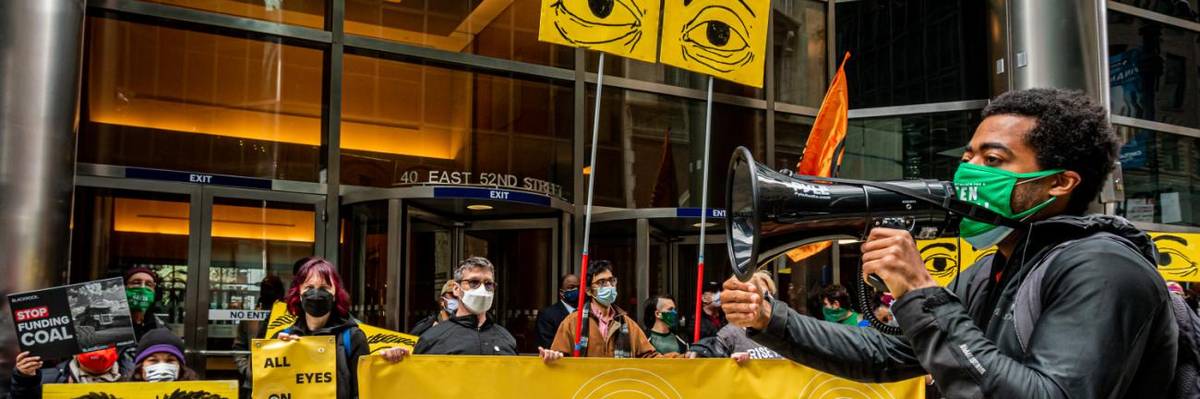
Even as it continues to hold billions of dollars in fossil fuel investments, the world's largest asset manager on Thursday told its clients that a transition to a post-carbon economy is inevitable, and that the company will work to ensure that they profit from it.
" BlackRock is not setting itself up for a successful transition unless it explicitly includes exclusion criteria on fossil fuel expansion, and recalibrates how it measures success within a sector."
In its annual letter to clients, BlackRock, which manages more than $9 trillion in assets, stressed that "the issue... is no longer whether the net-zero transition will happen but how--and what that means for your portfolio."
BlackRock's affirmation--which comes despite the company holding tens of billions of dollars in fossil fuel investments, including more than $1.5 billion in direct sector investments--was welcomed by climate and environmental campaigners, with caveats.
Amazon Watch climate and finance director Moira Birss said that "BlackRock crossed a big hurdle today: It finally acknowledged that a global transition to a decarbonized economy is underway, and began telling clients that they must navigate this transition."
Ben Cushing, fossil-free finance campaign manager at Sierra Club, said in a statement that "BlackRock is making it clearer than ever that the transition to a clean energy economy is inevitable, and the key questions are how fast we will progress and which businesses will fail to seize the opportunities that lie ahead."
"Achieving this necessary shift in thinking in the financial world was hard," he added. "What comes next will be even harder."
In a report accompanying the letter, BlackRock acknowledged that "the transition to decarbonize the world is happening," and that "ignoring the transition is no longer an option."
"Understanding how the journey will unfold in years to come has never been more important for companies and investors alike," the company asserted.
The report continued:
On top of physical climate risks, companies and asset owners must now grapple with the transition. Economies will be reshaped as carbon emissions are cut. The transition will involve a massive reallocation of resources. Supply and demand will shift, with mismatches along the way. Value will be created and destroyed across companies.
Companies must decide how to revamp their business models, where to invest and what operations to phase out. Asset owners must decide where to put capital to work, and how to use their shareholder votes to try to guard their long-term economic interests.
Despite BlackRock CEO Larry Fink's purported commitment to climate leadership, the firm remains one of the world's leading fossil fuel investors, and Fink opposes hydrocarbon divestment. According to BlackRock's own estimate, companies in the firm's portfolio released more than 330 million tons of greenhouse gases into the atmosphere in 2020--the equivalent of the annual emissions generated by 71 million automobiles.
Related Content

Birss said that "what BlackRock needs to confront next is the fact that the decarbonization it recognizes is needed can't happen without clear guardrails for the specific activities--including the expansion of oil and gas production and of deforestation-risk commodities--that will prevent us from achieving the Paris goal of limiting global warming to 1.5degC."
While acknowledging that BlackRock "has raised the bar for its clients, establishing the expectation that at a minimum, investors have to navigate the massive economic transition that the climate crisis necessitates," Sunrise Project senior strategist Casey Harrell said in a statement that "BlackRock is not setting itself up for a successful transition unless it explicitly includes exclusion criteria on fossil fuel expansion, and recalibrates how it measures success within a sector."
"If BlackRock is to successfully drive the energy transition in line with what climate science says is necessary," added Harrell, "it will have to face these details."
Even as it continues to hold billions of dollars in fossil fuel investments, the world's largest asset manager on Thursday told its clients that a transition to a post-carbon economy is inevitable, and that the company will work to ensure that they profit from it.
" BlackRock is not setting itself up for a successful transition unless it explicitly includes exclusion criteria on fossil fuel expansion, and recalibrates how it measures success within a sector."
In its annual letter to clients, BlackRock, which manages more than $9 trillion in assets, stressed that "the issue... is no longer whether the net-zero transition will happen but how--and what that means for your portfolio."
BlackRock's affirmation--which comes despite the company holding tens of billions of dollars in fossil fuel investments, including more than $1.5 billion in direct sector investments--was welcomed by climate and environmental campaigners, with caveats.
Amazon Watch climate and finance director Moira Birss said that "BlackRock crossed a big hurdle today: It finally acknowledged that a global transition to a decarbonized economy is underway, and began telling clients that they must navigate this transition."
Ben Cushing, fossil-free finance campaign manager at Sierra Club, said in a statement that "BlackRock is making it clearer than ever that the transition to a clean energy economy is inevitable, and the key questions are how fast we will progress and which businesses will fail to seize the opportunities that lie ahead."
"Achieving this necessary shift in thinking in the financial world was hard," he added. "What comes next will be even harder."
In a report accompanying the letter, BlackRock acknowledged that "the transition to decarbonize the world is happening," and that "ignoring the transition is no longer an option."
"Understanding how the journey will unfold in years to come has never been more important for companies and investors alike," the company asserted.
The report continued:
On top of physical climate risks, companies and asset owners must now grapple with the transition. Economies will be reshaped as carbon emissions are cut. The transition will involve a massive reallocation of resources. Supply and demand will shift, with mismatches along the way. Value will be created and destroyed across companies.
Companies must decide how to revamp their business models, where to invest and what operations to phase out. Asset owners must decide where to put capital to work, and how to use their shareholder votes to try to guard their long-term economic interests.
Despite BlackRock CEO Larry Fink's purported commitment to climate leadership, the firm remains one of the world's leading fossil fuel investors, and Fink opposes hydrocarbon divestment. According to BlackRock's own estimate, companies in the firm's portfolio released more than 330 million tons of greenhouse gases into the atmosphere in 2020--the equivalent of the annual emissions generated by 71 million automobiles.
Related Content
Birss said that "what BlackRock needs to confront next is the fact that the decarbonization it recognizes is needed can't happen without clear guardrails for the specific activities--including the expansion of oil and gas production and of deforestation-risk commodities--that will prevent us from achieving the Paris goal of limiting global warming to 1.5degC."
While acknowledging that BlackRock "has raised the bar for its clients, establishing the expectation that at a minimum, investors have to navigate the massive economic transition that the climate crisis necessitates," Sunrise Project senior strategist Casey Harrell said in a statement that "BlackRock is not setting itself up for a successful transition unless it explicitly includes exclusion criteria on fossil fuel expansion, and recalibrates how it measures success within a sector."
"If BlackRock is to successfully drive the energy transition in line with what climate science says is necessary," added Harrell, "it will have to face these details."
Even as it continues to hold billions of dollars in fossil fuel investments, the world's largest asset manager on Thursday told its clients that a transition to a post-carbon economy is inevitable, and that the company will work to ensure that they profit from it.
" BlackRock is not setting itself up for a successful transition unless it explicitly includes exclusion criteria on fossil fuel expansion, and recalibrates how it measures success within a sector."
In its annual letter to clients, BlackRock, which manages more than $9 trillion in assets, stressed that "the issue... is no longer whether the net-zero transition will happen but how--and what that means for your portfolio."
BlackRock's affirmation--which comes despite the company holding tens of billions of dollars in fossil fuel investments, including more than $1.5 billion in direct sector investments--was welcomed by climate and environmental campaigners, with caveats.
Amazon Watch climate and finance director Moira Birss said that "BlackRock crossed a big hurdle today: It finally acknowledged that a global transition to a decarbonized economy is underway, and began telling clients that they must navigate this transition."
Ben Cushing, fossil-free finance campaign manager at Sierra Club, said in a statement that "BlackRock is making it clearer than ever that the transition to a clean energy economy is inevitable, and the key questions are how fast we will progress and which businesses will fail to seize the opportunities that lie ahead."
"Achieving this necessary shift in thinking in the financial world was hard," he added. "What comes next will be even harder."
In a report accompanying the letter, BlackRock acknowledged that "the transition to decarbonize the world is happening," and that "ignoring the transition is no longer an option."
"Understanding how the journey will unfold in years to come has never been more important for companies and investors alike," the company asserted.
The report continued:
On top of physical climate risks, companies and asset owners must now grapple with the transition. Economies will be reshaped as carbon emissions are cut. The transition will involve a massive reallocation of resources. Supply and demand will shift, with mismatches along the way. Value will be created and destroyed across companies.
Companies must decide how to revamp their business models, where to invest and what operations to phase out. Asset owners must decide where to put capital to work, and how to use their shareholder votes to try to guard their long-term economic interests.
Despite BlackRock CEO Larry Fink's purported commitment to climate leadership, the firm remains one of the world's leading fossil fuel investors, and Fink opposes hydrocarbon divestment. According to BlackRock's own estimate, companies in the firm's portfolio released more than 330 million tons of greenhouse gases into the atmosphere in 2020--the equivalent of the annual emissions generated by 71 million automobiles.
Related Content
Birss said that "what BlackRock needs to confront next is the fact that the decarbonization it recognizes is needed can't happen without clear guardrails for the specific activities--including the expansion of oil and gas production and of deforestation-risk commodities--that will prevent us from achieving the Paris goal of limiting global warming to 1.5degC."
While acknowledging that BlackRock "has raised the bar for its clients, establishing the expectation that at a minimum, investors have to navigate the massive economic transition that the climate crisis necessitates," Sunrise Project senior strategist Casey Harrell said in a statement that "BlackRock is not setting itself up for a successful transition unless it explicitly includes exclusion criteria on fossil fuel expansion, and recalibrates how it measures success within a sector."
"If BlackRock is to successfully drive the energy transition in line with what climate science says is necessary," added Harrell, "it will have to face these details."