SUBSCRIBE TO OUR FREE NEWSLETTER
Daily news & progressive opinion—funded by the people, not the corporations—delivered straight to your inbox.
5
#000000
#FFFFFF
To donate by check, phone, or other method, see our More Ways to Give page.
Daily news & progressive opinion—funded by the people, not the corporations—delivered straight to your inbox.
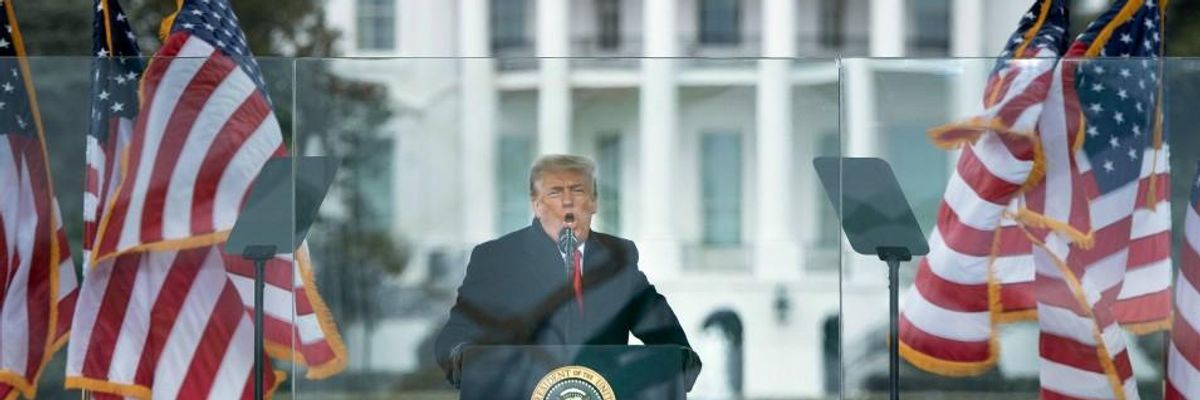
Then-President Donald Trump spoke at a rally on January 6, 2021 in Washington, D.C. (Photo: Tasos Katopodis/Getty Images)
The U.S. Supreme Court on Wednesday denied former President Donald Trump's attempt to block the release of White House records to a House of Representatives panel investigating last year's deadly Capitol attack.
The high court's 8-1 decision--Justice Clarence Thomas dissented--clears the way for the National Archives to share over 700 documents with the House Select Committee to Investigate the January 6th Attack on the United States Capitol.
"A huge win for transparency!" Citizens for Responsibility and Ethics in Washington (CREW) declared of the decision, which the government watchdog group shared on Twitter.
CREW president Noah Bookbinder similarly described the development as "hugely significant for accountability."
According to CNN:
The documents include activity logs, schedules, speech notes, and three pages of handwritten notes from then-White House chief of staff Mark Meadows--paperwork that could reveal goings-on inside the West Wing as Trump supporters gathered in Washington and then overran the Capitol, disrupting the certification of the 2020 vote.
Trump is also seeking to keep secret a draft proclamation honoring two police officers who died in the siege and memos and other documents about supposed election fraud and efforts to overturn Trump's loss of the presidency, the National Archives has said in court documents.
The House committee wants the records to better understand Trump's role in the January 6 attack. The former president's "Big Lie" about the 2020 election, including at a rally just before a mob of his supporters stormed the Capitol, led to Trump's historic second impeachment.
The panel had warned the high court that granting Trump's request "would cause irreparable harm to the select committee by denying it the records it urgently needs to inform its ongoing investigation, including upcoming interviews of scores of witnesses."
While Trump tried to use executive privilege to prevent the documents from reaching the panel, President Joe Biden declined to invoke the same doctrine, concluding that doing so "is not in the best interests of the United States."
Justice Brett Kavanaugh concurred with the majority opinion on Wednesday but also made clear that he disagrees with a federal appeals court's suggestion that a former president may not invoke privilege for communications during their tenure if the current president does not support the claim--though the Trump appointee added that allowing ex-leaders to use the power does not mean that it "is absolute or cannot be overcome."
Dear Common Dreams reader, It’s been nearly 30 years since I co-founded Common Dreams with my late wife, Lina Newhouser. We had the radical notion that journalism should serve the public good, not corporate profits. It was clear to us from the outset what it would take to build such a project. No paid advertisements. No corporate sponsors. No millionaire publisher telling us what to think or do. Many people said we wouldn't last a year, but we proved those doubters wrong. Together with a tremendous team of journalists and dedicated staff, we built an independent media outlet free from the constraints of profits and corporate control. Our mission has always been simple: To inform. To inspire. To ignite change for the common good. Building Common Dreams was not easy. Our survival was never guaranteed. When you take on the most powerful forces—Wall Street greed, fossil fuel industry destruction, Big Tech lobbyists, and uber-rich oligarchs who have spent billions upon billions rigging the economy and democracy in their favor—the only bulwark you have is supporters who believe in your work. But here’s the urgent message from me today. It's never been this bad out there. And it's never been this hard to keep us going. At the very moment Common Dreams is most needed, the threats we face are intensifying. We need your support now more than ever. We don't accept corporate advertising and never will. We don't have a paywall because we don't think people should be blocked from critical news based on their ability to pay. Everything we do is funded by the donations of readers like you. When everyone does the little they can afford, we are strong. But if that support retreats or dries up, so do we. Will you donate now to make sure Common Dreams not only survives but thrives? —Craig Brown, Co-founder |
The U.S. Supreme Court on Wednesday denied former President Donald Trump's attempt to block the release of White House records to a House of Representatives panel investigating last year's deadly Capitol attack.
The high court's 8-1 decision--Justice Clarence Thomas dissented--clears the way for the National Archives to share over 700 documents with the House Select Committee to Investigate the January 6th Attack on the United States Capitol.
"A huge win for transparency!" Citizens for Responsibility and Ethics in Washington (CREW) declared of the decision, which the government watchdog group shared on Twitter.
CREW president Noah Bookbinder similarly described the development as "hugely significant for accountability."
According to CNN:
The documents include activity logs, schedules, speech notes, and three pages of handwritten notes from then-White House chief of staff Mark Meadows--paperwork that could reveal goings-on inside the West Wing as Trump supporters gathered in Washington and then overran the Capitol, disrupting the certification of the 2020 vote.
Trump is also seeking to keep secret a draft proclamation honoring two police officers who died in the siege and memos and other documents about supposed election fraud and efforts to overturn Trump's loss of the presidency, the National Archives has said in court documents.
The House committee wants the records to better understand Trump's role in the January 6 attack. The former president's "Big Lie" about the 2020 election, including at a rally just before a mob of his supporters stormed the Capitol, led to Trump's historic second impeachment.
The panel had warned the high court that granting Trump's request "would cause irreparable harm to the select committee by denying it the records it urgently needs to inform its ongoing investigation, including upcoming interviews of scores of witnesses."
While Trump tried to use executive privilege to prevent the documents from reaching the panel, President Joe Biden declined to invoke the same doctrine, concluding that doing so "is not in the best interests of the United States."
Justice Brett Kavanaugh concurred with the majority opinion on Wednesday but also made clear that he disagrees with a federal appeals court's suggestion that a former president may not invoke privilege for communications during their tenure if the current president does not support the claim--though the Trump appointee added that allowing ex-leaders to use the power does not mean that it "is absolute or cannot be overcome."
The U.S. Supreme Court on Wednesday denied former President Donald Trump's attempt to block the release of White House records to a House of Representatives panel investigating last year's deadly Capitol attack.
The high court's 8-1 decision--Justice Clarence Thomas dissented--clears the way for the National Archives to share over 700 documents with the House Select Committee to Investigate the January 6th Attack on the United States Capitol.
"A huge win for transparency!" Citizens for Responsibility and Ethics in Washington (CREW) declared of the decision, which the government watchdog group shared on Twitter.
CREW president Noah Bookbinder similarly described the development as "hugely significant for accountability."
According to CNN:
The documents include activity logs, schedules, speech notes, and three pages of handwritten notes from then-White House chief of staff Mark Meadows--paperwork that could reveal goings-on inside the West Wing as Trump supporters gathered in Washington and then overran the Capitol, disrupting the certification of the 2020 vote.
Trump is also seeking to keep secret a draft proclamation honoring two police officers who died in the siege and memos and other documents about supposed election fraud and efforts to overturn Trump's loss of the presidency, the National Archives has said in court documents.
The House committee wants the records to better understand Trump's role in the January 6 attack. The former president's "Big Lie" about the 2020 election, including at a rally just before a mob of his supporters stormed the Capitol, led to Trump's historic second impeachment.
The panel had warned the high court that granting Trump's request "would cause irreparable harm to the select committee by denying it the records it urgently needs to inform its ongoing investigation, including upcoming interviews of scores of witnesses."
While Trump tried to use executive privilege to prevent the documents from reaching the panel, President Joe Biden declined to invoke the same doctrine, concluding that doing so "is not in the best interests of the United States."
Justice Brett Kavanaugh concurred with the majority opinion on Wednesday but also made clear that he disagrees with a federal appeals court's suggestion that a former president may not invoke privilege for communications during their tenure if the current president does not support the claim--though the Trump appointee added that allowing ex-leaders to use the power does not mean that it "is absolute or cannot be overcome."