SUBSCRIBE TO OUR FREE NEWSLETTER
Daily news & progressive opinion—funded by the people, not the corporations—delivered straight to your inbox.
5
#000000
#FFFFFF
To donate by check, phone, or other method, see our More Ways to Give page.
Daily news & progressive opinion—funded by the people, not the corporations—delivered straight to your inbox.
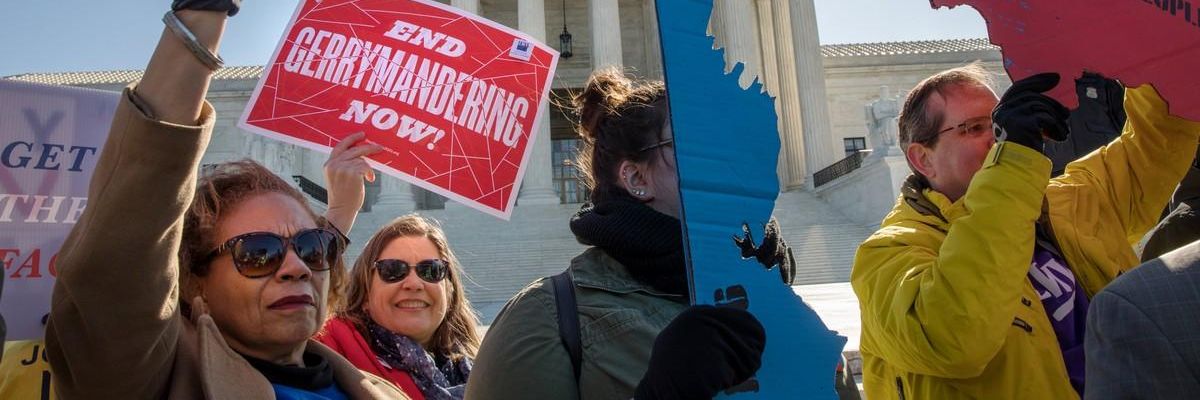
Demonstrators protest against gerrymandering at a rally in front of the U.S. Supreme Court on March 26, 2019, during the cases Lamone v. Benisek and Rucho v. Common Cause. (Photo: Evelyn Hockstein/Washington Post via Getty Images)
Democracy defenders on Wednesday cheered a ruling by the Ohio Supreme Court that invalidated Republican-drawn state legislative district maps, which a majority of the justices found were unconstitutionally gerrymandered against the will of the state's voters.
"The General Assembly maps entrenched a GOP supermajority and flouted clear partisan fairness requirements in the Ohio constitution."
In a 4-3 decision, the justices ordered the maps redrawn, as the GOP-controlled Ohio Redistricting Commission failed to "draw legislative districts that correspond with the statewide voter preference of Ohioans."
The commission now has 10 days to come up with a new plan that is constitutional.
"Ohioans voted for fair maps," former Ohio state senator and U.S. congressional candidate Nina Turner tweeted in response to the ruling.
"I applaud the decision of the Ohio Supreme Court to uphold the law and strike down these maps," she added.
"Ohio voters have demanded an end to political gerrymandering time and time again," the ACLU tweeted in response to the ruling. "Gerrymandering disproportionately affects minority voters and this decision ensures that people--especially people of color--can have a voice in our government."
"Politicians do not get to choose their voters," the group added. "We the voters get to choose our politicians."
Alicia Bannon, director of the Judiciary Program at the Brennan Center for Justice, said in a statement welcoming the ruling that "today the Ohio Supreme Court held the Ohio Redistricting Commission accountable to the constitution."
Bannon added that "the General Assembly maps entrenched a GOP supermajority and flouted clear partisan fairness requirements in the Ohio constitution--abuses that especially impacted Ohio's Black, Muslim, and immigrant communities. The commission is now tasked with drawing replacement maps."
"We will be watching to ensure that all Ohioans get the fair representation they are due," she vowed.
The Ohio decision comes a day after a three-judge panel in North Carolina ruled that Republicans' newly drawn political districts--which will give the GOP an edge in future elections--do not violate the state's constitution. The judges asserted that "redistricting is an inherently political process" that does "not impinge on the right to vote."
Last month, civil rights groups sued South Carolina's Republican governor, as well as state legislative and elections leaders, to challenge the state's new redistricting law.
The groups say gerrymandered state House maps intentionally discriminate against Black voters by "packing" them into the same district to minimize their power in surrounding areas and by "cracking," or splitting, communities of color to dilute their power.
Dear Common Dreams reader, It’s been nearly 30 years since I co-founded Common Dreams with my late wife, Lina Newhouser. We had the radical notion that journalism should serve the public good, not corporate profits. It was clear to us from the outset what it would take to build such a project. No paid advertisements. No corporate sponsors. No millionaire publisher telling us what to think or do. Many people said we wouldn't last a year, but we proved those doubters wrong. Together with a tremendous team of journalists and dedicated staff, we built an independent media outlet free from the constraints of profits and corporate control. Our mission has always been simple: To inform. To inspire. To ignite change for the common good. Building Common Dreams was not easy. Our survival was never guaranteed. When you take on the most powerful forces—Wall Street greed, fossil fuel industry destruction, Big Tech lobbyists, and uber-rich oligarchs who have spent billions upon billions rigging the economy and democracy in their favor—the only bulwark you have is supporters who believe in your work. But here’s the urgent message from me today. It's never been this bad out there. And it's never been this hard to keep us going. At the very moment Common Dreams is most needed, the threats we face are intensifying. We need your support now more than ever. We don't accept corporate advertising and never will. We don't have a paywall because we don't think people should be blocked from critical news based on their ability to pay. Everything we do is funded by the donations of readers like you. When everyone does the little they can afford, we are strong. But if that support retreats or dries up, so do we. Will you donate now to make sure Common Dreams not only survives but thrives? —Craig Brown, Co-founder |
Democracy defenders on Wednesday cheered a ruling by the Ohio Supreme Court that invalidated Republican-drawn state legislative district maps, which a majority of the justices found were unconstitutionally gerrymandered against the will of the state's voters.
"The General Assembly maps entrenched a GOP supermajority and flouted clear partisan fairness requirements in the Ohio constitution."
In a 4-3 decision, the justices ordered the maps redrawn, as the GOP-controlled Ohio Redistricting Commission failed to "draw legislative districts that correspond with the statewide voter preference of Ohioans."
The commission now has 10 days to come up with a new plan that is constitutional.
"Ohioans voted for fair maps," former Ohio state senator and U.S. congressional candidate Nina Turner tweeted in response to the ruling.
"I applaud the decision of the Ohio Supreme Court to uphold the law and strike down these maps," she added.
"Ohio voters have demanded an end to political gerrymandering time and time again," the ACLU tweeted in response to the ruling. "Gerrymandering disproportionately affects minority voters and this decision ensures that people--especially people of color--can have a voice in our government."
"Politicians do not get to choose their voters," the group added. "We the voters get to choose our politicians."
Alicia Bannon, director of the Judiciary Program at the Brennan Center for Justice, said in a statement welcoming the ruling that "today the Ohio Supreme Court held the Ohio Redistricting Commission accountable to the constitution."
Bannon added that "the General Assembly maps entrenched a GOP supermajority and flouted clear partisan fairness requirements in the Ohio constitution--abuses that especially impacted Ohio's Black, Muslim, and immigrant communities. The commission is now tasked with drawing replacement maps."
"We will be watching to ensure that all Ohioans get the fair representation they are due," she vowed.
The Ohio decision comes a day after a three-judge panel in North Carolina ruled that Republicans' newly drawn political districts--which will give the GOP an edge in future elections--do not violate the state's constitution. The judges asserted that "redistricting is an inherently political process" that does "not impinge on the right to vote."
Last month, civil rights groups sued South Carolina's Republican governor, as well as state legislative and elections leaders, to challenge the state's new redistricting law.
The groups say gerrymandered state House maps intentionally discriminate against Black voters by "packing" them into the same district to minimize their power in surrounding areas and by "cracking," or splitting, communities of color to dilute their power.
Democracy defenders on Wednesday cheered a ruling by the Ohio Supreme Court that invalidated Republican-drawn state legislative district maps, which a majority of the justices found were unconstitutionally gerrymandered against the will of the state's voters.
"The General Assembly maps entrenched a GOP supermajority and flouted clear partisan fairness requirements in the Ohio constitution."
In a 4-3 decision, the justices ordered the maps redrawn, as the GOP-controlled Ohio Redistricting Commission failed to "draw legislative districts that correspond with the statewide voter preference of Ohioans."
The commission now has 10 days to come up with a new plan that is constitutional.
"Ohioans voted for fair maps," former Ohio state senator and U.S. congressional candidate Nina Turner tweeted in response to the ruling.
"I applaud the decision of the Ohio Supreme Court to uphold the law and strike down these maps," she added.
"Ohio voters have demanded an end to political gerrymandering time and time again," the ACLU tweeted in response to the ruling. "Gerrymandering disproportionately affects minority voters and this decision ensures that people--especially people of color--can have a voice in our government."
"Politicians do not get to choose their voters," the group added. "We the voters get to choose our politicians."
Alicia Bannon, director of the Judiciary Program at the Brennan Center for Justice, said in a statement welcoming the ruling that "today the Ohio Supreme Court held the Ohio Redistricting Commission accountable to the constitution."
Bannon added that "the General Assembly maps entrenched a GOP supermajority and flouted clear partisan fairness requirements in the Ohio constitution--abuses that especially impacted Ohio's Black, Muslim, and immigrant communities. The commission is now tasked with drawing replacement maps."
"We will be watching to ensure that all Ohioans get the fair representation they are due," she vowed.
The Ohio decision comes a day after a three-judge panel in North Carolina ruled that Republicans' newly drawn political districts--which will give the GOP an edge in future elections--do not violate the state's constitution. The judges asserted that "redistricting is an inherently political process" that does "not impinge on the right to vote."
Last month, civil rights groups sued South Carolina's Republican governor, as well as state legislative and elections leaders, to challenge the state's new redistricting law.
The groups say gerrymandered state House maps intentionally discriminate against Black voters by "packing" them into the same district to minimize their power in surrounding areas and by "cracking," or splitting, communities of color to dilute their power.