

SUBSCRIBE TO OUR FREE NEWSLETTER
Daily news & progressive opinion—funded by the people, not the corporations—delivered straight to your inbox.
5
#000000
#FFFFFF
To donate by check, phone, or other method, see our More Ways to Give page.
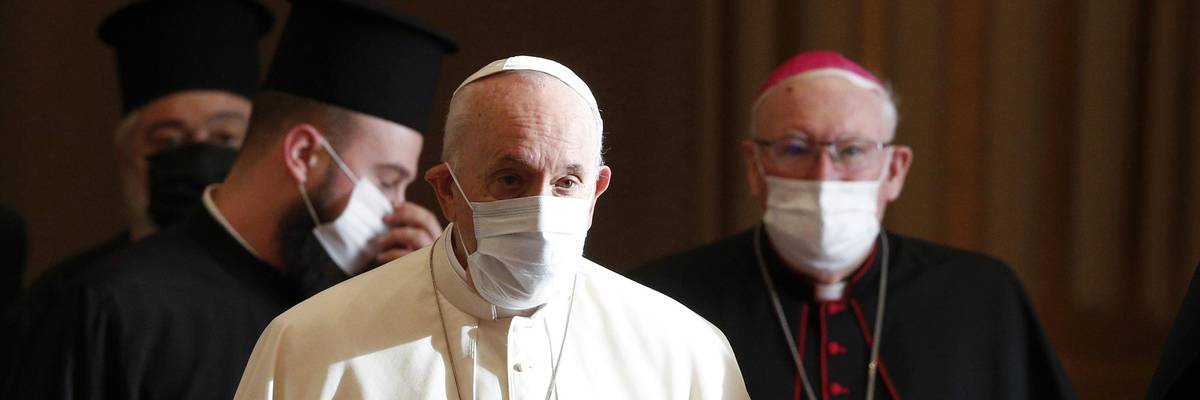
Pope Francis has released a new peace message in which he rebukes soaring military spending and praises work and activism that uplift the common good.
"We ought to esteem and encourage all those young people who work for a more just world."
"The deafening noise of war and conflict is intensifying," Francis said, lamenting the global pandemic, worsening climate crisis, and an economic model that eschews solidarity.
The remarks came in his message for World Peace Day, held on January 1. The message was released by the Vatican Tuesday and signed December 8.
A three-pronged approach to peace is laid out, with necessary steps involving intergenerational dialogue, education, and labor.
A need "for an intergenerational partnership" is clear especially regarding "our common home," he said, referring to the environment.
On that front, Francis nodded to youth activists worldwide.
"We ought to esteem and encourage all those young people who work for a more just world, one that is careful to safeguard the creation entrusted to our stewardship," he said. "They go about this with restlessness, enthusiasm, and most of all a sense of responsibility before the urgent change of direction required by the challenges emerging from the present ethical and socio-environmental crisis."
Related Content

Despite being "essential for the defense and promotion of peace," the pope said that investments in education have seen reductions. At the same time, military expenditures "increased beyond the levels at the end of the Cold War," he said, "and they seem certain to grow exorbitantly."
"It is high time," said Francis, "that governments develop economic policies aimed at inverting the proportion of public funds spent on education and on weaponry."
Doing so will have far-reaching benefits, he said.
"The pursuit of a genuine process of international disarmament can only prove beneficial for the development of peoples and nations," said Francis, "freeing up financial resources better used for healthcare, schools, infrastructure, care of the land, and so forth."
Data released earlier this year showed that global military spending grew to nearly $2 trillion in 2020, despite the social needs that went unmet and the Covid-19 pandemic raging worldwide. Last week, a group of Nobel laureates issued a call for a "Global Peace Dividend" to divert just 2% of that money to fund public investments and reduce poverty.
The peace message also drew attention to the plight of migrant workers, who in some places "are not even recognized" by the nations in which they reside, he said. "It is as though they did not exist."
Pope Francis also said that work must not be focused on profit above all else and instead called for "decent and dignified working conditions, oriented to the common good and to the safeguarding of creation."
The pontiff concluded by expressing hope others would be encouraged "to be artisans of peace."
Pope Francis has released a new peace message in which he rebukes soaring military spending and praises work and activism that uplift the common good.
"We ought to esteem and encourage all those young people who work for a more just world."
"The deafening noise of war and conflict is intensifying," Francis said, lamenting the global pandemic, worsening climate crisis, and an economic model that eschews solidarity.
The remarks came in his message for World Peace Day, held on January 1. The message was released by the Vatican Tuesday and signed December 8.
A three-pronged approach to peace is laid out, with necessary steps involving intergenerational dialogue, education, and labor.
A need "for an intergenerational partnership" is clear especially regarding "our common home," he said, referring to the environment.
On that front, Francis nodded to youth activists worldwide.
"We ought to esteem and encourage all those young people who work for a more just world, one that is careful to safeguard the creation entrusted to our stewardship," he said. "They go about this with restlessness, enthusiasm, and most of all a sense of responsibility before the urgent change of direction required by the challenges emerging from the present ethical and socio-environmental crisis."
Related Content
Despite being "essential for the defense and promotion of peace," the pope said that investments in education have seen reductions. At the same time, military expenditures "increased beyond the levels at the end of the Cold War," he said, "and they seem certain to grow exorbitantly."
"It is high time," said Francis, "that governments develop economic policies aimed at inverting the proportion of public funds spent on education and on weaponry."
Doing so will have far-reaching benefits, he said.
"The pursuit of a genuine process of international disarmament can only prove beneficial for the development of peoples and nations," said Francis, "freeing up financial resources better used for healthcare, schools, infrastructure, care of the land, and so forth."
Data released earlier this year showed that global military spending grew to nearly $2 trillion in 2020, despite the social needs that went unmet and the Covid-19 pandemic raging worldwide. Last week, a group of Nobel laureates issued a call for a "Global Peace Dividend" to divert just 2% of that money to fund public investments and reduce poverty.
The peace message also drew attention to the plight of migrant workers, who in some places "are not even recognized" by the nations in which they reside, he said. "It is as though they did not exist."
Pope Francis also said that work must not be focused on profit above all else and instead called for "decent and dignified working conditions, oriented to the common good and to the safeguarding of creation."
The pontiff concluded by expressing hope others would be encouraged "to be artisans of peace."

