SUBSCRIBE TO OUR FREE NEWSLETTER
Daily news & progressive opinion—funded by the people, not the corporations—delivered straight to your inbox.
5
#000000
#FFFFFF
To donate by check, phone, or other method, see our More Ways to Give page.
Daily news & progressive opinion—funded by the people, not the corporations—delivered straight to your inbox.
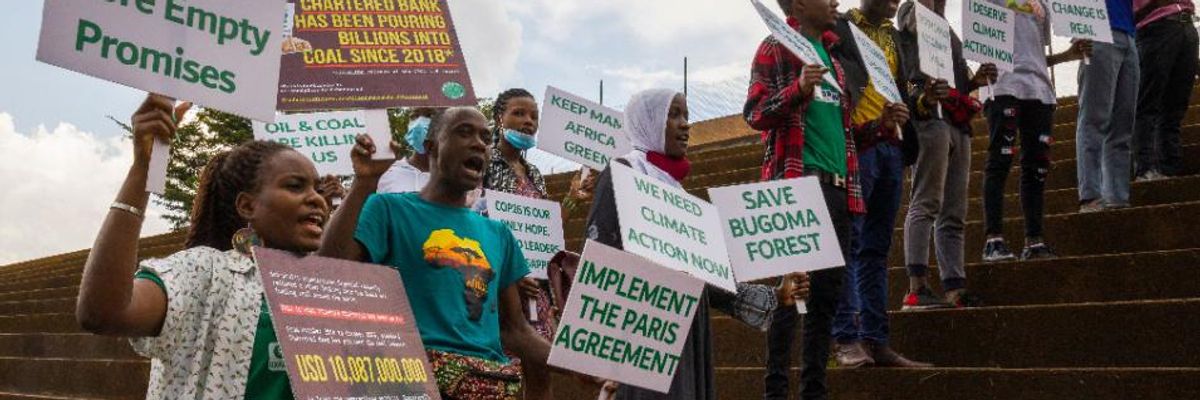
Young environment activists hold placards with climate change-related messages directed toward the Ugandan government and other world leaders at Kampala International University as part of the Fridays for Future global climate strike under the motto "No More Empty Promises" on March 19, 2021. (Photo: Badru Katumba/AFP via Getty Images)
After a year of online actions and occasional in-person protests limited by the coronavirus pandemic, the youth climate strikers of the Fridays for Future movement returned to streets around the world on Friday to demand urgent, ambitious action that meets the scale of the planetary emergency.
"We strike because climate justice isn't a myth, but a reality we intend to build."
--Luisa Neubauer, Fridays for Future
Frustrated that governments across the globe continue to craft emissions reduction plans that experts warn are inadequate to avert climate catastrophe, youth campaigners planned actions in more than 60 countries with a clear, unified demand: #NoMoreEmptyPromises.
"When your house is on fire, you don't wait for 10, 20 years before you call the fire department; you act as soon and as much as you possibly can," said movement founder Greta Thunberg when the global strike was announced in January.
In a tweet Friday, Thunberg explained that she and some fellow activists were striking in shifts to keep numbers low. The 18-year-old Swede shared a photo of Fridays for Future members--masked and socially distanced--holding signs.
Sweden has banned gatherings of more than eight people due to the public health crisis, Reuters noted. Unlike the pandemic, world leaders aren't treating climate change like a crisis, Thunberg told the news agency.
"The first step must be to start treating it like a crisis and to just take in the full picture, to see this in a holistic point of view," she said. "Science says that we can still avoid the worst consequences. So it's possible, but it's not possible if we continue like today."
While researchers and advocates continue to warn of the looming consequences of dangerously inadequate efforts to reduce planet-heating pollution, participants in the worldwide strike emphasized that the climate emergency isn't just something to worry about for the future.
"The climate crisis already affects thousands of people in the world," Fridays for Future member Hannah Pirot told The Berlin Spectator, which reported on activists painting temporary slogans on the Oberbaum Bridge, a famous landmark in the German capital.
"We need systematic changes because the climate crisis is the result of structural exploitation and ecological destruction," Pirot said. "Fighting the climate crisis also means championing for an anti-racist, feminist, and solidary society, and to think about a a fair way of cohabitation."
"We strike because climate justice isn't a myth, but a reality we intend to build," explained German Fridays for Future member Luisa Neubauer. "We strike because we are done with empty promises and distant net zero targets. We strike because we need real action, starting now."
In the Philippines, campaigners gathered outside an office of Standard Chartered, a British banking and financial services company, demanding divestment from the coal industry. "Enough injustice!" tweeted Mitzi Jonelle Tan, a local climate justice activist. "Divest from coal completely and stop funding our destruction!"
Activists in New Delhi sent a similar message on coal mining to the State Bank of India (SBI) while demonstrators in Uganda spoke out against sugarcane companies clearing sections of the Bugoma Forest and campaigners in Turkey called on their goverment to ratify the Paris climate agreement.
Fridays for Future urged strikers who planned to join in-person protests around the world to wear face masks, keep hand sanitizer handy, physically distance, not touch their faces, look into and abide by any local coronavirus restrictions, stay home if they are feeling unwell, and consider participating digitally.
Ahead of a physically distanced protest in the Hague in the Netherlands, 16-year-old Erik Christiansson discussed with German broadcaster Deutsche Welle how the pandemic has changed the youth climate movement, acknowledging that "the big marches with tens of thousands of people which we had in 2019 are just not possible anymore."
"We've talked a lot more internationally than we did before, when everyone was focused on their own strikes and their national politics," Christiansson said of the past year. "Since we were communicating with everyone online already, it was easy to get connections with people in other countries as well."
Still, as Jens Marquardt, a postdoctoral researcher in climate change politics and societal transformation at Stockholm University, told DW, "visible public events are undeniably the foundation for a social movement--to mobilize people, to mobilize support, and to gain public attention. And this is definitely missing."
"It is actually quite astonishing to see that this [FFF] movement has been so resilient and robust, despite this massive crisis," Marquardt added. "This year of reflection has been helpful in shaping the agenda about what this movement is about and what this movement wants to achieve in the future."
"We stand with our defenders battling the monsters in the fossil fuel industry. We are fed up," declared a post on Fridays for Future's primary Twitter account. "We strike all over the world for justice and say #NoMoreEmptyPromises. World leaders, fossil fuel industry, watch out. We are relentless, uncompromising, and we will keep fighting back."
Dear Common Dreams reader, It’s been nearly 30 years since I co-founded Common Dreams with my late wife, Lina Newhouser. We had the radical notion that journalism should serve the public good, not corporate profits. It was clear to us from the outset what it would take to build such a project. No paid advertisements. No corporate sponsors. No millionaire publisher telling us what to think or do. Many people said we wouldn't last a year, but we proved those doubters wrong. Together with a tremendous team of journalists and dedicated staff, we built an independent media outlet free from the constraints of profits and corporate control. Our mission has always been simple: To inform. To inspire. To ignite change for the common good. Building Common Dreams was not easy. Our survival was never guaranteed. When you take on the most powerful forces—Wall Street greed, fossil fuel industry destruction, Big Tech lobbyists, and uber-rich oligarchs who have spent billions upon billions rigging the economy and democracy in their favor—the only bulwark you have is supporters who believe in your work. But here’s the urgent message from me today. It's never been this bad out there. And it's never been this hard to keep us going. At the very moment Common Dreams is most needed, the threats we face are intensifying. We need your support now more than ever. We don't accept corporate advertising and never will. We don't have a paywall because we don't think people should be blocked from critical news based on their ability to pay. Everything we do is funded by the donations of readers like you. When everyone does the little they can afford, we are strong. But if that support retreats or dries up, so do we. Will you donate now to make sure Common Dreams not only survives but thrives? —Craig Brown, Co-founder |
After a year of online actions and occasional in-person protests limited by the coronavirus pandemic, the youth climate strikers of the Fridays for Future movement returned to streets around the world on Friday to demand urgent, ambitious action that meets the scale of the planetary emergency.
"We strike because climate justice isn't a myth, but a reality we intend to build."
--Luisa Neubauer, Fridays for Future
Frustrated that governments across the globe continue to craft emissions reduction plans that experts warn are inadequate to avert climate catastrophe, youth campaigners planned actions in more than 60 countries with a clear, unified demand: #NoMoreEmptyPromises.
"When your house is on fire, you don't wait for 10, 20 years before you call the fire department; you act as soon and as much as you possibly can," said movement founder Greta Thunberg when the global strike was announced in January.
In a tweet Friday, Thunberg explained that she and some fellow activists were striking in shifts to keep numbers low. The 18-year-old Swede shared a photo of Fridays for Future members--masked and socially distanced--holding signs.
Sweden has banned gatherings of more than eight people due to the public health crisis, Reuters noted. Unlike the pandemic, world leaders aren't treating climate change like a crisis, Thunberg told the news agency.
"The first step must be to start treating it like a crisis and to just take in the full picture, to see this in a holistic point of view," she said. "Science says that we can still avoid the worst consequences. So it's possible, but it's not possible if we continue like today."
While researchers and advocates continue to warn of the looming consequences of dangerously inadequate efforts to reduce planet-heating pollution, participants in the worldwide strike emphasized that the climate emergency isn't just something to worry about for the future.
"The climate crisis already affects thousands of people in the world," Fridays for Future member Hannah Pirot told The Berlin Spectator, which reported on activists painting temporary slogans on the Oberbaum Bridge, a famous landmark in the German capital.
"We need systematic changes because the climate crisis is the result of structural exploitation and ecological destruction," Pirot said. "Fighting the climate crisis also means championing for an anti-racist, feminist, and solidary society, and to think about a a fair way of cohabitation."
"We strike because climate justice isn't a myth, but a reality we intend to build," explained German Fridays for Future member Luisa Neubauer. "We strike because we are done with empty promises and distant net zero targets. We strike because we need real action, starting now."
In the Philippines, campaigners gathered outside an office of Standard Chartered, a British banking and financial services company, demanding divestment from the coal industry. "Enough injustice!" tweeted Mitzi Jonelle Tan, a local climate justice activist. "Divest from coal completely and stop funding our destruction!"
Activists in New Delhi sent a similar message on coal mining to the State Bank of India (SBI) while demonstrators in Uganda spoke out against sugarcane companies clearing sections of the Bugoma Forest and campaigners in Turkey called on their goverment to ratify the Paris climate agreement.
Fridays for Future urged strikers who planned to join in-person protests around the world to wear face masks, keep hand sanitizer handy, physically distance, not touch their faces, look into and abide by any local coronavirus restrictions, stay home if they are feeling unwell, and consider participating digitally.
Ahead of a physically distanced protest in the Hague in the Netherlands, 16-year-old Erik Christiansson discussed with German broadcaster Deutsche Welle how the pandemic has changed the youth climate movement, acknowledging that "the big marches with tens of thousands of people which we had in 2019 are just not possible anymore."
"We've talked a lot more internationally than we did before, when everyone was focused on their own strikes and their national politics," Christiansson said of the past year. "Since we were communicating with everyone online already, it was easy to get connections with people in other countries as well."
Still, as Jens Marquardt, a postdoctoral researcher in climate change politics and societal transformation at Stockholm University, told DW, "visible public events are undeniably the foundation for a social movement--to mobilize people, to mobilize support, and to gain public attention. And this is definitely missing."
"It is actually quite astonishing to see that this [FFF] movement has been so resilient and robust, despite this massive crisis," Marquardt added. "This year of reflection has been helpful in shaping the agenda about what this movement is about and what this movement wants to achieve in the future."
"We stand with our defenders battling the monsters in the fossil fuel industry. We are fed up," declared a post on Fridays for Future's primary Twitter account. "We strike all over the world for justice and say #NoMoreEmptyPromises. World leaders, fossil fuel industry, watch out. We are relentless, uncompromising, and we will keep fighting back."
After a year of online actions and occasional in-person protests limited by the coronavirus pandemic, the youth climate strikers of the Fridays for Future movement returned to streets around the world on Friday to demand urgent, ambitious action that meets the scale of the planetary emergency.
"We strike because climate justice isn't a myth, but a reality we intend to build."
--Luisa Neubauer, Fridays for Future
Frustrated that governments across the globe continue to craft emissions reduction plans that experts warn are inadequate to avert climate catastrophe, youth campaigners planned actions in more than 60 countries with a clear, unified demand: #NoMoreEmptyPromises.
"When your house is on fire, you don't wait for 10, 20 years before you call the fire department; you act as soon and as much as you possibly can," said movement founder Greta Thunberg when the global strike was announced in January.
In a tweet Friday, Thunberg explained that she and some fellow activists were striking in shifts to keep numbers low. The 18-year-old Swede shared a photo of Fridays for Future members--masked and socially distanced--holding signs.
Sweden has banned gatherings of more than eight people due to the public health crisis, Reuters noted. Unlike the pandemic, world leaders aren't treating climate change like a crisis, Thunberg told the news agency.
"The first step must be to start treating it like a crisis and to just take in the full picture, to see this in a holistic point of view," she said. "Science says that we can still avoid the worst consequences. So it's possible, but it's not possible if we continue like today."
While researchers and advocates continue to warn of the looming consequences of dangerously inadequate efforts to reduce planet-heating pollution, participants in the worldwide strike emphasized that the climate emergency isn't just something to worry about for the future.
"The climate crisis already affects thousands of people in the world," Fridays for Future member Hannah Pirot told The Berlin Spectator, which reported on activists painting temporary slogans on the Oberbaum Bridge, a famous landmark in the German capital.
"We need systematic changes because the climate crisis is the result of structural exploitation and ecological destruction," Pirot said. "Fighting the climate crisis also means championing for an anti-racist, feminist, and solidary society, and to think about a a fair way of cohabitation."
"We strike because climate justice isn't a myth, but a reality we intend to build," explained German Fridays for Future member Luisa Neubauer. "We strike because we are done with empty promises and distant net zero targets. We strike because we need real action, starting now."
In the Philippines, campaigners gathered outside an office of Standard Chartered, a British banking and financial services company, demanding divestment from the coal industry. "Enough injustice!" tweeted Mitzi Jonelle Tan, a local climate justice activist. "Divest from coal completely and stop funding our destruction!"
Activists in New Delhi sent a similar message on coal mining to the State Bank of India (SBI) while demonstrators in Uganda spoke out against sugarcane companies clearing sections of the Bugoma Forest and campaigners in Turkey called on their goverment to ratify the Paris climate agreement.
Fridays for Future urged strikers who planned to join in-person protests around the world to wear face masks, keep hand sanitizer handy, physically distance, not touch their faces, look into and abide by any local coronavirus restrictions, stay home if they are feeling unwell, and consider participating digitally.
Ahead of a physically distanced protest in the Hague in the Netherlands, 16-year-old Erik Christiansson discussed with German broadcaster Deutsche Welle how the pandemic has changed the youth climate movement, acknowledging that "the big marches with tens of thousands of people which we had in 2019 are just not possible anymore."
"We've talked a lot more internationally than we did before, when everyone was focused on their own strikes and their national politics," Christiansson said of the past year. "Since we were communicating with everyone online already, it was easy to get connections with people in other countries as well."
Still, as Jens Marquardt, a postdoctoral researcher in climate change politics and societal transformation at Stockholm University, told DW, "visible public events are undeniably the foundation for a social movement--to mobilize people, to mobilize support, and to gain public attention. And this is definitely missing."
"It is actually quite astonishing to see that this [FFF] movement has been so resilient and robust, despite this massive crisis," Marquardt added. "This year of reflection has been helpful in shaping the agenda about what this movement is about and what this movement wants to achieve in the future."
"We stand with our defenders battling the monsters in the fossil fuel industry. We are fed up," declared a post on Fridays for Future's primary Twitter account. "We strike all over the world for justice and say #NoMoreEmptyPromises. World leaders, fossil fuel industry, watch out. We are relentless, uncompromising, and we will keep fighting back."