SUBSCRIBE TO OUR FREE NEWSLETTER
Daily news & progressive opinion—funded by the people, not the corporations—delivered straight to your inbox.
5
#000000
#FFFFFF
To donate by check, phone, or other method, see our More Ways to Give page.
Daily news & progressive opinion—funded by the people, not the corporations—delivered straight to your inbox.
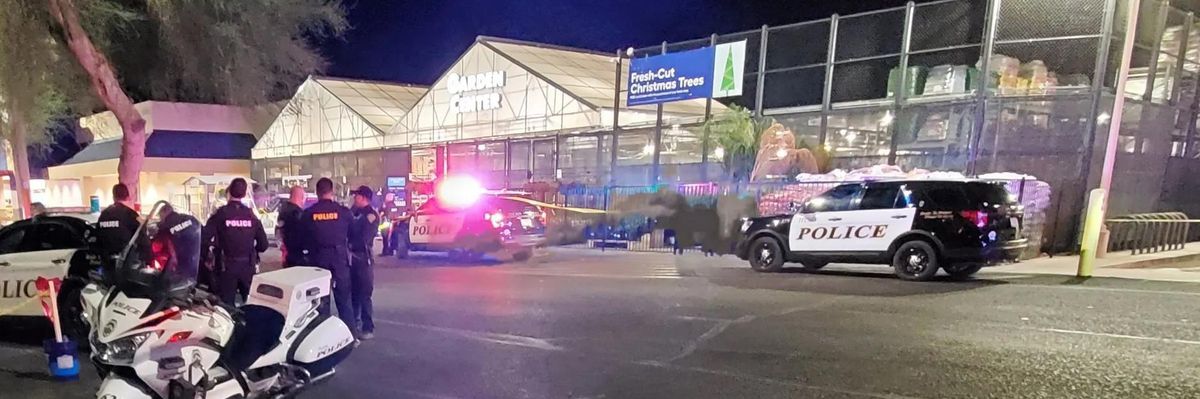
Tucson police officers respond to an officer-involved shooting in which a 61-year-old wheelchair-bound man was shot nine times in the back and side after allegedly shoplifting a toolbox from a Lowe's home improvement store on November 29, 2021. (Photo: Tucson Police Department)
Noting that up to half of all fatal U.S. police use-of-force incidents involve people with disabilities, rights advocates on Thursday voiced serious concerns over what they called the "unacceptable" killing of a wheelchair-bound Arizona man by a Tucson police officer who shot the victim nine times in the back on Monday evening.
"The fact that Mr. Richards was a person with a disability is of particular concern because persons with disabilities are more likely to die in an encounter with law enforcement than the general population."
Video released by the Tucson Police Department shows TPD officer Ryan Remington walking behind 61-year-old Richard Lee Richards, who is moving at low speed through the parking lot of a Lowe's home improvement center in his motorized wheelchair after being accused of shoplifting a toolbox from the store and brandishing a knife at employees.
As Richards slowly heads back toward the store entrance, Remington and another officer, Stephanie Taylor, order him to stop. Richards refuses, and Remington fires eight shots from his handgun at the man's back. Remington briefly pauses as Richards slumps forward in his wheelchair; the officer then fires a ninth shot. Remington then roughly handcuffs Richards, who is lying unresponsive on the ground in the store's entrance.
"The fact that Mr. Richards was a person with a disability is of particular concern because persons with disabilities are more likely to die in an encounter with law enforcement than the general population," the Arizona Center for Disability Law and DIRECT Center for Independence wrote in a letter to Tucson Mayor Regina Romero and members of the City Council on Thursday.
"Persons with disabilities are often subject to excessive force and discrimination in their encounters with law enforcement because of bias and stigma regarding disability, whether explicit or implicit," the groups continued.
Romero called Remington's actions "unconscionable and indefensible."
"It is moments like this that test our resolve to ensure justice and accountability," she said in a statement Wednesday.
Also on Wednesday, TPD Chief Chris Magnus said he is "deeply troubled" by Remington's actions, whose "use of deadly force in this incident is a clear violation of department policy."
"As a result, the department moved earlier today to terminate Officer Remington," the chief stated.
The advocacy groups' letter cites Remington's "lack of ability to de-escalate the situation" as a primary area of concern. The officer's lawyer, Mike Storie, told media outlets that his client was "trying to talk this guy down and de-escalate" the situation.
The attorney said that Remington "did have a Taser, but in his mind, he couldn't use it because he didn't feel he had the proper spread to deploy it, with the wheelchair between him and Richards."
"Police work is messy at times," Storie added.
However, the groups' letter argues that Remington "used excessive force against an individual with a disability who had his back turned to the officer."
"Situations like this one play out all over the country, in Arizona, and now Tucson," the letter says. "TPD touts on its website that it is a 'progressive police department, engaged in community policing,' as well as being one of just two police departments in the largest 100 cities in the United States to initiate all of the '8 Can't Wait' policies promoted by Campaign Zero's Use of Force Project."
The "8 Can't Wait" reforms include requiring law enforcement officers to de-escalate, warn, and "exhaust all alternatives" before shooting suspects.
"This particular incident met none of those measures," the letter states. "And, any training TPD officers have received put to question the fidelity of the department, especially since this is the second incident in a year in which a TPD officer did not de-escalate a situation concerning a person with a disability."
"These situations are unacceptable," the letter stresses, "especially for a police department that prides itself on being an integral part of the community."
Dear Common Dreams reader, It’s been nearly 30 years since I co-founded Common Dreams with my late wife, Lina Newhouser. We had the radical notion that journalism should serve the public good, not corporate profits. It was clear to us from the outset what it would take to build such a project. No paid advertisements. No corporate sponsors. No millionaire publisher telling us what to think or do. Many people said we wouldn't last a year, but we proved those doubters wrong. Together with a tremendous team of journalists and dedicated staff, we built an independent media outlet free from the constraints of profits and corporate control. Our mission has always been simple: To inform. To inspire. To ignite change for the common good. Building Common Dreams was not easy. Our survival was never guaranteed. When you take on the most powerful forces—Wall Street greed, fossil fuel industry destruction, Big Tech lobbyists, and uber-rich oligarchs who have spent billions upon billions rigging the economy and democracy in their favor—the only bulwark you have is supporters who believe in your work. But here’s the urgent message from me today. It's never been this bad out there. And it's never been this hard to keep us going. At the very moment Common Dreams is most needed, the threats we face are intensifying. We need your support now more than ever. We don't accept corporate advertising and never will. We don't have a paywall because we don't think people should be blocked from critical news based on their ability to pay. Everything we do is funded by the donations of readers like you. When everyone does the little they can afford, we are strong. But if that support retreats or dries up, so do we. Will you donate now to make sure Common Dreams not only survives but thrives? —Craig Brown, Co-founder |
Noting that up to half of all fatal U.S. police use-of-force incidents involve people with disabilities, rights advocates on Thursday voiced serious concerns over what they called the "unacceptable" killing of a wheelchair-bound Arizona man by a Tucson police officer who shot the victim nine times in the back on Monday evening.
"The fact that Mr. Richards was a person with a disability is of particular concern because persons with disabilities are more likely to die in an encounter with law enforcement than the general population."
Video released by the Tucson Police Department shows TPD officer Ryan Remington walking behind 61-year-old Richard Lee Richards, who is moving at low speed through the parking lot of a Lowe's home improvement center in his motorized wheelchair after being accused of shoplifting a toolbox from the store and brandishing a knife at employees.
As Richards slowly heads back toward the store entrance, Remington and another officer, Stephanie Taylor, order him to stop. Richards refuses, and Remington fires eight shots from his handgun at the man's back. Remington briefly pauses as Richards slumps forward in his wheelchair; the officer then fires a ninth shot. Remington then roughly handcuffs Richards, who is lying unresponsive on the ground in the store's entrance.
"The fact that Mr. Richards was a person with a disability is of particular concern because persons with disabilities are more likely to die in an encounter with law enforcement than the general population," the Arizona Center for Disability Law and DIRECT Center for Independence wrote in a letter to Tucson Mayor Regina Romero and members of the City Council on Thursday.
"Persons with disabilities are often subject to excessive force and discrimination in their encounters with law enforcement because of bias and stigma regarding disability, whether explicit or implicit," the groups continued.
Romero called Remington's actions "unconscionable and indefensible."
"It is moments like this that test our resolve to ensure justice and accountability," she said in a statement Wednesday.
Also on Wednesday, TPD Chief Chris Magnus said he is "deeply troubled" by Remington's actions, whose "use of deadly force in this incident is a clear violation of department policy."
"As a result, the department moved earlier today to terminate Officer Remington," the chief stated.
The advocacy groups' letter cites Remington's "lack of ability to de-escalate the situation" as a primary area of concern. The officer's lawyer, Mike Storie, told media outlets that his client was "trying to talk this guy down and de-escalate" the situation.
The attorney said that Remington "did have a Taser, but in his mind, he couldn't use it because he didn't feel he had the proper spread to deploy it, with the wheelchair between him and Richards."
"Police work is messy at times," Storie added.
However, the groups' letter argues that Remington "used excessive force against an individual with a disability who had his back turned to the officer."
"Situations like this one play out all over the country, in Arizona, and now Tucson," the letter says. "TPD touts on its website that it is a 'progressive police department, engaged in community policing,' as well as being one of just two police departments in the largest 100 cities in the United States to initiate all of the '8 Can't Wait' policies promoted by Campaign Zero's Use of Force Project."
The "8 Can't Wait" reforms include requiring law enforcement officers to de-escalate, warn, and "exhaust all alternatives" before shooting suspects.
"This particular incident met none of those measures," the letter states. "And, any training TPD officers have received put to question the fidelity of the department, especially since this is the second incident in a year in which a TPD officer did not de-escalate a situation concerning a person with a disability."
"These situations are unacceptable," the letter stresses, "especially for a police department that prides itself on being an integral part of the community."
Noting that up to half of all fatal U.S. police use-of-force incidents involve people with disabilities, rights advocates on Thursday voiced serious concerns over what they called the "unacceptable" killing of a wheelchair-bound Arizona man by a Tucson police officer who shot the victim nine times in the back on Monday evening.
"The fact that Mr. Richards was a person with a disability is of particular concern because persons with disabilities are more likely to die in an encounter with law enforcement than the general population."
Video released by the Tucson Police Department shows TPD officer Ryan Remington walking behind 61-year-old Richard Lee Richards, who is moving at low speed through the parking lot of a Lowe's home improvement center in his motorized wheelchair after being accused of shoplifting a toolbox from the store and brandishing a knife at employees.
As Richards slowly heads back toward the store entrance, Remington and another officer, Stephanie Taylor, order him to stop. Richards refuses, and Remington fires eight shots from his handgun at the man's back. Remington briefly pauses as Richards slumps forward in his wheelchair; the officer then fires a ninth shot. Remington then roughly handcuffs Richards, who is lying unresponsive on the ground in the store's entrance.
"The fact that Mr. Richards was a person with a disability is of particular concern because persons with disabilities are more likely to die in an encounter with law enforcement than the general population," the Arizona Center for Disability Law and DIRECT Center for Independence wrote in a letter to Tucson Mayor Regina Romero and members of the City Council on Thursday.
"Persons with disabilities are often subject to excessive force and discrimination in their encounters with law enforcement because of bias and stigma regarding disability, whether explicit or implicit," the groups continued.
Romero called Remington's actions "unconscionable and indefensible."
"It is moments like this that test our resolve to ensure justice and accountability," she said in a statement Wednesday.
Also on Wednesday, TPD Chief Chris Magnus said he is "deeply troubled" by Remington's actions, whose "use of deadly force in this incident is a clear violation of department policy."
"As a result, the department moved earlier today to terminate Officer Remington," the chief stated.
The advocacy groups' letter cites Remington's "lack of ability to de-escalate the situation" as a primary area of concern. The officer's lawyer, Mike Storie, told media outlets that his client was "trying to talk this guy down and de-escalate" the situation.
The attorney said that Remington "did have a Taser, but in his mind, he couldn't use it because he didn't feel he had the proper spread to deploy it, with the wheelchair between him and Richards."
"Police work is messy at times," Storie added.
However, the groups' letter argues that Remington "used excessive force against an individual with a disability who had his back turned to the officer."
"Situations like this one play out all over the country, in Arizona, and now Tucson," the letter says. "TPD touts on its website that it is a 'progressive police department, engaged in community policing,' as well as being one of just two police departments in the largest 100 cities in the United States to initiate all of the '8 Can't Wait' policies promoted by Campaign Zero's Use of Force Project."
The "8 Can't Wait" reforms include requiring law enforcement officers to de-escalate, warn, and "exhaust all alternatives" before shooting suspects.
"This particular incident met none of those measures," the letter states. "And, any training TPD officers have received put to question the fidelity of the department, especially since this is the second incident in a year in which a TPD officer did not de-escalate a situation concerning a person with a disability."
"These situations are unacceptable," the letter stresses, "especially for a police department that prides itself on being an integral part of the community."