

SUBSCRIBE TO OUR FREE NEWSLETTER
Daily news & progressive opinion—funded by the people, not the corporations—delivered straight to your inbox.
5
#000000
#FFFFFF
To donate by check, phone, or other method, see our More Ways to Give page.
Daily news & progressive opinion—funded by the people, not the corporations—delivered straight to your inbox.
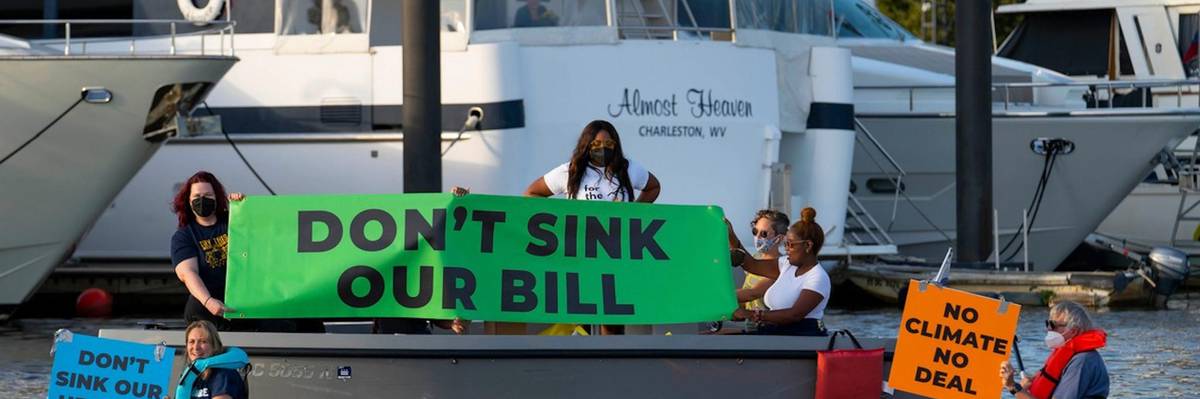
A flotilla of activists from Center for Popular Democracy, CASA, and Greenpeace USA take to kayaks and electric boats to demonstrate near Sen. Joe Manchin's (D-W.Va.) houseboat in the Washington, D.C. Wharf to demand that he support the Build Back Better Act. (Photo: Sarah Silbiger/Greenpeace)
In the wake of Friday's passage of Democrats' flagship Build Back Better budget reconciliation bill by the House of Representatives, climate campaigners turned their attention to the U.S. Senate, urging members of the upper chamber to approve the $1.75 trillion social and climate investment package without delay.
"We'd be lying if we said the Build Back Better Act passing the House was not a historic moment for climate action, but it means nothing if the Senate does not pass it."
As passed by the House, the reconciliation package includes $555 billion in funding for measures to combat the climate emergency, including $320 billion for clean energy and electric vehicles and $105 billion for reducing pollution in low-income communities. Proponents say the bill would create millions of green jobs.
Now the measure heads to the Senate, where it needs the votes of all 50 Democrats to pass in the evenly divided chamber, and where right-wing Democrats Joe Manchin of West Virginia and Arizona's Kyrsten Sinema have voiced strong opposition to the package's scope and price tag. Manchin, an ally of the fossil fuel industry, succeeded in removing a major clean energy program from the legislation.
"We'd be lying if we said the Build Back Better Act passing the House was not a historic moment for climate action, but it means nothing if the Senate does not pass it," Sunrise Movement executive director Varshini Prakash said in a statement. "The Senate better pass the damn bill."
" Progressives have made enough compromises," she continued. "We've fought hard to defend the president's popular agenda, while Democratic leadership allowed fossil-fuel-funded Sens. Manchin and Sinema to water this bill down from its original, transformative promise."
Prakash asserted that President Joe Biden and Senate Majority Leader Chuck Schumer (D-N.Y.) "must get their party in line, not cower to corporate Democrats, and pass the full Build Back Better Act through the Senate immediately. There are no excuses left."
Janet Redman, climate campaign director at Greenpeace USA, lauded the House for its commitment "to much-needed investments in deploying clean energy, a Civilian Climate Corps program, and environmental and climate justice grants."
"However," she said, "their failure to eliminate billions of dollars in handouts of our tax money to prop up the fossil fuel industry means Congress continues to fund racist impacts of fossil fuel pollution and further lock-in death and destruction from extreme droughts, wildfires, and storms fueled by the climate crisis."
"At COP26 John Kerry told the world that fossil fuel subsidies are the definition of insanity," Redman continued, referring to the recently concluded United Nations Climate Change Conference in Glasgow, Scotland. "It's time for Congress to follow through on these public statements."
"As the Build Back Better Act moves to the Senate, we're looking at Sen. Schumer to pass a bill that eliminates fossil fuel subsidies," she added. "Our tax dollars should support us, not kill us."
Union of Concerned Scientists president Johanna Chao Kreilick said that "it's a relief and thrill to see the House pass this transformative bill," which "would help address climate change through vital tax credits and incentives that would get more clean energy on the grid and electrify cars, buses, and trucks."
"It would put a significant dent in U.S. emissions and be the most far-reaching climate legislation our country has enacted to date," she noted. "This foundation would position the United States to do more in the years ahead to further reduce heat-trapping emissions in line with what science shows is necessary."
Chao Kreilick continued:
If this bill becomes law its benefits will be evident as clean energy jobs are created, heavily polluted neighborhoods are cleaned up, electric vehicles become more commonplace in all communities, and farms become more resilient to the droughts and floods that are now more frequent and severe due to climate change.
The substantial investments the Build Back Better Act makes in predominantly Black, Brown, and Indigenous communities that continue to suffer from systemic discrimination and disproportionate amounts of pollution marks a turning point in Congress' recognition of the environmental injustices and the loss of land and capital that these communities have suffered.
"Securing the Build Back Better Act would be a historic and hard-fought win for the broad and diverse climate justice movement in the face of relentless opposition from fossil fuel interests," she added. "Today is a moment to recognize the power of collective action and celebrate the benefits this legislation would bring to people around the country. We look forward to the Senate passing this bill expeditiously."
Dear Common Dreams reader, It’s been nearly 30 years since I co-founded Common Dreams with my late wife, Lina Newhouser. We had the radical notion that journalism should serve the public good, not corporate profits. It was clear to us from the outset what it would take to build such a project. No paid advertisements. No corporate sponsors. No millionaire publisher telling us what to think or do. Many people said we wouldn't last a year, but we proved those doubters wrong. Together with a tremendous team of journalists and dedicated staff, we built an independent media outlet free from the constraints of profits and corporate control. Our mission has always been simple: To inform. To inspire. To ignite change for the common good. Building Common Dreams was not easy. Our survival was never guaranteed. When you take on the most powerful forces—Wall Street greed, fossil fuel industry destruction, Big Tech lobbyists, and uber-rich oligarchs who have spent billions upon billions rigging the economy and democracy in their favor—the only bulwark you have is supporters who believe in your work. But here’s the urgent message from me today. It's never been this bad out there. And it's never been this hard to keep us going. At the very moment Common Dreams is most needed, the threats we face are intensifying. We need your support now more than ever. We don't accept corporate advertising and never will. We don't have a paywall because we don't think people should be blocked from critical news based on their ability to pay. Everything we do is funded by the donations of readers like you. When everyone does the little they can afford, we are strong. But if that support retreats or dries up, so do we. Will you donate now to make sure Common Dreams not only survives but thrives? —Craig Brown, Co-founder |
In the wake of Friday's passage of Democrats' flagship Build Back Better budget reconciliation bill by the House of Representatives, climate campaigners turned their attention to the U.S. Senate, urging members of the upper chamber to approve the $1.75 trillion social and climate investment package without delay.
"We'd be lying if we said the Build Back Better Act passing the House was not a historic moment for climate action, but it means nothing if the Senate does not pass it."
As passed by the House, the reconciliation package includes $555 billion in funding for measures to combat the climate emergency, including $320 billion for clean energy and electric vehicles and $105 billion for reducing pollution in low-income communities. Proponents say the bill would create millions of green jobs.
Now the measure heads to the Senate, where it needs the votes of all 50 Democrats to pass in the evenly divided chamber, and where right-wing Democrats Joe Manchin of West Virginia and Arizona's Kyrsten Sinema have voiced strong opposition to the package's scope and price tag. Manchin, an ally of the fossil fuel industry, succeeded in removing a major clean energy program from the legislation.
"We'd be lying if we said the Build Back Better Act passing the House was not a historic moment for climate action, but it means nothing if the Senate does not pass it," Sunrise Movement executive director Varshini Prakash said in a statement. "The Senate better pass the damn bill."
" Progressives have made enough compromises," she continued. "We've fought hard to defend the president's popular agenda, while Democratic leadership allowed fossil-fuel-funded Sens. Manchin and Sinema to water this bill down from its original, transformative promise."
Prakash asserted that President Joe Biden and Senate Majority Leader Chuck Schumer (D-N.Y.) "must get their party in line, not cower to corporate Democrats, and pass the full Build Back Better Act through the Senate immediately. There are no excuses left."
Janet Redman, climate campaign director at Greenpeace USA, lauded the House for its commitment "to much-needed investments in deploying clean energy, a Civilian Climate Corps program, and environmental and climate justice grants."
"However," she said, "their failure to eliminate billions of dollars in handouts of our tax money to prop up the fossil fuel industry means Congress continues to fund racist impacts of fossil fuel pollution and further lock-in death and destruction from extreme droughts, wildfires, and storms fueled by the climate crisis."
"At COP26 John Kerry told the world that fossil fuel subsidies are the definition of insanity," Redman continued, referring to the recently concluded United Nations Climate Change Conference in Glasgow, Scotland. "It's time for Congress to follow through on these public statements."
"As the Build Back Better Act moves to the Senate, we're looking at Sen. Schumer to pass a bill that eliminates fossil fuel subsidies," she added. "Our tax dollars should support us, not kill us."
Union of Concerned Scientists president Johanna Chao Kreilick said that "it's a relief and thrill to see the House pass this transformative bill," which "would help address climate change through vital tax credits and incentives that would get more clean energy on the grid and electrify cars, buses, and trucks."
"It would put a significant dent in U.S. emissions and be the most far-reaching climate legislation our country has enacted to date," she noted. "This foundation would position the United States to do more in the years ahead to further reduce heat-trapping emissions in line with what science shows is necessary."
Chao Kreilick continued:
If this bill becomes law its benefits will be evident as clean energy jobs are created, heavily polluted neighborhoods are cleaned up, electric vehicles become more commonplace in all communities, and farms become more resilient to the droughts and floods that are now more frequent and severe due to climate change.
The substantial investments the Build Back Better Act makes in predominantly Black, Brown, and Indigenous communities that continue to suffer from systemic discrimination and disproportionate amounts of pollution marks a turning point in Congress' recognition of the environmental injustices and the loss of land and capital that these communities have suffered.
"Securing the Build Back Better Act would be a historic and hard-fought win for the broad and diverse climate justice movement in the face of relentless opposition from fossil fuel interests," she added. "Today is a moment to recognize the power of collective action and celebrate the benefits this legislation would bring to people around the country. We look forward to the Senate passing this bill expeditiously."
In the wake of Friday's passage of Democrats' flagship Build Back Better budget reconciliation bill by the House of Representatives, climate campaigners turned their attention to the U.S. Senate, urging members of the upper chamber to approve the $1.75 trillion social and climate investment package without delay.
"We'd be lying if we said the Build Back Better Act passing the House was not a historic moment for climate action, but it means nothing if the Senate does not pass it."
As passed by the House, the reconciliation package includes $555 billion in funding for measures to combat the climate emergency, including $320 billion for clean energy and electric vehicles and $105 billion for reducing pollution in low-income communities. Proponents say the bill would create millions of green jobs.
Now the measure heads to the Senate, where it needs the votes of all 50 Democrats to pass in the evenly divided chamber, and where right-wing Democrats Joe Manchin of West Virginia and Arizona's Kyrsten Sinema have voiced strong opposition to the package's scope and price tag. Manchin, an ally of the fossil fuel industry, succeeded in removing a major clean energy program from the legislation.
"We'd be lying if we said the Build Back Better Act passing the House was not a historic moment for climate action, but it means nothing if the Senate does not pass it," Sunrise Movement executive director Varshini Prakash said in a statement. "The Senate better pass the damn bill."
" Progressives have made enough compromises," she continued. "We've fought hard to defend the president's popular agenda, while Democratic leadership allowed fossil-fuel-funded Sens. Manchin and Sinema to water this bill down from its original, transformative promise."
Prakash asserted that President Joe Biden and Senate Majority Leader Chuck Schumer (D-N.Y.) "must get their party in line, not cower to corporate Democrats, and pass the full Build Back Better Act through the Senate immediately. There are no excuses left."
Janet Redman, climate campaign director at Greenpeace USA, lauded the House for its commitment "to much-needed investments in deploying clean energy, a Civilian Climate Corps program, and environmental and climate justice grants."
"However," she said, "their failure to eliminate billions of dollars in handouts of our tax money to prop up the fossil fuel industry means Congress continues to fund racist impacts of fossil fuel pollution and further lock-in death and destruction from extreme droughts, wildfires, and storms fueled by the climate crisis."
"At COP26 John Kerry told the world that fossil fuel subsidies are the definition of insanity," Redman continued, referring to the recently concluded United Nations Climate Change Conference in Glasgow, Scotland. "It's time for Congress to follow through on these public statements."
"As the Build Back Better Act moves to the Senate, we're looking at Sen. Schumer to pass a bill that eliminates fossil fuel subsidies," she added. "Our tax dollars should support us, not kill us."
Union of Concerned Scientists president Johanna Chao Kreilick said that "it's a relief and thrill to see the House pass this transformative bill," which "would help address climate change through vital tax credits and incentives that would get more clean energy on the grid and electrify cars, buses, and trucks."
"It would put a significant dent in U.S. emissions and be the most far-reaching climate legislation our country has enacted to date," she noted. "This foundation would position the United States to do more in the years ahead to further reduce heat-trapping emissions in line with what science shows is necessary."
Chao Kreilick continued:
If this bill becomes law its benefits will be evident as clean energy jobs are created, heavily polluted neighborhoods are cleaned up, electric vehicles become more commonplace in all communities, and farms become more resilient to the droughts and floods that are now more frequent and severe due to climate change.
The substantial investments the Build Back Better Act makes in predominantly Black, Brown, and Indigenous communities that continue to suffer from systemic discrimination and disproportionate amounts of pollution marks a turning point in Congress' recognition of the environmental injustices and the loss of land and capital that these communities have suffered.
"Securing the Build Back Better Act would be a historic and hard-fought win for the broad and diverse climate justice movement in the face of relentless opposition from fossil fuel interests," she added. "Today is a moment to recognize the power of collective action and celebrate the benefits this legislation would bring to people around the country. We look forward to the Senate passing this bill expeditiously."

