SUBSCRIBE TO OUR FREE NEWSLETTER
Daily news & progressive opinion—funded by the people, not the corporations—delivered straight to your inbox.
5
#000000
#FFFFFF
To donate by check, phone, or other method, see our More Ways to Give page.
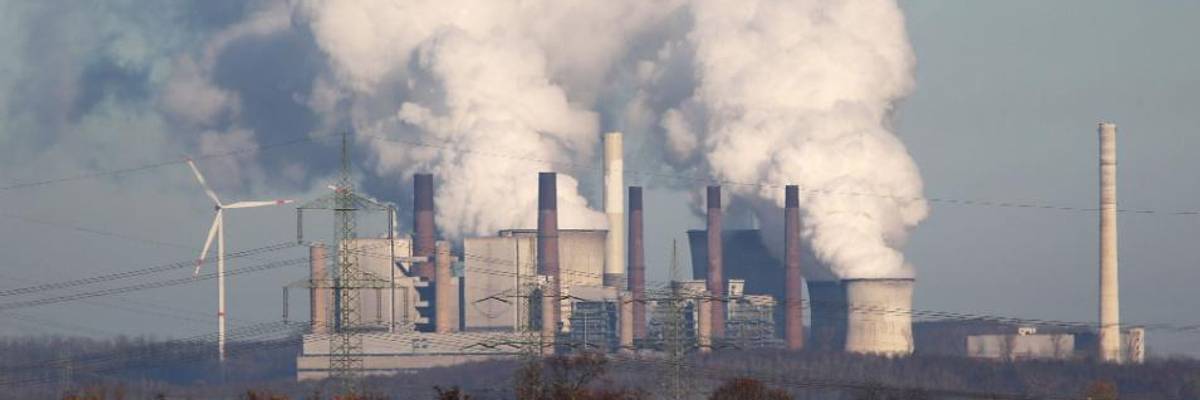
After falling in 2020 due to coronavirus-related shutdowns, global carbon dioxide emissions are on pace to nearly reach pre-pandemic levels this year as powerful nations--including the United States--continue to burn fossil fuels at a dangerous clip.
"To stop further global warming, global CO2 emissions must stop or reach net-zero."
That's according to new research from the Global Carbon Project, which warned Thursday that "emissions from coal and gas use are set to grow more in 2021 than they fell in 2020"--an alarming finding that came as world leaders gathered in Glasgow, Scotland to discuss cooperative solutions to the climate emergency, including phasing out coal use.
Researchers for the project, an initiative led by dozens of institutions across the globe, estimated that global CO2 emissions will rise by 4.9% in 2021 after they fell 5.4% in the previous year. Planet-warming carbon emissions in both the U.S. and the European Union are on track to rise 7.6% this year, the experts found.
"The rapid rebound in emissions as economies recover from the pandemic reinforces the need for immediate global action on climate change," Professor Pierre Friedlingstein of the University of Exeter's Global Systems Institute, said in a statement. "The rebound in global fossil CO2 emissions in 2021 reflects a return towards the pre-Covid fossil-based economy. Investments in the green economy in post-Covid recovery plans of some countries have been insufficient so far, on their own, to avoid a substantial return close to pre-Covid emissions."
Corinne Le Quere, a climate scientist at the University of East Anglia and one of the co-authors of the new report, told the Washington Post that the findings are "a reality check."
"It's really important what happens these next two weeks," Le Quere said, referring to the COP26 talks. "All the emissions are back on their long-term trajectories."
The research team's latest report projects that the world is set to burn through its so-called "carbon budget"--the amount of CO2 nations can emit and still keep warming below 1.5degC by the end of the century--in just 11 years.
Scientists have warned that heating above 1.5degC would come with devastating consequences. In September, the U.N. Framework Convention on Climate Change said that inaction from world leaders has put the planet on a path to 2.7degC of warming by the end of the century.
"Reaching net zero CO2 emissions by 2050 entails cutting global CO2 emissions by about 1.4 billion tonnes each year on average," said Friedlingstein. "Emissions fell by 1.9 billion tonnes in 2020--so, to achieve net zero by 2050, we must cut emissions every year by an amount comparable to that seen during Covid. This highlights the scale of the action that is now required, and hence the importance of the COP26 discussions."
Related Content

In an op-ed for The Conversation, Le Quere, Friedlingstein, and other leaders of the Global Carbon Project argued that "the fast recovery in CO2 emissions, following last year's sharp drop, should come as no surprise" given that "the world's strong economic rebound has created a surge in demand for energy, and the global energy system is still heavily dependent on fossil fuels."
"Most concerning is the long-term upward trends of CO2 emissions from oil and gas, and this year's growth in coal emissions, which together are far from trending towards net-zero by 2050," the researchers wrote. "To stop further global warming, global CO2 emissions must stop or reach net-zero--the latter meaning that any remaining CO2 emissions would have to be compensated for by removing an equivalent amount from the atmosphere."
After falling in 2020 due to coronavirus-related shutdowns, global carbon dioxide emissions are on pace to nearly reach pre-pandemic levels this year as powerful nations--including the United States--continue to burn fossil fuels at a dangerous clip.
"To stop further global warming, global CO2 emissions must stop or reach net-zero."
That's according to new research from the Global Carbon Project, which warned Thursday that "emissions from coal and gas use are set to grow more in 2021 than they fell in 2020"--an alarming finding that came as world leaders gathered in Glasgow, Scotland to discuss cooperative solutions to the climate emergency, including phasing out coal use.
Researchers for the project, an initiative led by dozens of institutions across the globe, estimated that global CO2 emissions will rise by 4.9% in 2021 after they fell 5.4% in the previous year. Planet-warming carbon emissions in both the U.S. and the European Union are on track to rise 7.6% this year, the experts found.
"The rapid rebound in emissions as economies recover from the pandemic reinforces the need for immediate global action on climate change," Professor Pierre Friedlingstein of the University of Exeter's Global Systems Institute, said in a statement. "The rebound in global fossil CO2 emissions in 2021 reflects a return towards the pre-Covid fossil-based economy. Investments in the green economy in post-Covid recovery plans of some countries have been insufficient so far, on their own, to avoid a substantial return close to pre-Covid emissions."
Corinne Le Quere, a climate scientist at the University of East Anglia and one of the co-authors of the new report, told the Washington Post that the findings are "a reality check."
"It's really important what happens these next two weeks," Le Quere said, referring to the COP26 talks. "All the emissions are back on their long-term trajectories."
The research team's latest report projects that the world is set to burn through its so-called "carbon budget"--the amount of CO2 nations can emit and still keep warming below 1.5degC by the end of the century--in just 11 years.
Scientists have warned that heating above 1.5degC would come with devastating consequences. In September, the U.N. Framework Convention on Climate Change said that inaction from world leaders has put the planet on a path to 2.7degC of warming by the end of the century.
"Reaching net zero CO2 emissions by 2050 entails cutting global CO2 emissions by about 1.4 billion tonnes each year on average," said Friedlingstein. "Emissions fell by 1.9 billion tonnes in 2020--so, to achieve net zero by 2050, we must cut emissions every year by an amount comparable to that seen during Covid. This highlights the scale of the action that is now required, and hence the importance of the COP26 discussions."
Related Content
In an op-ed for The Conversation, Le Quere, Friedlingstein, and other leaders of the Global Carbon Project argued that "the fast recovery in CO2 emissions, following last year's sharp drop, should come as no surprise" given that "the world's strong economic rebound has created a surge in demand for energy, and the global energy system is still heavily dependent on fossil fuels."
"Most concerning is the long-term upward trends of CO2 emissions from oil and gas, and this year's growth in coal emissions, which together are far from trending towards net-zero by 2050," the researchers wrote. "To stop further global warming, global CO2 emissions must stop or reach net-zero--the latter meaning that any remaining CO2 emissions would have to be compensated for by removing an equivalent amount from the atmosphere."
After falling in 2020 due to coronavirus-related shutdowns, global carbon dioxide emissions are on pace to nearly reach pre-pandemic levels this year as powerful nations--including the United States--continue to burn fossil fuels at a dangerous clip.
"To stop further global warming, global CO2 emissions must stop or reach net-zero."
That's according to new research from the Global Carbon Project, which warned Thursday that "emissions from coal and gas use are set to grow more in 2021 than they fell in 2020"--an alarming finding that came as world leaders gathered in Glasgow, Scotland to discuss cooperative solutions to the climate emergency, including phasing out coal use.
Researchers for the project, an initiative led by dozens of institutions across the globe, estimated that global CO2 emissions will rise by 4.9% in 2021 after they fell 5.4% in the previous year. Planet-warming carbon emissions in both the U.S. and the European Union are on track to rise 7.6% this year, the experts found.
"The rapid rebound in emissions as economies recover from the pandemic reinforces the need for immediate global action on climate change," Professor Pierre Friedlingstein of the University of Exeter's Global Systems Institute, said in a statement. "The rebound in global fossil CO2 emissions in 2021 reflects a return towards the pre-Covid fossil-based economy. Investments in the green economy in post-Covid recovery plans of some countries have been insufficient so far, on their own, to avoid a substantial return close to pre-Covid emissions."
Corinne Le Quere, a climate scientist at the University of East Anglia and one of the co-authors of the new report, told the Washington Post that the findings are "a reality check."
"It's really important what happens these next two weeks," Le Quere said, referring to the COP26 talks. "All the emissions are back on their long-term trajectories."
The research team's latest report projects that the world is set to burn through its so-called "carbon budget"--the amount of CO2 nations can emit and still keep warming below 1.5degC by the end of the century--in just 11 years.
Scientists have warned that heating above 1.5degC would come with devastating consequences. In September, the U.N. Framework Convention on Climate Change said that inaction from world leaders has put the planet on a path to 2.7degC of warming by the end of the century.
"Reaching net zero CO2 emissions by 2050 entails cutting global CO2 emissions by about 1.4 billion tonnes each year on average," said Friedlingstein. "Emissions fell by 1.9 billion tonnes in 2020--so, to achieve net zero by 2050, we must cut emissions every year by an amount comparable to that seen during Covid. This highlights the scale of the action that is now required, and hence the importance of the COP26 discussions."
Related Content
In an op-ed for The Conversation, Le Quere, Friedlingstein, and other leaders of the Global Carbon Project argued that "the fast recovery in CO2 emissions, following last year's sharp drop, should come as no surprise" given that "the world's strong economic rebound has created a surge in demand for energy, and the global energy system is still heavily dependent on fossil fuels."
"Most concerning is the long-term upward trends of CO2 emissions from oil and gas, and this year's growth in coal emissions, which together are far from trending towards net-zero by 2050," the researchers wrote. "To stop further global warming, global CO2 emissions must stop or reach net-zero--the latter meaning that any remaining CO2 emissions would have to be compensated for by removing an equivalent amount from the atmosphere."