
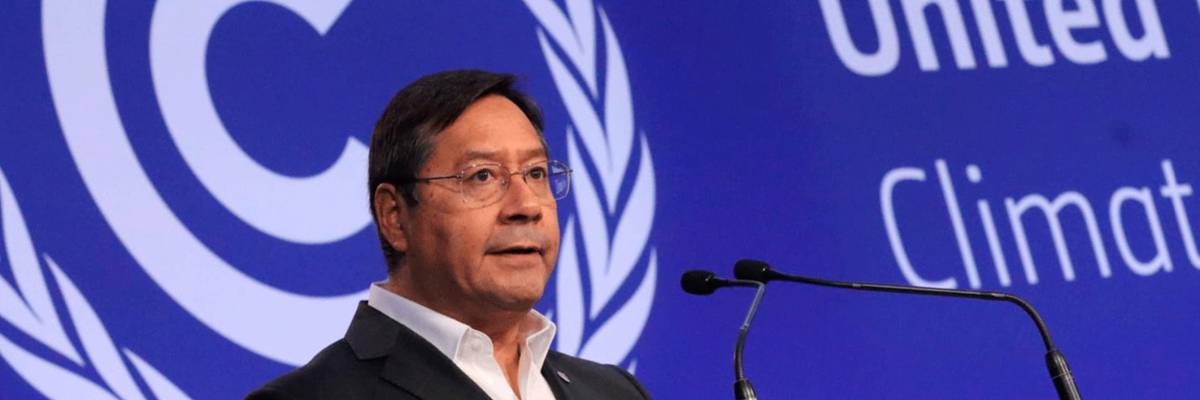
Bolivian President Luis Arce addresses the United Nations Climate Change Conference in Glasgow, Scotland on November 1, 2021. (Photo: Luis Arce/Twitter)
Bolivian President Warns 'Carbon Colonialism' Won't Solve Climate Crisis
"The solution," said Luis Arce at COP26, "is to change the model of civilization and move towards an alternative model to capitalism, the concept of living well together in harmony with Mother Earth."
While rich country leaders pushed what critics called false capitalist fixes to the climate crisis during Monday's sessions of the United Nations Climate Change Conference in Glasgow, Scotland, Bolivia's socialist president warned that true solutions to the planetary emergency require moving beyond capitalism to an "alternative model" that centers living "together in harmony with Mother Earth."
"The solution to the climate crisis is not going to be achieved with more green capitalism and more global carbon markets."
"We view with frustration the enduring global framework that hasn't finished defining a global solution to the climate crisis, which has become the principal problem we must face in defense of humanity and the life of Mother Earth," Bolivian President Luis Arce said during his address to the U.N. conference--also called COP26--on Monday. "We perceive that developed countries are simply buying time without any sense of responsibility for humanity."
Echoing concerns voiced by Indigenous activists, Arce said that "developed countries are promoting a new world recolonization process that we can call the 'new carbon colonialism,' because they are trying to impose their own rules of the game in the climate negotiations to continue feeding the new green capitalist system, while pushing developing nations to accept these rules of the game without any other options."
"The solution to the climate crisis is not going to be achieved with more green capitalism and more global carbon markets," stressed Arce, who is also an economist. "The solution is to change the model of civilization and move towards an alternative model to capitalism, the concept of living well together in harmony with Mother Earth."
The president said that if the nations of the Global North truly want to be leaders in tackling the climate emergency, they must reduce emissions within the framework of the Paris climate agreement, promote an equitable distribution of "atmospheric space," and provide financial and other resources for developing nations.
"If the current generations do not solve the climate crisis, this will be a very heavy burden and impossible to solve for the generations to come," he warned.
A 2009 Oxfam report predicted Bolivia would suffer acute food and water insecurity, disappearing glaciers, more frequent and severe natural disasters, increased mosquito-borne diseases, and more forest fires as a result of human-driven climate change. Last December, the group issued a follow-up report which confirmed many of the earlier predictions, including a water crisis driven by glacier melt, dengue fever outbreaks, and historic forest fires.
We are at a crossroads
This country and this world are at a monumental crossroads. In a few short weeks, US voters will have an opportunity to beat back the forces of fascism and confront the billionaires who are rigging the economy, our media system, and our democracy, making it increasingly impossible for ordinary people to get by. We’re not just talking about the election. We’re talking about what must be done once these fascist elements are vanquished from power. We need a bolder set of solutions than what either major party has so far been willing to offer and a working-class movement ready to fight like hell for it. Trump didn't emerge from nowhere. The conditions that fueled MAGA authoritarianism were created by decades of radical neoliberal economic policies and a corrupt political system dominated by corporate interests. They slashed taxes on the super-rich, promising that the benefits would trickle down. They said giveaways to the corporate titans would make life more affordable for the rest of us. It was all bullshit. And when a bitter, betrayed populace searches for someone to blame, right-wing demagogues have little trouble finding scapegoats. People know when they're being lied to, but you won't hear any of this from the corporate media. Only independent journalism—powered and funded by people who believe in building a better world—can deliver truly trustworthy daily news. Our Fall Campaign is underway, and we need your help. To power our newsroom through the rest of the year, we need to raise $125,000 by midnight on October 31. So if you share our vision, please contribute whatever you can to sustain our work. |
While rich country leaders pushed what critics called false capitalist fixes to the climate crisis during Monday's sessions of the United Nations Climate Change Conference in Glasgow, Scotland, Bolivia's socialist president warned that true solutions to the planetary emergency require moving beyond capitalism to an "alternative model" that centers living "together in harmony with Mother Earth."
"The solution to the climate crisis is not going to be achieved with more green capitalism and more global carbon markets."
"We view with frustration the enduring global framework that hasn't finished defining a global solution to the climate crisis, which has become the principal problem we must face in defense of humanity and the life of Mother Earth," Bolivian President Luis Arce said during his address to the U.N. conference--also called COP26--on Monday. "We perceive that developed countries are simply buying time without any sense of responsibility for humanity."
Echoing concerns voiced by Indigenous activists, Arce said that "developed countries are promoting a new world recolonization process that we can call the 'new carbon colonialism,' because they are trying to impose their own rules of the game in the climate negotiations to continue feeding the new green capitalist system, while pushing developing nations to accept these rules of the game without any other options."
"The solution to the climate crisis is not going to be achieved with more green capitalism and more global carbon markets," stressed Arce, who is also an economist. "The solution is to change the model of civilization and move towards an alternative model to capitalism, the concept of living well together in harmony with Mother Earth."
The president said that if the nations of the Global North truly want to be leaders in tackling the climate emergency, they must reduce emissions within the framework of the Paris climate agreement, promote an equitable distribution of "atmospheric space," and provide financial and other resources for developing nations.
"If the current generations do not solve the climate crisis, this will be a very heavy burden and impossible to solve for the generations to come," he warned.
A 2009 Oxfam report predicted Bolivia would suffer acute food and water insecurity, disappearing glaciers, more frequent and severe natural disasters, increased mosquito-borne diseases, and more forest fires as a result of human-driven climate change. Last December, the group issued a follow-up report which confirmed many of the earlier predictions, including a water crisis driven by glacier melt, dengue fever outbreaks, and historic forest fires.
While rich country leaders pushed what critics called false capitalist fixes to the climate crisis during Monday's sessions of the United Nations Climate Change Conference in Glasgow, Scotland, Bolivia's socialist president warned that true solutions to the planetary emergency require moving beyond capitalism to an "alternative model" that centers living "together in harmony with Mother Earth."
"The solution to the climate crisis is not going to be achieved with more green capitalism and more global carbon markets."
"We view with frustration the enduring global framework that hasn't finished defining a global solution to the climate crisis, which has become the principal problem we must face in defense of humanity and the life of Mother Earth," Bolivian President Luis Arce said during his address to the U.N. conference--also called COP26--on Monday. "We perceive that developed countries are simply buying time without any sense of responsibility for humanity."
Echoing concerns voiced by Indigenous activists, Arce said that "developed countries are promoting a new world recolonization process that we can call the 'new carbon colonialism,' because they are trying to impose their own rules of the game in the climate negotiations to continue feeding the new green capitalist system, while pushing developing nations to accept these rules of the game without any other options."
"The solution to the climate crisis is not going to be achieved with more green capitalism and more global carbon markets," stressed Arce, who is also an economist. "The solution is to change the model of civilization and move towards an alternative model to capitalism, the concept of living well together in harmony with Mother Earth."
The president said that if the nations of the Global North truly want to be leaders in tackling the climate emergency, they must reduce emissions within the framework of the Paris climate agreement, promote an equitable distribution of "atmospheric space," and provide financial and other resources for developing nations.
"If the current generations do not solve the climate crisis, this will be a very heavy burden and impossible to solve for the generations to come," he warned.
A 2009 Oxfam report predicted Bolivia would suffer acute food and water insecurity, disappearing glaciers, more frequent and severe natural disasters, increased mosquito-borne diseases, and more forest fires as a result of human-driven climate change. Last December, the group issued a follow-up report which confirmed many of the earlier predictions, including a water crisis driven by glacier melt, dengue fever outbreaks, and historic forest fires.