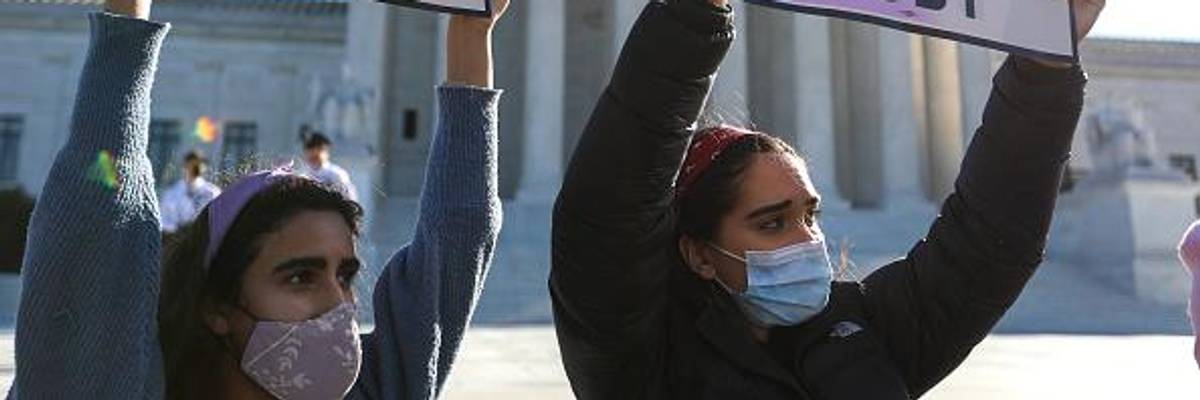
Pro-choice demonstrators protest outside of the U.S. Supreme Court in Washington, D.C. on November 1, 2021. (Photo: Yasin Ozturk/Anadolu Agency via Getty Images)
'Stakes Could Not Be Higher': With Roe in Danger, Coalition Demands Supreme Court Expansion
"We need both legislation to protect our rights and legislation to expand the Court so six hyper-partisan conservative justices can't undo that progress," said one advocate. "This is the urgent response the Court's onslaught on our rights demands.”
Nov 01, 2021
As the U.S. Supreme Court heard oral arguments Monday in two cases challenging the forced-birth law that went into effect in Texas in September, reproductive rights defenders rallied on the steps as judicial reform advocates said the intensifying fight for abortion rights exemplifies the urgent need for court expansion.
The majority-conservative court heard two cases--one brought by the Biden administration and one by the Center for Reproductive Rights (CRR), representing abortion providers--regarding the question of whether Texas can invalidate the constitutional right to abortion care by allowing ordinary citizens rather than courts and government officials from enforcing an abortion ban.
"It should frighten all of us that the Supreme Court is actively attacking settled constitutional doctrine to achieve partisan political outcomes."
Reproductive rights groups expressed horror in September when the Supreme Court declined to step in to stop Texas' law, S.B. 8, from taking effect. The law bans nearly all abortions after about six weeks of pregnancy, makes no exceptions for pregnancies resulting from rape or incest, and establishes a bounty-hunting scheme in the state--allowing any citizen to sue anyone who's helped a person obtain abortion care and entitling the plaintiff to $10,000 if they win their court case.
Since the law was allowed to go into effect, pregnant people have been forced to travel across state lines to obtain abortion care, overwhelming clinics in nearby states. A Planned Parenthood clinic in Oklahoma City reported in recent weeks that more than 60% of its appointments were booked by patients from Texas, including women who had been raped.
"We know exactly what has happened as a result of this law," said Justice Elena Kagan during the oral arguments Monday. "It has chilled everybody on the ground."
Solicitor General Elizabeth B. Prelogar, who was confirmed by the Senate last week, argued on behalf of the Biden administration Monday that S.B. 8 and the Supreme Court's inaction were "an affront to this Court's constitutionally assigned role as the final arbiter of the rights the Constitution secures to the people of this nation."
If the law is allowed to stand, Prelogar said, "no constitutional right is safe. No constitutional decision from this court is safe."
As pro-choice organizers rallied outside the Supreme Court, Democratic lawmakers joined advocacy groups in calling for the addition of seats to the court to help protect reproductive rights.
Reps. Judy Chu (D-Calif.) and Dina Titus (D-Nev.) announced they were joining more than three dozen Democratic lawmakers in co-sponsoring the Judiciary Act of 2021, which would add four seats to the court--countering Republican efforts to pack the court and matching the number of judicial circuit courts. The last time Congress changed the number of Supreme Court seats in 1869, lawmakers settled on nine to match the nine judicial circuits, which have since increased to 13.
"It's time to do what we've done seven times before and expand the court," tweeted Chu.
"With so many important court decisions coming soon, like the future of abortion access in our country, we need the Judiciary Act to expand the Court and ensure that it is representative of America," added the congresswoman. "We are now at a place where the Court has been manipulated by a minority to be intentionally unrepresentative of the country."
Take Back the Court, one of several groups that have lobbied for court expansion in recent years, applauded Chu's announcement and said the Republican Party's intense focus on securing a majority on the high court necessitates "a 'both-and' strategy."
"We need both legislation to protect our rights, and legislation to expand the Court so six hyper-partisan conservative justices can't undo that progress," said Sarah Lipton-Lubet, executive director of Take Back the Court Action Fund. "This is the urgent response the Court's onslaught on our rights demands."
As the court prepared to hear arguments regarding Texas' law, Sen. Ed Markey (D-Mass.), a lead sponsor of the Judiciary Act, applauded the advocacy group Demand Justice for its work to stop "a stolen, far-right [Supreme Court] to threaten the rights of millions of Americans."
"If you care about abortion rights, today would be a good day to get involved in the fight to expand the court," Demand Justice tweeted Monday.
Demand Justice and Take Back the Court joined other progressive groups in the Unrig the Courts coalition with a statement ahead of the oral arguments Monday, saying the 6-3 right-wing majority on the high court is the result of a "long-con effort to roll back our rights" by the Republican Party.
"Because of their scheme, the court has become so overrun by its radical conservative supermajority that it is now electing to hear cases aimed at overturning long-settled rights and freedoms--but not because the law or the Constitution demand it," said the groups. "It should frighten all of us that the Supreme Court is actively attacking settled constitutional doctrine to achieve partisan political outcomes."
They continued:
With reproductive freedom and the right to live free from gun violence on the docket this term, the stakes could not be higher. The truth is, only powerful elites like those on the bench will be safe from the conservative supermajority's war on our rights and freedoms--the rest of us, especially those of us who are already marginalized by the courts system, have too much to lose.It's time for Congress to intervene in this Trump-stacked court's assault on our constitutional rights, and pass the Judiciary Act.

Following the oral arguments on Monday, the Supreme Court suggested it was open to allowing abortion providers pursue their challenge to S.B. 8, potentially returning the case to lower courts. The justices did not indicate whether they might allow the law to stand during further legal proceedings.
An Urgent Message From Our Co-Founder
Dear Common Dreams reader, It’s been nearly 30 years since I co-founded Common Dreams with my late wife, Lina Newhouser. We had the radical notion that journalism should serve the public good, not corporate profits. It was clear to us from the outset what it would take to build such a project. No paid advertisements. No corporate sponsors. No millionaire publisher telling us what to think or do. Many people said we wouldn't last a year, but we proved those doubters wrong. Together with a tremendous team of journalists and dedicated staff, we built an independent media outlet free from the constraints of profits and corporate control. Our mission has always been simple: To inform. To inspire. To ignite change for the common good. Building Common Dreams was not easy. Our survival was never guaranteed. When you take on the most powerful forces—Wall Street greed, fossil fuel industry destruction, Big Tech lobbyists, and uber-rich oligarchs who have spent billions upon billions rigging the economy and democracy in their favor—the only bulwark you have is supporters who believe in your work. But here’s the urgent message from me today. It's never been this bad out there. And it's never been this hard to keep us going. At the very moment Common Dreams is most needed, the threats we face are intensifying. We need your support now more than ever. We don't accept corporate advertising and never will. We don't have a paywall because we don't think people should be blocked from critical news based on their ability to pay. Everything we do is funded by the donations of readers like you. When everyone does the little they can afford, we are strong. But if that support retreats or dries up, so do we. Will you donate now to make sure Common Dreams not only survives but thrives? —Craig Brown, Co-founder |
Our work is licensed under Creative Commons (CC BY-NC-ND 3.0). Feel free to republish and share widely.
As the U.S. Supreme Court heard oral arguments Monday in two cases challenging the forced-birth law that went into effect in Texas in September, reproductive rights defenders rallied on the steps as judicial reform advocates said the intensifying fight for abortion rights exemplifies the urgent need for court expansion.
The majority-conservative court heard two cases--one brought by the Biden administration and one by the Center for Reproductive Rights (CRR), representing abortion providers--regarding the question of whether Texas can invalidate the constitutional right to abortion care by allowing ordinary citizens rather than courts and government officials from enforcing an abortion ban.
"It should frighten all of us that the Supreme Court is actively attacking settled constitutional doctrine to achieve partisan political outcomes."
Reproductive rights groups expressed horror in September when the Supreme Court declined to step in to stop Texas' law, S.B. 8, from taking effect. The law bans nearly all abortions after about six weeks of pregnancy, makes no exceptions for pregnancies resulting from rape or incest, and establishes a bounty-hunting scheme in the state--allowing any citizen to sue anyone who's helped a person obtain abortion care and entitling the plaintiff to $10,000 if they win their court case.
Since the law was allowed to go into effect, pregnant people have been forced to travel across state lines to obtain abortion care, overwhelming clinics in nearby states. A Planned Parenthood clinic in Oklahoma City reported in recent weeks that more than 60% of its appointments were booked by patients from Texas, including women who had been raped.
"We know exactly what has happened as a result of this law," said Justice Elena Kagan during the oral arguments Monday. "It has chilled everybody on the ground."
Solicitor General Elizabeth B. Prelogar, who was confirmed by the Senate last week, argued on behalf of the Biden administration Monday that S.B. 8 and the Supreme Court's inaction were "an affront to this Court's constitutionally assigned role as the final arbiter of the rights the Constitution secures to the people of this nation."
If the law is allowed to stand, Prelogar said, "no constitutional right is safe. No constitutional decision from this court is safe."
As pro-choice organizers rallied outside the Supreme Court, Democratic lawmakers joined advocacy groups in calling for the addition of seats to the court to help protect reproductive rights.
Reps. Judy Chu (D-Calif.) and Dina Titus (D-Nev.) announced they were joining more than three dozen Democratic lawmakers in co-sponsoring the Judiciary Act of 2021, which would add four seats to the court--countering Republican efforts to pack the court and matching the number of judicial circuit courts. The last time Congress changed the number of Supreme Court seats in 1869, lawmakers settled on nine to match the nine judicial circuits, which have since increased to 13.
"It's time to do what we've done seven times before and expand the court," tweeted Chu.
"With so many important court decisions coming soon, like the future of abortion access in our country, we need the Judiciary Act to expand the Court and ensure that it is representative of America," added the congresswoman. "We are now at a place where the Court has been manipulated by a minority to be intentionally unrepresentative of the country."
Take Back the Court, one of several groups that have lobbied for court expansion in recent years, applauded Chu's announcement and said the Republican Party's intense focus on securing a majority on the high court necessitates "a 'both-and' strategy."
"We need both legislation to protect our rights, and legislation to expand the Court so six hyper-partisan conservative justices can't undo that progress," said Sarah Lipton-Lubet, executive director of Take Back the Court Action Fund. "This is the urgent response the Court's onslaught on our rights demands."
As the court prepared to hear arguments regarding Texas' law, Sen. Ed Markey (D-Mass.), a lead sponsor of the Judiciary Act, applauded the advocacy group Demand Justice for its work to stop "a stolen, far-right [Supreme Court] to threaten the rights of millions of Americans."
"If you care about abortion rights, today would be a good day to get involved in the fight to expand the court," Demand Justice tweeted Monday.
Demand Justice and Take Back the Court joined other progressive groups in the Unrig the Courts coalition with a statement ahead of the oral arguments Monday, saying the 6-3 right-wing majority on the high court is the result of a "long-con effort to roll back our rights" by the Republican Party.
"Because of their scheme, the court has become so overrun by its radical conservative supermajority that it is now electing to hear cases aimed at overturning long-settled rights and freedoms--but not because the law or the Constitution demand it," said the groups. "It should frighten all of us that the Supreme Court is actively attacking settled constitutional doctrine to achieve partisan political outcomes."
They continued:
With reproductive freedom and the right to live free from gun violence on the docket this term, the stakes could not be higher. The truth is, only powerful elites like those on the bench will be safe from the conservative supermajority's war on our rights and freedoms--the rest of us, especially those of us who are already marginalized by the courts system, have too much to lose.It's time for Congress to intervene in this Trump-stacked court's assault on our constitutional rights, and pass the Judiciary Act.

Following the oral arguments on Monday, the Supreme Court suggested it was open to allowing abortion providers pursue their challenge to S.B. 8, potentially returning the case to lower courts. The justices did not indicate whether they might allow the law to stand during further legal proceedings.
As the U.S. Supreme Court heard oral arguments Monday in two cases challenging the forced-birth law that went into effect in Texas in September, reproductive rights defenders rallied on the steps as judicial reform advocates said the intensifying fight for abortion rights exemplifies the urgent need for court expansion.
The majority-conservative court heard two cases--one brought by the Biden administration and one by the Center for Reproductive Rights (CRR), representing abortion providers--regarding the question of whether Texas can invalidate the constitutional right to abortion care by allowing ordinary citizens rather than courts and government officials from enforcing an abortion ban.
"It should frighten all of us that the Supreme Court is actively attacking settled constitutional doctrine to achieve partisan political outcomes."
Reproductive rights groups expressed horror in September when the Supreme Court declined to step in to stop Texas' law, S.B. 8, from taking effect. The law bans nearly all abortions after about six weeks of pregnancy, makes no exceptions for pregnancies resulting from rape or incest, and establishes a bounty-hunting scheme in the state--allowing any citizen to sue anyone who's helped a person obtain abortion care and entitling the plaintiff to $10,000 if they win their court case.
Since the law was allowed to go into effect, pregnant people have been forced to travel across state lines to obtain abortion care, overwhelming clinics in nearby states. A Planned Parenthood clinic in Oklahoma City reported in recent weeks that more than 60% of its appointments were booked by patients from Texas, including women who had been raped.
"We know exactly what has happened as a result of this law," said Justice Elena Kagan during the oral arguments Monday. "It has chilled everybody on the ground."
Solicitor General Elizabeth B. Prelogar, who was confirmed by the Senate last week, argued on behalf of the Biden administration Monday that S.B. 8 and the Supreme Court's inaction were "an affront to this Court's constitutionally assigned role as the final arbiter of the rights the Constitution secures to the people of this nation."
If the law is allowed to stand, Prelogar said, "no constitutional right is safe. No constitutional decision from this court is safe."
As pro-choice organizers rallied outside the Supreme Court, Democratic lawmakers joined advocacy groups in calling for the addition of seats to the court to help protect reproductive rights.
Reps. Judy Chu (D-Calif.) and Dina Titus (D-Nev.) announced they were joining more than three dozen Democratic lawmakers in co-sponsoring the Judiciary Act of 2021, which would add four seats to the court--countering Republican efforts to pack the court and matching the number of judicial circuit courts. The last time Congress changed the number of Supreme Court seats in 1869, lawmakers settled on nine to match the nine judicial circuits, which have since increased to 13.
"It's time to do what we've done seven times before and expand the court," tweeted Chu.
"With so many important court decisions coming soon, like the future of abortion access in our country, we need the Judiciary Act to expand the Court and ensure that it is representative of America," added the congresswoman. "We are now at a place where the Court has been manipulated by a minority to be intentionally unrepresentative of the country."
Take Back the Court, one of several groups that have lobbied for court expansion in recent years, applauded Chu's announcement and said the Republican Party's intense focus on securing a majority on the high court necessitates "a 'both-and' strategy."
"We need both legislation to protect our rights, and legislation to expand the Court so six hyper-partisan conservative justices can't undo that progress," said Sarah Lipton-Lubet, executive director of Take Back the Court Action Fund. "This is the urgent response the Court's onslaught on our rights demands."
As the court prepared to hear arguments regarding Texas' law, Sen. Ed Markey (D-Mass.), a lead sponsor of the Judiciary Act, applauded the advocacy group Demand Justice for its work to stop "a stolen, far-right [Supreme Court] to threaten the rights of millions of Americans."
"If you care about abortion rights, today would be a good day to get involved in the fight to expand the court," Demand Justice tweeted Monday.
Demand Justice and Take Back the Court joined other progressive groups in the Unrig the Courts coalition with a statement ahead of the oral arguments Monday, saying the 6-3 right-wing majority on the high court is the result of a "long-con effort to roll back our rights" by the Republican Party.
"Because of their scheme, the court has become so overrun by its radical conservative supermajority that it is now electing to hear cases aimed at overturning long-settled rights and freedoms--but not because the law or the Constitution demand it," said the groups. "It should frighten all of us that the Supreme Court is actively attacking settled constitutional doctrine to achieve partisan political outcomes."
They continued:
With reproductive freedom and the right to live free from gun violence on the docket this term, the stakes could not be higher. The truth is, only powerful elites like those on the bench will be safe from the conservative supermajority's war on our rights and freedoms--the rest of us, especially those of us who are already marginalized by the courts system, have too much to lose.It's time for Congress to intervene in this Trump-stacked court's assault on our constitutional rights, and pass the Judiciary Act.
Following the oral arguments on Monday, the Supreme Court suggested it was open to allowing abortion providers pursue their challenge to S.B. 8, potentially returning the case to lower courts. The justices did not indicate whether they might allow the law to stand during further legal proceedings.
We've had enough. The 1% own and operate the corporate media. They are doing everything they can to defend the status quo, squash dissent and protect the wealthy and the powerful. The Common Dreams media model is different. We cover the news that matters to the 99%. Our mission? To inform. To inspire. To ignite change for the common good. How? Nonprofit. Independent. Reader-supported. Free to read. Free to republish. Free to share. With no advertising. No paywalls. No selling of your data. Thousands of small donations fund our newsroom and allow us to continue publishing. Can you chip in? We can't do it without you. Thank you.