SUBSCRIBE TO OUR FREE NEWSLETTER
Daily news & progressive opinion—funded by the people, not the corporations—delivered straight to your inbox.
5
#000000
#FFFFFF
To donate by check, phone, or other method, see our More Ways to Give page.
Daily news & progressive opinion—funded by the people, not the corporations—delivered straight to your inbox.
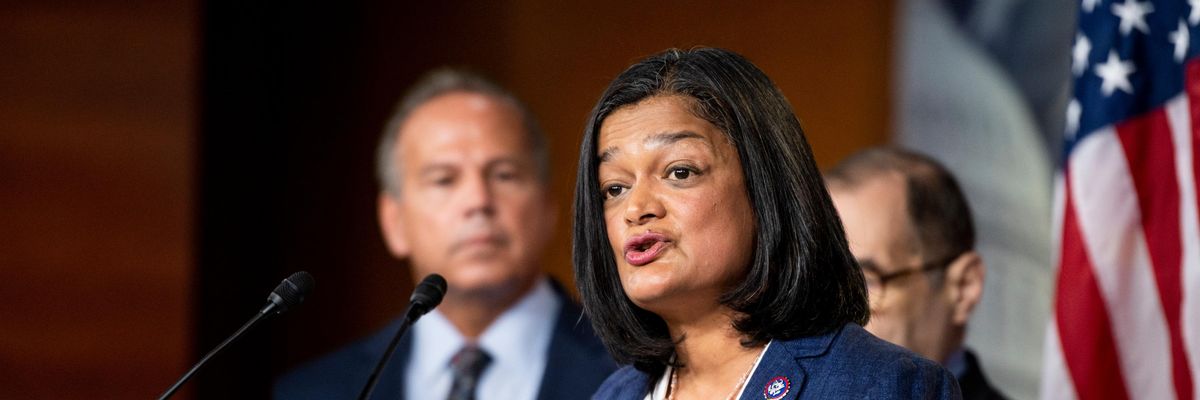
Rep. Pramila Jayapal (D-Wash.) participates in a news conference in the Capitol on June 16, 2021.
Leaders of the Congressional Progressive Caucus on Wednesday reiterated their top-level priorities for the nascent reconciliation package and urged their fellow Democrats to pursue universal programs instead of "complicated methods of means-testing that the wealthy and powerful will use to divide us."
"The CPC agrees that President [Joe] Biden has made a compelling case to the American people that government can, and should, be a force for good in this country, and we agree that bold investments in good-paying union jobs, climate action, immigration reform, and caregiving are essential to uplifting families and building back better," reads a letter that the CPC's executive board sent to House Speaker Nancy Pelosi (D-Calif). "This is our moment to make the president's vision a reality."
The letter--signed by CPC chair Rep. Pramila Jayapal (D-Wash.) and 26 other progressive lawmakers--goes on to outline the "five core priority areas" that the caucus has chosen to emphasize during ongoing negotiations over the reconciliation bill:
The CPC leaders also put forth the caucus' broad vision for how such programs should be crafted, pushing back against right-wing efforts to impose work requirements, income limits, and other restrictions that would limit the number of people who qualify for benefits.
"Much has been made in recent weeks about the compromises necessary to enact this transformative agenda," the CPC members write. "We have been told that we can either adequately fund a small number of investments or legislate broadly, but only make a shallow, short-term impact. We would argue that this is a false choice."
Instead of slashing the funding of key programs in order to extend their duration over 10 years and appease conservative lawmakers' demand for a lower price tag, the CPC executive board contends that Democrats should "make robust investments over a shorter window."
Speaking to reporters earlier this week, Pelosi indicated she is open to that approach.
"This will help make the case for our party's ability to govern, and establish a track record of success that will pave the way for a long-term extension of benefits," the CPC's letter reads. "We cannot pit childcare against housing, or paid leave against home- and community-based care."
The progressive Democrats also deliver a sharp warning against limiting benefits on the basis of income, a route some right-wing lawmakers--including Sen. Joe Manchin (D-W.Va.)--have advocated during recent negotiations over the Build Back Better package.
"We strongly believe that this is the moment to demonstrate to the American people that regardless of geography, race, gender, or class, Democrats believe that everyone has a right to affordable child care, pre-K, clean water, and a community college education," the CPC letter states. "We can choose to strengthen the bond Americans have to one another by proposing universal social insurance benefits that broadly benefit all Americans."
"This bill," the letter concludes, "offers us a chance to fundamentally transform the relationship between the American people and their government."
Dear Common Dreams reader, It’s been nearly 30 years since I co-founded Common Dreams with my late wife, Lina Newhouser. We had the radical notion that journalism should serve the public good, not corporate profits. It was clear to us from the outset what it would take to build such a project. No paid advertisements. No corporate sponsors. No millionaire publisher telling us what to think or do. Many people said we wouldn't last a year, but we proved those doubters wrong. Together with a tremendous team of journalists and dedicated staff, we built an independent media outlet free from the constraints of profits and corporate control. Our mission has always been simple: To inform. To inspire. To ignite change for the common good. Building Common Dreams was not easy. Our survival was never guaranteed. When you take on the most powerful forces—Wall Street greed, fossil fuel industry destruction, Big Tech lobbyists, and uber-rich oligarchs who have spent billions upon billions rigging the economy and democracy in their favor—the only bulwark you have is supporters who believe in your work. But here’s the urgent message from me today. It's never been this bad out there. And it's never been this hard to keep us going. At the very moment Common Dreams is most needed, the threats we face are intensifying. We need your support now more than ever. We don't accept corporate advertising and never will. We don't have a paywall because we don't think people should be blocked from critical news based on their ability to pay. Everything we do is funded by the donations of readers like you. When everyone does the little they can afford, we are strong. But if that support retreats or dries up, so do we. Will you donate now to make sure Common Dreams not only survives but thrives? —Craig Brown, Co-founder |
Leaders of the Congressional Progressive Caucus on Wednesday reiterated their top-level priorities for the nascent reconciliation package and urged their fellow Democrats to pursue universal programs instead of "complicated methods of means-testing that the wealthy and powerful will use to divide us."
"The CPC agrees that President [Joe] Biden has made a compelling case to the American people that government can, and should, be a force for good in this country, and we agree that bold investments in good-paying union jobs, climate action, immigration reform, and caregiving are essential to uplifting families and building back better," reads a letter that the CPC's executive board sent to House Speaker Nancy Pelosi (D-Calif). "This is our moment to make the president's vision a reality."
The letter--signed by CPC chair Rep. Pramila Jayapal (D-Wash.) and 26 other progressive lawmakers--goes on to outline the "five core priority areas" that the caucus has chosen to emphasize during ongoing negotiations over the reconciliation bill:
The CPC leaders also put forth the caucus' broad vision for how such programs should be crafted, pushing back against right-wing efforts to impose work requirements, income limits, and other restrictions that would limit the number of people who qualify for benefits.
"Much has been made in recent weeks about the compromises necessary to enact this transformative agenda," the CPC members write. "We have been told that we can either adequately fund a small number of investments or legislate broadly, but only make a shallow, short-term impact. We would argue that this is a false choice."
Instead of slashing the funding of key programs in order to extend their duration over 10 years and appease conservative lawmakers' demand for a lower price tag, the CPC executive board contends that Democrats should "make robust investments over a shorter window."
Speaking to reporters earlier this week, Pelosi indicated she is open to that approach.
"This will help make the case for our party's ability to govern, and establish a track record of success that will pave the way for a long-term extension of benefits," the CPC's letter reads. "We cannot pit childcare against housing, or paid leave against home- and community-based care."
The progressive Democrats also deliver a sharp warning against limiting benefits on the basis of income, a route some right-wing lawmakers--including Sen. Joe Manchin (D-W.Va.)--have advocated during recent negotiations over the Build Back Better package.
"We strongly believe that this is the moment to demonstrate to the American people that regardless of geography, race, gender, or class, Democrats believe that everyone has a right to affordable child care, pre-K, clean water, and a community college education," the CPC letter states. "We can choose to strengthen the bond Americans have to one another by proposing universal social insurance benefits that broadly benefit all Americans."
"This bill," the letter concludes, "offers us a chance to fundamentally transform the relationship between the American people and their government."
Leaders of the Congressional Progressive Caucus on Wednesday reiterated their top-level priorities for the nascent reconciliation package and urged their fellow Democrats to pursue universal programs instead of "complicated methods of means-testing that the wealthy and powerful will use to divide us."
"The CPC agrees that President [Joe] Biden has made a compelling case to the American people that government can, and should, be a force for good in this country, and we agree that bold investments in good-paying union jobs, climate action, immigration reform, and caregiving are essential to uplifting families and building back better," reads a letter that the CPC's executive board sent to House Speaker Nancy Pelosi (D-Calif). "This is our moment to make the president's vision a reality."
The letter--signed by CPC chair Rep. Pramila Jayapal (D-Wash.) and 26 other progressive lawmakers--goes on to outline the "five core priority areas" that the caucus has chosen to emphasize during ongoing negotiations over the reconciliation bill:
The CPC leaders also put forth the caucus' broad vision for how such programs should be crafted, pushing back against right-wing efforts to impose work requirements, income limits, and other restrictions that would limit the number of people who qualify for benefits.
"Much has been made in recent weeks about the compromises necessary to enact this transformative agenda," the CPC members write. "We have been told that we can either adequately fund a small number of investments or legislate broadly, but only make a shallow, short-term impact. We would argue that this is a false choice."
Instead of slashing the funding of key programs in order to extend their duration over 10 years and appease conservative lawmakers' demand for a lower price tag, the CPC executive board contends that Democrats should "make robust investments over a shorter window."
Speaking to reporters earlier this week, Pelosi indicated she is open to that approach.
"This will help make the case for our party's ability to govern, and establish a track record of success that will pave the way for a long-term extension of benefits," the CPC's letter reads. "We cannot pit childcare against housing, or paid leave against home- and community-based care."
The progressive Democrats also deliver a sharp warning against limiting benefits on the basis of income, a route some right-wing lawmakers--including Sen. Joe Manchin (D-W.Va.)--have advocated during recent negotiations over the Build Back Better package.
"We strongly believe that this is the moment to demonstrate to the American people that regardless of geography, race, gender, or class, Democrats believe that everyone has a right to affordable child care, pre-K, clean water, and a community college education," the CPC letter states. "We can choose to strengthen the bond Americans have to one another by proposing universal social insurance benefits that broadly benefit all Americans."
"This bill," the letter concludes, "offers us a chance to fundamentally transform the relationship between the American people and their government."