SUBSCRIBE TO OUR FREE NEWSLETTER
Daily news & progressive opinion—funded by the people, not the corporations—delivered straight to your inbox.
5
#000000
#FFFFFF
To donate by check, phone, or other method, see our More Ways to Give page.
Daily news & progressive opinion—funded by the people, not the corporations—delivered straight to your inbox.
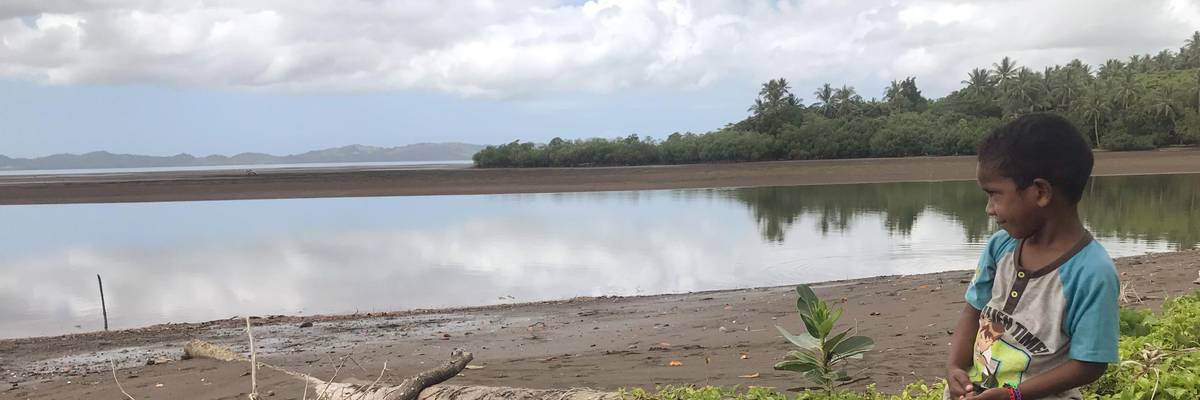
A boy sits on a log in the village of Vunisavisavi in Fiji, on October 16, 2017. The village is the first in the country to be forced to relocate due to rising water levels. (Photo: Christoph Sator/Picture Alliance via Getty Images)
As world leaders prepare to jet off to this month's United Nations Climate Change Conference in Scotland, the heads of several Pacific island nations in recent days urged world leaders to leave their good intentions at home and commit to urgent, meaningful climate action.
"We refuse to be the proverbial canaries in the coal mine, as we are so often called."
On Thursday, Fijian Prime Minister Frank Bainimarama, Marshallese President David Kabua, and Samoan Prime Minister Fiame Naomi Mata'afa addressed the European Union-Indo-Pacific Virtual Conference on Climate Change.
"For our sake and all of humanity's, small island developing states will use the full measure of our moral authority against major emitters who refuse to arrive in Glasgow with strong commitments," Bainimarama told the conference, according to Agence France-Presse.
Bainimarama lamented that low-lying Pacific island nations--which are among the least responsible for the climate emergency and but most adversely affected by it--stressed that the Glasgow summit, also known as COP 26, must not end in "a litany of good intentions."
"The consequences of inaction are unthinkable," he said. "The loss of entire islands, as well as vast stretches of coastline from Lagos to Venice to Miami, the coastal belt of Bangladesh. Mass climate-driven migration, wildfire seasons in arid regions that incinerate homes, farms, ecosystems, and an unimaginable loss of biodiversity--the list of horrors goes on."
Earlier this week, Bainimarama angrily told a forum organized by former U.S. Vice President Al Gore's Climate Reality Project that "we refuse to be the proverbial canaries in the coal mine, as we are so often called."
"We want more of ourselves than to be helpless songbirds whose demand serves as a warning to others," he said, urging Pacific island nations to not allow world leaders to "sneak in and out of Glasgow without making a single serious commitment."
According to The Syndey Morning Herald:
Bainimarama said Pacific Island nations will demand that... wealthier countries make good on the commitment they made during the Paris talks to extend to developing nations $100 billion in finance annually for climate adaptation and mitigation; and to commit to emission cuts that keep the 1.5degC warming target within reach.
"That is our expectation for every nation," said Bainimarama. "Our actions will decide whether islands exist or are lost to the rising seas."
Kabua said Thursday that "my country and this region needs the world to recognize that this cannot wait."
"We face the most difficult questions--which islands to preserve, what happens when our people are forced to move against their will, how will we preserve our culture?" he said. "We need a signal from the rest of the world, particularly the large emitters, that our voices and our needs are being heard."
Mata'afa told the E.U.-backed conference that "we are already experiencing intense and frequent tropical cyclones and droughts, increased heavy precipitation and floods, ocean warming, and acidification. The impacts are detrimental to our health, wellbeing, livelihoods, and way of life."
Speaking late last month at the United Nations General Assembly, she stressed: "It is about action for survival, and we all need to shoulder our responsibilities and play our part. The big polluters and emitters need to demonstrate more commitment and leadership."
"The upcoming COP in Glasgow is our point of no return," she added. "Our commitments from there onwards will determine the future trajectory of our planet. Can we avoid a climate catastrophe in our children's lifetime?"
Dear Common Dreams reader, It’s been nearly 30 years since I co-founded Common Dreams with my late wife, Lina Newhouser. We had the radical notion that journalism should serve the public good, not corporate profits. It was clear to us from the outset what it would take to build such a project. No paid advertisements. No corporate sponsors. No millionaire publisher telling us what to think or do. Many people said we wouldn't last a year, but we proved those doubters wrong. Together with a tremendous team of journalists and dedicated staff, we built an independent media outlet free from the constraints of profits and corporate control. Our mission has always been simple: To inform. To inspire. To ignite change for the common good. Building Common Dreams was not easy. Our survival was never guaranteed. When you take on the most powerful forces—Wall Street greed, fossil fuel industry destruction, Big Tech lobbyists, and uber-rich oligarchs who have spent billions upon billions rigging the economy and democracy in their favor—the only bulwark you have is supporters who believe in your work. But here’s the urgent message from me today. It's never been this bad out there. And it's never been this hard to keep us going. At the very moment Common Dreams is most needed, the threats we face are intensifying. We need your support now more than ever. We don't accept corporate advertising and never will. We don't have a paywall because we don't think people should be blocked from critical news based on their ability to pay. Everything we do is funded by the donations of readers like you. When everyone does the little they can afford, we are strong. But if that support retreats or dries up, so do we. Will you donate now to make sure Common Dreams not only survives but thrives? —Craig Brown, Co-founder |
As world leaders prepare to jet off to this month's United Nations Climate Change Conference in Scotland, the heads of several Pacific island nations in recent days urged world leaders to leave their good intentions at home and commit to urgent, meaningful climate action.
"We refuse to be the proverbial canaries in the coal mine, as we are so often called."
On Thursday, Fijian Prime Minister Frank Bainimarama, Marshallese President David Kabua, and Samoan Prime Minister Fiame Naomi Mata'afa addressed the European Union-Indo-Pacific Virtual Conference on Climate Change.
"For our sake and all of humanity's, small island developing states will use the full measure of our moral authority against major emitters who refuse to arrive in Glasgow with strong commitments," Bainimarama told the conference, according to Agence France-Presse.
Bainimarama lamented that low-lying Pacific island nations--which are among the least responsible for the climate emergency and but most adversely affected by it--stressed that the Glasgow summit, also known as COP 26, must not end in "a litany of good intentions."
"The consequences of inaction are unthinkable," he said. "The loss of entire islands, as well as vast stretches of coastline from Lagos to Venice to Miami, the coastal belt of Bangladesh. Mass climate-driven migration, wildfire seasons in arid regions that incinerate homes, farms, ecosystems, and an unimaginable loss of biodiversity--the list of horrors goes on."
Earlier this week, Bainimarama angrily told a forum organized by former U.S. Vice President Al Gore's Climate Reality Project that "we refuse to be the proverbial canaries in the coal mine, as we are so often called."
"We want more of ourselves than to be helpless songbirds whose demand serves as a warning to others," he said, urging Pacific island nations to not allow world leaders to "sneak in and out of Glasgow without making a single serious commitment."
According to The Syndey Morning Herald:
Bainimarama said Pacific Island nations will demand that... wealthier countries make good on the commitment they made during the Paris talks to extend to developing nations $100 billion in finance annually for climate adaptation and mitigation; and to commit to emission cuts that keep the 1.5degC warming target within reach.
"That is our expectation for every nation," said Bainimarama. "Our actions will decide whether islands exist or are lost to the rising seas."
Kabua said Thursday that "my country and this region needs the world to recognize that this cannot wait."
"We face the most difficult questions--which islands to preserve, what happens when our people are forced to move against their will, how will we preserve our culture?" he said. "We need a signal from the rest of the world, particularly the large emitters, that our voices and our needs are being heard."
Mata'afa told the E.U.-backed conference that "we are already experiencing intense and frequent tropical cyclones and droughts, increased heavy precipitation and floods, ocean warming, and acidification. The impacts are detrimental to our health, wellbeing, livelihoods, and way of life."
Speaking late last month at the United Nations General Assembly, she stressed: "It is about action for survival, and we all need to shoulder our responsibilities and play our part. The big polluters and emitters need to demonstrate more commitment and leadership."
"The upcoming COP in Glasgow is our point of no return," she added. "Our commitments from there onwards will determine the future trajectory of our planet. Can we avoid a climate catastrophe in our children's lifetime?"
As world leaders prepare to jet off to this month's United Nations Climate Change Conference in Scotland, the heads of several Pacific island nations in recent days urged world leaders to leave their good intentions at home and commit to urgent, meaningful climate action.
"We refuse to be the proverbial canaries in the coal mine, as we are so often called."
On Thursday, Fijian Prime Minister Frank Bainimarama, Marshallese President David Kabua, and Samoan Prime Minister Fiame Naomi Mata'afa addressed the European Union-Indo-Pacific Virtual Conference on Climate Change.
"For our sake and all of humanity's, small island developing states will use the full measure of our moral authority against major emitters who refuse to arrive in Glasgow with strong commitments," Bainimarama told the conference, according to Agence France-Presse.
Bainimarama lamented that low-lying Pacific island nations--which are among the least responsible for the climate emergency and but most adversely affected by it--stressed that the Glasgow summit, also known as COP 26, must not end in "a litany of good intentions."
"The consequences of inaction are unthinkable," he said. "The loss of entire islands, as well as vast stretches of coastline from Lagos to Venice to Miami, the coastal belt of Bangladesh. Mass climate-driven migration, wildfire seasons in arid regions that incinerate homes, farms, ecosystems, and an unimaginable loss of biodiversity--the list of horrors goes on."
Earlier this week, Bainimarama angrily told a forum organized by former U.S. Vice President Al Gore's Climate Reality Project that "we refuse to be the proverbial canaries in the coal mine, as we are so often called."
"We want more of ourselves than to be helpless songbirds whose demand serves as a warning to others," he said, urging Pacific island nations to not allow world leaders to "sneak in and out of Glasgow without making a single serious commitment."
According to The Syndey Morning Herald:
Bainimarama said Pacific Island nations will demand that... wealthier countries make good on the commitment they made during the Paris talks to extend to developing nations $100 billion in finance annually for climate adaptation and mitigation; and to commit to emission cuts that keep the 1.5degC warming target within reach.
"That is our expectation for every nation," said Bainimarama. "Our actions will decide whether islands exist or are lost to the rising seas."
Kabua said Thursday that "my country and this region needs the world to recognize that this cannot wait."
"We face the most difficult questions--which islands to preserve, what happens when our people are forced to move against their will, how will we preserve our culture?" he said. "We need a signal from the rest of the world, particularly the large emitters, that our voices and our needs are being heard."
Mata'afa told the E.U.-backed conference that "we are already experiencing intense and frequent tropical cyclones and droughts, increased heavy precipitation and floods, ocean warming, and acidification. The impacts are detrimental to our health, wellbeing, livelihoods, and way of life."
Speaking late last month at the United Nations General Assembly, she stressed: "It is about action for survival, and we all need to shoulder our responsibilities and play our part. The big polluters and emitters need to demonstrate more commitment and leadership."
"The upcoming COP in Glasgow is our point of no return," she added. "Our commitments from there onwards will determine the future trajectory of our planet. Can we avoid a climate catastrophe in our children's lifetime?"