SUBSCRIBE TO OUR FREE NEWSLETTER
Daily news & progressive opinion—funded by the people, not the corporations—delivered straight to your inbox.
5
#000000
#FFFFFF
To donate by check, phone, or other method, see our More Ways to Give page.
Daily news & progressive opinion—funded by the people, not the corporations—delivered straight to your inbox.
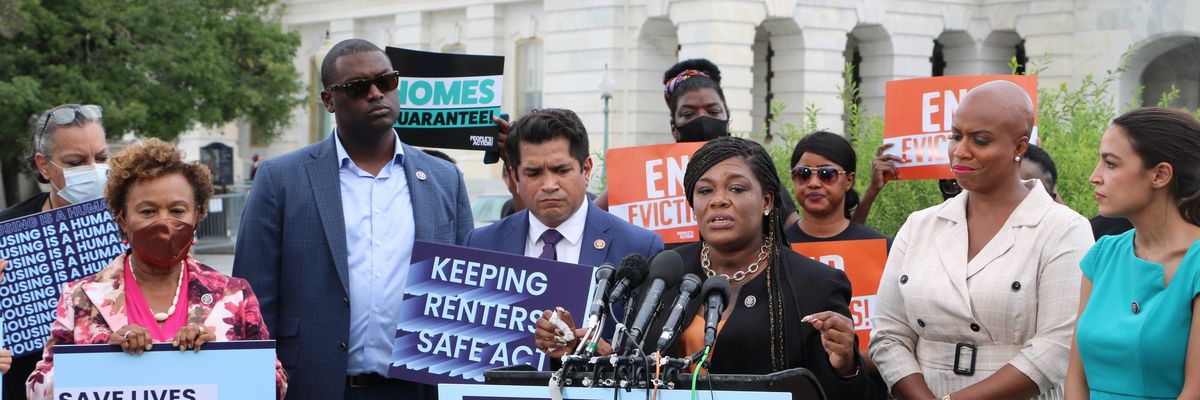
Rep. Cori Bush (D-Mo.) is the lead House sponsor of the Keeping Renters Safe Act of 2021. (Photo: Rep. Barbara Lee/Twitter)
With millions of people across the United States facing lapsed eviction moratoria, joblessness, and expired unemployment benefits as the coronavirus pandemic drags on, U.S. Rep. Cori Bush and Sen. Elizabeth Warren on Tuesday unveiled a bill to help keep renters in their homes.
The pair led dozens of lawmakers in introducing the Keeping Renters Safe Act of 2021 (pdf), which would clarify that the head of the Department of Health and Human Services (HHS) has the statutory authority to implement an eviction moratorium in the interest of public health, and call on him to do so in response to the current emergency.
"Housing is a human right, not a bargaining chip to let fall between bureaucratic cracks."
--Rep. Cori Bush
The bill, if passed, would direct HHS Secretary Xavier Becerra to implement a national moratorium that automatically "applies to all residential eviction filings, hearings, judgments, and execution of judgments," and would remain in effect for at least 60 days after the end of the Covid-19 pandemic.
"Housing is a human right, not a bargaining chip to let fall between bureaucratic cracks," declared Bush (D-Mo.), who was previously homeless and has led multiple legislative proposals to address housing insecurity, including the Unhoused Bill of Rights.
Noting that the virus has killed over 670,000 people nationwide and infected millions more Americans, leaving an unknown number "permanently disabled from its aftereffects," Bush argued that "as the Delta variant continues to force individuals to quarantine, close schools, and stifle businesses, we must do all we can to save lives."
"That starts with keeping every person safely housed," she added. "The Keeping Renters Safe of 2021 will save lives and give us more time: time for renters to receive financial assistance, time for the economy to fully recover, and time for the pandemic to finally come to an end."
As Warren (D-Mass.) put it: "This pandemic isn't over, and we have to do everything we can to protect renters from the harm and trauma of needless eviction, which upends the lives of those struggling to get back on their feet."
"Pushing hundreds of thousands of people out of their homes will only exacerbate this public health crisis, and cause economic harm to families, their communities, and our overall recovery," the former bankruptcy law professor warned. "Congress must pass the Keeping Renters Safe Act of 2021 to put the eviction moratorium back in place and clarify that HHS has the authority to protect renters throughout this public health crisis. Safe housing saves lives."
Their proposal comes after months of uncertainty over whether renters would be evicted during the public health crisis due to a series of actions by all three branches of the U.S. government.
In late July, just three days before the expiration of a national eviction moratorium that was in effect, President Joe Biden's White House called on lawmakers to extend it, claiming that a recent U.S. Supreme Court ruling prevented the administration from doing so directly.
After the Democrat-controlled Congress failed to act to prevent evictions--in spite of pressure from Bush and other progressives who slept on the steps of the U.S. Capitol--the Biden administration took a new approach to a moratorium, which was also blocked by the court.
Meanwhile, Congress and its state and local partners have struggled to rapidly distribute billions of dollars in pandemic-related federal rental assistance--an issue for which Bush has also proposed legislative fixes.
"With millions of vulnerable renters at risk of being unhoused as Covid-19 deaths spike nationwide, Congress must act with urgency to prevent the impending eviction crisis and the trauma that would accompany it," said Rep. Ayanna Pressley (D-Mass.), a co-sponsor of the new bill. "Without collective action, Covid-19 will continue to spread, lives and homes will continue to be lost, and the hurt our communities are experiencing will only get worse."
Rep. Mondaire Jones (D-N.Y.)--another co-sponsor who joined Bush and Pressley on the Capitol steps last month--called out the Supreme Court's far-right majority for its "dangerous, partisan decision" striking down the administration's last-ditch effort to avert a national eviction crisis and emphasized Congress' responsibility to act now.
"In the world's richest nation, no one should have to experience housing insecurity--especially not during a deadly pandemic with the Delta variant ravaging our communities," Jones said Tuesday. "We have a moral obligation to ensure every person remains safe and housed for the duration of this pandemic and long after. That's exactly what our bill, the Keeping Renters Safe Act, would do."
In addition to five other progressive senators and dozens more House Democrats, the bill is supported by 82 organizations, including the National Coalition for the Homeless, National Low Income Housing Coalition (NLIHC), People's Action, Sunrise Movement, and Working Families Party.
Warning that the Supreme Court's latest decision "will have devastating and long-lasting consequences," NLIHC president and CEO Diane Yentel called on Congress to urgently pass Bush and Warren's bill.
"Without the moratorium in place," she said, "families will be pushed deeper into poverty, communities will struggle with increased spread of Covid-19, and our country will have a harder time containing the virus."
Dear Common Dreams reader, It’s been nearly 30 years since I co-founded Common Dreams with my late wife, Lina Newhouser. We had the radical notion that journalism should serve the public good, not corporate profits. It was clear to us from the outset what it would take to build such a project. No paid advertisements. No corporate sponsors. No millionaire publisher telling us what to think or do. Many people said we wouldn't last a year, but we proved those doubters wrong. Together with a tremendous team of journalists and dedicated staff, we built an independent media outlet free from the constraints of profits and corporate control. Our mission has always been simple: To inform. To inspire. To ignite change for the common good. Building Common Dreams was not easy. Our survival was never guaranteed. When you take on the most powerful forces—Wall Street greed, fossil fuel industry destruction, Big Tech lobbyists, and uber-rich oligarchs who have spent billions upon billions rigging the economy and democracy in their favor—the only bulwark you have is supporters who believe in your work. But here’s the urgent message from me today. It's never been this bad out there. And it's never been this hard to keep us going. At the very moment Common Dreams is most needed, the threats we face are intensifying. We need your support now more than ever. We don't accept corporate advertising and never will. We don't have a paywall because we don't think people should be blocked from critical news based on their ability to pay. Everything we do is funded by the donations of readers like you. When everyone does the little they can afford, we are strong. But if that support retreats or dries up, so do we. Will you donate now to make sure Common Dreams not only survives but thrives? —Craig Brown, Co-founder |
With millions of people across the United States facing lapsed eviction moratoria, joblessness, and expired unemployment benefits as the coronavirus pandemic drags on, U.S. Rep. Cori Bush and Sen. Elizabeth Warren on Tuesday unveiled a bill to help keep renters in their homes.
The pair led dozens of lawmakers in introducing the Keeping Renters Safe Act of 2021 (pdf), which would clarify that the head of the Department of Health and Human Services (HHS) has the statutory authority to implement an eviction moratorium in the interest of public health, and call on him to do so in response to the current emergency.
"Housing is a human right, not a bargaining chip to let fall between bureaucratic cracks."
--Rep. Cori Bush
The bill, if passed, would direct HHS Secretary Xavier Becerra to implement a national moratorium that automatically "applies to all residential eviction filings, hearings, judgments, and execution of judgments," and would remain in effect for at least 60 days after the end of the Covid-19 pandemic.
"Housing is a human right, not a bargaining chip to let fall between bureaucratic cracks," declared Bush (D-Mo.), who was previously homeless and has led multiple legislative proposals to address housing insecurity, including the Unhoused Bill of Rights.
Noting that the virus has killed over 670,000 people nationwide and infected millions more Americans, leaving an unknown number "permanently disabled from its aftereffects," Bush argued that "as the Delta variant continues to force individuals to quarantine, close schools, and stifle businesses, we must do all we can to save lives."
"That starts with keeping every person safely housed," she added. "The Keeping Renters Safe of 2021 will save lives and give us more time: time for renters to receive financial assistance, time for the economy to fully recover, and time for the pandemic to finally come to an end."
As Warren (D-Mass.) put it: "This pandemic isn't over, and we have to do everything we can to protect renters from the harm and trauma of needless eviction, which upends the lives of those struggling to get back on their feet."
"Pushing hundreds of thousands of people out of their homes will only exacerbate this public health crisis, and cause economic harm to families, their communities, and our overall recovery," the former bankruptcy law professor warned. "Congress must pass the Keeping Renters Safe Act of 2021 to put the eviction moratorium back in place and clarify that HHS has the authority to protect renters throughout this public health crisis. Safe housing saves lives."
Their proposal comes after months of uncertainty over whether renters would be evicted during the public health crisis due to a series of actions by all three branches of the U.S. government.
In late July, just three days before the expiration of a national eviction moratorium that was in effect, President Joe Biden's White House called on lawmakers to extend it, claiming that a recent U.S. Supreme Court ruling prevented the administration from doing so directly.
After the Democrat-controlled Congress failed to act to prevent evictions--in spite of pressure from Bush and other progressives who slept on the steps of the U.S. Capitol--the Biden administration took a new approach to a moratorium, which was also blocked by the court.
Meanwhile, Congress and its state and local partners have struggled to rapidly distribute billions of dollars in pandemic-related federal rental assistance--an issue for which Bush has also proposed legislative fixes.
"With millions of vulnerable renters at risk of being unhoused as Covid-19 deaths spike nationwide, Congress must act with urgency to prevent the impending eviction crisis and the trauma that would accompany it," said Rep. Ayanna Pressley (D-Mass.), a co-sponsor of the new bill. "Without collective action, Covid-19 will continue to spread, lives and homes will continue to be lost, and the hurt our communities are experiencing will only get worse."
Rep. Mondaire Jones (D-N.Y.)--another co-sponsor who joined Bush and Pressley on the Capitol steps last month--called out the Supreme Court's far-right majority for its "dangerous, partisan decision" striking down the administration's last-ditch effort to avert a national eviction crisis and emphasized Congress' responsibility to act now.
"In the world's richest nation, no one should have to experience housing insecurity--especially not during a deadly pandemic with the Delta variant ravaging our communities," Jones said Tuesday. "We have a moral obligation to ensure every person remains safe and housed for the duration of this pandemic and long after. That's exactly what our bill, the Keeping Renters Safe Act, would do."
In addition to five other progressive senators and dozens more House Democrats, the bill is supported by 82 organizations, including the National Coalition for the Homeless, National Low Income Housing Coalition (NLIHC), People's Action, Sunrise Movement, and Working Families Party.
Warning that the Supreme Court's latest decision "will have devastating and long-lasting consequences," NLIHC president and CEO Diane Yentel called on Congress to urgently pass Bush and Warren's bill.
"Without the moratorium in place," she said, "families will be pushed deeper into poverty, communities will struggle with increased spread of Covid-19, and our country will have a harder time containing the virus."
With millions of people across the United States facing lapsed eviction moratoria, joblessness, and expired unemployment benefits as the coronavirus pandemic drags on, U.S. Rep. Cori Bush and Sen. Elizabeth Warren on Tuesday unveiled a bill to help keep renters in their homes.
The pair led dozens of lawmakers in introducing the Keeping Renters Safe Act of 2021 (pdf), which would clarify that the head of the Department of Health and Human Services (HHS) has the statutory authority to implement an eviction moratorium in the interest of public health, and call on him to do so in response to the current emergency.
"Housing is a human right, not a bargaining chip to let fall between bureaucratic cracks."
--Rep. Cori Bush
The bill, if passed, would direct HHS Secretary Xavier Becerra to implement a national moratorium that automatically "applies to all residential eviction filings, hearings, judgments, and execution of judgments," and would remain in effect for at least 60 days after the end of the Covid-19 pandemic.
"Housing is a human right, not a bargaining chip to let fall between bureaucratic cracks," declared Bush (D-Mo.), who was previously homeless and has led multiple legislative proposals to address housing insecurity, including the Unhoused Bill of Rights.
Noting that the virus has killed over 670,000 people nationwide and infected millions more Americans, leaving an unknown number "permanently disabled from its aftereffects," Bush argued that "as the Delta variant continues to force individuals to quarantine, close schools, and stifle businesses, we must do all we can to save lives."
"That starts with keeping every person safely housed," she added. "The Keeping Renters Safe of 2021 will save lives and give us more time: time for renters to receive financial assistance, time for the economy to fully recover, and time for the pandemic to finally come to an end."
As Warren (D-Mass.) put it: "This pandemic isn't over, and we have to do everything we can to protect renters from the harm and trauma of needless eviction, which upends the lives of those struggling to get back on their feet."
"Pushing hundreds of thousands of people out of their homes will only exacerbate this public health crisis, and cause economic harm to families, their communities, and our overall recovery," the former bankruptcy law professor warned. "Congress must pass the Keeping Renters Safe Act of 2021 to put the eviction moratorium back in place and clarify that HHS has the authority to protect renters throughout this public health crisis. Safe housing saves lives."
Their proposal comes after months of uncertainty over whether renters would be evicted during the public health crisis due to a series of actions by all three branches of the U.S. government.
In late July, just three days before the expiration of a national eviction moratorium that was in effect, President Joe Biden's White House called on lawmakers to extend it, claiming that a recent U.S. Supreme Court ruling prevented the administration from doing so directly.
After the Democrat-controlled Congress failed to act to prevent evictions--in spite of pressure from Bush and other progressives who slept on the steps of the U.S. Capitol--the Biden administration took a new approach to a moratorium, which was also blocked by the court.
Meanwhile, Congress and its state and local partners have struggled to rapidly distribute billions of dollars in pandemic-related federal rental assistance--an issue for which Bush has also proposed legislative fixes.
"With millions of vulnerable renters at risk of being unhoused as Covid-19 deaths spike nationwide, Congress must act with urgency to prevent the impending eviction crisis and the trauma that would accompany it," said Rep. Ayanna Pressley (D-Mass.), a co-sponsor of the new bill. "Without collective action, Covid-19 will continue to spread, lives and homes will continue to be lost, and the hurt our communities are experiencing will only get worse."
Rep. Mondaire Jones (D-N.Y.)--another co-sponsor who joined Bush and Pressley on the Capitol steps last month--called out the Supreme Court's far-right majority for its "dangerous, partisan decision" striking down the administration's last-ditch effort to avert a national eviction crisis and emphasized Congress' responsibility to act now.
"In the world's richest nation, no one should have to experience housing insecurity--especially not during a deadly pandemic with the Delta variant ravaging our communities," Jones said Tuesday. "We have a moral obligation to ensure every person remains safe and housed for the duration of this pandemic and long after. That's exactly what our bill, the Keeping Renters Safe Act, would do."
In addition to five other progressive senators and dozens more House Democrats, the bill is supported by 82 organizations, including the National Coalition for the Homeless, National Low Income Housing Coalition (NLIHC), People's Action, Sunrise Movement, and Working Families Party.
Warning that the Supreme Court's latest decision "will have devastating and long-lasting consequences," NLIHC president and CEO Diane Yentel called on Congress to urgently pass Bush and Warren's bill.
"Without the moratorium in place," she said, "families will be pushed deeper into poverty, communities will struggle with increased spread of Covid-19, and our country will have a harder time containing the virus."