SUBSCRIBE TO OUR FREE NEWSLETTER
Daily news & progressive opinion—funded by the people, not the corporations—delivered straight to your inbox.
5
#000000
#FFFFFF
To donate by check, phone, or other method, see our More Ways to Give page.
Daily news & progressive opinion—funded by the people, not the corporations—delivered straight to your inbox.
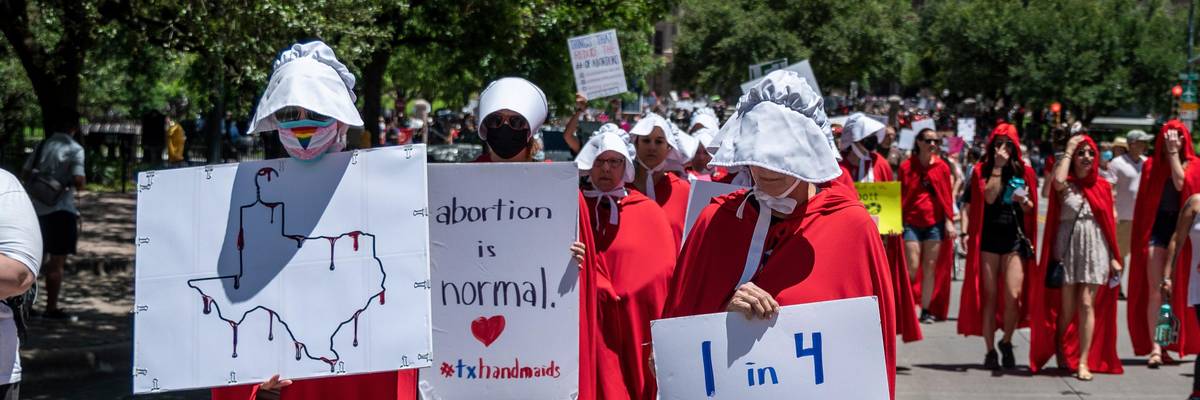
Pro-choice protesters march down Congress Avenue at a protest in Austin, Texas on May 29, 2021. (Photo: Sergio Flores/Getty Images)
"I provided an abortion to a woman who, though still in her first trimester, was beyond the state's new limit. I acted because I had a duty of care to this patient, as I do for all patients, and because she has a fundamental right to receive this care."
Dr. Alan Braid, who provides abortion care in San Antonio, explained his decision to violate Texas' new law in a Saturday opinion piece for The Washington Post, drawing praise and gratitude from reproductive rights advocates and healthcare professionals nationwide.
Texas' Senate Bill 8--which the U.S. Supreme Court's right-wing majority let take effect this month, in spite of Roe v. Wade--bans abortions after about six weeks of pregnancy, with no expectations for rape or incest, and empowers anti-choice vigilantes to enforce the law.
Readers turned to Twitter to thank Braid, express admiration for his courage and integrity, and encourage others to engage with his "extremely powerful, must-read" piece.
Braid began his obstetrics and gynecology residency in 1972, the year before the nation's highest court affirmed the constitutional right to abortion with Roe. He noted that before the landmark ruling, "abortion was effectively illegal in Texas--unless a psychiatrist certified a woman was suicidal."
"At the hospital that year, I saw three teenagers die from illegal abortions," the doctor recalled of 1972. "One I will never forget. When she came into the ER, her vaginal cavity was packed with rags. She died a few days later from massive organ failure, caused by a septic infection."
Detailing his career from Roe to S.B. 8, he wrote, "For the next 45 years--not including the two years I was away in the Air Force--I was a practicing OB/GYN in Texas, conducting Pap smears, pelvic exams and pregnancy check-ups; delivering more than 10,000 babies; and providing abortion care at clinics I opened in Houston and San Antonio, and another in Oklahoma."
According to Braid:
Though we never ask why someone has come to our clinic, they often tell us. They're finishing school or they already have three children, they're in an abusive relationship, or it's just not time. A majority are mothers. Most are between 18 and 30. Many are struggling financially--more than half qualify for some form of financial aid from us.
Several times a month, a woman confides that she is having the abortion because she has been raped. Sometimes, she reports it to the police; more often, she doesn't.
The doctor disclosed that he provided an abortion that violated state law on September 6. Although his unidentified patient is not legally at risk, Braid is. As part of a scheme to make the statute harder to strike down in court, S.B. 8 enables individuals to sue anyone who "aids or abets" an abortion beyond the new limit and potentially collect a $10,000 "bounty."
"I fully understood that there could be legal consequences--but I wanted to make sure that Texas didn't get away with its bid to prevent this blatantly unconstitutional law from being tested," wrote Braid, whose clinics are among the plaintiffs represented by the Center for Reproductive Rights (CRR) in an ongoing federal lawsuit to stop S.B. 8.
In an interview with The New York Times, Braid said he had consulted with CRR lawyers and expressed hope that his disclosure would contribute to invalidating the Texas law.
"I hope the law gets overturned," Braid told new newspaper, "and if this is what does it, that would be great."
After the Post piece was published, Nancy Northup, CRR's president and CEO, said in a statement that "Dr. Braid has courageously stood up against this blatantly unconstitutional law."
"We stand ready to defend him against the vigilante lawsuits that S.B. 8 threatens to unleash against those providing or supporting access to constitutionally protected abortion care," Northup added.
In addition to challenging Texas' ban, CRR is among the advocacy groups calling on the Democrat-controlled Congress to pass the Women's Health Protection Act (H.R. 3755/S. 1975), legislation to codify Roe that the U.S. House of Representatives plans to vote on this month.
While the Biden administration is also suing Texas over S.B. 8 and taking steps to support abortion patients and providers in the state, the new law and an upcoming U.S. Supreme Court case that could overturn Roe has bolstered arguments for abolishing the filibuster in the Senate so that Democrats can enact federal protections for reproductive rights.
Dear Common Dreams reader, It’s been nearly 30 years since I co-founded Common Dreams with my late wife, Lina Newhouser. We had the radical notion that journalism should serve the public good, not corporate profits. It was clear to us from the outset what it would take to build such a project. No paid advertisements. No corporate sponsors. No millionaire publisher telling us what to think or do. Many people said we wouldn't last a year, but we proved those doubters wrong. Together with a tremendous team of journalists and dedicated staff, we built an independent media outlet free from the constraints of profits and corporate control. Our mission has always been simple: To inform. To inspire. To ignite change for the common good. Building Common Dreams was not easy. Our survival was never guaranteed. When you take on the most powerful forces—Wall Street greed, fossil fuel industry destruction, Big Tech lobbyists, and uber-rich oligarchs who have spent billions upon billions rigging the economy and democracy in their favor—the only bulwark you have is supporters who believe in your work. But here’s the urgent message from me today. It's never been this bad out there. And it's never been this hard to keep us going. At the very moment Common Dreams is most needed, the threats we face are intensifying. We need your support now more than ever. We don't accept corporate advertising and never will. We don't have a paywall because we don't think people should be blocked from critical news based on their ability to pay. Everything we do is funded by the donations of readers like you. When everyone does the little they can afford, we are strong. But if that support retreats or dries up, so do we. Will you donate now to make sure Common Dreams not only survives but thrives? —Craig Brown, Co-founder |
"I provided an abortion to a woman who, though still in her first trimester, was beyond the state's new limit. I acted because I had a duty of care to this patient, as I do for all patients, and because she has a fundamental right to receive this care."
Dr. Alan Braid, who provides abortion care in San Antonio, explained his decision to violate Texas' new law in a Saturday opinion piece for The Washington Post, drawing praise and gratitude from reproductive rights advocates and healthcare professionals nationwide.
Texas' Senate Bill 8--which the U.S. Supreme Court's right-wing majority let take effect this month, in spite of Roe v. Wade--bans abortions after about six weeks of pregnancy, with no expectations for rape or incest, and empowers anti-choice vigilantes to enforce the law.
Readers turned to Twitter to thank Braid, express admiration for his courage and integrity, and encourage others to engage with his "extremely powerful, must-read" piece.
Braid began his obstetrics and gynecology residency in 1972, the year before the nation's highest court affirmed the constitutional right to abortion with Roe. He noted that before the landmark ruling, "abortion was effectively illegal in Texas--unless a psychiatrist certified a woman was suicidal."
"At the hospital that year, I saw three teenagers die from illegal abortions," the doctor recalled of 1972. "One I will never forget. When she came into the ER, her vaginal cavity was packed with rags. She died a few days later from massive organ failure, caused by a septic infection."
Detailing his career from Roe to S.B. 8, he wrote, "For the next 45 years--not including the two years I was away in the Air Force--I was a practicing OB/GYN in Texas, conducting Pap smears, pelvic exams and pregnancy check-ups; delivering more than 10,000 babies; and providing abortion care at clinics I opened in Houston and San Antonio, and another in Oklahoma."
According to Braid:
Though we never ask why someone has come to our clinic, they often tell us. They're finishing school or they already have three children, they're in an abusive relationship, or it's just not time. A majority are mothers. Most are between 18 and 30. Many are struggling financially--more than half qualify for some form of financial aid from us.
Several times a month, a woman confides that she is having the abortion because she has been raped. Sometimes, she reports it to the police; more often, she doesn't.
The doctor disclosed that he provided an abortion that violated state law on September 6. Although his unidentified patient is not legally at risk, Braid is. As part of a scheme to make the statute harder to strike down in court, S.B. 8 enables individuals to sue anyone who "aids or abets" an abortion beyond the new limit and potentially collect a $10,000 "bounty."
"I fully understood that there could be legal consequences--but I wanted to make sure that Texas didn't get away with its bid to prevent this blatantly unconstitutional law from being tested," wrote Braid, whose clinics are among the plaintiffs represented by the Center for Reproductive Rights (CRR) in an ongoing federal lawsuit to stop S.B. 8.
In an interview with The New York Times, Braid said he had consulted with CRR lawyers and expressed hope that his disclosure would contribute to invalidating the Texas law.
"I hope the law gets overturned," Braid told new newspaper, "and if this is what does it, that would be great."
After the Post piece was published, Nancy Northup, CRR's president and CEO, said in a statement that "Dr. Braid has courageously stood up against this blatantly unconstitutional law."
"We stand ready to defend him against the vigilante lawsuits that S.B. 8 threatens to unleash against those providing or supporting access to constitutionally protected abortion care," Northup added.
In addition to challenging Texas' ban, CRR is among the advocacy groups calling on the Democrat-controlled Congress to pass the Women's Health Protection Act (H.R. 3755/S. 1975), legislation to codify Roe that the U.S. House of Representatives plans to vote on this month.
While the Biden administration is also suing Texas over S.B. 8 and taking steps to support abortion patients and providers in the state, the new law and an upcoming U.S. Supreme Court case that could overturn Roe has bolstered arguments for abolishing the filibuster in the Senate so that Democrats can enact federal protections for reproductive rights.
"I provided an abortion to a woman who, though still in her first trimester, was beyond the state's new limit. I acted because I had a duty of care to this patient, as I do for all patients, and because she has a fundamental right to receive this care."
Dr. Alan Braid, who provides abortion care in San Antonio, explained his decision to violate Texas' new law in a Saturday opinion piece for The Washington Post, drawing praise and gratitude from reproductive rights advocates and healthcare professionals nationwide.
Texas' Senate Bill 8--which the U.S. Supreme Court's right-wing majority let take effect this month, in spite of Roe v. Wade--bans abortions after about six weeks of pregnancy, with no expectations for rape or incest, and empowers anti-choice vigilantes to enforce the law.
Readers turned to Twitter to thank Braid, express admiration for his courage and integrity, and encourage others to engage with his "extremely powerful, must-read" piece.
Braid began his obstetrics and gynecology residency in 1972, the year before the nation's highest court affirmed the constitutional right to abortion with Roe. He noted that before the landmark ruling, "abortion was effectively illegal in Texas--unless a psychiatrist certified a woman was suicidal."
"At the hospital that year, I saw three teenagers die from illegal abortions," the doctor recalled of 1972. "One I will never forget. When she came into the ER, her vaginal cavity was packed with rags. She died a few days later from massive organ failure, caused by a septic infection."
Detailing his career from Roe to S.B. 8, he wrote, "For the next 45 years--not including the two years I was away in the Air Force--I was a practicing OB/GYN in Texas, conducting Pap smears, pelvic exams and pregnancy check-ups; delivering more than 10,000 babies; and providing abortion care at clinics I opened in Houston and San Antonio, and another in Oklahoma."
According to Braid:
Though we never ask why someone has come to our clinic, they often tell us. They're finishing school or they already have three children, they're in an abusive relationship, or it's just not time. A majority are mothers. Most are between 18 and 30. Many are struggling financially--more than half qualify for some form of financial aid from us.
Several times a month, a woman confides that she is having the abortion because she has been raped. Sometimes, she reports it to the police; more often, she doesn't.
The doctor disclosed that he provided an abortion that violated state law on September 6. Although his unidentified patient is not legally at risk, Braid is. As part of a scheme to make the statute harder to strike down in court, S.B. 8 enables individuals to sue anyone who "aids or abets" an abortion beyond the new limit and potentially collect a $10,000 "bounty."
"I fully understood that there could be legal consequences--but I wanted to make sure that Texas didn't get away with its bid to prevent this blatantly unconstitutional law from being tested," wrote Braid, whose clinics are among the plaintiffs represented by the Center for Reproductive Rights (CRR) in an ongoing federal lawsuit to stop S.B. 8.
In an interview with The New York Times, Braid said he had consulted with CRR lawyers and expressed hope that his disclosure would contribute to invalidating the Texas law.
"I hope the law gets overturned," Braid told new newspaper, "and if this is what does it, that would be great."
After the Post piece was published, Nancy Northup, CRR's president and CEO, said in a statement that "Dr. Braid has courageously stood up against this blatantly unconstitutional law."
"We stand ready to defend him against the vigilante lawsuits that S.B. 8 threatens to unleash against those providing or supporting access to constitutionally protected abortion care," Northup added.
In addition to challenging Texas' ban, CRR is among the advocacy groups calling on the Democrat-controlled Congress to pass the Women's Health Protection Act (H.R. 3755/S. 1975), legislation to codify Roe that the U.S. House of Representatives plans to vote on this month.
While the Biden administration is also suing Texas over S.B. 8 and taking steps to support abortion patients and providers in the state, the new law and an upcoming U.S. Supreme Court case that could overturn Roe has bolstered arguments for abolishing the filibuster in the Senate so that Democrats can enact federal protections for reproductive rights.