SUBSCRIBE TO OUR FREE NEWSLETTER
Daily news & progressive opinion—funded by the people, not the corporations—delivered straight to your inbox.
5
#000000
#FFFFFF
To donate by check, phone, or other method, see our More Ways to Give page.

A Treasury Department report released Wednesday estimates that the richest 1% of Americans are responsible for more than $160 billion in unpaid taxes per year, a finding that comes as Democratic lawmakers are working to bolster IRS enforcement capacity in their emerging reconciliation package.
Authored by Natasha Sarin, the deputy assistant secretary for economic policy at the Treasury Department, the new report argues that "today's tax code contains two sets of rules: one for regular wage and salary workers who report virtually all the income they earn; and another for wealthy taxpayers, who are often able to avoid a large share of the taxes they owe."
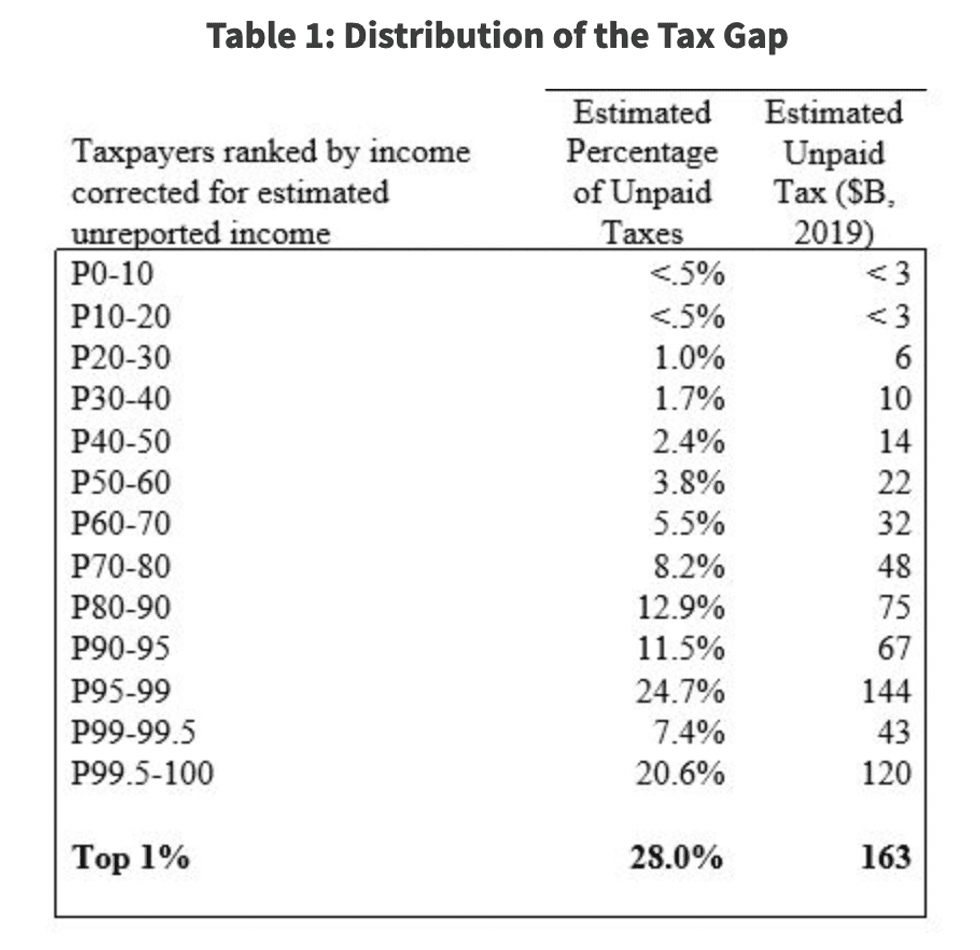
Each year, according to the Treasury analysis, the top 1% of earners in the U.S. don't pay $163 billion in taxes they owe by law. The bottom 10% of earners, by contrast, account for less than $3 billion in unpaid taxes annually.
Persistent tax dodging by the wealthiest people in the country has resulted in a staggering $7 trillion "tax gap"--the difference between taxes owed and taxes the federal government actually collects. Earlier this year, Treasury Secretary Janet Yellen called the tax gap "really shocking" and said the administration is looking to take "meaningful steps" to close it.
"The sheer magnitude of lost revenue is striking: it is equal to 3% of GDP, or all the income taxes paid by the lowest earning 90% of taxpayers," Sarin writes. "The United States collects less tax revenue as a percentage of GDP than at most points in recent history, in part because owed but uncollected taxes are so significant."
The Treasury report notes that unlike ordinary taxpayers, the wealthiest Americans "have the ability to tap into the services of accountants and tax preparers who help shield them from bearing their true income tax liability" using a range of complex avoidance tactics. Because congressional Republicans have starved the IRS of crucial funding in recent years, the agency is ill-prepared to crack down on rich tax cheats.
"Currently, an understaffed IRS, with outdated technology, is unable to collect 15% of taxes that are owed, and a lack of resources means that audit rates have fallen across the board, but they've decreased more in the last decade for high earners than for Earned Income Tax Credit (EITC) recipients," Sarin observes. "For the IRS to appropriately enforce the tax laws against high earners and large corporations, it needs funding to hire and train revenue agents who can decipher their thousands of pages of sophisticated tax filings."
The agency "also needs access to information about opaque income streams--like proprietorship and partnership income--that accrue disproportionately to high-earners," Sarin adds.
The Biden administration has proposed investing an additional $80 billion in the IRS over the next decade to update the agency's technology, hire more enforcement staff, implement new reporting requirements, and ramp up audits of the rich and large corporations. Last week, the Congressional Budget Office projected that the administration's plan would raise $200 billion in new revenue over a ten-year period.
Predictably, Republicans have vocally opposed increasing the IRS budget, as have right-wing political organizations bankrolled by ultra-wealthy Americans.
In a recent letter to Sen. Elizabeth Warren (D-Mass.), IRS Commissioner Charles Rettig warned that "every measure that is important to effective tax administration has suffered tremendously" due to years of steep funding cuts.
"Taxpayers are more likely to be compliant when they know the IRS has the information necessary to pursue them should they not meet their tax obligations," Rettig wrote. "Our research shows that compliance is as low as 45% when income is subject to little or no information reporting or tax withholding. When there is substantial information reporting, compliance rises above 95%."
Pointing to the Treasury Department's new report, Rep. Rashida Tlaib (D-Mich.) tweeted Wednesday that the rich "spend money convincing the public that a single mother working three jobs advocating for free child care is the problem while they take and threaten our systems by cheating and benefiting from unchecked power."
"I say tax these moochers," Tlaib wrote.
Sen. Bernie Sanders (I-Vt.), chair of the Senate Budget Committee, echoed that message.
"At a time of massive wealth and income inequality, we can no longer tolerate a rigged tax system that allows the top 1% to avoid $163 billion in taxes that they owe," Sanders said. "Yes, we will demand that the 1% pays its fair share and we will use that revenue to invest in working families."
A Treasury Department report released Wednesday estimates that the richest 1% of Americans are responsible for more than $160 billion in unpaid taxes per year, a finding that comes as Democratic lawmakers are working to bolster IRS enforcement capacity in their emerging reconciliation package.
Authored by Natasha Sarin, the deputy assistant secretary for economic policy at the Treasury Department, the new report argues that "today's tax code contains two sets of rules: one for regular wage and salary workers who report virtually all the income they earn; and another for wealthy taxpayers, who are often able to avoid a large share of the taxes they owe."
Each year, according to the Treasury analysis, the top 1% of earners in the U.S. don't pay $163 billion in taxes they owe by law. The bottom 10% of earners, by contrast, account for less than $3 billion in unpaid taxes annually.
Persistent tax dodging by the wealthiest people in the country has resulted in a staggering $7 trillion "tax gap"--the difference between taxes owed and taxes the federal government actually collects. Earlier this year, Treasury Secretary Janet Yellen called the tax gap "really shocking" and said the administration is looking to take "meaningful steps" to close it.
"The sheer magnitude of lost revenue is striking: it is equal to 3% of GDP, or all the income taxes paid by the lowest earning 90% of taxpayers," Sarin writes. "The United States collects less tax revenue as a percentage of GDP than at most points in recent history, in part because owed but uncollected taxes are so significant."
The Treasury report notes that unlike ordinary taxpayers, the wealthiest Americans "have the ability to tap into the services of accountants and tax preparers who help shield them from bearing their true income tax liability" using a range of complex avoidance tactics. Because congressional Republicans have starved the IRS of crucial funding in recent years, the agency is ill-prepared to crack down on rich tax cheats.
"Currently, an understaffed IRS, with outdated technology, is unable to collect 15% of taxes that are owed, and a lack of resources means that audit rates have fallen across the board, but they've decreased more in the last decade for high earners than for Earned Income Tax Credit (EITC) recipients," Sarin observes. "For the IRS to appropriately enforce the tax laws against high earners and large corporations, it needs funding to hire and train revenue agents who can decipher their thousands of pages of sophisticated tax filings."
The agency "also needs access to information about opaque income streams--like proprietorship and partnership income--that accrue disproportionately to high-earners," Sarin adds.
The Biden administration has proposed investing an additional $80 billion in the IRS over the next decade to update the agency's technology, hire more enforcement staff, implement new reporting requirements, and ramp up audits of the rich and large corporations. Last week, the Congressional Budget Office projected that the administration's plan would raise $200 billion in new revenue over a ten-year period.
Predictably, Republicans have vocally opposed increasing the IRS budget, as have right-wing political organizations bankrolled by ultra-wealthy Americans.
In a recent letter to Sen. Elizabeth Warren (D-Mass.), IRS Commissioner Charles Rettig warned that "every measure that is important to effective tax administration has suffered tremendously" due to years of steep funding cuts.
"Taxpayers are more likely to be compliant when they know the IRS has the information necessary to pursue them should they not meet their tax obligations," Rettig wrote. "Our research shows that compliance is as low as 45% when income is subject to little or no information reporting or tax withholding. When there is substantial information reporting, compliance rises above 95%."
Pointing to the Treasury Department's new report, Rep. Rashida Tlaib (D-Mich.) tweeted Wednesday that the rich "spend money convincing the public that a single mother working three jobs advocating for free child care is the problem while they take and threaten our systems by cheating and benefiting from unchecked power."
"I say tax these moochers," Tlaib wrote.
Sen. Bernie Sanders (I-Vt.), chair of the Senate Budget Committee, echoed that message.
"At a time of massive wealth and income inequality, we can no longer tolerate a rigged tax system that allows the top 1% to avoid $163 billion in taxes that they owe," Sanders said. "Yes, we will demand that the 1% pays its fair share and we will use that revenue to invest in working families."