SUBSCRIBE TO OUR FREE NEWSLETTER
Daily news & progressive opinion—funded by the people, not the corporations—delivered straight to your inbox.
5
#000000
#FFFFFF
To donate by check, phone, or other method, see our More Ways to Give page.
Daily news & progressive opinion—funded by the people, not the corporations—delivered straight to your inbox.
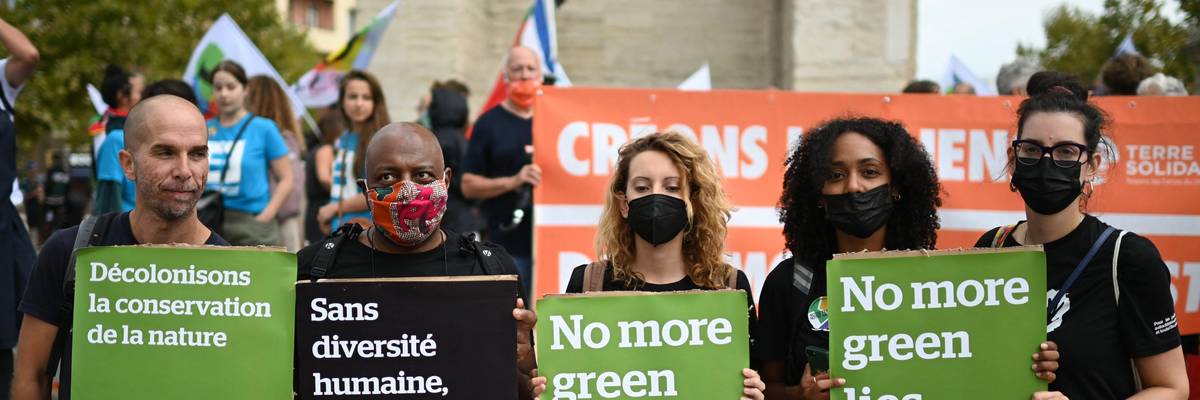
Protesters demonstrate to demand action against the climate emergency on the sidelines of the International Union for Conservation of Nature (IUCN) congress in Marseille, on September 3, 2021. As the IUCN World Conservation Congress kicks off in France on September 3, an urgent question will be how to reduce the devastation wrought by humanity on the environment. (Photo by CHRISTOPHE SIMON/AFP via Getty Images)
Of the 138,374 species assessed by the International Union for the Conservation of Nature (IUCN) for its survival watchlist more than 38,000 are now at risk of extinction, as the destructive impact of human activity on our planet deepens.
An update of the 'Red List of Threatened Species' was released Saturday morning.
Efforts to halt extensive declines in numbers and diversity of animals and plants have largely failed.
In 2019 the UN's biodiversity experts warned that more than a million species are on the brink of extinction - raising the specter that the planet is on the verge of its sixth mass extinction event in 500 million years.
"It's hard to read the headlines, floods, fires, famines, plagues and tell your children that everything is all right. It's not all right. Damn it, it's not all right."
"The red list status shows that we're on the cusp of the sixth extinction event," the IUCN's Head of Red List Unit Craig Hilton-Taylor told Agence France Presse on the eve of the congress.
"If the trends carry on going upward at that rate, we'll be facing a major crisis soon."
On Thursday, a group of human rights NGOs, including Survival International, Attac and Minority Rights Group, held a counter-summit presenting their alternative vision.
Climate Home News reported: "They denounced calls for governments to protect at least 30% of the planet's land by 2030 - up from a previous target of around 17% - as a "false solution" which risks pushing local communities off their land and diverts attention away from the over-consumption and exploitation of natural resources, which they say is the root cause of the climate and biodiversity crisis."
Fiore Longo, of Survival International, told Climate Home News that expanding protected areas was "terrible from a human rights perspective" and could lead to one of the biggest land grabs in history.
The main message from the IUCN World Conservation Congress, which opened Friday in Marseille, France, is that disappearing species and the destruction of ecosystems are no less existential threats than global warming.
At the same time, climate change itself is casting a darker shadow than ever before on the futures of many species.
Habitat loss, overexploitation and illegal trade have hammered global wildlife populations, but scientists say they are increasingly worried about the looming threats of climate change.
Actor Harrison Ford made an impassioned plea to safeguard biodiversity at the opening of the Congress on Friday.
"It's hard to watch the rise of nationalism in the face of a global threat that requires global cooperation, global action," he said. "It's hard to read the headlines, floods, fires, famines, plagues and tell your children that everything is all right. It's not all right. Damn it, it's not all right."
"C'mon everybody," he said. "Let's get to work."
The Marseille conference runs from Sept. 3-11. Among topics are the links between climate change and biodiversity loss, and the ethics of genetic enhancement to increase species' chances of survival. The talks are meant to inform COP26, the U.N.'s global climate summit, which will be held from November 1-12, 2021 in Glasgow, Scotland.
Dear Common Dreams reader, It’s been nearly 30 years since I co-founded Common Dreams with my late wife, Lina Newhouser. We had the radical notion that journalism should serve the public good, not corporate profits. It was clear to us from the outset what it would take to build such a project. No paid advertisements. No corporate sponsors. No millionaire publisher telling us what to think or do. Many people said we wouldn't last a year, but we proved those doubters wrong. Together with a tremendous team of journalists and dedicated staff, we built an independent media outlet free from the constraints of profits and corporate control. Our mission has always been simple: To inform. To inspire. To ignite change for the common good. Building Common Dreams was not easy. Our survival was never guaranteed. When you take on the most powerful forces—Wall Street greed, fossil fuel industry destruction, Big Tech lobbyists, and uber-rich oligarchs who have spent billions upon billions rigging the economy and democracy in their favor—the only bulwark you have is supporters who believe in your work. But here’s the urgent message from me today. It's never been this bad out there. And it's never been this hard to keep us going. At the very moment Common Dreams is most needed, the threats we face are intensifying. We need your support now more than ever. We don't accept corporate advertising and never will. We don't have a paywall because we don't think people should be blocked from critical news based on their ability to pay. Everything we do is funded by the donations of readers like you. When everyone does the little they can afford, we are strong. But if that support retreats or dries up, so do we. Will you donate now to make sure Common Dreams not only survives but thrives? —Craig Brown, Co-founder |
Of the 138,374 species assessed by the International Union for the Conservation of Nature (IUCN) for its survival watchlist more than 38,000 are now at risk of extinction, as the destructive impact of human activity on our planet deepens.
An update of the 'Red List of Threatened Species' was released Saturday morning.
Efforts to halt extensive declines in numbers and diversity of animals and plants have largely failed.
In 2019 the UN's biodiversity experts warned that more than a million species are on the brink of extinction - raising the specter that the planet is on the verge of its sixth mass extinction event in 500 million years.
"It's hard to read the headlines, floods, fires, famines, plagues and tell your children that everything is all right. It's not all right. Damn it, it's not all right."
"The red list status shows that we're on the cusp of the sixth extinction event," the IUCN's Head of Red List Unit Craig Hilton-Taylor told Agence France Presse on the eve of the congress.
"If the trends carry on going upward at that rate, we'll be facing a major crisis soon."
On Thursday, a group of human rights NGOs, including Survival International, Attac and Minority Rights Group, held a counter-summit presenting their alternative vision.
Climate Home News reported: "They denounced calls for governments to protect at least 30% of the planet's land by 2030 - up from a previous target of around 17% - as a "false solution" which risks pushing local communities off their land and diverts attention away from the over-consumption and exploitation of natural resources, which they say is the root cause of the climate and biodiversity crisis."
Fiore Longo, of Survival International, told Climate Home News that expanding protected areas was "terrible from a human rights perspective" and could lead to one of the biggest land grabs in history.
The main message from the IUCN World Conservation Congress, which opened Friday in Marseille, France, is that disappearing species and the destruction of ecosystems are no less existential threats than global warming.
At the same time, climate change itself is casting a darker shadow than ever before on the futures of many species.
Habitat loss, overexploitation and illegal trade have hammered global wildlife populations, but scientists say they are increasingly worried about the looming threats of climate change.
Actor Harrison Ford made an impassioned plea to safeguard biodiversity at the opening of the Congress on Friday.
"It's hard to watch the rise of nationalism in the face of a global threat that requires global cooperation, global action," he said. "It's hard to read the headlines, floods, fires, famines, plagues and tell your children that everything is all right. It's not all right. Damn it, it's not all right."
"C'mon everybody," he said. "Let's get to work."
The Marseille conference runs from Sept. 3-11. Among topics are the links between climate change and biodiversity loss, and the ethics of genetic enhancement to increase species' chances of survival. The talks are meant to inform COP26, the U.N.'s global climate summit, which will be held from November 1-12, 2021 in Glasgow, Scotland.
Of the 138,374 species assessed by the International Union for the Conservation of Nature (IUCN) for its survival watchlist more than 38,000 are now at risk of extinction, as the destructive impact of human activity on our planet deepens.
An update of the 'Red List of Threatened Species' was released Saturday morning.
Efforts to halt extensive declines in numbers and diversity of animals and plants have largely failed.
In 2019 the UN's biodiversity experts warned that more than a million species are on the brink of extinction - raising the specter that the planet is on the verge of its sixth mass extinction event in 500 million years.
"It's hard to read the headlines, floods, fires, famines, plagues and tell your children that everything is all right. It's not all right. Damn it, it's not all right."
"The red list status shows that we're on the cusp of the sixth extinction event," the IUCN's Head of Red List Unit Craig Hilton-Taylor told Agence France Presse on the eve of the congress.
"If the trends carry on going upward at that rate, we'll be facing a major crisis soon."
On Thursday, a group of human rights NGOs, including Survival International, Attac and Minority Rights Group, held a counter-summit presenting their alternative vision.
Climate Home News reported: "They denounced calls for governments to protect at least 30% of the planet's land by 2030 - up from a previous target of around 17% - as a "false solution" which risks pushing local communities off their land and diverts attention away from the over-consumption and exploitation of natural resources, which they say is the root cause of the climate and biodiversity crisis."
Fiore Longo, of Survival International, told Climate Home News that expanding protected areas was "terrible from a human rights perspective" and could lead to one of the biggest land grabs in history.
The main message from the IUCN World Conservation Congress, which opened Friday in Marseille, France, is that disappearing species and the destruction of ecosystems are no less existential threats than global warming.
At the same time, climate change itself is casting a darker shadow than ever before on the futures of many species.
Habitat loss, overexploitation and illegal trade have hammered global wildlife populations, but scientists say they are increasingly worried about the looming threats of climate change.
Actor Harrison Ford made an impassioned plea to safeguard biodiversity at the opening of the Congress on Friday.
"It's hard to watch the rise of nationalism in the face of a global threat that requires global cooperation, global action," he said. "It's hard to read the headlines, floods, fires, famines, plagues and tell your children that everything is all right. It's not all right. Damn it, it's not all right."
"C'mon everybody," he said. "Let's get to work."
The Marseille conference runs from Sept. 3-11. Among topics are the links between climate change and biodiversity loss, and the ethics of genetic enhancement to increase species' chances of survival. The talks are meant to inform COP26, the U.N.'s global climate summit, which will be held from November 1-12, 2021 in Glasgow, Scotland.