
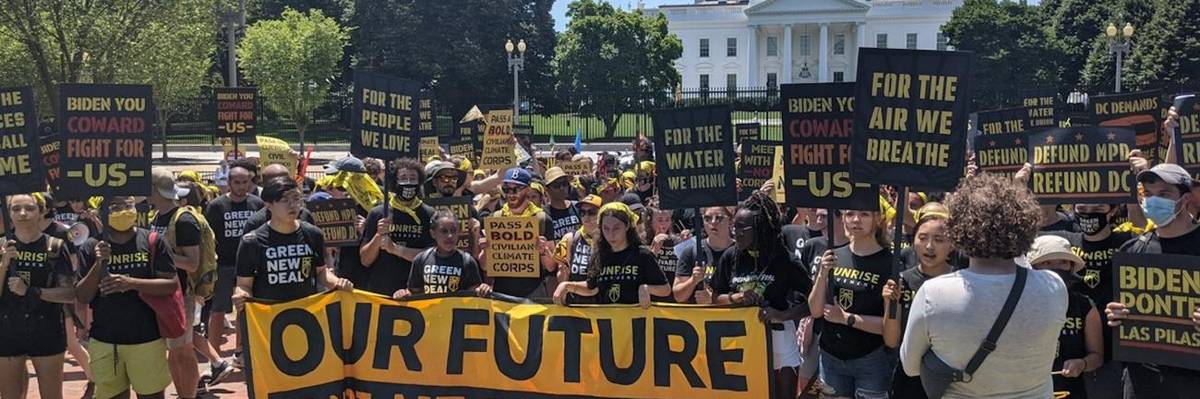
Hundreds of young climate activists rally in Lafayette Square on the north side of the White House to demand that U.S. President Joe Biden work to make the Green New Deal into law on June 28, 2021 in Washington, D.C. Organized by the Sunrise Movement, the 'No Climate, No Deal' marchers demanded a meeting with Biden to insist on an "infrastructure package that truly invests in job creation and acts to combat the climate crisis." (Photo by Chip Somodevilla/Getty Images)
Climate Groups Target Congress With 'Gas Is Not Clean' Campaign
"Using gas to fight climate change is like using gasoline to fight a fire," said one renewable energy campaigner.
Stressing that every stage of gas production pollutes the Earth's air and water, a coalition of climate and social justice groups on Wednesday launched an initiative aimed at strengthening a proposed federal energy policy by ensuring that it excludes the fossil fuel.
"The science is clear: There is nothing clean about gas."
--Lauren Maunus, Sunrise Movement
Sunrise Movement, Greenpeace USA, Oil Change U.S., and other partners launched the Gas Is Not Clean campaign, an effort to ensure that the federal Clean Energy Standard (CES)--a policy proposal requiring a mininum share of electricity to be generated from clean sources--does not include gas.
According to Sunrise Movement, the new campaign "will build pressure on politicians to commit to prioritizing truly clean, renewable energy... by making clear that gas is not clean, and that every stage of its production--extraction, processing, transport, and combustion--generates toxic air and water pollution."
The initiative's website will track which federal lawmakers support excluding a gas carve-out from the CES, while serving as a resource for lawmakers and their staffers. The campaign also says it will be "engaging members of Congress through digital amplification, Hill blasts, and local organizing efforts."
On August 24, the Democrat-controlled U.S. House of Representatives voted along party lines in favor of a $3.5 trillion budget reconciliation blueprint that includes federal tax incentives of around $150 billion to $200 billion for CES implementation. In the absence of a universal definition of what constitutes "clean" energy, the fossil fuel industry has been lobbying for the inclusion of gas in the CES.
Republican and right-wing Democratic U.S. lawmakers have also pushed for what they call a "technology-neutral" approach to meeting the Biden administration's goal of generating 80% clean power by 2035. In June, Reps. David B. McKinley (R-W.Va.) and Kurt Schrader (D-Ore.) introduced an industry-backed bill that would extend partial credit to gas generation as part of a plan to reduce carbon emissions 80% by 2050.
Rep. Jamaal Bowman (D-N.Y.), on the other hand, says there is absolutely no room for gas in the CES.
"With climate disasters coming at us from every direction, the stakes of the reconciliation bill could not be higher," Bowman said in a statement. "This is our moment to turbocharge the transition to a green, just economy, and the Clean Energy Standard can play a key role--but it needs to be as ambitious as possible on renewables, and it needs to exclude gas."
"This is not complicated, and we can't allow the gas industry to confuse the issue," he added. "No fossil fuels, period."
Senate Majority Leader Chuck Schumer (D-N.Y.) stands with his party's progressive wing in staunchly opposing gas inclusion in the CES, asserting in July that it is "an imperative, not just an option... to stop all of the expansion of coal, oil, and gas throughout our country and, frankly, throughout our world."
"You've gotta get to the 80%," Schumer told The New Republic, referring to the White House's 2035 clean power goal. "Gas doesn't help us get there... The number one goal is to get to the 80%, period."
Climate advocates are pushing for a Renewable Energy Standard (RES)--a policy adopted by at least 28 states, Washington, D.C., and Puerto Rico--that would ideally achieve a 100% renewable energy portfolio for the U.S. electrical grid by the end of the decade. Such a policy would include renewable energy technologies like solar and wind, while excluding gas, carbon capture and storage, biomass, nuclear, and other false climate "solutions."
"We need a Clean Energy Standard that centers the health of the planet, communities, and people," tweeted Greenpeace USA. "We cannot continue using harmful energy sources, like natural gas, that pollute our air, water, and human health."
Sunrise Movement advocacy director Lauren Maunus said in a statement announcing the new campaign that "we're making our politicians pick a side--are you with us or fossil fuel executives?"
"The science is clear: There is nothing clean about gas," Maunus continued. "It's a potent fossil fuel that pollutes the air we breathe, the water we drink, and is the reason Hurricane Ida intensified to the point of fatality and utter destruction. A CES that includes investments towards gas does not meet the scale of the climate crisis, and is a slap in the face to communities across the country who are facing climate disasters."
"We deserve a liveable future free of toxic pollution and catastrophic climate disasters," she added. "We will continue to pressure members of Congress until they exclude gas from the CES."
We are at a crossroads
This country and this world are at a monumental crossroads. In a few short weeks, US voters will have an opportunity to beat back the forces of fascism and confront the billionaires who are rigging the economy, our media system, and our democracy, making it increasingly impossible for ordinary people to get by. We’re not just talking about the election. We’re talking about what must be done once these fascist elements are vanquished from power. We need a bolder set of solutions than what either major party has so far been willing to offer and a working-class movement ready to fight like hell for it. Trump didn't emerge from nowhere. The conditions that fueled MAGA authoritarianism were created by decades of radical neoliberal economic policies and a corrupt political system dominated by corporate interests. They slashed taxes on the super-rich, promising that the benefits would trickle down. They said giveaways to the corporate titans would make life more affordable for the rest of us. It was all bullshit. And when a bitter, betrayed populace searches for someone to blame, right-wing demagogues have little trouble finding scapegoats. People know when they're being lied to, but you won't hear any of this from the corporate media. Only independent journalism—powered and funded by people who believe in building a better world—can deliver truly trustworthy daily news. Our Fall Campaign is underway, and we need your help. To power our newsroom through the rest of the year, we need to raise $125,000 by midnight on October 31. So if you share our vision, please contribute whatever you can to sustain our work. |
Stressing that every stage of gas production pollutes the Earth's air and water, a coalition of climate and social justice groups on Wednesday launched an initiative aimed at strengthening a proposed federal energy policy by ensuring that it excludes the fossil fuel.
"The science is clear: There is nothing clean about gas."
--Lauren Maunus, Sunrise Movement
Sunrise Movement, Greenpeace USA, Oil Change U.S., and other partners launched the Gas Is Not Clean campaign, an effort to ensure that the federal Clean Energy Standard (CES)--a policy proposal requiring a mininum share of electricity to be generated from clean sources--does not include gas.
According to Sunrise Movement, the new campaign "will build pressure on politicians to commit to prioritizing truly clean, renewable energy... by making clear that gas is not clean, and that every stage of its production--extraction, processing, transport, and combustion--generates toxic air and water pollution."
The initiative's website will track which federal lawmakers support excluding a gas carve-out from the CES, while serving as a resource for lawmakers and their staffers. The campaign also says it will be "engaging members of Congress through digital amplification, Hill blasts, and local organizing efforts."
On August 24, the Democrat-controlled U.S. House of Representatives voted along party lines in favor of a $3.5 trillion budget reconciliation blueprint that includes federal tax incentives of around $150 billion to $200 billion for CES implementation. In the absence of a universal definition of what constitutes "clean" energy, the fossil fuel industry has been lobbying for the inclusion of gas in the CES.
Republican and right-wing Democratic U.S. lawmakers have also pushed for what they call a "technology-neutral" approach to meeting the Biden administration's goal of generating 80% clean power by 2035. In June, Reps. David B. McKinley (R-W.Va.) and Kurt Schrader (D-Ore.) introduced an industry-backed bill that would extend partial credit to gas generation as part of a plan to reduce carbon emissions 80% by 2050.
Rep. Jamaal Bowman (D-N.Y.), on the other hand, says there is absolutely no room for gas in the CES.
"With climate disasters coming at us from every direction, the stakes of the reconciliation bill could not be higher," Bowman said in a statement. "This is our moment to turbocharge the transition to a green, just economy, and the Clean Energy Standard can play a key role--but it needs to be as ambitious as possible on renewables, and it needs to exclude gas."
"This is not complicated, and we can't allow the gas industry to confuse the issue," he added. "No fossil fuels, period."
Senate Majority Leader Chuck Schumer (D-N.Y.) stands with his party's progressive wing in staunchly opposing gas inclusion in the CES, asserting in July that it is "an imperative, not just an option... to stop all of the expansion of coal, oil, and gas throughout our country and, frankly, throughout our world."
"You've gotta get to the 80%," Schumer told The New Republic, referring to the White House's 2035 clean power goal. "Gas doesn't help us get there... The number one goal is to get to the 80%, period."
Climate advocates are pushing for a Renewable Energy Standard (RES)--a policy adopted by at least 28 states, Washington, D.C., and Puerto Rico--that would ideally achieve a 100% renewable energy portfolio for the U.S. electrical grid by the end of the decade. Such a policy would include renewable energy technologies like solar and wind, while excluding gas, carbon capture and storage, biomass, nuclear, and other false climate "solutions."
"We need a Clean Energy Standard that centers the health of the planet, communities, and people," tweeted Greenpeace USA. "We cannot continue using harmful energy sources, like natural gas, that pollute our air, water, and human health."
Sunrise Movement advocacy director Lauren Maunus said in a statement announcing the new campaign that "we're making our politicians pick a side--are you with us or fossil fuel executives?"
"The science is clear: There is nothing clean about gas," Maunus continued. "It's a potent fossil fuel that pollutes the air we breathe, the water we drink, and is the reason Hurricane Ida intensified to the point of fatality and utter destruction. A CES that includes investments towards gas does not meet the scale of the climate crisis, and is a slap in the face to communities across the country who are facing climate disasters."
"We deserve a liveable future free of toxic pollution and catastrophic climate disasters," she added. "We will continue to pressure members of Congress until they exclude gas from the CES."
Stressing that every stage of gas production pollutes the Earth's air and water, a coalition of climate and social justice groups on Wednesday launched an initiative aimed at strengthening a proposed federal energy policy by ensuring that it excludes the fossil fuel.
"The science is clear: There is nothing clean about gas."
--Lauren Maunus, Sunrise Movement
Sunrise Movement, Greenpeace USA, Oil Change U.S., and other partners launched the Gas Is Not Clean campaign, an effort to ensure that the federal Clean Energy Standard (CES)--a policy proposal requiring a mininum share of electricity to be generated from clean sources--does not include gas.
According to Sunrise Movement, the new campaign "will build pressure on politicians to commit to prioritizing truly clean, renewable energy... by making clear that gas is not clean, and that every stage of its production--extraction, processing, transport, and combustion--generates toxic air and water pollution."
The initiative's website will track which federal lawmakers support excluding a gas carve-out from the CES, while serving as a resource for lawmakers and their staffers. The campaign also says it will be "engaging members of Congress through digital amplification, Hill blasts, and local organizing efforts."
On August 24, the Democrat-controlled U.S. House of Representatives voted along party lines in favor of a $3.5 trillion budget reconciliation blueprint that includes federal tax incentives of around $150 billion to $200 billion for CES implementation. In the absence of a universal definition of what constitutes "clean" energy, the fossil fuel industry has been lobbying for the inclusion of gas in the CES.
Republican and right-wing Democratic U.S. lawmakers have also pushed for what they call a "technology-neutral" approach to meeting the Biden administration's goal of generating 80% clean power by 2035. In June, Reps. David B. McKinley (R-W.Va.) and Kurt Schrader (D-Ore.) introduced an industry-backed bill that would extend partial credit to gas generation as part of a plan to reduce carbon emissions 80% by 2050.
Rep. Jamaal Bowman (D-N.Y.), on the other hand, says there is absolutely no room for gas in the CES.
"With climate disasters coming at us from every direction, the stakes of the reconciliation bill could not be higher," Bowman said in a statement. "This is our moment to turbocharge the transition to a green, just economy, and the Clean Energy Standard can play a key role--but it needs to be as ambitious as possible on renewables, and it needs to exclude gas."
"This is not complicated, and we can't allow the gas industry to confuse the issue," he added. "No fossil fuels, period."
Senate Majority Leader Chuck Schumer (D-N.Y.) stands with his party's progressive wing in staunchly opposing gas inclusion in the CES, asserting in July that it is "an imperative, not just an option... to stop all of the expansion of coal, oil, and gas throughout our country and, frankly, throughout our world."
"You've gotta get to the 80%," Schumer told The New Republic, referring to the White House's 2035 clean power goal. "Gas doesn't help us get there... The number one goal is to get to the 80%, period."
Climate advocates are pushing for a Renewable Energy Standard (RES)--a policy adopted by at least 28 states, Washington, D.C., and Puerto Rico--that would ideally achieve a 100% renewable energy portfolio for the U.S. electrical grid by the end of the decade. Such a policy would include renewable energy technologies like solar and wind, while excluding gas, carbon capture and storage, biomass, nuclear, and other false climate "solutions."
"We need a Clean Energy Standard that centers the health of the planet, communities, and people," tweeted Greenpeace USA. "We cannot continue using harmful energy sources, like natural gas, that pollute our air, water, and human health."
Sunrise Movement advocacy director Lauren Maunus said in a statement announcing the new campaign that "we're making our politicians pick a side--are you with us or fossil fuel executives?"
"The science is clear: There is nothing clean about gas," Maunus continued. "It's a potent fossil fuel that pollutes the air we breathe, the water we drink, and is the reason Hurricane Ida intensified to the point of fatality and utter destruction. A CES that includes investments towards gas does not meet the scale of the climate crisis, and is a slap in the face to communities across the country who are facing climate disasters."
"We deserve a liveable future free of toxic pollution and catastrophic climate disasters," she added. "We will continue to pressure members of Congress until they exclude gas from the CES."