SUBSCRIBE TO OUR FREE NEWSLETTER
Daily news & progressive opinion—funded by the people, not the corporations—delivered straight to your inbox.
5
#000000
#FFFFFF
To donate by check, phone, or other method, see our More Ways to Give page.
Daily news & progressive opinion—funded by the people, not the corporations—delivered straight to your inbox.
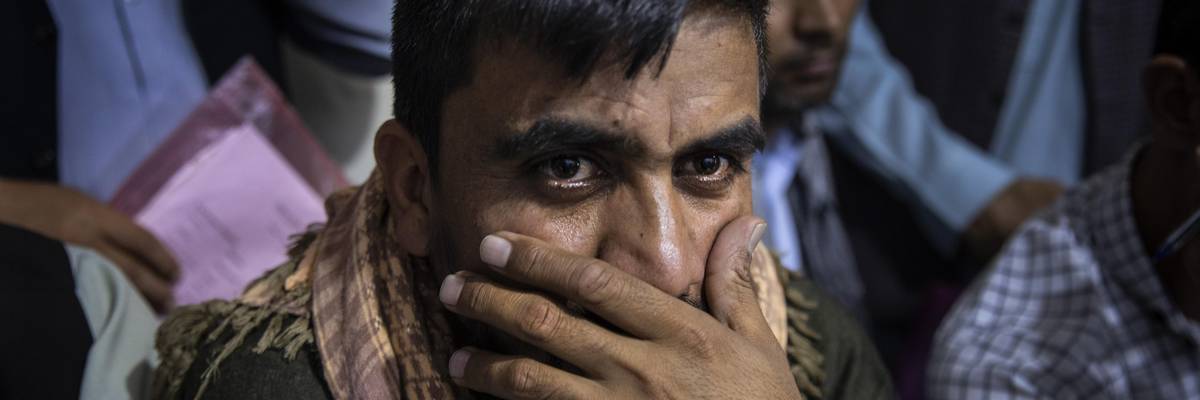
Afghan Special Immigrant Visa (SIV) applicants crowd into the Herat Kabul Internet cafe to apply for the SIV program on August 8, 2021 in Kabul, Afghanistan. Many Afghans are in desperate need of assistance completing the forms and obtaining required human resources letters, a particular challenge for those whose U.S. government work ended years ago. (Photo: Paula Bronstein/Getty Images)
Democratic Congresswoman Barbara Lee--who cast the sole vote against the 2001 Authorization for the Use of Military Force that was used to justify the war in Afghanistan--reiterated on Sunday her assessment that "there is no military solution" to address the worsening chaos in that country.
Lee's (D-Calif.) remarks came in an interview on MSNBC's "American Voices with Alicia Menendez" as the Taliban effectively took control of the country and desperate Afghans tried to flee.
"Our focus now," said Lee, "has got to be... the safety and security of everyone at this moment, and I think it's a very dire situation."
"This is an example, though, that there is no military solution," she said. "We've been there 20 years, we have spent over a trillion dollars, and we have trained over 300,000 of the Afghan forces," Lee added, calling the current situation "a tragedy."
Citing Brown University's Costs of War Project's estimate that the war in Afghanistan cost U.S. taxpayers over $2 trillion, guest host Anand Giridharadas asked Lee about just where all the money ended up.
After acknowledging the hundreds of thousands of U.S. troops and Afghan civilians who lost their lives as a result of the war, the California Democrat pointed to "many, many reports [showing] that there was an enormous amount of corruption" and graft.
"It was just an untenable situation," she said.
Asked if the U.S. would learn any lessons from current disaster, Lee said: "Listen, 20 years ago I said that there was no military solution in Afghanistan. Of course we have to deal with the terrorist threats, of course we have to deal with national security."
"But," she said, "we have to remember we have three stools of our foreign and military policy: diplomacy, development, and defense." And those three aspects have "been out of balance."
"We need to get back to rebalancing," said Lee, praising the Biden administration for what she said was "doing the right thing" by pulling out of Afghanistan.
Lee's 2001 vote against the AUMF was referenced on Sunday by MSNBC political analyst Mehdi Hasan in a Twitter thread in which he lamented that "those of us who warned against invading and occupying Afghanistan 20 years ago have been tragically, awfully, vindicated."
"I also wish everyone had listened to Rep. Barbara Lee back in September 2001," he wrote.
According to the Costs of War Project, over 5.3 million Afghans have been displaced since the U.S. occupation and invasion in 2001. The project further estimates that 241,000 people have died as a direct result of the war.
Dear Common Dreams reader, It’s been nearly 30 years since I co-founded Common Dreams with my late wife, Lina Newhouser. We had the radical notion that journalism should serve the public good, not corporate profits. It was clear to us from the outset what it would take to build such a project. No paid advertisements. No corporate sponsors. No millionaire publisher telling us what to think or do. Many people said we wouldn't last a year, but we proved those doubters wrong. Together with a tremendous team of journalists and dedicated staff, we built an independent media outlet free from the constraints of profits and corporate control. Our mission has always been simple: To inform. To inspire. To ignite change for the common good. Building Common Dreams was not easy. Our survival was never guaranteed. When you take on the most powerful forces—Wall Street greed, fossil fuel industry destruction, Big Tech lobbyists, and uber-rich oligarchs who have spent billions upon billions rigging the economy and democracy in their favor—the only bulwark you have is supporters who believe in your work. But here’s the urgent message from me today. It's never been this bad out there. And it's never been this hard to keep us going. At the very moment Common Dreams is most needed, the threats we face are intensifying. We need your support now more than ever. We don't accept corporate advertising and never will. We don't have a paywall because we don't think people should be blocked from critical news based on their ability to pay. Everything we do is funded by the donations of readers like you. When everyone does the little they can afford, we are strong. But if that support retreats or dries up, so do we. Will you donate now to make sure Common Dreams not only survives but thrives? —Craig Brown, Co-founder |
Democratic Congresswoman Barbara Lee--who cast the sole vote against the 2001 Authorization for the Use of Military Force that was used to justify the war in Afghanistan--reiterated on Sunday her assessment that "there is no military solution" to address the worsening chaos in that country.
Lee's (D-Calif.) remarks came in an interview on MSNBC's "American Voices with Alicia Menendez" as the Taliban effectively took control of the country and desperate Afghans tried to flee.
"Our focus now," said Lee, "has got to be... the safety and security of everyone at this moment, and I think it's a very dire situation."
"This is an example, though, that there is no military solution," she said. "We've been there 20 years, we have spent over a trillion dollars, and we have trained over 300,000 of the Afghan forces," Lee added, calling the current situation "a tragedy."
Citing Brown University's Costs of War Project's estimate that the war in Afghanistan cost U.S. taxpayers over $2 trillion, guest host Anand Giridharadas asked Lee about just where all the money ended up.
After acknowledging the hundreds of thousands of U.S. troops and Afghan civilians who lost their lives as a result of the war, the California Democrat pointed to "many, many reports [showing] that there was an enormous amount of corruption" and graft.
"It was just an untenable situation," she said.
Asked if the U.S. would learn any lessons from current disaster, Lee said: "Listen, 20 years ago I said that there was no military solution in Afghanistan. Of course we have to deal with the terrorist threats, of course we have to deal with national security."
"But," she said, "we have to remember we have three stools of our foreign and military policy: diplomacy, development, and defense." And those three aspects have "been out of balance."
"We need to get back to rebalancing," said Lee, praising the Biden administration for what she said was "doing the right thing" by pulling out of Afghanistan.
Lee's 2001 vote against the AUMF was referenced on Sunday by MSNBC political analyst Mehdi Hasan in a Twitter thread in which he lamented that "those of us who warned against invading and occupying Afghanistan 20 years ago have been tragically, awfully, vindicated."
"I also wish everyone had listened to Rep. Barbara Lee back in September 2001," he wrote.
According to the Costs of War Project, over 5.3 million Afghans have been displaced since the U.S. occupation and invasion in 2001. The project further estimates that 241,000 people have died as a direct result of the war.
Democratic Congresswoman Barbara Lee--who cast the sole vote against the 2001 Authorization for the Use of Military Force that was used to justify the war in Afghanistan--reiterated on Sunday her assessment that "there is no military solution" to address the worsening chaos in that country.
Lee's (D-Calif.) remarks came in an interview on MSNBC's "American Voices with Alicia Menendez" as the Taliban effectively took control of the country and desperate Afghans tried to flee.
"Our focus now," said Lee, "has got to be... the safety and security of everyone at this moment, and I think it's a very dire situation."
"This is an example, though, that there is no military solution," she said. "We've been there 20 years, we have spent over a trillion dollars, and we have trained over 300,000 of the Afghan forces," Lee added, calling the current situation "a tragedy."
Citing Brown University's Costs of War Project's estimate that the war in Afghanistan cost U.S. taxpayers over $2 trillion, guest host Anand Giridharadas asked Lee about just where all the money ended up.
After acknowledging the hundreds of thousands of U.S. troops and Afghan civilians who lost their lives as a result of the war, the California Democrat pointed to "many, many reports [showing] that there was an enormous amount of corruption" and graft.
"It was just an untenable situation," she said.
Asked if the U.S. would learn any lessons from current disaster, Lee said: "Listen, 20 years ago I said that there was no military solution in Afghanistan. Of course we have to deal with the terrorist threats, of course we have to deal with national security."
"But," she said, "we have to remember we have three stools of our foreign and military policy: diplomacy, development, and defense." And those three aspects have "been out of balance."
"We need to get back to rebalancing," said Lee, praising the Biden administration for what she said was "doing the right thing" by pulling out of Afghanistan.
Lee's 2001 vote against the AUMF was referenced on Sunday by MSNBC political analyst Mehdi Hasan in a Twitter thread in which he lamented that "those of us who warned against invading and occupying Afghanistan 20 years ago have been tragically, awfully, vindicated."
"I also wish everyone had listened to Rep. Barbara Lee back in September 2001," he wrote.
According to the Costs of War Project, over 5.3 million Afghans have been displaced since the U.S. occupation and invasion in 2001. The project further estimates that 241,000 people have died as a direct result of the war.