

SUBSCRIBE TO OUR FREE NEWSLETTER
Daily news & progressive opinion—funded by the people, not the corporations—delivered straight to your inbox.
5
#000000
#FFFFFF
To donate by check, phone, or other method, see our More Ways to Give page.
Daily news & progressive opinion—funded by the people, not the corporations—delivered straight to your inbox.
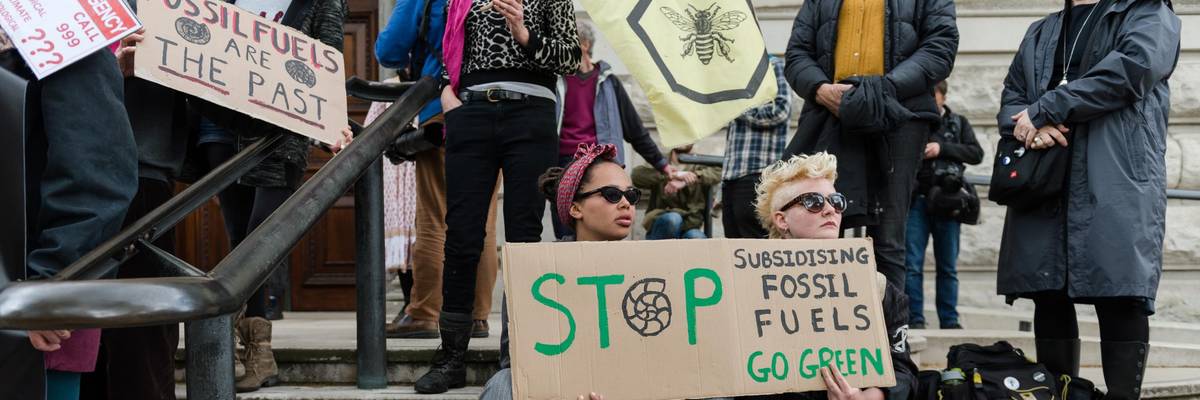
Activists protest fossil fuel subsidies during an Extinction Rebellion demonstration in London on April 25, 2019. (Photo: WIktor Szymanowicz/NurPhoto via Getty Images)
Dozens of executives at U.S. fossil fuel firms that failed during the recent surge in oil and gas company bankruptcies nevertheless reaped massive payouts before taking their leave, a new report published Thursday by Public Citizen and Documented revealed.
"The fossil fuel industry has been a poster child for ill-conceived corporate welfare for decades, benefiting from numerous subsidies, tax breaks, and regulatory favors."
--Robert Weissman,
Public Citizen
The report (pdf), entitled Fueling Failure, examines how 76 executives at oil and gas companies that filed the 25 largest bankruptcy cases between 2018 and 2020 pocketed nearly $200 million in cash bonuses, retention payments, and severances, while leaving more than 10,000 workers without jobs and over $10 billion in cleanup costs, largely to be absorbed by taxpayers.
The average payout was $2.6 million per executive--compared with salaries of $50,000 to $60,000 for oil rig workers--while 10 CEOs each received payouts of $4 million or more.
Todd Williams, the former president and CEO of California Resources Corporation, topped the list with $14.5 million in total payments, followed by Chesapeake Energy's Robert Lawler and Thomas Nusz of Oasis Petroleum, who respectively received $8.9 million and $8.4 million before leaving their companies.
"For oil industry executives, failure is very much an option," Alan Zibel, a Public Citizen researcher who co-authored the report, said in a statement. "Whether these fossil fuel executives lead their corporations to financial success or catastrophic flops, they still receive exorbitant payouts, while workers lose jobs, investors lose money, and taxpayers may wind up footing the bill for environmental cleanup."
"These polluting companies are able to profit due to subsidies and regulatory favors, while putting the planet at risk, exploiting public lands, and leaving a mess for others to clean up," Zibel added.
Projected cleanup costs for more than 57,000 oil and gas wells owned by bankrupt drilling companies "could be as high as $10.3 billion," the report says, citing estimates by CarbonTracker, while the firms responsible for those wells issued just $281 million in bonds to mitigate their environmental damage.
According to a March report (pdf) from the Western Organization of Resource Councils, "hundreds of thousands of oil and gas wells, tanks, pipelines, pits, and roads across the country have been built without adequate assurances that they will ever be cleaned up."
Public Citizen president Robert Weissman said that "the fossil fuel industry has been a poster child for ill-conceived corporate welfare for decades, benefiting from numerous subsidies, tax breaks, and regulatory favors."
"President [Joe] Biden must fulfill his campaign pledge of stopping senseless subsidies to this planet-destroying industry and must force polluters to shoulder the cost of cleaning up their own mess," he added.
While the Biden administration has reportedly considered ending or slashing federal fossil fuel subsidies, green groups have argued its proposals have fallen short. Meanwhile, the administration has approved fossil fuel drilling permits on public and tribal lands at a faster rate than the Obama and Trump administrations, leading to accusations that Biden is not as serious about combating the climate emergency as he claims to be.
Dear Common Dreams reader, It’s been nearly 30 years since I co-founded Common Dreams with my late wife, Lina Newhouser. We had the radical notion that journalism should serve the public good, not corporate profits. It was clear to us from the outset what it would take to build such a project. No paid advertisements. No corporate sponsors. No millionaire publisher telling us what to think or do. Many people said we wouldn't last a year, but we proved those doubters wrong. Together with a tremendous team of journalists and dedicated staff, we built an independent media outlet free from the constraints of profits and corporate control. Our mission has always been simple: To inform. To inspire. To ignite change for the common good. Building Common Dreams was not easy. Our survival was never guaranteed. When you take on the most powerful forces—Wall Street greed, fossil fuel industry destruction, Big Tech lobbyists, and uber-rich oligarchs who have spent billions upon billions rigging the economy and democracy in their favor—the only bulwark you have is supporters who believe in your work. But here’s the urgent message from me today. It's never been this bad out there. And it's never been this hard to keep us going. At the very moment Common Dreams is most needed, the threats we face are intensifying. We need your support now more than ever. We don't accept corporate advertising and never will. We don't have a paywall because we don't think people should be blocked from critical news based on their ability to pay. Everything we do is funded by the donations of readers like you. When everyone does the little they can afford, we are strong. But if that support retreats or dries up, so do we. Will you donate now to make sure Common Dreams not only survives but thrives? —Craig Brown, Co-founder |
Dozens of executives at U.S. fossil fuel firms that failed during the recent surge in oil and gas company bankruptcies nevertheless reaped massive payouts before taking their leave, a new report published Thursday by Public Citizen and Documented revealed.
"The fossil fuel industry has been a poster child for ill-conceived corporate welfare for decades, benefiting from numerous subsidies, tax breaks, and regulatory favors."
--Robert Weissman,
Public Citizen
The report (pdf), entitled Fueling Failure, examines how 76 executives at oil and gas companies that filed the 25 largest bankruptcy cases between 2018 and 2020 pocketed nearly $200 million in cash bonuses, retention payments, and severances, while leaving more than 10,000 workers without jobs and over $10 billion in cleanup costs, largely to be absorbed by taxpayers.
The average payout was $2.6 million per executive--compared with salaries of $50,000 to $60,000 for oil rig workers--while 10 CEOs each received payouts of $4 million or more.
Todd Williams, the former president and CEO of California Resources Corporation, topped the list with $14.5 million in total payments, followed by Chesapeake Energy's Robert Lawler and Thomas Nusz of Oasis Petroleum, who respectively received $8.9 million and $8.4 million before leaving their companies.
"For oil industry executives, failure is very much an option," Alan Zibel, a Public Citizen researcher who co-authored the report, said in a statement. "Whether these fossil fuel executives lead their corporations to financial success or catastrophic flops, they still receive exorbitant payouts, while workers lose jobs, investors lose money, and taxpayers may wind up footing the bill for environmental cleanup."
"These polluting companies are able to profit due to subsidies and regulatory favors, while putting the planet at risk, exploiting public lands, and leaving a mess for others to clean up," Zibel added.
Projected cleanup costs for more than 57,000 oil and gas wells owned by bankrupt drilling companies "could be as high as $10.3 billion," the report says, citing estimates by CarbonTracker, while the firms responsible for those wells issued just $281 million in bonds to mitigate their environmental damage.
According to a March report (pdf) from the Western Organization of Resource Councils, "hundreds of thousands of oil and gas wells, tanks, pipelines, pits, and roads across the country have been built without adequate assurances that they will ever be cleaned up."
Public Citizen president Robert Weissman said that "the fossil fuel industry has been a poster child for ill-conceived corporate welfare for decades, benefiting from numerous subsidies, tax breaks, and regulatory favors."
"President [Joe] Biden must fulfill his campaign pledge of stopping senseless subsidies to this planet-destroying industry and must force polluters to shoulder the cost of cleaning up their own mess," he added.
While the Biden administration has reportedly considered ending or slashing federal fossil fuel subsidies, green groups have argued its proposals have fallen short. Meanwhile, the administration has approved fossil fuel drilling permits on public and tribal lands at a faster rate than the Obama and Trump administrations, leading to accusations that Biden is not as serious about combating the climate emergency as he claims to be.
Dozens of executives at U.S. fossil fuel firms that failed during the recent surge in oil and gas company bankruptcies nevertheless reaped massive payouts before taking their leave, a new report published Thursday by Public Citizen and Documented revealed.
"The fossil fuel industry has been a poster child for ill-conceived corporate welfare for decades, benefiting from numerous subsidies, tax breaks, and regulatory favors."
--Robert Weissman,
Public Citizen
The report (pdf), entitled Fueling Failure, examines how 76 executives at oil and gas companies that filed the 25 largest bankruptcy cases between 2018 and 2020 pocketed nearly $200 million in cash bonuses, retention payments, and severances, while leaving more than 10,000 workers without jobs and over $10 billion in cleanup costs, largely to be absorbed by taxpayers.
The average payout was $2.6 million per executive--compared with salaries of $50,000 to $60,000 for oil rig workers--while 10 CEOs each received payouts of $4 million or more.
Todd Williams, the former president and CEO of California Resources Corporation, topped the list with $14.5 million in total payments, followed by Chesapeake Energy's Robert Lawler and Thomas Nusz of Oasis Petroleum, who respectively received $8.9 million and $8.4 million before leaving their companies.
"For oil industry executives, failure is very much an option," Alan Zibel, a Public Citizen researcher who co-authored the report, said in a statement. "Whether these fossil fuel executives lead their corporations to financial success or catastrophic flops, they still receive exorbitant payouts, while workers lose jobs, investors lose money, and taxpayers may wind up footing the bill for environmental cleanup."
"These polluting companies are able to profit due to subsidies and regulatory favors, while putting the planet at risk, exploiting public lands, and leaving a mess for others to clean up," Zibel added.
Projected cleanup costs for more than 57,000 oil and gas wells owned by bankrupt drilling companies "could be as high as $10.3 billion," the report says, citing estimates by CarbonTracker, while the firms responsible for those wells issued just $281 million in bonds to mitigate their environmental damage.
According to a March report (pdf) from the Western Organization of Resource Councils, "hundreds of thousands of oil and gas wells, tanks, pipelines, pits, and roads across the country have been built without adequate assurances that they will ever be cleaned up."
Public Citizen president Robert Weissman said that "the fossil fuel industry has been a poster child for ill-conceived corporate welfare for decades, benefiting from numerous subsidies, tax breaks, and regulatory favors."
"President [Joe] Biden must fulfill his campaign pledge of stopping senseless subsidies to this planet-destroying industry and must force polluters to shoulder the cost of cleaning up their own mess," he added.
While the Biden administration has reportedly considered ending or slashing federal fossil fuel subsidies, green groups have argued its proposals have fallen short. Meanwhile, the administration has approved fossil fuel drilling permits on public and tribal lands at a faster rate than the Obama and Trump administrations, leading to accusations that Biden is not as serious about combating the climate emergency as he claims to be.

