SUBSCRIBE TO OUR FREE NEWSLETTER
Daily news & progressive opinion—funded by the people, not the corporations—delivered straight to your inbox.
5
#000000
#FFFFFF
To donate by check, phone, or other method, see our More Ways to Give page.
Daily news & progressive opinion—funded by the people, not the corporations—delivered straight to your inbox.

People marched in more than 50 U.S. cities on Saturday to demand Medicare for All. (Photo: @Jaybefaunt/Twitter)
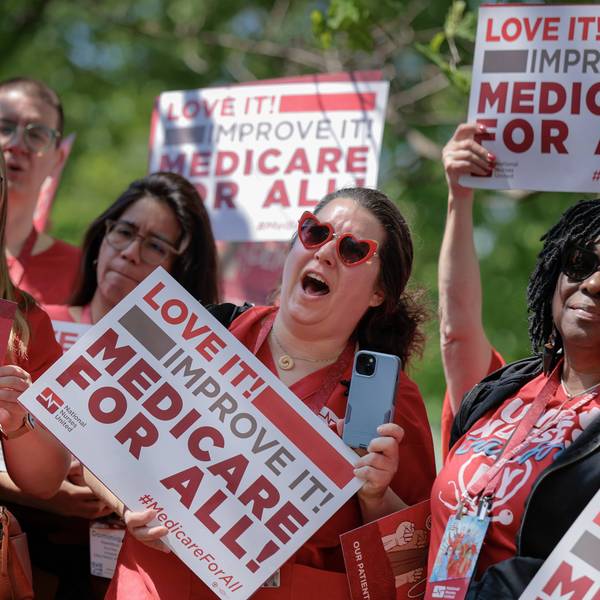
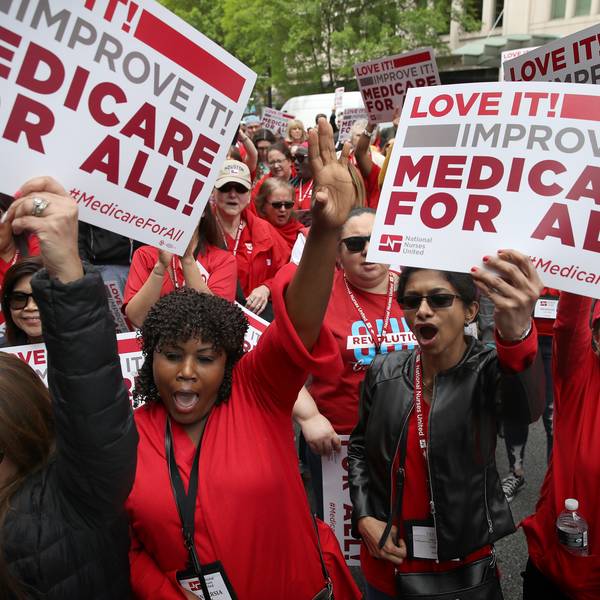
Just days before the 56th anniversary of Medicare being signed into law, advocates for creating a public, universal health insurance program in the United States to replace the largely private, for-profit system held marches in more than 50 cities across the country on Saturday.
The day of action was organized by a coalition of over 100 groups, from Mainers for Accountable Leadership, the Chicago Teachers Union, and Sunrise Movement Seattle to various arms of Democratic Socialists of America, Physicians for a National Health Program (PNHP), and Our Revolution.
"Our movement was founded from a place of compassion and love," the coalition's website explains. "We came together out of frustration with the lack of action from the powers that be."
"Many of us have our own personal stories as to why we are in this fight," the coalition continues. "All of us know that healthcare is a right, not a privilege. It is a basic freedom. How can we have life, liberty, and the pursuit of happiness when we live in constant fear of illness, bankruptcy, or homelessness because of the outrageous for-profit healthcare system?"
Highlighting that "universal healthcare isn't radical," the coalition points to more than 30 other countries that have it--from Australia, Canada, Germany, and Iceland, to Japan, Kuwait, South Korea, and the United Kingdom.
"Like most Americans, when the Covid pandemic shut down our country, we thought this was it--America would finally catch up to the rest of the developed world and have a healthcare system that is free at the point of service," says a petition from the coalition. "As we all know, this did not happen... yet!"
The coalition's petition--which is open for signature--has three key demands for the U.S. government:
"If all three demands are not met on or before Friday, August 6, 2021," the petition says, "we the Medicare for All Movement will file a human rights violation complaint with the United Nations."
In cities nationwide--including Atlanta, Austin, Chicago, Detroit, Honolulu, Kansas City, Las Vegas, Los Angeles, Louisville, Nashville, New York, Orlando, Philadelphia, Phoenix, Salt Lake City, San Francisco, Seattle, Tampa, and Washington, D.C.--Medicare for All supporters carried signs and chanted slogans directed at federal lawmakers.
"Don't drop the ball on Medicare for All," they shouted. "Healthcare, not warfare!"
One D.C. marcher's sign declared, "Medical debt is unjust!"
As Common Dreams reported earlier this week, a new study shows that Americans owe collection agencies $140 billion because of unpaid medical bills--meaning that healthcare is the nation's largest source of debt in collections.
Some signs shared personal stories--one said, "Heart attack, could not afford in$ulin."
A marcher in Austin noted that "people die" when insurance companies deny coverage.
"Patients not profits!" read a sign from a man in New York wearing a white lab coat.
Rep. Cori Bush (D-Mo.) showed up at the #M4M4ALL rally in D.C. She is one of the 117 co-sponsors of the Medicare for All Act of 2021 (H.R. 1976).
Reps. Pramila Jayapal (D-Wash.) and Debbie Dingell (D-Mich.) introduced the Medicare for All Act in March, at a time when the U.S. death toll from the Covid-19 pandemic had topped half a million.
"While this devastating pandemic is shining a bright light on our broken, for-profit healthcare system, we were already leaving nearly half of all adults under the age of 65 uninsured or underinsured before Covid-19 hit," Jayapal said at the time. "And we were cruelly doing so while paying more per capita for health care than any other country in the world."
"There is a solution to this health crisis--a popular one that guarantees healthcare to every person as a human right and finally puts people over profits and care over corporations," added the Congressional Progressive Caucus chair. "That solution is Medicare for All--everyone in, nobody out--and I am proud to introduce it today alongside a powerful movement across America."
As F. Douglas Stephenson--a retired psychotherapist, former instructor of social work in the University of Florida, and member of PNHP--wrote Saturday for Informed Comment, "Since 1965, Medicare has become living proof that public, universal health insurance is superior to private insurance in every way."
Stephenson continued:
When Medicare was enacted 56 years ago, following a broad grassroots campaign, many believed the dream of a full national health insurance system was right around the corner. Five decades later, Medicare still has not been expanded. Most of the changes have been contractions with higher out-of-pocket costs for beneficiaries and repeated attempts at privatization by Big Pharma, the health insurance industry, and its champions in the White House and Congress.
"Everyone knows that this inhumane system should have been corrected long ago, but the death and illness ravages of the pandemic crisis makes it impossible to any longer avoid reality," he asserted. "We must immediately end our moral crime of having the greatest health system in the world, but only for those who can afford it."
This country and this world are at a monumental crossroads. US voters have an opportunity to beat back the forces of fascism and confront the billionaires who are rigging the economy, our media system, and our democracy, making it increasingly impossible for ordinary people to get by. We’re not just talking about the election. We’re talking about what must be done once these fascist elements are vanquished from power. We need a bolder set of solutions than what either major party has so far been willing to offer and a working-class movement ready to fight like hell for it. Trump didn't emerge from nowhere. The conditions that fueled MAGA authoritarianism were created by decades of radical neoliberal economic policies and a corrupt political system dominated by corporate interests. They slashed taxes on the super-rich, promising that the benefits would trickle down. They said giveaways to the corporate titans would make life more affordable for the rest of us. It was all bullshit. And when a bitter, betrayed populace searches for someone to blame, right-wing demagogues have little trouble finding scapegoats. People know when they're being lied to, but you won't hear any of this from the corporate media. Only independent journalism—powered and funded by people who believe in building a better world—can deliver truly trustworthy daily news. If you share our vision, please contribute whatever you can to sustain our work. |
Just days before the 56th anniversary of Medicare being signed into law, advocates for creating a public, universal health insurance program in the United States to replace the largely private, for-profit system held marches in more than 50 cities across the country on Saturday.
The day of action was organized by a coalition of over 100 groups, from Mainers for Accountable Leadership, the Chicago Teachers Union, and Sunrise Movement Seattle to various arms of Democratic Socialists of America, Physicians for a National Health Program (PNHP), and Our Revolution.
"Our movement was founded from a place of compassion and love," the coalition's website explains. "We came together out of frustration with the lack of action from the powers that be."
"Many of us have our own personal stories as to why we are in this fight," the coalition continues. "All of us know that healthcare is a right, not a privilege. It is a basic freedom. How can we have life, liberty, and the pursuit of happiness when we live in constant fear of illness, bankruptcy, or homelessness because of the outrageous for-profit healthcare system?"
Highlighting that "universal healthcare isn't radical," the coalition points to more than 30 other countries that have it--from Australia, Canada, Germany, and Iceland, to Japan, Kuwait, South Korea, and the United Kingdom.
"Like most Americans, when the Covid pandemic shut down our country, we thought this was it--America would finally catch up to the rest of the developed world and have a healthcare system that is free at the point of service," says a petition from the coalition. "As we all know, this did not happen... yet!"
The coalition's petition--which is open for signature--has three key demands for the U.S. government:
"If all three demands are not met on or before Friday, August 6, 2021," the petition says, "we the Medicare for All Movement will file a human rights violation complaint with the United Nations."
In cities nationwide--including Atlanta, Austin, Chicago, Detroit, Honolulu, Kansas City, Las Vegas, Los Angeles, Louisville, Nashville, New York, Orlando, Philadelphia, Phoenix, Salt Lake City, San Francisco, Seattle, Tampa, and Washington, D.C.--Medicare for All supporters carried signs and chanted slogans directed at federal lawmakers.
"Don't drop the ball on Medicare for All," they shouted. "Healthcare, not warfare!"
One D.C. marcher's sign declared, "Medical debt is unjust!"
As Common Dreams reported earlier this week, a new study shows that Americans owe collection agencies $140 billion because of unpaid medical bills--meaning that healthcare is the nation's largest source of debt in collections.
Some signs shared personal stories--one said, "Heart attack, could not afford in$ulin."
A marcher in Austin noted that "people die" when insurance companies deny coverage.
"Patients not profits!" read a sign from a man in New York wearing a white lab coat.
Rep. Cori Bush (D-Mo.) showed up at the #M4M4ALL rally in D.C. She is one of the 117 co-sponsors of the Medicare for All Act of 2021 (H.R. 1976).
Reps. Pramila Jayapal (D-Wash.) and Debbie Dingell (D-Mich.) introduced the Medicare for All Act in March, at a time when the U.S. death toll from the Covid-19 pandemic had topped half a million.
"While this devastating pandemic is shining a bright light on our broken, for-profit healthcare system, we were already leaving nearly half of all adults under the age of 65 uninsured or underinsured before Covid-19 hit," Jayapal said at the time. "And we were cruelly doing so while paying more per capita for health care than any other country in the world."
"There is a solution to this health crisis--a popular one that guarantees healthcare to every person as a human right and finally puts people over profits and care over corporations," added the Congressional Progressive Caucus chair. "That solution is Medicare for All--everyone in, nobody out--and I am proud to introduce it today alongside a powerful movement across America."
As F. Douglas Stephenson--a retired psychotherapist, former instructor of social work in the University of Florida, and member of PNHP--wrote Saturday for Informed Comment, "Since 1965, Medicare has become living proof that public, universal health insurance is superior to private insurance in every way."
Stephenson continued:
When Medicare was enacted 56 years ago, following a broad grassroots campaign, many believed the dream of a full national health insurance system was right around the corner. Five decades later, Medicare still has not been expanded. Most of the changes have been contractions with higher out-of-pocket costs for beneficiaries and repeated attempts at privatization by Big Pharma, the health insurance industry, and its champions in the White House and Congress.
"Everyone knows that this inhumane system should have been corrected long ago, but the death and illness ravages of the pandemic crisis makes it impossible to any longer avoid reality," he asserted. "We must immediately end our moral crime of having the greatest health system in the world, but only for those who can afford it."