

SUBSCRIBE TO OUR FREE NEWSLETTER
Daily news & progressive opinion—funded by the people, not the corporations—delivered straight to your inbox.
5
#000000
#FFFFFF
To donate by check, phone, or other method, see our More Ways to Give page.
Daily news & progressive opinion—funded by the people, not the corporations—delivered straight to your inbox.
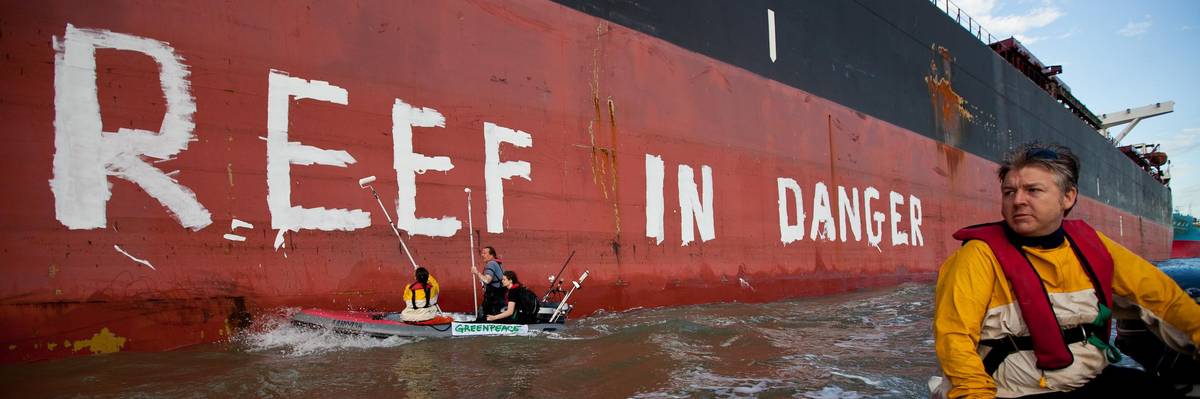
In this handout photo provided by Greenpeace, activists paint the message "Reef in Danger" on the side of coal ship Chou San on March 7, 2012 in Gladstone, Australia. (Photo: Greenpeace via Getty Images)
Just ahead of a United Nations World Heritage Committee meeting weighing updated classifications for U.N. Educational, Scientific, and Cultural Organization sites, new reporting on Wednesday reveals how Australia is working to thwart the Great Barrier Reef being designated as "in danger."
According to The Guardian, Saudi Arabia and Bahrain are co-sponsoring amendments that reject UNESCO's finding, released last month, that the reef is in danger and would prevent such a designation until 2023 or later.
"Imagine teaming up with fossil fuel pariah states to delay saving Australia's greatest natural wonder," quipped Jo Robb, a Green Party councillor for South Oxfordshire in England. Prime Minister "Scott Morrison's Australia is a disgrace."
In its draft recommendation in June, UNESCO said (pdf) the reef should be inscribed on the List of World Heritage in Danger as it's facing "ascertained danger," language the body uses to refer to "specific and proven imminent threats." The draft pointed to ongoing deterioration from threats including the climate emergency and suffering from significant coral bleaching events in 2016, 2017, and 2020.
That recommendation drew immediate criticism from Morrison's government, which continues to prop up the fossil industry. Climate campaigners, however, said the recommendation was totally unsurprising. "The UNESCO warning could not be any clearer," Greenpeace Australia Pacific spokesperson Martin Zavan said last month. "The Great Barrier Reef is in danger because of the Morrison government's failure to act on climate change."
As The Guardian noted, Morrison's government is engaging in a multi-pronged effort to keep the reef off the "in danger" list, or at least delay the decision. Apart from the proposed amendments, Australia's government is hosting a snorkeling trip in the reef for ambassadors from several countries including nine that have voting rights at the two-week World Heritage Committee meeting starting July 16. The committee is set to consider Australia's designation on July 23.
Further efforts come from Australian Environment Minister Sussan Ley--who last month accused UNESCO of carrying out an "appalling" process in making its "in danger" assessment of the reef. She is now in Europe lobbying ambassadors to vote against the designation.
"The government is sparing no effort, or expense, trying to develop conceal the dire situation faced by the Great Barrier Reef," wrote Lesley Hughes, a Climate Council spokesperson and distinguished professor of biology at Macquarie University, in an op-ed Wednesday at The Age. "Imagine if the federal government displayed the same zeal and urgency in trying to fix the root cause of the reef's poor health: climate change, driven by the burning of fossil fuels like coal, oil, andarent' gas."
The Guardian reported Wednesday:
In the amendments, the committee is being asked to reject UNESCO's official finding the reef was facing "ascertained danger"--a trigger for entry onto the "in danger" list.
A UNESCO mission would be held to "develop a set of corrective measures" before Australia sends a report to the U.N. organization by December 2022, rather than the original February 2022 date.
Instead of asking the committee to decide next week on the "in danger" inscription, the amendments state that should not be considered until 2023 at the earliest.
The revelations come just a days after a coalition of leading Australian environmental groups sent a joint letter to World Heritage Committee members that the "science is clear: the Great Barrier Reef is in danger from rising sea temperatures and ocean acidification, driven by increasing greenhouse gas emissions."
"The World Heritage Committee placing the Great Barrier Reef on the List of World Heritage in Danger must prompt decisive action from the Australian government," the groups said, "united with the global community, to protect the Outstanding Universal Value of one of the most beautiful and biodiverse places on Earth. "
In her op-ed, Hughes said that the committee is facing "a high-stakes decision" and warned that "if the factors endangering the reef aren't addressed, it could eventually be removed from the World Heritage list all together, which would be both humiliating and economically devastating for Australia."
"Every country needs to play a role in the global effort to rapidly bring down greenhouse gas emissions and address climate change, so as to ensure a safe future for people, flora, and fauna, and precious places like the Great Barrier Reef," she added. "The world is noticing that Australia is not."
Dear Common Dreams reader, It’s been nearly 30 years since I co-founded Common Dreams with my late wife, Lina Newhouser. We had the radical notion that journalism should serve the public good, not corporate profits. It was clear to us from the outset what it would take to build such a project. No paid advertisements. No corporate sponsors. No millionaire publisher telling us what to think or do. Many people said we wouldn't last a year, but we proved those doubters wrong. Together with a tremendous team of journalists and dedicated staff, we built an independent media outlet free from the constraints of profits and corporate control. Our mission has always been simple: To inform. To inspire. To ignite change for the common good. Building Common Dreams was not easy. Our survival was never guaranteed. When you take on the most powerful forces—Wall Street greed, fossil fuel industry destruction, Big Tech lobbyists, and uber-rich oligarchs who have spent billions upon billions rigging the economy and democracy in their favor—the only bulwark you have is supporters who believe in your work. But here’s the urgent message from me today. It's never been this bad out there. And it's never been this hard to keep us going. At the very moment Common Dreams is most needed, the threats we face are intensifying. We need your support now more than ever. We don't accept corporate advertising and never will. We don't have a paywall because we don't think people should be blocked from critical news based on their ability to pay. Everything we do is funded by the donations of readers like you. When everyone does the little they can afford, we are strong. But if that support retreats or dries up, so do we. Will you donate now to make sure Common Dreams not only survives but thrives? —Craig Brown, Co-founder |
Just ahead of a United Nations World Heritage Committee meeting weighing updated classifications for U.N. Educational, Scientific, and Cultural Organization sites, new reporting on Wednesday reveals how Australia is working to thwart the Great Barrier Reef being designated as "in danger."
According to The Guardian, Saudi Arabia and Bahrain are co-sponsoring amendments that reject UNESCO's finding, released last month, that the reef is in danger and would prevent such a designation until 2023 or later.
"Imagine teaming up with fossil fuel pariah states to delay saving Australia's greatest natural wonder," quipped Jo Robb, a Green Party councillor for South Oxfordshire in England. Prime Minister "Scott Morrison's Australia is a disgrace."
In its draft recommendation in June, UNESCO said (pdf) the reef should be inscribed on the List of World Heritage in Danger as it's facing "ascertained danger," language the body uses to refer to "specific and proven imminent threats." The draft pointed to ongoing deterioration from threats including the climate emergency and suffering from significant coral bleaching events in 2016, 2017, and 2020.
That recommendation drew immediate criticism from Morrison's government, which continues to prop up the fossil industry. Climate campaigners, however, said the recommendation was totally unsurprising. "The UNESCO warning could not be any clearer," Greenpeace Australia Pacific spokesperson Martin Zavan said last month. "The Great Barrier Reef is in danger because of the Morrison government's failure to act on climate change."
As The Guardian noted, Morrison's government is engaging in a multi-pronged effort to keep the reef off the "in danger" list, or at least delay the decision. Apart from the proposed amendments, Australia's government is hosting a snorkeling trip in the reef for ambassadors from several countries including nine that have voting rights at the two-week World Heritage Committee meeting starting July 16. The committee is set to consider Australia's designation on July 23.
Further efforts come from Australian Environment Minister Sussan Ley--who last month accused UNESCO of carrying out an "appalling" process in making its "in danger" assessment of the reef. She is now in Europe lobbying ambassadors to vote against the designation.
"The government is sparing no effort, or expense, trying to develop conceal the dire situation faced by the Great Barrier Reef," wrote Lesley Hughes, a Climate Council spokesperson and distinguished professor of biology at Macquarie University, in an op-ed Wednesday at The Age. "Imagine if the federal government displayed the same zeal and urgency in trying to fix the root cause of the reef's poor health: climate change, driven by the burning of fossil fuels like coal, oil, andarent' gas."
The Guardian reported Wednesday:
In the amendments, the committee is being asked to reject UNESCO's official finding the reef was facing "ascertained danger"--a trigger for entry onto the "in danger" list.
A UNESCO mission would be held to "develop a set of corrective measures" before Australia sends a report to the U.N. organization by December 2022, rather than the original February 2022 date.
Instead of asking the committee to decide next week on the "in danger" inscription, the amendments state that should not be considered until 2023 at the earliest.
The revelations come just a days after a coalition of leading Australian environmental groups sent a joint letter to World Heritage Committee members that the "science is clear: the Great Barrier Reef is in danger from rising sea temperatures and ocean acidification, driven by increasing greenhouse gas emissions."
"The World Heritage Committee placing the Great Barrier Reef on the List of World Heritage in Danger must prompt decisive action from the Australian government," the groups said, "united with the global community, to protect the Outstanding Universal Value of one of the most beautiful and biodiverse places on Earth. "
In her op-ed, Hughes said that the committee is facing "a high-stakes decision" and warned that "if the factors endangering the reef aren't addressed, it could eventually be removed from the World Heritage list all together, which would be both humiliating and economically devastating for Australia."
"Every country needs to play a role in the global effort to rapidly bring down greenhouse gas emissions and address climate change, so as to ensure a safe future for people, flora, and fauna, and precious places like the Great Barrier Reef," she added. "The world is noticing that Australia is not."
Just ahead of a United Nations World Heritage Committee meeting weighing updated classifications for U.N. Educational, Scientific, and Cultural Organization sites, new reporting on Wednesday reveals how Australia is working to thwart the Great Barrier Reef being designated as "in danger."
According to The Guardian, Saudi Arabia and Bahrain are co-sponsoring amendments that reject UNESCO's finding, released last month, that the reef is in danger and would prevent such a designation until 2023 or later.
"Imagine teaming up with fossil fuel pariah states to delay saving Australia's greatest natural wonder," quipped Jo Robb, a Green Party councillor for South Oxfordshire in England. Prime Minister "Scott Morrison's Australia is a disgrace."
In its draft recommendation in June, UNESCO said (pdf) the reef should be inscribed on the List of World Heritage in Danger as it's facing "ascertained danger," language the body uses to refer to "specific and proven imminent threats." The draft pointed to ongoing deterioration from threats including the climate emergency and suffering from significant coral bleaching events in 2016, 2017, and 2020.
That recommendation drew immediate criticism from Morrison's government, which continues to prop up the fossil industry. Climate campaigners, however, said the recommendation was totally unsurprising. "The UNESCO warning could not be any clearer," Greenpeace Australia Pacific spokesperson Martin Zavan said last month. "The Great Barrier Reef is in danger because of the Morrison government's failure to act on climate change."
As The Guardian noted, Morrison's government is engaging in a multi-pronged effort to keep the reef off the "in danger" list, or at least delay the decision. Apart from the proposed amendments, Australia's government is hosting a snorkeling trip in the reef for ambassadors from several countries including nine that have voting rights at the two-week World Heritage Committee meeting starting July 16. The committee is set to consider Australia's designation on July 23.
Further efforts come from Australian Environment Minister Sussan Ley--who last month accused UNESCO of carrying out an "appalling" process in making its "in danger" assessment of the reef. She is now in Europe lobbying ambassadors to vote against the designation.
"The government is sparing no effort, or expense, trying to develop conceal the dire situation faced by the Great Barrier Reef," wrote Lesley Hughes, a Climate Council spokesperson and distinguished professor of biology at Macquarie University, in an op-ed Wednesday at The Age. "Imagine if the federal government displayed the same zeal and urgency in trying to fix the root cause of the reef's poor health: climate change, driven by the burning of fossil fuels like coal, oil, andarent' gas."
The Guardian reported Wednesday:
In the amendments, the committee is being asked to reject UNESCO's official finding the reef was facing "ascertained danger"--a trigger for entry onto the "in danger" list.
A UNESCO mission would be held to "develop a set of corrective measures" before Australia sends a report to the U.N. organization by December 2022, rather than the original February 2022 date.
Instead of asking the committee to decide next week on the "in danger" inscription, the amendments state that should not be considered until 2023 at the earliest.
The revelations come just a days after a coalition of leading Australian environmental groups sent a joint letter to World Heritage Committee members that the "science is clear: the Great Barrier Reef is in danger from rising sea temperatures and ocean acidification, driven by increasing greenhouse gas emissions."
"The World Heritage Committee placing the Great Barrier Reef on the List of World Heritage in Danger must prompt decisive action from the Australian government," the groups said, "united with the global community, to protect the Outstanding Universal Value of one of the most beautiful and biodiverse places on Earth. "
In her op-ed, Hughes said that the committee is facing "a high-stakes decision" and warned that "if the factors endangering the reef aren't addressed, it could eventually be removed from the World Heritage list all together, which would be both humiliating and economically devastating for Australia."
"Every country needs to play a role in the global effort to rapidly bring down greenhouse gas emissions and address climate change, so as to ensure a safe future for people, flora, and fauna, and precious places like the Great Barrier Reef," she added. "The world is noticing that Australia is not."

