

SUBSCRIBE TO OUR FREE NEWSLETTER
Daily news & progressive opinion—funded by the people, not the corporations—delivered straight to your inbox.
5
#000000
#FFFFFF
To donate by check, phone, or other method, see our More Ways to Give page.
Daily news & progressive opinion—funded by the people, not the corporations—delivered straight to your inbox.
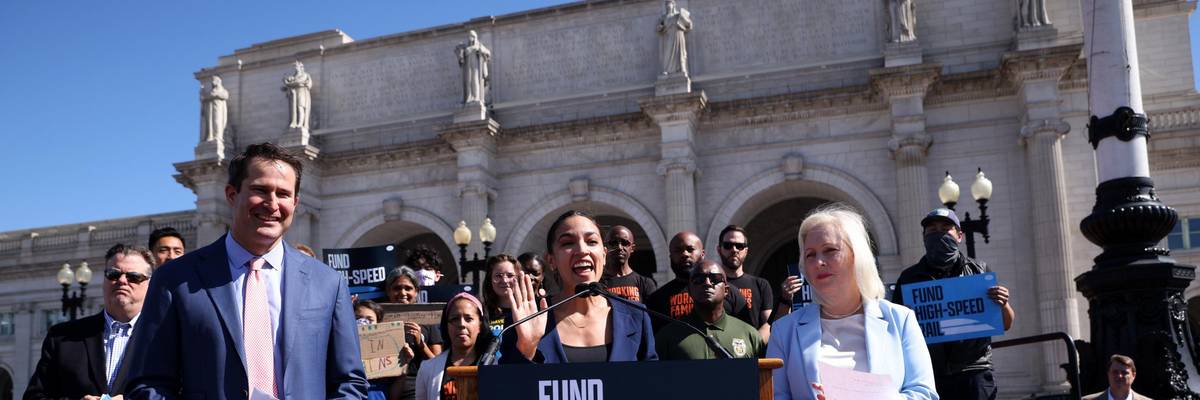
Rep. Alexandria Ocasio-Cortez (D-N.Y.) speaks during an event outside Union Station on June 16, 2021 in Washington, D.C. Ocasio-Cortez, joined by Rep. Seth Moulton (D-N.Y.) and Sen. Kirsten Gillibrand (D-N.Y.), called for increased federal funding for high-speed rail in the infrastructure package being discussed on Capitol Hill. (Photo: Win McNamee/Getty Images)
Rep. Alexandria Ocasio-Cortez on Sunday urged President Joe Biden against being "limited by Republicans" in moving infrastructure legislation forward, calling the political moment "our one big shot" on issues from Medicare to the climate emergency.
The New York Democrat's remarks in an interview with NBC's "Meet the Press" came a day after Biden walked back his vow of a two-track approach to infrastructure in which, to progressive praise and GOP ire, he would sign a $579 billion bipartisan deal if it came with a separate Democratic reconciliation bill "in tandem."
While Democrats can "welcome collaboration with Republicans and in those areas where this is agreement," said Ocasio-Cortez, "Republicans are more than welcome to join so that we can get this work on infrastructure done."
"But that doesn't mean that the president should be limited by Republicans," she said, "particularly when we have a House majority, we have 50 Democratic senators, and we have the White House."
Regarding the price tag of the bigger Democratic spending bill, Ocasio-Cortez stressed that it's more important to look at "what impact are we making."
"You can have an enormous price tag that is chock-full of fossil fuel giveaways and doesn't spend that money in a way that is going to solve our problems. Likewise," she continued, "you can also have an infrastructure plan that is... so small that it doesn't invest in any meaningful way."
"This is our one big shot, not just in terms of family, childcare, Medicare, but on climate change," she said, and referenced a leaked draft of an IPCC report last week "that showed devastating [climate] consequences if we under-invest."
"Building car infrastructure does not draw down carbon," she noted.
On Saturday--days after he touted a deal reached with a group of Democratic and Republican senators on an infrastructure framework that omitted key measures to address the climate crisis--Biden released a statement indicating he was not making a veto threat. He will support the bipartisan deal "with vigor," the statement added, and suggested Democrats opposing an infrastructure deal that doesn't include key priorities like climate crisis measures are "making a mistake."
"I indicated that I would refuse to sign the infrastructure bill if it was sent to me without my Families Plan and other priorities, including clean energy," said Biden. "That statement understandably upset some Republicans, who do not see the two plans as linked; they are hoping to defeat my Families Plan--and do not want their support for the infrastructure plan to be seen as aiding passage of the Families Plan."
"Issuing a veto threat on the very plan I had just agreed to," he added, "was certainly not my intent."
Biden's Thursday comments at a press conference suggesting he would veto the bipartisan deal, which is much smaller than the American Jobs Plan, without also getting a reconciliation bill containing Democratic priorities was followed by more than 24 hours of "damage control" by the White House, "with top advisers calling senators from both parties," the New York Times reported.
Washington Post reporter Jeff Stein tweeted that the White House statement indicated a "major shift" and "quick pivot after anger from Republican senators."
According to Politico, Republican negotiators were "mollified" by the statement, with comments from Sens. Rob Portman (R-Ohio) Sen. Mitt Romney (R-Utah) signaling "that over the two-week July Fourth recess, negotiators can start drafting legislation that provides the largest investments in physical infrastructure in U.S. history."
That bipartisan deal has sparked a wide range of concerns from progressives, including that it could cut unemployment benefits from jobless workers and has funding mechanisms like "asset recycling" that amount to "privatization scams."
Responding to Biden's statement Saturday that he will continue to pursue the bipartisan deal while also "seeking to pass my Families Plan through reconciliation," Sam Ricketts, co-founder and senior advisor for advocacy group Evergreen Action, urged the president not to omit bold measures to address the climate emergency.
"The reconciliation bill can't just be the American Families Plan with a couple bucks for clean energy," he tweeted. "Included also must be major climate investments that Biden campaigned on and put forward in his American Jobs Plan and that are not in his bipartisan infrastructure deal."
Dear Common Dreams reader, It’s been nearly 30 years since I co-founded Common Dreams with my late wife, Lina Newhouser. We had the radical notion that journalism should serve the public good, not corporate profits. It was clear to us from the outset what it would take to build such a project. No paid advertisements. No corporate sponsors. No millionaire publisher telling us what to think or do. Many people said we wouldn't last a year, but we proved those doubters wrong. Together with a tremendous team of journalists and dedicated staff, we built an independent media outlet free from the constraints of profits and corporate control. Our mission has always been simple: To inform. To inspire. To ignite change for the common good. Building Common Dreams was not easy. Our survival was never guaranteed. When you take on the most powerful forces—Wall Street greed, fossil fuel industry destruction, Big Tech lobbyists, and uber-rich oligarchs who have spent billions upon billions rigging the economy and democracy in their favor—the only bulwark you have is supporters who believe in your work. But here’s the urgent message from me today. It's never been this bad out there. And it's never been this hard to keep us going. At the very moment Common Dreams is most needed, the threats we face are intensifying. We need your support now more than ever. We don't accept corporate advertising and never will. We don't have a paywall because we don't think people should be blocked from critical news based on their ability to pay. Everything we do is funded by the donations of readers like you. When everyone does the little they can afford, we are strong. But if that support retreats or dries up, so do we. Will you donate now to make sure Common Dreams not only survives but thrives? —Craig Brown, Co-founder |
Rep. Alexandria Ocasio-Cortez on Sunday urged President Joe Biden against being "limited by Republicans" in moving infrastructure legislation forward, calling the political moment "our one big shot" on issues from Medicare to the climate emergency.
The New York Democrat's remarks in an interview with NBC's "Meet the Press" came a day after Biden walked back his vow of a two-track approach to infrastructure in which, to progressive praise and GOP ire, he would sign a $579 billion bipartisan deal if it came with a separate Democratic reconciliation bill "in tandem."
While Democrats can "welcome collaboration with Republicans and in those areas where this is agreement," said Ocasio-Cortez, "Republicans are more than welcome to join so that we can get this work on infrastructure done."
"But that doesn't mean that the president should be limited by Republicans," she said, "particularly when we have a House majority, we have 50 Democratic senators, and we have the White House."
Regarding the price tag of the bigger Democratic spending bill, Ocasio-Cortez stressed that it's more important to look at "what impact are we making."
"You can have an enormous price tag that is chock-full of fossil fuel giveaways and doesn't spend that money in a way that is going to solve our problems. Likewise," she continued, "you can also have an infrastructure plan that is... so small that it doesn't invest in any meaningful way."
"This is our one big shot, not just in terms of family, childcare, Medicare, but on climate change," she said, and referenced a leaked draft of an IPCC report last week "that showed devastating [climate] consequences if we under-invest."
"Building car infrastructure does not draw down carbon," she noted.
On Saturday--days after he touted a deal reached with a group of Democratic and Republican senators on an infrastructure framework that omitted key measures to address the climate crisis--Biden released a statement indicating he was not making a veto threat. He will support the bipartisan deal "with vigor," the statement added, and suggested Democrats opposing an infrastructure deal that doesn't include key priorities like climate crisis measures are "making a mistake."
"I indicated that I would refuse to sign the infrastructure bill if it was sent to me without my Families Plan and other priorities, including clean energy," said Biden. "That statement understandably upset some Republicans, who do not see the two plans as linked; they are hoping to defeat my Families Plan--and do not want their support for the infrastructure plan to be seen as aiding passage of the Families Plan."
"Issuing a veto threat on the very plan I had just agreed to," he added, "was certainly not my intent."
Biden's Thursday comments at a press conference suggesting he would veto the bipartisan deal, which is much smaller than the American Jobs Plan, without also getting a reconciliation bill containing Democratic priorities was followed by more than 24 hours of "damage control" by the White House, "with top advisers calling senators from both parties," the New York Times reported.
Washington Post reporter Jeff Stein tweeted that the White House statement indicated a "major shift" and "quick pivot after anger from Republican senators."
According to Politico, Republican negotiators were "mollified" by the statement, with comments from Sens. Rob Portman (R-Ohio) Sen. Mitt Romney (R-Utah) signaling "that over the two-week July Fourth recess, negotiators can start drafting legislation that provides the largest investments in physical infrastructure in U.S. history."
That bipartisan deal has sparked a wide range of concerns from progressives, including that it could cut unemployment benefits from jobless workers and has funding mechanisms like "asset recycling" that amount to "privatization scams."
Responding to Biden's statement Saturday that he will continue to pursue the bipartisan deal while also "seeking to pass my Families Plan through reconciliation," Sam Ricketts, co-founder and senior advisor for advocacy group Evergreen Action, urged the president not to omit bold measures to address the climate emergency.
"The reconciliation bill can't just be the American Families Plan with a couple bucks for clean energy," he tweeted. "Included also must be major climate investments that Biden campaigned on and put forward in his American Jobs Plan and that are not in his bipartisan infrastructure deal."
Rep. Alexandria Ocasio-Cortez on Sunday urged President Joe Biden against being "limited by Republicans" in moving infrastructure legislation forward, calling the political moment "our one big shot" on issues from Medicare to the climate emergency.
The New York Democrat's remarks in an interview with NBC's "Meet the Press" came a day after Biden walked back his vow of a two-track approach to infrastructure in which, to progressive praise and GOP ire, he would sign a $579 billion bipartisan deal if it came with a separate Democratic reconciliation bill "in tandem."
While Democrats can "welcome collaboration with Republicans and in those areas where this is agreement," said Ocasio-Cortez, "Republicans are more than welcome to join so that we can get this work on infrastructure done."
"But that doesn't mean that the president should be limited by Republicans," she said, "particularly when we have a House majority, we have 50 Democratic senators, and we have the White House."
Regarding the price tag of the bigger Democratic spending bill, Ocasio-Cortez stressed that it's more important to look at "what impact are we making."
"You can have an enormous price tag that is chock-full of fossil fuel giveaways and doesn't spend that money in a way that is going to solve our problems. Likewise," she continued, "you can also have an infrastructure plan that is... so small that it doesn't invest in any meaningful way."
"This is our one big shot, not just in terms of family, childcare, Medicare, but on climate change," she said, and referenced a leaked draft of an IPCC report last week "that showed devastating [climate] consequences if we under-invest."
"Building car infrastructure does not draw down carbon," she noted.
On Saturday--days after he touted a deal reached with a group of Democratic and Republican senators on an infrastructure framework that omitted key measures to address the climate crisis--Biden released a statement indicating he was not making a veto threat. He will support the bipartisan deal "with vigor," the statement added, and suggested Democrats opposing an infrastructure deal that doesn't include key priorities like climate crisis measures are "making a mistake."
"I indicated that I would refuse to sign the infrastructure bill if it was sent to me without my Families Plan and other priorities, including clean energy," said Biden. "That statement understandably upset some Republicans, who do not see the two plans as linked; they are hoping to defeat my Families Plan--and do not want their support for the infrastructure plan to be seen as aiding passage of the Families Plan."
"Issuing a veto threat on the very plan I had just agreed to," he added, "was certainly not my intent."
Biden's Thursday comments at a press conference suggesting he would veto the bipartisan deal, which is much smaller than the American Jobs Plan, without also getting a reconciliation bill containing Democratic priorities was followed by more than 24 hours of "damage control" by the White House, "with top advisers calling senators from both parties," the New York Times reported.
Washington Post reporter Jeff Stein tweeted that the White House statement indicated a "major shift" and "quick pivot after anger from Republican senators."
According to Politico, Republican negotiators were "mollified" by the statement, with comments from Sens. Rob Portman (R-Ohio) Sen. Mitt Romney (R-Utah) signaling "that over the two-week July Fourth recess, negotiators can start drafting legislation that provides the largest investments in physical infrastructure in U.S. history."
That bipartisan deal has sparked a wide range of concerns from progressives, including that it could cut unemployment benefits from jobless workers and has funding mechanisms like "asset recycling" that amount to "privatization scams."
Responding to Biden's statement Saturday that he will continue to pursue the bipartisan deal while also "seeking to pass my Families Plan through reconciliation," Sam Ricketts, co-founder and senior advisor for advocacy group Evergreen Action, urged the president not to omit bold measures to address the climate emergency.
"The reconciliation bill can't just be the American Families Plan with a couple bucks for clean energy," he tweeted. "Included also must be major climate investments that Biden campaigned on and put forward in his American Jobs Plan and that are not in his bipartisan infrastructure deal."

