SUBSCRIBE TO OUR FREE NEWSLETTER
Daily news & progressive opinion—funded by the people, not the corporations—delivered straight to your inbox.
5
#000000
#FFFFFF
To donate by check, phone, or other method, see our More Ways to Give page.
Daily news & progressive opinion—funded by the people, not the corporations—delivered straight to your inbox.
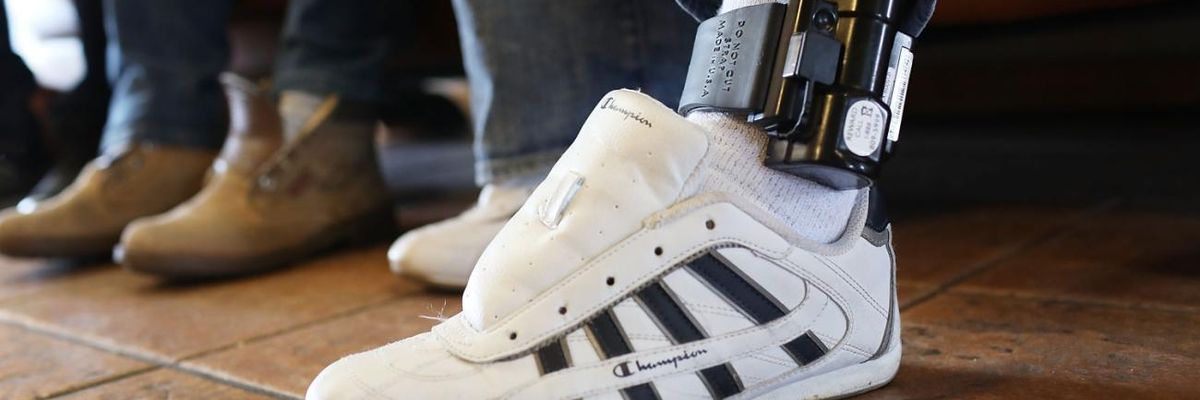
A father wears an ankle bracelet as he is cared for in an Annunciation House facility after being reunited with his son on July 25, 2018 in El Paso, Texas. (Photo: Joe Raedle/Getty Images)
A new report by immigrant rights and legal aid groups highlights the Biden administration's failed attempt to distinguish its immigration policy from former President Donald Trump's by relying on digital surveillance rather than detention--and calls on officials to end the use of "digital prisons."
"ICE Digital Prisons," a report by Mijente and Just Futures Law, condemned the use of "so-called 'alternatives to detention'" including ankle monitors, voiceprint verification, unannounced home visits, and app-based surveillance such as "SmartLINK," which requires immigrants to upload a photo of themselves while confirming their location.
"Asylum seekers who would have previously been released from detention and not responsible for reporting to the agency are often incorporated into the program, expanding its reach."
--Mijente and Just Futures Law
The administration's "digital prisons," said the groups, "are operated by private, for-profit companies with the purpose of extending incarceration beyond the walls of detention centers and do not provide resources like access to education, housing, and legal services for immigrant communities to thrive."
"The technologies that these programs employ only further entrench the criminalization of immigration and pose barriers to social and economic wellbeing," reads the report, which the two groups released as they began a two-day conference focused on how immigrant communities are targeted by digital surveillance and data mining.
More than 96,000 people are currently tracked by the government's Alternatives to Detention program, the report says, and the Biden administration's 2022 budget calls for an increase to 140,000 people.
The expanded program, whose funding rose from $28 million in 2006 to $440 million in 2021, will actually increase the number of people who are subject to supervision by ICE.
"For example, asylum seekers who would have previously been released from detention and not responsible for reporting to the agency are often incorporated into the program, expanding its reach," the report reads. "Most importantly, these e-carceration tools exact physical and emotional harm onthe immigrants subjected to these surveillance technologies, such as wounds from the ankle shackle or the psychological weight of ICE tracking a person's movement and personal interactions."
ICE's growing reliance on digital surveillance has also led to the agency's experimentation with "other predictive technologies to decide who to detain and who to release under supervision," the report says.
Since 2013, ICE has used a "risk assessment classification tool," feeding information into 178 data fields to calculate the "risk" of releasing an individual.
"Perhaps intentionally so, the algorithm did not lead to the release of large percentages of individuals classified as 'low-risk,'" the report states. "Between 2013-2017, individuals classified as 'low risk' were recommended for pretrial detention with no bond 53% of the time. That percentage went up to 97% by 2019."
People placed in the Alternatives to Detention program are also likely to eventually end up in detention centers, according to the report, sometimes due to technological issues or minor mistakes made with monitors.
For example, a report is generated if a person does not return a voice verification call within five minutes. Meanwhile, people placed in ICE's GPS monitoring programs are reported for a host of "vaguely defined" infractions, including suspected tampering, unauthorized movement, and contact from people connected to "organized crime" or the media.
The use of algorithms, GPS monitoring, and other digital mechanisms to determine the whereabouts of immigrants and asylum seekers "impact an individual's ability to gain or retain employment, hinder access to legal resources, limit participation in caregiving, increase risk of domestic violence, negatively impact health, punish family members, and heighten racial disparities," the report reads.
When federal agents raided several food-processing plants in Mississippi in 2019 and arrested nearly 700 people--the largest ICE raid in U.S. history--GPS data was used to execute the search warrants.
So-called Alternatives to Detention "do more harm and inhibit any true progress in providing the social and economic tools for immigrants to thrive in their communities," the groups said.
"Electronic monitoring not only poses undue burdens on immigrants, including physical harm to their bodies, but increases the number of individuals under ICE's supervision and in detention."
Dear Common Dreams reader, It’s been nearly 30 years since I co-founded Common Dreams with my late wife, Lina Newhouser. We had the radical notion that journalism should serve the public good, not corporate profits. It was clear to us from the outset what it would take to build such a project. No paid advertisements. No corporate sponsors. No millionaire publisher telling us what to think or do. Many people said we wouldn't last a year, but we proved those doubters wrong. Together with a tremendous team of journalists and dedicated staff, we built an independent media outlet free from the constraints of profits and corporate control. Our mission has always been simple: To inform. To inspire. To ignite change for the common good. Building Common Dreams was not easy. Our survival was never guaranteed. When you take on the most powerful forces—Wall Street greed, fossil fuel industry destruction, Big Tech lobbyists, and uber-rich oligarchs who have spent billions upon billions rigging the economy and democracy in their favor—the only bulwark you have is supporters who believe in your work. But here’s the urgent message from me today. It's never been this bad out there. And it's never been this hard to keep us going. At the very moment Common Dreams is most needed, the threats we face are intensifying. We need your support now more than ever. We don't accept corporate advertising and never will. We don't have a paywall because we don't think people should be blocked from critical news based on their ability to pay. Everything we do is funded by the donations of readers like you. When everyone does the little they can afford, we are strong. But if that support retreats or dries up, so do we. Will you donate now to make sure Common Dreams not only survives but thrives? —Craig Brown, Co-founder |
A new report by immigrant rights and legal aid groups highlights the Biden administration's failed attempt to distinguish its immigration policy from former President Donald Trump's by relying on digital surveillance rather than detention--and calls on officials to end the use of "digital prisons."
"ICE Digital Prisons," a report by Mijente and Just Futures Law, condemned the use of "so-called 'alternatives to detention'" including ankle monitors, voiceprint verification, unannounced home visits, and app-based surveillance such as "SmartLINK," which requires immigrants to upload a photo of themselves while confirming their location.
"Asylum seekers who would have previously been released from detention and not responsible for reporting to the agency are often incorporated into the program, expanding its reach."
--Mijente and Just Futures Law
The administration's "digital prisons," said the groups, "are operated by private, for-profit companies with the purpose of extending incarceration beyond the walls of detention centers and do not provide resources like access to education, housing, and legal services for immigrant communities to thrive."
"The technologies that these programs employ only further entrench the criminalization of immigration and pose barriers to social and economic wellbeing," reads the report, which the two groups released as they began a two-day conference focused on how immigrant communities are targeted by digital surveillance and data mining.
More than 96,000 people are currently tracked by the government's Alternatives to Detention program, the report says, and the Biden administration's 2022 budget calls for an increase to 140,000 people.
The expanded program, whose funding rose from $28 million in 2006 to $440 million in 2021, will actually increase the number of people who are subject to supervision by ICE.
"For example, asylum seekers who would have previously been released from detention and not responsible for reporting to the agency are often incorporated into the program, expanding its reach," the report reads. "Most importantly, these e-carceration tools exact physical and emotional harm onthe immigrants subjected to these surveillance technologies, such as wounds from the ankle shackle or the psychological weight of ICE tracking a person's movement and personal interactions."
ICE's growing reliance on digital surveillance has also led to the agency's experimentation with "other predictive technologies to decide who to detain and who to release under supervision," the report says.
Since 2013, ICE has used a "risk assessment classification tool," feeding information into 178 data fields to calculate the "risk" of releasing an individual.
"Perhaps intentionally so, the algorithm did not lead to the release of large percentages of individuals classified as 'low-risk,'" the report states. "Between 2013-2017, individuals classified as 'low risk' were recommended for pretrial detention with no bond 53% of the time. That percentage went up to 97% by 2019."
People placed in the Alternatives to Detention program are also likely to eventually end up in detention centers, according to the report, sometimes due to technological issues or minor mistakes made with monitors.
For example, a report is generated if a person does not return a voice verification call within five minutes. Meanwhile, people placed in ICE's GPS monitoring programs are reported for a host of "vaguely defined" infractions, including suspected tampering, unauthorized movement, and contact from people connected to "organized crime" or the media.
The use of algorithms, GPS monitoring, and other digital mechanisms to determine the whereabouts of immigrants and asylum seekers "impact an individual's ability to gain or retain employment, hinder access to legal resources, limit participation in caregiving, increase risk of domestic violence, negatively impact health, punish family members, and heighten racial disparities," the report reads.
When federal agents raided several food-processing plants in Mississippi in 2019 and arrested nearly 700 people--the largest ICE raid in U.S. history--GPS data was used to execute the search warrants.
So-called Alternatives to Detention "do more harm and inhibit any true progress in providing the social and economic tools for immigrants to thrive in their communities," the groups said.
"Electronic monitoring not only poses undue burdens on immigrants, including physical harm to their bodies, but increases the number of individuals under ICE's supervision and in detention."
A new report by immigrant rights and legal aid groups highlights the Biden administration's failed attempt to distinguish its immigration policy from former President Donald Trump's by relying on digital surveillance rather than detention--and calls on officials to end the use of "digital prisons."
"ICE Digital Prisons," a report by Mijente and Just Futures Law, condemned the use of "so-called 'alternatives to detention'" including ankle monitors, voiceprint verification, unannounced home visits, and app-based surveillance such as "SmartLINK," which requires immigrants to upload a photo of themselves while confirming their location.
"Asylum seekers who would have previously been released from detention and not responsible for reporting to the agency are often incorporated into the program, expanding its reach."
--Mijente and Just Futures Law
The administration's "digital prisons," said the groups, "are operated by private, for-profit companies with the purpose of extending incarceration beyond the walls of detention centers and do not provide resources like access to education, housing, and legal services for immigrant communities to thrive."
"The technologies that these programs employ only further entrench the criminalization of immigration and pose barriers to social and economic wellbeing," reads the report, which the two groups released as they began a two-day conference focused on how immigrant communities are targeted by digital surveillance and data mining.
More than 96,000 people are currently tracked by the government's Alternatives to Detention program, the report says, and the Biden administration's 2022 budget calls for an increase to 140,000 people.
The expanded program, whose funding rose from $28 million in 2006 to $440 million in 2021, will actually increase the number of people who are subject to supervision by ICE.
"For example, asylum seekers who would have previously been released from detention and not responsible for reporting to the agency are often incorporated into the program, expanding its reach," the report reads. "Most importantly, these e-carceration tools exact physical and emotional harm onthe immigrants subjected to these surveillance technologies, such as wounds from the ankle shackle or the psychological weight of ICE tracking a person's movement and personal interactions."
ICE's growing reliance on digital surveillance has also led to the agency's experimentation with "other predictive technologies to decide who to detain and who to release under supervision," the report says.
Since 2013, ICE has used a "risk assessment classification tool," feeding information into 178 data fields to calculate the "risk" of releasing an individual.
"Perhaps intentionally so, the algorithm did not lead to the release of large percentages of individuals classified as 'low-risk,'" the report states. "Between 2013-2017, individuals classified as 'low risk' were recommended for pretrial detention with no bond 53% of the time. That percentage went up to 97% by 2019."
People placed in the Alternatives to Detention program are also likely to eventually end up in detention centers, according to the report, sometimes due to technological issues or minor mistakes made with monitors.
For example, a report is generated if a person does not return a voice verification call within five minutes. Meanwhile, people placed in ICE's GPS monitoring programs are reported for a host of "vaguely defined" infractions, including suspected tampering, unauthorized movement, and contact from people connected to "organized crime" or the media.
The use of algorithms, GPS monitoring, and other digital mechanisms to determine the whereabouts of immigrants and asylum seekers "impact an individual's ability to gain or retain employment, hinder access to legal resources, limit participation in caregiving, increase risk of domestic violence, negatively impact health, punish family members, and heighten racial disparities," the report reads.
When federal agents raided several food-processing plants in Mississippi in 2019 and arrested nearly 700 people--the largest ICE raid in U.S. history--GPS data was used to execute the search warrants.
So-called Alternatives to Detention "do more harm and inhibit any true progress in providing the social and economic tools for immigrants to thrive in their communities," the groups said.
"Electronic monitoring not only poses undue burdens on immigrants, including physical harm to their bodies, but increases the number of individuals under ICE's supervision and in detention."