

SUBSCRIBE TO OUR FREE NEWSLETTER
Daily news & progressive opinion—funded by the people, not the corporations—delivered straight to your inbox.
5
#000000
#FFFFFF
To donate by check, phone, or other method, see our More Ways to Give page.
Daily news & progressive opinion—funded by the people, not the corporations—delivered straight to your inbox.
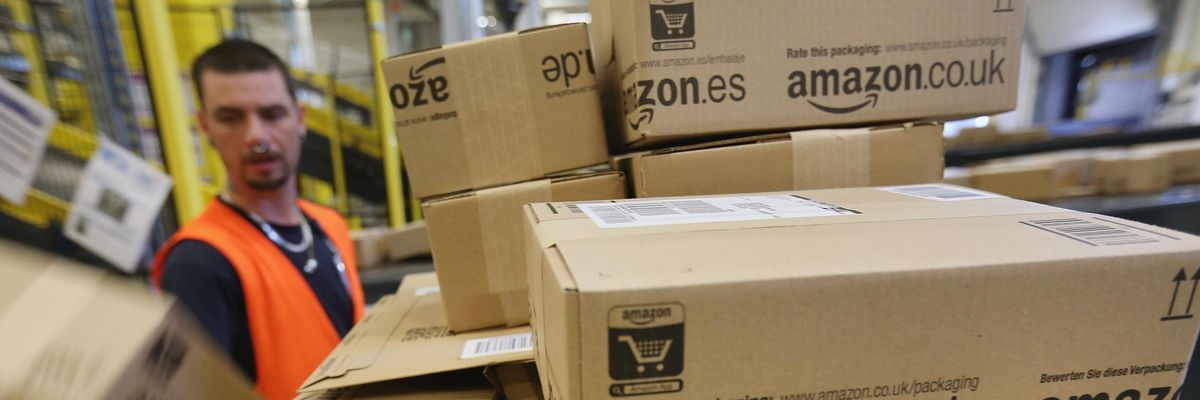
A worker prepares packages for delivery at an Amazon warehouse on September 4, 2014 in Brieselang, Germany. (Photo: Sean Gallup/Getty Images)
A new report out Tuesday accuses Amazon of having an "abysmal health and safety record" as a result of its obsession with production speed, pointing to worker injury rates that are far higher than those across the warehouse and shipping industry.
The analysis, Primed for Pain: Amazon's Epidemic of Workplace Injuries, was released by the Strategic Organizing Center (SOC), a collection of four labor unions, and comes amid sustained scrutiny over the company's mistreatment of workers amid soaring profits.
The report is based on data Amazon provided to the federal Occupational Safety and Health Administration (OSHA) and covers the four-year period 2017-2020.
"Every day is just go, go, go," said Safiyo Muhamed, a former worker at an Amazon fulfillment center in Shakopee, Minnesota for two and a half years who suffered a slipped disc in her back while lifting a heavy tote.
"Amazon wants you to work like a robot, like a machine," she said in a statement. "Every week they rank you, they monitor you through the computer. You have to be so fast. Humans aren't able to do it."
Muhamed's assessment is unsurprising given the report's assertion that "Amazon's obsession with speed in every part of its business has been a key element of its growth strategy."
"But the company's obsession with speed has come at a huge cost for Amazon's workforce," the report states.
Amazon's workforce grew from 208,764 workers in 2017 to 581,624 in 2020. There were injuries at 191 facilities in 2017, and at 658 facilities in 2020.
The data showed "substantially higher rates of workplace injuries" for Amazon workers compared to those in the same industry at other companies, the analysis found.
In 2017, Amazon had 11,883 recordable injuries--about 87% of which were injuries that made workers unable to perform their regular job functions (light duty) or forced them to miss work (lost time).
In 2020, there were 27,178 recordable injuries, 90% of which forced workers into light duty or lost time. That rate is more notable, the report said, because the coronavirus pandemic forced Amazon to make "massive operational changes" in 2020 that likely lessened speed.
While the warehouse industry is notoriously dangerous, the report says that Amazon's injury rate was still well above those of other warehouse employers.
"In all four years for which data are available, Amazon's rate of injuries per 100 warehouse workers is substantially higher than it is for non-Amazon employers in the general warehouse industry," the report states.
In 2020, for example, there were 6.5 injuries per 100 Amazon warehouse workers and just 4.0 injuries per 100 at all other warehouses.
What's more, the injuries suffered by Amazon workers are more severe. Singling out 2020 again, the report says there were 5.9 serious injuries per 100 Amazon workers--a rate that's about 80% higher than those of other warehousing industry employers.
The analysis also compared Amazon with retail e-commerce competitor Walmart. "In 2020, Amazon's overall warehouse injury rate (6.5/100 FTEs) was over twice that of Walmart (3.0), while Amazon's severe injury rate (2.6) was more than two-and-a-half times Walmart's."
SOS gathered further data from a February 2021 survey of 996 Amazon workers across 42 states. Forty-two percent of those queried said a workplace injury caused them to miss work, and roughly 80% of those attributed their injury to production pressure or speed.
Another finding from that survey: 52% said that since the pandemic broke out, Amazon has either terminated, disciplined, or threatened workers who don't keep up with the work pace.
"Workers' accounts of extreme production pressure in 2021 suggest that Amazon's reduced injury rates during Covid may not be sustained as the company returns to its previous practices," the report warns.
That wouldn't be unpredictable, according to the analysis.
"Amazon's abysmal health and safety record is not an accident," the report states. "Rather, it is the predictable outcome of a company that prioritizes speed, growth, and profits over the health and safety of its employees."
"Unfortunately," the publication continues, "this alarming rate of serious workplace injuries is likely to continue unless Amazon is forced by workers and others to take long-term meaningful action to make its workplaces safer."
Eric Frumin, SOC's director of health and safety, didn't mince words in his assessment of Amazon's duty to workers.
"By effectively ignoring the obvious consequences of their own decisions," said Frumin, "Amazon's leaders have failed in their legal, ethical, and moral responsibility to protect their own employees from serious hazards and the very real danger of career-threatening injuries."
Dear Common Dreams reader, It’s been nearly 30 years since I co-founded Common Dreams with my late wife, Lina Newhouser. We had the radical notion that journalism should serve the public good, not corporate profits. It was clear to us from the outset what it would take to build such a project. No paid advertisements. No corporate sponsors. No millionaire publisher telling us what to think or do. Many people said we wouldn't last a year, but we proved those doubters wrong. Together with a tremendous team of journalists and dedicated staff, we built an independent media outlet free from the constraints of profits and corporate control. Our mission has always been simple: To inform. To inspire. To ignite change for the common good. Building Common Dreams was not easy. Our survival was never guaranteed. When you take on the most powerful forces—Wall Street greed, fossil fuel industry destruction, Big Tech lobbyists, and uber-rich oligarchs who have spent billions upon billions rigging the economy and democracy in their favor—the only bulwark you have is supporters who believe in your work. But here’s the urgent message from me today. It's never been this bad out there. And it's never been this hard to keep us going. At the very moment Common Dreams is most needed, the threats we face are intensifying. We need your support now more than ever. We don't accept corporate advertising and never will. We don't have a paywall because we don't think people should be blocked from critical news based on their ability to pay. Everything we do is funded by the donations of readers like you. When everyone does the little they can afford, we are strong. But if that support retreats or dries up, so do we. Will you donate now to make sure Common Dreams not only survives but thrives? —Craig Brown, Co-founder |
A new report out Tuesday accuses Amazon of having an "abysmal health and safety record" as a result of its obsession with production speed, pointing to worker injury rates that are far higher than those across the warehouse and shipping industry.
The analysis, Primed for Pain: Amazon's Epidemic of Workplace Injuries, was released by the Strategic Organizing Center (SOC), a collection of four labor unions, and comes amid sustained scrutiny over the company's mistreatment of workers amid soaring profits.
The report is based on data Amazon provided to the federal Occupational Safety and Health Administration (OSHA) and covers the four-year period 2017-2020.
"Every day is just go, go, go," said Safiyo Muhamed, a former worker at an Amazon fulfillment center in Shakopee, Minnesota for two and a half years who suffered a slipped disc in her back while lifting a heavy tote.
"Amazon wants you to work like a robot, like a machine," she said in a statement. "Every week they rank you, they monitor you through the computer. You have to be so fast. Humans aren't able to do it."
Muhamed's assessment is unsurprising given the report's assertion that "Amazon's obsession with speed in every part of its business has been a key element of its growth strategy."
"But the company's obsession with speed has come at a huge cost for Amazon's workforce," the report states.
Amazon's workforce grew from 208,764 workers in 2017 to 581,624 in 2020. There were injuries at 191 facilities in 2017, and at 658 facilities in 2020.
The data showed "substantially higher rates of workplace injuries" for Amazon workers compared to those in the same industry at other companies, the analysis found.
In 2017, Amazon had 11,883 recordable injuries--about 87% of which were injuries that made workers unable to perform their regular job functions (light duty) or forced them to miss work (lost time).
In 2020, there were 27,178 recordable injuries, 90% of which forced workers into light duty or lost time. That rate is more notable, the report said, because the coronavirus pandemic forced Amazon to make "massive operational changes" in 2020 that likely lessened speed.
While the warehouse industry is notoriously dangerous, the report says that Amazon's injury rate was still well above those of other warehouse employers.
"In all four years for which data are available, Amazon's rate of injuries per 100 warehouse workers is substantially higher than it is for non-Amazon employers in the general warehouse industry," the report states.
In 2020, for example, there were 6.5 injuries per 100 Amazon warehouse workers and just 4.0 injuries per 100 at all other warehouses.
What's more, the injuries suffered by Amazon workers are more severe. Singling out 2020 again, the report says there were 5.9 serious injuries per 100 Amazon workers--a rate that's about 80% higher than those of other warehousing industry employers.
The analysis also compared Amazon with retail e-commerce competitor Walmart. "In 2020, Amazon's overall warehouse injury rate (6.5/100 FTEs) was over twice that of Walmart (3.0), while Amazon's severe injury rate (2.6) was more than two-and-a-half times Walmart's."
SOS gathered further data from a February 2021 survey of 996 Amazon workers across 42 states. Forty-two percent of those queried said a workplace injury caused them to miss work, and roughly 80% of those attributed their injury to production pressure or speed.
Another finding from that survey: 52% said that since the pandemic broke out, Amazon has either terminated, disciplined, or threatened workers who don't keep up with the work pace.
"Workers' accounts of extreme production pressure in 2021 suggest that Amazon's reduced injury rates during Covid may not be sustained as the company returns to its previous practices," the report warns.
That wouldn't be unpredictable, according to the analysis.
"Amazon's abysmal health and safety record is not an accident," the report states. "Rather, it is the predictable outcome of a company that prioritizes speed, growth, and profits over the health and safety of its employees."
"Unfortunately," the publication continues, "this alarming rate of serious workplace injuries is likely to continue unless Amazon is forced by workers and others to take long-term meaningful action to make its workplaces safer."
Eric Frumin, SOC's director of health and safety, didn't mince words in his assessment of Amazon's duty to workers.
"By effectively ignoring the obvious consequences of their own decisions," said Frumin, "Amazon's leaders have failed in their legal, ethical, and moral responsibility to protect their own employees from serious hazards and the very real danger of career-threatening injuries."
A new report out Tuesday accuses Amazon of having an "abysmal health and safety record" as a result of its obsession with production speed, pointing to worker injury rates that are far higher than those across the warehouse and shipping industry.
The analysis, Primed for Pain: Amazon's Epidemic of Workplace Injuries, was released by the Strategic Organizing Center (SOC), a collection of four labor unions, and comes amid sustained scrutiny over the company's mistreatment of workers amid soaring profits.
The report is based on data Amazon provided to the federal Occupational Safety and Health Administration (OSHA) and covers the four-year period 2017-2020.
"Every day is just go, go, go," said Safiyo Muhamed, a former worker at an Amazon fulfillment center in Shakopee, Minnesota for two and a half years who suffered a slipped disc in her back while lifting a heavy tote.
"Amazon wants you to work like a robot, like a machine," she said in a statement. "Every week they rank you, they monitor you through the computer. You have to be so fast. Humans aren't able to do it."
Muhamed's assessment is unsurprising given the report's assertion that "Amazon's obsession with speed in every part of its business has been a key element of its growth strategy."
"But the company's obsession with speed has come at a huge cost for Amazon's workforce," the report states.
Amazon's workforce grew from 208,764 workers in 2017 to 581,624 in 2020. There were injuries at 191 facilities in 2017, and at 658 facilities in 2020.
The data showed "substantially higher rates of workplace injuries" for Amazon workers compared to those in the same industry at other companies, the analysis found.
In 2017, Amazon had 11,883 recordable injuries--about 87% of which were injuries that made workers unable to perform their regular job functions (light duty) or forced them to miss work (lost time).
In 2020, there were 27,178 recordable injuries, 90% of which forced workers into light duty or lost time. That rate is more notable, the report said, because the coronavirus pandemic forced Amazon to make "massive operational changes" in 2020 that likely lessened speed.
While the warehouse industry is notoriously dangerous, the report says that Amazon's injury rate was still well above those of other warehouse employers.
"In all four years for which data are available, Amazon's rate of injuries per 100 warehouse workers is substantially higher than it is for non-Amazon employers in the general warehouse industry," the report states.
In 2020, for example, there were 6.5 injuries per 100 Amazon warehouse workers and just 4.0 injuries per 100 at all other warehouses.
What's more, the injuries suffered by Amazon workers are more severe. Singling out 2020 again, the report says there were 5.9 serious injuries per 100 Amazon workers--a rate that's about 80% higher than those of other warehousing industry employers.
The analysis also compared Amazon with retail e-commerce competitor Walmart. "In 2020, Amazon's overall warehouse injury rate (6.5/100 FTEs) was over twice that of Walmart (3.0), while Amazon's severe injury rate (2.6) was more than two-and-a-half times Walmart's."
SOS gathered further data from a February 2021 survey of 996 Amazon workers across 42 states. Forty-two percent of those queried said a workplace injury caused them to miss work, and roughly 80% of those attributed their injury to production pressure or speed.
Another finding from that survey: 52% said that since the pandemic broke out, Amazon has either terminated, disciplined, or threatened workers who don't keep up with the work pace.
"Workers' accounts of extreme production pressure in 2021 suggest that Amazon's reduced injury rates during Covid may not be sustained as the company returns to its previous practices," the report warns.
That wouldn't be unpredictable, according to the analysis.
"Amazon's abysmal health and safety record is not an accident," the report states. "Rather, it is the predictable outcome of a company that prioritizes speed, growth, and profits over the health and safety of its employees."
"Unfortunately," the publication continues, "this alarming rate of serious workplace injuries is likely to continue unless Amazon is forced by workers and others to take long-term meaningful action to make its workplaces safer."
Eric Frumin, SOC's director of health and safety, didn't mince words in his assessment of Amazon's duty to workers.
"By effectively ignoring the obvious consequences of their own decisions," said Frumin, "Amazon's leaders have failed in their legal, ethical, and moral responsibility to protect their own employees from serious hazards and the very real danger of career-threatening injuries."

