SUBSCRIBE TO OUR FREE NEWSLETTER
Daily news & progressive opinion—funded by the people, not the corporations—delivered straight to your inbox.
5
#000000
#FFFFFF
To donate by check, phone, or other method, see our More Ways to Give page.
Daily news & progressive opinion—funded by the people, not the corporations—delivered straight to your inbox.
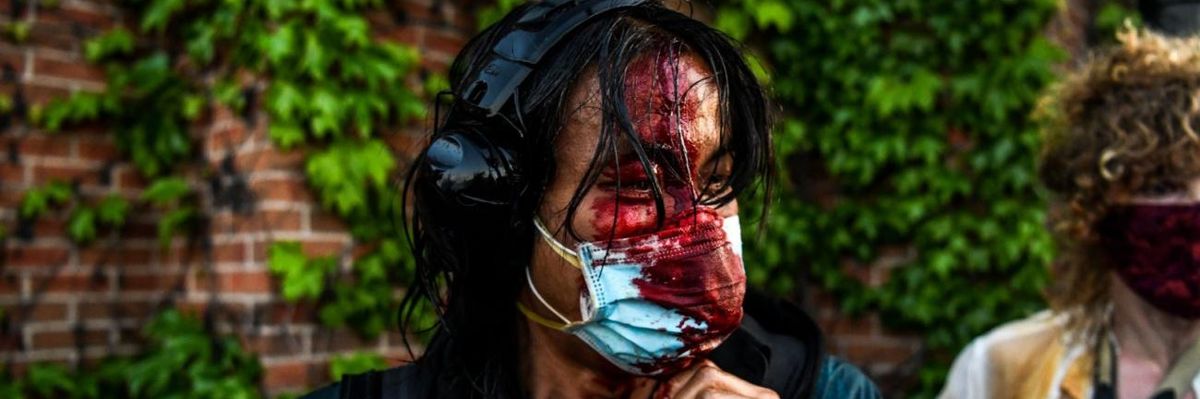
A journalist is seen bleeding after police started firing tear gas and rubber bullets near the 5th police precinct in Minneapolis following a demonstration to call for justice for George Floyd, a unarmed Black man killed by police, on May 30, 2020. (Photo: Chandan Khanna/AFP via Getty Images)
The Reporters Committee for Freedom of the Press on Monday released its fourth annual report about conditions that members of the U.S. media faced while on the job last year--and revealed "the startling extent of police violence against journalists during a year of protest."
The new report (pdf), published on World Press Freedom Day, analyzes data from the U.S. Press Freedom Tracker. Launched in 2017, the tracker is led by the Freedom of the Press Foundation and Committee to Protect Journalists (CPJ) along with other organizations including Reporters Without Borders and the Reporters Committee for Freedom of the Press.
"The importance of the tracker and its role documenting press freedoms in the U.S. came into sharp focus in 2020--only the fourth year of its existence--when the country faced a wave of protests, and journalists covering those protests were arrested and attacked in record numbers," the report says.
While noting that "protests have long been one of the most dangerous places for journalists to report the news," the report highlights some startling figures:
Ignited by the May 25 murder of George Floyd by a Minneapolis police officer, protests for racial justice and against police brutality erupted across the country, marking a tumultuous moment for press freedom in the U.S. As journalists reported on these historic demonstrations (collectively referred to as Black Lives Matter protests by the tracker), they faced a record number of attacks (400) and arrests (129)--more than 11 and 15 times the number reported for 2019, respectively. The press freedom incidents that occurred during these protests, which included damaged equipment, represented the vast majority--at least 82% (517)--of the total number of incidents documented by the Tracker in 2020 (625).
While private individuals assaulted many journalists, law enforcement was responsible for 80% of these attacks. In cities across the country--from Portland to Miami, Minneapolis to Los Angeles--police officers shot journalists with various forms of projectiles, like rubber-coated bullets, which can be lethal at close range. They caused serious injuries to reporters, permanently blinding one of them. Police also sprayed tear gas, fired pepper balls, and used their batons and fists. Officers often ignored journalists' press credentials and flouted news media exemptions to local curfew ordinances. Police also detained reporters during mass arrests--and, in at least one case, even handcuffed a TV news journalist as he reported live, on-air.
In another case, the report says, a Buffalo officer reportedly told a freelance photojournalist, "F*ck your First Amendment," as police pointed guns at his head.
"2020 marked the third consecutive year that the number of subpoenas reported to the tracker increased, renewing concerns that journalists may be facing these legal threats more frequently," according to the report. It also notes that "although 2020 saw a drop in prior restraint cases, three lawsuits over the summer involved unsuccessful efforts to block the publication of books about former President Donald Trump."
Other key findings include:
Although the report concludes that "there are reasons for optimism in 2021," it also points out that President Joe Biden's administration "has continued to pursue a historic criminal prosecution against WikiLeaks founder Julian Assange, which includes charges based solely on the act of publicly disclosing government secrets--the first time such a legal theory has advanced beyond the grand jury stage."
In a lengthy statement acknowledging World Press Freedom Day, Biden said that "we celebrate the courage of truth-tellers who refuse to be intimidated, often at great personal risk, and we reaffirm the timeless and essential role journalism and a free media play in societies everywhere."
Journalists "are indispensable to the functioning of democracy," Biden continued. "Throughout the Covid-19 pandemic, journalists and media workers have been on the frontlines to keep the public informed, at significant risk to their own health. And, at a time when the truth is increasingly under attack, our need for accurate, fact-based reporting, open public conversation, and accountability has never been greater."
"It is incumbent on all of us to counter these threats to a free and independent media, including physical risk and arbitrary detention," the president added, citing the CPJ's imprisonment findings for 2020. "Online abuse and harassment of journalists, particularly women and journalists of color, continues to increase. Authoritarians are striving to undermine the free press, manipulate the truth, or spread disinformation even as a shrinking news industry is creating more and more 'news deserts,' areas without local media, around the world. These attacks are nothing less than a threat to democracies everywhere."
Though Biden's administration has faced some criticism from reporters and press freedom advocates--particularly for his refusal to hold Saudi Arabian Crown Prince Mohammad bin Salman accountable for the assassination of journalist Jamal Khashoggi as well as for delaying media access to U.S. government facilities used to temporarily detain unaccompanied migrant children--his statement still stood in stark contrast to those of his predecessor.
CPJ program director Carlos Martinez de la Serna told Newsweek that "Biden's statement is an important reminder of the essential value of press freedom and the role of the U.S. in defending it."
"It is critical for the safety of journalists around the world that his administration restores U.S. press freedom leadership after the attacks on journalists and their work became a defining feature of the Trump years," Martinez de la Serna said, "and is vocal about its support of a free press as a matter of principle and a cornerstone of U.S. foreign policy, one of the six steps we laid out in our white paper released in November."
Dear Common Dreams reader, It’s been nearly 30 years since I co-founded Common Dreams with my late wife, Lina Newhouser. We had the radical notion that journalism should serve the public good, not corporate profits. It was clear to us from the outset what it would take to build such a project. No paid advertisements. No corporate sponsors. No millionaire publisher telling us what to think or do. Many people said we wouldn't last a year, but we proved those doubters wrong. Together with a tremendous team of journalists and dedicated staff, we built an independent media outlet free from the constraints of profits and corporate control. Our mission has always been simple: To inform. To inspire. To ignite change for the common good. Building Common Dreams was not easy. Our survival was never guaranteed. When you take on the most powerful forces—Wall Street greed, fossil fuel industry destruction, Big Tech lobbyists, and uber-rich oligarchs who have spent billions upon billions rigging the economy and democracy in their favor—the only bulwark you have is supporters who believe in your work. But here’s the urgent message from me today. It's never been this bad out there. And it's never been this hard to keep us going. At the very moment Common Dreams is most needed, the threats we face are intensifying. We need your support now more than ever. We don't accept corporate advertising and never will. We don't have a paywall because we don't think people should be blocked from critical news based on their ability to pay. Everything we do is funded by the donations of readers like you. When everyone does the little they can afford, we are strong. But if that support retreats or dries up, so do we. Will you donate now to make sure Common Dreams not only survives but thrives? —Craig Brown, Co-founder |
The Reporters Committee for Freedom of the Press on Monday released its fourth annual report about conditions that members of the U.S. media faced while on the job last year--and revealed "the startling extent of police violence against journalists during a year of protest."
The new report (pdf), published on World Press Freedom Day, analyzes data from the U.S. Press Freedom Tracker. Launched in 2017, the tracker is led by the Freedom of the Press Foundation and Committee to Protect Journalists (CPJ) along with other organizations including Reporters Without Borders and the Reporters Committee for Freedom of the Press.
"The importance of the tracker and its role documenting press freedoms in the U.S. came into sharp focus in 2020--only the fourth year of its existence--when the country faced a wave of protests, and journalists covering those protests were arrested and attacked in record numbers," the report says.
While noting that "protests have long been one of the most dangerous places for journalists to report the news," the report highlights some startling figures:
Ignited by the May 25 murder of George Floyd by a Minneapolis police officer, protests for racial justice and against police brutality erupted across the country, marking a tumultuous moment for press freedom in the U.S. As journalists reported on these historic demonstrations (collectively referred to as Black Lives Matter protests by the tracker), they faced a record number of attacks (400) and arrests (129)--more than 11 and 15 times the number reported for 2019, respectively. The press freedom incidents that occurred during these protests, which included damaged equipment, represented the vast majority--at least 82% (517)--of the total number of incidents documented by the Tracker in 2020 (625).
While private individuals assaulted many journalists, law enforcement was responsible for 80% of these attacks. In cities across the country--from Portland to Miami, Minneapolis to Los Angeles--police officers shot journalists with various forms of projectiles, like rubber-coated bullets, which can be lethal at close range. They caused serious injuries to reporters, permanently blinding one of them. Police also sprayed tear gas, fired pepper balls, and used their batons and fists. Officers often ignored journalists' press credentials and flouted news media exemptions to local curfew ordinances. Police also detained reporters during mass arrests--and, in at least one case, even handcuffed a TV news journalist as he reported live, on-air.
In another case, the report says, a Buffalo officer reportedly told a freelance photojournalist, "F*ck your First Amendment," as police pointed guns at his head.
"2020 marked the third consecutive year that the number of subpoenas reported to the tracker increased, renewing concerns that journalists may be facing these legal threats more frequently," according to the report. It also notes that "although 2020 saw a drop in prior restraint cases, three lawsuits over the summer involved unsuccessful efforts to block the publication of books about former President Donald Trump."
Other key findings include:
Although the report concludes that "there are reasons for optimism in 2021," it also points out that President Joe Biden's administration "has continued to pursue a historic criminal prosecution against WikiLeaks founder Julian Assange, which includes charges based solely on the act of publicly disclosing government secrets--the first time such a legal theory has advanced beyond the grand jury stage."
In a lengthy statement acknowledging World Press Freedom Day, Biden said that "we celebrate the courage of truth-tellers who refuse to be intimidated, often at great personal risk, and we reaffirm the timeless and essential role journalism and a free media play in societies everywhere."
Journalists "are indispensable to the functioning of democracy," Biden continued. "Throughout the Covid-19 pandemic, journalists and media workers have been on the frontlines to keep the public informed, at significant risk to their own health. And, at a time when the truth is increasingly under attack, our need for accurate, fact-based reporting, open public conversation, and accountability has never been greater."
"It is incumbent on all of us to counter these threats to a free and independent media, including physical risk and arbitrary detention," the president added, citing the CPJ's imprisonment findings for 2020. "Online abuse and harassment of journalists, particularly women and journalists of color, continues to increase. Authoritarians are striving to undermine the free press, manipulate the truth, or spread disinformation even as a shrinking news industry is creating more and more 'news deserts,' areas without local media, around the world. These attacks are nothing less than a threat to democracies everywhere."
Though Biden's administration has faced some criticism from reporters and press freedom advocates--particularly for his refusal to hold Saudi Arabian Crown Prince Mohammad bin Salman accountable for the assassination of journalist Jamal Khashoggi as well as for delaying media access to U.S. government facilities used to temporarily detain unaccompanied migrant children--his statement still stood in stark contrast to those of his predecessor.
CPJ program director Carlos Martinez de la Serna told Newsweek that "Biden's statement is an important reminder of the essential value of press freedom and the role of the U.S. in defending it."
"It is critical for the safety of journalists around the world that his administration restores U.S. press freedom leadership after the attacks on journalists and their work became a defining feature of the Trump years," Martinez de la Serna said, "and is vocal about its support of a free press as a matter of principle and a cornerstone of U.S. foreign policy, one of the six steps we laid out in our white paper released in November."
The Reporters Committee for Freedom of the Press on Monday released its fourth annual report about conditions that members of the U.S. media faced while on the job last year--and revealed "the startling extent of police violence against journalists during a year of protest."
The new report (pdf), published on World Press Freedom Day, analyzes data from the U.S. Press Freedom Tracker. Launched in 2017, the tracker is led by the Freedom of the Press Foundation and Committee to Protect Journalists (CPJ) along with other organizations including Reporters Without Borders and the Reporters Committee for Freedom of the Press.
"The importance of the tracker and its role documenting press freedoms in the U.S. came into sharp focus in 2020--only the fourth year of its existence--when the country faced a wave of protests, and journalists covering those protests were arrested and attacked in record numbers," the report says.
While noting that "protests have long been one of the most dangerous places for journalists to report the news," the report highlights some startling figures:
Ignited by the May 25 murder of George Floyd by a Minneapolis police officer, protests for racial justice and against police brutality erupted across the country, marking a tumultuous moment for press freedom in the U.S. As journalists reported on these historic demonstrations (collectively referred to as Black Lives Matter protests by the tracker), they faced a record number of attacks (400) and arrests (129)--more than 11 and 15 times the number reported for 2019, respectively. The press freedom incidents that occurred during these protests, which included damaged equipment, represented the vast majority--at least 82% (517)--of the total number of incidents documented by the Tracker in 2020 (625).
While private individuals assaulted many journalists, law enforcement was responsible for 80% of these attacks. In cities across the country--from Portland to Miami, Minneapolis to Los Angeles--police officers shot journalists with various forms of projectiles, like rubber-coated bullets, which can be lethal at close range. They caused serious injuries to reporters, permanently blinding one of them. Police also sprayed tear gas, fired pepper balls, and used their batons and fists. Officers often ignored journalists' press credentials and flouted news media exemptions to local curfew ordinances. Police also detained reporters during mass arrests--and, in at least one case, even handcuffed a TV news journalist as he reported live, on-air.
In another case, the report says, a Buffalo officer reportedly told a freelance photojournalist, "F*ck your First Amendment," as police pointed guns at his head.
"2020 marked the third consecutive year that the number of subpoenas reported to the tracker increased, renewing concerns that journalists may be facing these legal threats more frequently," according to the report. It also notes that "although 2020 saw a drop in prior restraint cases, three lawsuits over the summer involved unsuccessful efforts to block the publication of books about former President Donald Trump."
Other key findings include:
Although the report concludes that "there are reasons for optimism in 2021," it also points out that President Joe Biden's administration "has continued to pursue a historic criminal prosecution against WikiLeaks founder Julian Assange, which includes charges based solely on the act of publicly disclosing government secrets--the first time such a legal theory has advanced beyond the grand jury stage."
In a lengthy statement acknowledging World Press Freedom Day, Biden said that "we celebrate the courage of truth-tellers who refuse to be intimidated, often at great personal risk, and we reaffirm the timeless and essential role journalism and a free media play in societies everywhere."
Journalists "are indispensable to the functioning of democracy," Biden continued. "Throughout the Covid-19 pandemic, journalists and media workers have been on the frontlines to keep the public informed, at significant risk to their own health. And, at a time when the truth is increasingly under attack, our need for accurate, fact-based reporting, open public conversation, and accountability has never been greater."
"It is incumbent on all of us to counter these threats to a free and independent media, including physical risk and arbitrary detention," the president added, citing the CPJ's imprisonment findings for 2020. "Online abuse and harassment of journalists, particularly women and journalists of color, continues to increase. Authoritarians are striving to undermine the free press, manipulate the truth, or spread disinformation even as a shrinking news industry is creating more and more 'news deserts,' areas without local media, around the world. These attacks are nothing less than a threat to democracies everywhere."
Though Biden's administration has faced some criticism from reporters and press freedom advocates--particularly for his refusal to hold Saudi Arabian Crown Prince Mohammad bin Salman accountable for the assassination of journalist Jamal Khashoggi as well as for delaying media access to U.S. government facilities used to temporarily detain unaccompanied migrant children--his statement still stood in stark contrast to those of his predecessor.
CPJ program director Carlos Martinez de la Serna told Newsweek that "Biden's statement is an important reminder of the essential value of press freedom and the role of the U.S. in defending it."
"It is critical for the safety of journalists around the world that his administration restores U.S. press freedom leadership after the attacks on journalists and their work became a defining feature of the Trump years," Martinez de la Serna said, "and is vocal about its support of a free press as a matter of principle and a cornerstone of U.S. foreign policy, one of the six steps we laid out in our white paper released in November."