SUBSCRIBE TO OUR FREE NEWSLETTER
Daily news & progressive opinion—funded by the people, not the corporations—delivered straight to your inbox.
5
#000000
#FFFFFF
To donate by check, phone, or other method, see our More Ways to Give page.
Daily news & progressive opinion—funded by the people, not the corporations—delivered straight to your inbox.
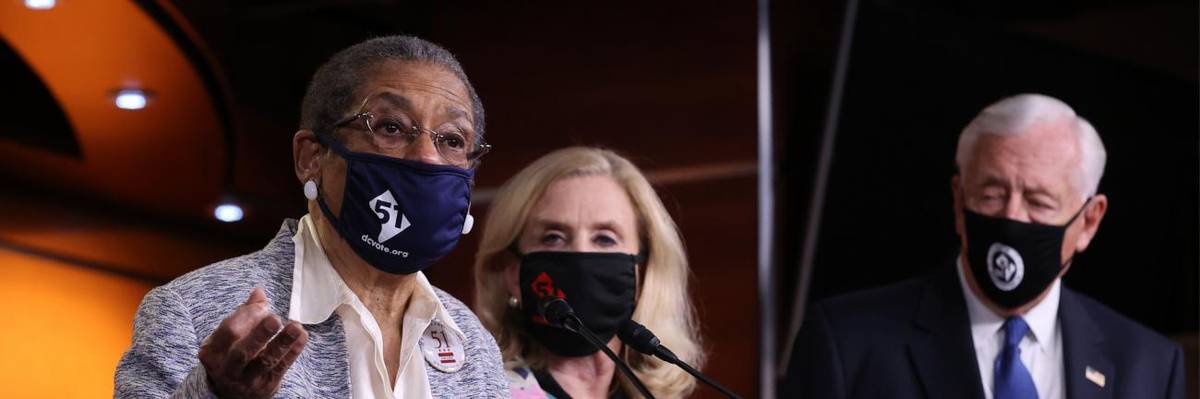
Del. Eleanor Holmes Norton (D-D.C.), speaks during a news conference about statehood for the District of Columbia with Rep. Carolyn Maloney (D-N.Y.) and House Majority Leader Steny Hoyer (D-Md.) at the U.S. Capitol on April 21, 2021 in Washington, D.C. (Photo by Chip Somodevilla/Getty Images)
Voting rights advocates urged the U.S. Senate on Thursday to pass legislation establishing statehood for Washington, D.C., after the House's historic vote in favor of the move.
The House voted for the second time in history to grant full representation to Washington's 700,000 full-time residents, passing the Washington, D.C. Admission Act (H.R. 51) in a party line vote--216 to 208.
"With the passage of the bill today, the residents of the nation's capital are closer than ever to achieving voting representation in Congress and full local self-government, and the United States is one step closer to deserving the term democracy."
--Del. Eleanor Holmes Norton (D-D.C.)
"All of our citizens should be afforded the same rights, regardless of where they live or the color of their skin," said Sean Eldridge, founder and president of Stand Up America. "Yet, for centuries, Americans living within the District of Columbia--a majority of whom are Black and Brown--have been denied the rights of representation afforded to their neighbors and have instead been at the mercy of lawmakers from far off states."
"Today, the House of Representatives moved closer to ensuring that those living within the District have autonomy over the laws that govern them and full representation in the halls of Congress," he added.
The bill was introduced last year by Del. Eleanor Holmes Norton (D-D.C.), who has represented D.C. in the House since 1991 but whose position doesn't allow her to vote on final legislation. If passed into law, the bill would establish a smaller federal district, comprised of government buildings, and rename the rest of the U.S. Capitol as the State of Washington, Douglass Commonwealth, to honor abolitionist Frederick Douglass.
The House passage came two days after the White House issued its first-ever official policy statement supporting D.C. statehood, which would give equal representation to the residents of the district, 46% of whom are Black.
During the debate over the legislation, freshman Rep. Mondaire Jones (D-N.Y.) explicitly called out the GOP for its support of the racist disenfranchisement of D.C. residents and members' failure to present any compelling arguments against D.C. statehood, leading some Republicans to ask that his statement be withdrawn.
"I have had enough of my colleagues' racist insinuations that somehow the people of Washington, D.C. are incapable or even unworthy of our democracy," Jones said. "One Senate Republican said that D.C. wouldn't be 'a well-rounded, working-class state.' I had no idea there were so many syllables in the word 'white.'"
The Biden administration's support for the measure as well as Senate Democrats' enthusiasm for giving the bill its first-ever hearing in the chamber has marked a turning point for the movement for D.C. statehood; when the House voted on the issue in 1993, a majority of Democrats joined the Republicans in rejecting the bill.
"With the passage of the bill today, the residents of the nation's capital are closer than ever to achieving voting representation in Congress and full local self-government, and the United States is one step closer to deserving the term democracy," Norton said in a statement Thursday.
In the Senate, the legislation faces an uphill battle, with Republicans refusing to back it and four members of the Democratic caucus--Sens. Mark Kelly and Kyrsten Sinema of Arizona, Angus King of Maine, and Joe Manchin of West Virginia--have not signaled their support for the bill. With the filibuster in place, the Democrats, who have 51 votes in the Senate, would need a majority of 60 votes to pass the bill.
The Leadership Conference on Civil and Human Rights called on the Senate "to act swiftly and also pass this critically important legislation."
"With the House passage of H.R. 51, more than 700,000 residents of D.C. are one step closer to finally having a meaningful voice in our nation's legislature and no longer being spectators to our democracy," said Wade Henderson, interim president and CEO of the organization. "The right to vote is our most fundamental right. It allows us to hold our leaders accountable. Democracy cannot exist without all of our participation."
Economic justice group Patriotic Millionaires denounced the "inexcusable hypocrisy that has left more than half a million U.S citizens without an equal say in our government."
"It is morally repugnant that over 700,000 citizens lack the most basic right in our democracy--equal representation--all because they live in our nation's capital," said Morris Pearl, chair of Patriotic Millionaires. "Washington, D.C. has a larger population than two current U.S states and a GDP larger than that of sixteen different states, yet the hundreds of thousands of residents and hardworking Americans receive no representation of their own."
"Today's vote by the House of Representatives and the White House's statement of support underscore just how vital D.C. statehood is to ensuring that our democracy is fair and representative of everyone who calls this country home," added Pearl.
Lawmakers and political advocates called on the Senate to end the use of the filibuster and follow the House's lead in passing the legislation.
"It's now up to the Senate to do what's right and finally give [D.C. residents] the justice they deserve!" tweeted Rep. Rashida Tlaib (D-Mich.).
Dear Common Dreams reader, It’s been nearly 30 years since I co-founded Common Dreams with my late wife, Lina Newhouser. We had the radical notion that journalism should serve the public good, not corporate profits. It was clear to us from the outset what it would take to build such a project. No paid advertisements. No corporate sponsors. No millionaire publisher telling us what to think or do. Many people said we wouldn't last a year, but we proved those doubters wrong. Together with a tremendous team of journalists and dedicated staff, we built an independent media outlet free from the constraints of profits and corporate control. Our mission has always been simple: To inform. To inspire. To ignite change for the common good. Building Common Dreams was not easy. Our survival was never guaranteed. When you take on the most powerful forces—Wall Street greed, fossil fuel industry destruction, Big Tech lobbyists, and uber-rich oligarchs who have spent billions upon billions rigging the economy and democracy in their favor—the only bulwark you have is supporters who believe in your work. But here’s the urgent message from me today. It's never been this bad out there. And it's never been this hard to keep us going. At the very moment Common Dreams is most needed, the threats we face are intensifying. We need your support now more than ever. We don't accept corporate advertising and never will. We don't have a paywall because we don't think people should be blocked from critical news based on their ability to pay. Everything we do is funded by the donations of readers like you. When everyone does the little they can afford, we are strong. But if that support retreats or dries up, so do we. Will you donate now to make sure Common Dreams not only survives but thrives? —Craig Brown, Co-founder |
Voting rights advocates urged the U.S. Senate on Thursday to pass legislation establishing statehood for Washington, D.C., after the House's historic vote in favor of the move.
The House voted for the second time in history to grant full representation to Washington's 700,000 full-time residents, passing the Washington, D.C. Admission Act (H.R. 51) in a party line vote--216 to 208.
"With the passage of the bill today, the residents of the nation's capital are closer than ever to achieving voting representation in Congress and full local self-government, and the United States is one step closer to deserving the term democracy."
--Del. Eleanor Holmes Norton (D-D.C.)
"All of our citizens should be afforded the same rights, regardless of where they live or the color of their skin," said Sean Eldridge, founder and president of Stand Up America. "Yet, for centuries, Americans living within the District of Columbia--a majority of whom are Black and Brown--have been denied the rights of representation afforded to their neighbors and have instead been at the mercy of lawmakers from far off states."
"Today, the House of Representatives moved closer to ensuring that those living within the District have autonomy over the laws that govern them and full representation in the halls of Congress," he added.
The bill was introduced last year by Del. Eleanor Holmes Norton (D-D.C.), who has represented D.C. in the House since 1991 but whose position doesn't allow her to vote on final legislation. If passed into law, the bill would establish a smaller federal district, comprised of government buildings, and rename the rest of the U.S. Capitol as the State of Washington, Douglass Commonwealth, to honor abolitionist Frederick Douglass.
The House passage came two days after the White House issued its first-ever official policy statement supporting D.C. statehood, which would give equal representation to the residents of the district, 46% of whom are Black.
During the debate over the legislation, freshman Rep. Mondaire Jones (D-N.Y.) explicitly called out the GOP for its support of the racist disenfranchisement of D.C. residents and members' failure to present any compelling arguments against D.C. statehood, leading some Republicans to ask that his statement be withdrawn.
"I have had enough of my colleagues' racist insinuations that somehow the people of Washington, D.C. are incapable or even unworthy of our democracy," Jones said. "One Senate Republican said that D.C. wouldn't be 'a well-rounded, working-class state.' I had no idea there were so many syllables in the word 'white.'"
The Biden administration's support for the measure as well as Senate Democrats' enthusiasm for giving the bill its first-ever hearing in the chamber has marked a turning point for the movement for D.C. statehood; when the House voted on the issue in 1993, a majority of Democrats joined the Republicans in rejecting the bill.
"With the passage of the bill today, the residents of the nation's capital are closer than ever to achieving voting representation in Congress and full local self-government, and the United States is one step closer to deserving the term democracy," Norton said in a statement Thursday.
In the Senate, the legislation faces an uphill battle, with Republicans refusing to back it and four members of the Democratic caucus--Sens. Mark Kelly and Kyrsten Sinema of Arizona, Angus King of Maine, and Joe Manchin of West Virginia--have not signaled their support for the bill. With the filibuster in place, the Democrats, who have 51 votes in the Senate, would need a majority of 60 votes to pass the bill.
The Leadership Conference on Civil and Human Rights called on the Senate "to act swiftly and also pass this critically important legislation."
"With the House passage of H.R. 51, more than 700,000 residents of D.C. are one step closer to finally having a meaningful voice in our nation's legislature and no longer being spectators to our democracy," said Wade Henderson, interim president and CEO of the organization. "The right to vote is our most fundamental right. It allows us to hold our leaders accountable. Democracy cannot exist without all of our participation."
Economic justice group Patriotic Millionaires denounced the "inexcusable hypocrisy that has left more than half a million U.S citizens without an equal say in our government."
"It is morally repugnant that over 700,000 citizens lack the most basic right in our democracy--equal representation--all because they live in our nation's capital," said Morris Pearl, chair of Patriotic Millionaires. "Washington, D.C. has a larger population than two current U.S states and a GDP larger than that of sixteen different states, yet the hundreds of thousands of residents and hardworking Americans receive no representation of their own."
"Today's vote by the House of Representatives and the White House's statement of support underscore just how vital D.C. statehood is to ensuring that our democracy is fair and representative of everyone who calls this country home," added Pearl.
Lawmakers and political advocates called on the Senate to end the use of the filibuster and follow the House's lead in passing the legislation.
"It's now up to the Senate to do what's right and finally give [D.C. residents] the justice they deserve!" tweeted Rep. Rashida Tlaib (D-Mich.).
Voting rights advocates urged the U.S. Senate on Thursday to pass legislation establishing statehood for Washington, D.C., after the House's historic vote in favor of the move.
The House voted for the second time in history to grant full representation to Washington's 700,000 full-time residents, passing the Washington, D.C. Admission Act (H.R. 51) in a party line vote--216 to 208.
"With the passage of the bill today, the residents of the nation's capital are closer than ever to achieving voting representation in Congress and full local self-government, and the United States is one step closer to deserving the term democracy."
--Del. Eleanor Holmes Norton (D-D.C.)
"All of our citizens should be afforded the same rights, regardless of where they live or the color of their skin," said Sean Eldridge, founder and president of Stand Up America. "Yet, for centuries, Americans living within the District of Columbia--a majority of whom are Black and Brown--have been denied the rights of representation afforded to their neighbors and have instead been at the mercy of lawmakers from far off states."
"Today, the House of Representatives moved closer to ensuring that those living within the District have autonomy over the laws that govern them and full representation in the halls of Congress," he added.
The bill was introduced last year by Del. Eleanor Holmes Norton (D-D.C.), who has represented D.C. in the House since 1991 but whose position doesn't allow her to vote on final legislation. If passed into law, the bill would establish a smaller federal district, comprised of government buildings, and rename the rest of the U.S. Capitol as the State of Washington, Douglass Commonwealth, to honor abolitionist Frederick Douglass.
The House passage came two days after the White House issued its first-ever official policy statement supporting D.C. statehood, which would give equal representation to the residents of the district, 46% of whom are Black.
During the debate over the legislation, freshman Rep. Mondaire Jones (D-N.Y.) explicitly called out the GOP for its support of the racist disenfranchisement of D.C. residents and members' failure to present any compelling arguments against D.C. statehood, leading some Republicans to ask that his statement be withdrawn.
"I have had enough of my colleagues' racist insinuations that somehow the people of Washington, D.C. are incapable or even unworthy of our democracy," Jones said. "One Senate Republican said that D.C. wouldn't be 'a well-rounded, working-class state.' I had no idea there were so many syllables in the word 'white.'"
The Biden administration's support for the measure as well as Senate Democrats' enthusiasm for giving the bill its first-ever hearing in the chamber has marked a turning point for the movement for D.C. statehood; when the House voted on the issue in 1993, a majority of Democrats joined the Republicans in rejecting the bill.
"With the passage of the bill today, the residents of the nation's capital are closer than ever to achieving voting representation in Congress and full local self-government, and the United States is one step closer to deserving the term democracy," Norton said in a statement Thursday.
In the Senate, the legislation faces an uphill battle, with Republicans refusing to back it and four members of the Democratic caucus--Sens. Mark Kelly and Kyrsten Sinema of Arizona, Angus King of Maine, and Joe Manchin of West Virginia--have not signaled their support for the bill. With the filibuster in place, the Democrats, who have 51 votes in the Senate, would need a majority of 60 votes to pass the bill.
The Leadership Conference on Civil and Human Rights called on the Senate "to act swiftly and also pass this critically important legislation."
"With the House passage of H.R. 51, more than 700,000 residents of D.C. are one step closer to finally having a meaningful voice in our nation's legislature and no longer being spectators to our democracy," said Wade Henderson, interim president and CEO of the organization. "The right to vote is our most fundamental right. It allows us to hold our leaders accountable. Democracy cannot exist without all of our participation."
Economic justice group Patriotic Millionaires denounced the "inexcusable hypocrisy that has left more than half a million U.S citizens without an equal say in our government."
"It is morally repugnant that over 700,000 citizens lack the most basic right in our democracy--equal representation--all because they live in our nation's capital," said Morris Pearl, chair of Patriotic Millionaires. "Washington, D.C. has a larger population than two current U.S states and a GDP larger than that of sixteen different states, yet the hundreds of thousands of residents and hardworking Americans receive no representation of their own."
"Today's vote by the House of Representatives and the White House's statement of support underscore just how vital D.C. statehood is to ensuring that our democracy is fair and representative of everyone who calls this country home," added Pearl.
Lawmakers and political advocates called on the Senate to end the use of the filibuster and follow the House's lead in passing the legislation.
"It's now up to the Senate to do what's right and finally give [D.C. residents] the justice they deserve!" tweeted Rep. Rashida Tlaib (D-Mich.).