SUBSCRIBE TO OUR FREE NEWSLETTER
Daily news & progressive opinion—funded by the people, not the corporations—delivered straight to your inbox.
5
#000000
#FFFFFF
To donate by check, phone, or other method, see our More Ways to Give page.
Daily news & progressive opinion—funded by the people, not the corporations—delivered straight to your inbox.
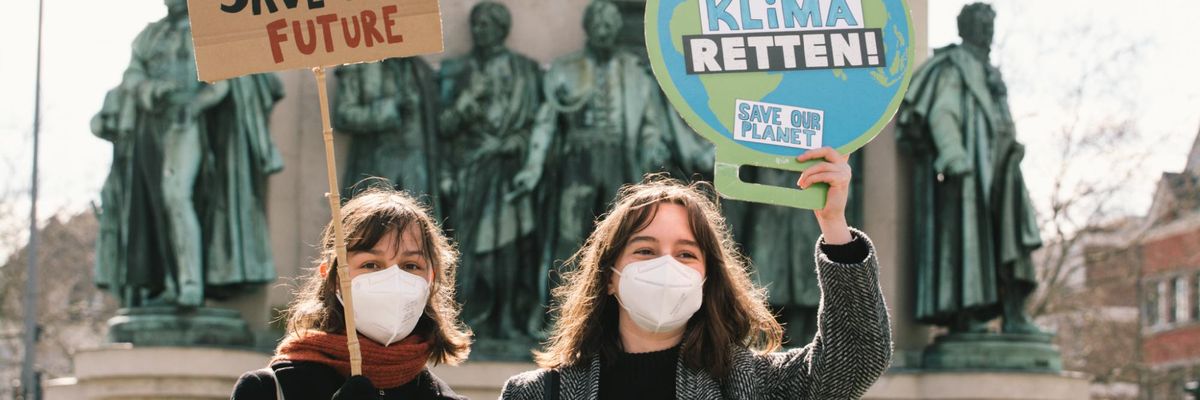
Activists participate in a global climate demonstration organized by the Fridays for Future movement in Cologne, Germany on March 19, 2021, (Photo: Ying Tang/NurPhoto via Getty Images)
After overnight negotiations to finalize a European Union climate law ahead of U.S. President Joe Biden's leaders summit at the end of the week, E.U. leaders reached a tentative deal on an emissions reduction target for 2030 that advocacy groups warn falls far short of what is needed to meet the Paris agreement's 1.5degC temperature goal.
"The E.U. is more worried about having something to brag about at Biden's climate summit than it is about what it means for the climate emergency," declared Greenpeace E.U. climate campaigner Silvia Pastorelli.
"This deal shows that Europe's climate action is all smoke and mirrors," she said. "Politicians copying the language of climate marchers are in fact concealing accounting tricks concocted by oil and gas lobbyists. This isn't much better than business as usual, saddling younger generations with the devastating consequences."
Following 14 hours of talks, representatives from the European Parliament and E.U. member states agreed to boost the bloc's 2030 greenhouse gas emissions reduction target from 40% to at least 55% compared to 1990 levels. The Associated Press reported that it still must be approved by member states and the legislature but "should be little more than a rubber stamp."
Euractiv noted that "the European Commission agreed to consider increasing the contribution of carbon sinks in order to bump up the E.U.'s climate ambition to 57%, although this is not written in the law." However, even with that addition, the goal is below the 60% target sought by the European Parliament.
Still, European Parliament rapporteur and Swedish Social Democrat Jytte Guteland framed the provisional deal as a victory, saying in a statement that "after a long night of negotiations, I am proud that we now finally have a climate law."
"While I would of course have preferred to go even further, this is a good deal that is based on science and which will make a big difference for the climate," she added. "The E.U. must now reduce emissions more in the next decade than we have in the previous three decades put together, and we have new and more ambitious ground to stand on that can encourage more countries to step up."
Guteland specifically suggested that the new European law could motivate the Biden administration--which recommitted the United States to the Paris agreement--to step up its climate commitments, according to the AP.
"The U.S. is not our big brother on climate. We are the big brother or the big sister. So they will be actually encouraged by this. They will be pressed by this," she said. "They will need to deliver when they see what we have accomplished."
Greens MEP Michael Bloss of Germany was less satisfied, tweeting: "The #ClimateLaw does not live up to its ambition. Only 52.8% real emission reduction. This is not the #GreenDeal that we need to tackle the climate crisis and not enough for the Paris agreement! But we will not stop fighting. #SaveTheGreenDeal!"
Wendel Trio, director of Climate Action Network (CAN) Europe, was similarly disappointed in the deal.
"The fact of the matter is that the outcome of the climate law negotiations do not bring us any additional emission reductions on top of what the E.U. had already agreed," Trio said in a statement. "The 'at least 55% emission reduction target for 2030' is not in line with the Paris agreement's ambition to limit temperature rise to 1.5degC."
"European decision-makers missed a historic opportunity to adequately address the climate crisis," he added. "This climate law is nothing more than a new package for what already exists, rushed by E.U. lawmakers to bring something to the leaders summit organized by the U.S. This is definitely not the kind of climate law that will help the E.U. to lead the global efforts to tackle climate change."
Although CAN Europe called for more ambition from the bloc, the group did welcome the law's establishment of an expert advisory body to provide "scientific advice on already existing European measures."
"An independent expert body that will advise E.U. decision-makers on emissions budgets, targets, and trajectories, and the consistency of E.U. policies in meeting these targets is of crucial importance for the accountability of lawmakers and guiding the public debate," said Harriet Mackaill-Hill, governance policy officer at CAN Europe. "To fill the gaps in the E.U. climate framework, the expert advisory body needs to be able to deliver cross-cutting policy advice and not be limited to scientific advice only."
Noting a new letter signed by 101 Nobel laureates urging world leaders to keep fossil fuels in the ground, Friends of the Earth Europe said the law "is already a letdown."
The E.U. agreement comes on the heels of an alarming World Meteorological Organization report released Monday. As Petteri Taalas, the United Nations agency's secretary-general, summarized, the report showed that "all key climate indicators and associated impact information provided in this report highlight relentless, continuing climate change, an increasing occurrence and intensification of extreme events, and severe losses and damage, affecting people, societies, and economies."
Dear Common Dreams reader, It’s been nearly 30 years since I co-founded Common Dreams with my late wife, Lina Newhouser. We had the radical notion that journalism should serve the public good, not corporate profits. It was clear to us from the outset what it would take to build such a project. No paid advertisements. No corporate sponsors. No millionaire publisher telling us what to think or do. Many people said we wouldn't last a year, but we proved those doubters wrong. Together with a tremendous team of journalists and dedicated staff, we built an independent media outlet free from the constraints of profits and corporate control. Our mission has always been simple: To inform. To inspire. To ignite change for the common good. Building Common Dreams was not easy. Our survival was never guaranteed. When you take on the most powerful forces—Wall Street greed, fossil fuel industry destruction, Big Tech lobbyists, and uber-rich oligarchs who have spent billions upon billions rigging the economy and democracy in their favor—the only bulwark you have is supporters who believe in your work. But here’s the urgent message from me today. It's never been this bad out there. And it's never been this hard to keep us going. At the very moment Common Dreams is most needed, the threats we face are intensifying. We need your support now more than ever. We don't accept corporate advertising and never will. We don't have a paywall because we don't think people should be blocked from critical news based on their ability to pay. Everything we do is funded by the donations of readers like you. When everyone does the little they can afford, we are strong. But if that support retreats or dries up, so do we. Will you donate now to make sure Common Dreams not only survives but thrives? —Craig Brown, Co-founder |
After overnight negotiations to finalize a European Union climate law ahead of U.S. President Joe Biden's leaders summit at the end of the week, E.U. leaders reached a tentative deal on an emissions reduction target for 2030 that advocacy groups warn falls far short of what is needed to meet the Paris agreement's 1.5degC temperature goal.
"The E.U. is more worried about having something to brag about at Biden's climate summit than it is about what it means for the climate emergency," declared Greenpeace E.U. climate campaigner Silvia Pastorelli.
"This deal shows that Europe's climate action is all smoke and mirrors," she said. "Politicians copying the language of climate marchers are in fact concealing accounting tricks concocted by oil and gas lobbyists. This isn't much better than business as usual, saddling younger generations with the devastating consequences."
Following 14 hours of talks, representatives from the European Parliament and E.U. member states agreed to boost the bloc's 2030 greenhouse gas emissions reduction target from 40% to at least 55% compared to 1990 levels. The Associated Press reported that it still must be approved by member states and the legislature but "should be little more than a rubber stamp."
Euractiv noted that "the European Commission agreed to consider increasing the contribution of carbon sinks in order to bump up the E.U.'s climate ambition to 57%, although this is not written in the law." However, even with that addition, the goal is below the 60% target sought by the European Parliament.
Still, European Parliament rapporteur and Swedish Social Democrat Jytte Guteland framed the provisional deal as a victory, saying in a statement that "after a long night of negotiations, I am proud that we now finally have a climate law."
"While I would of course have preferred to go even further, this is a good deal that is based on science and which will make a big difference for the climate," she added. "The E.U. must now reduce emissions more in the next decade than we have in the previous three decades put together, and we have new and more ambitious ground to stand on that can encourage more countries to step up."
Guteland specifically suggested that the new European law could motivate the Biden administration--which recommitted the United States to the Paris agreement--to step up its climate commitments, according to the AP.
"The U.S. is not our big brother on climate. We are the big brother or the big sister. So they will be actually encouraged by this. They will be pressed by this," she said. "They will need to deliver when they see what we have accomplished."
Greens MEP Michael Bloss of Germany was less satisfied, tweeting: "The #ClimateLaw does not live up to its ambition. Only 52.8% real emission reduction. This is not the #GreenDeal that we need to tackle the climate crisis and not enough for the Paris agreement! But we will not stop fighting. #SaveTheGreenDeal!"
Wendel Trio, director of Climate Action Network (CAN) Europe, was similarly disappointed in the deal.
"The fact of the matter is that the outcome of the climate law negotiations do not bring us any additional emission reductions on top of what the E.U. had already agreed," Trio said in a statement. "The 'at least 55% emission reduction target for 2030' is not in line with the Paris agreement's ambition to limit temperature rise to 1.5degC."
"European decision-makers missed a historic opportunity to adequately address the climate crisis," he added. "This climate law is nothing more than a new package for what already exists, rushed by E.U. lawmakers to bring something to the leaders summit organized by the U.S. This is definitely not the kind of climate law that will help the E.U. to lead the global efforts to tackle climate change."
Although CAN Europe called for more ambition from the bloc, the group did welcome the law's establishment of an expert advisory body to provide "scientific advice on already existing European measures."
"An independent expert body that will advise E.U. decision-makers on emissions budgets, targets, and trajectories, and the consistency of E.U. policies in meeting these targets is of crucial importance for the accountability of lawmakers and guiding the public debate," said Harriet Mackaill-Hill, governance policy officer at CAN Europe. "To fill the gaps in the E.U. climate framework, the expert advisory body needs to be able to deliver cross-cutting policy advice and not be limited to scientific advice only."
Noting a new letter signed by 101 Nobel laureates urging world leaders to keep fossil fuels in the ground, Friends of the Earth Europe said the law "is already a letdown."
The E.U. agreement comes on the heels of an alarming World Meteorological Organization report released Monday. As Petteri Taalas, the United Nations agency's secretary-general, summarized, the report showed that "all key climate indicators and associated impact information provided in this report highlight relentless, continuing climate change, an increasing occurrence and intensification of extreme events, and severe losses and damage, affecting people, societies, and economies."
After overnight negotiations to finalize a European Union climate law ahead of U.S. President Joe Biden's leaders summit at the end of the week, E.U. leaders reached a tentative deal on an emissions reduction target for 2030 that advocacy groups warn falls far short of what is needed to meet the Paris agreement's 1.5degC temperature goal.
"The E.U. is more worried about having something to brag about at Biden's climate summit than it is about what it means for the climate emergency," declared Greenpeace E.U. climate campaigner Silvia Pastorelli.
"This deal shows that Europe's climate action is all smoke and mirrors," she said. "Politicians copying the language of climate marchers are in fact concealing accounting tricks concocted by oil and gas lobbyists. This isn't much better than business as usual, saddling younger generations with the devastating consequences."
Following 14 hours of talks, representatives from the European Parliament and E.U. member states agreed to boost the bloc's 2030 greenhouse gas emissions reduction target from 40% to at least 55% compared to 1990 levels. The Associated Press reported that it still must be approved by member states and the legislature but "should be little more than a rubber stamp."
Euractiv noted that "the European Commission agreed to consider increasing the contribution of carbon sinks in order to bump up the E.U.'s climate ambition to 57%, although this is not written in the law." However, even with that addition, the goal is below the 60% target sought by the European Parliament.
Still, European Parliament rapporteur and Swedish Social Democrat Jytte Guteland framed the provisional deal as a victory, saying in a statement that "after a long night of negotiations, I am proud that we now finally have a climate law."
"While I would of course have preferred to go even further, this is a good deal that is based on science and which will make a big difference for the climate," she added. "The E.U. must now reduce emissions more in the next decade than we have in the previous three decades put together, and we have new and more ambitious ground to stand on that can encourage more countries to step up."
Guteland specifically suggested that the new European law could motivate the Biden administration--which recommitted the United States to the Paris agreement--to step up its climate commitments, according to the AP.
"The U.S. is not our big brother on climate. We are the big brother or the big sister. So they will be actually encouraged by this. They will be pressed by this," she said. "They will need to deliver when they see what we have accomplished."
Greens MEP Michael Bloss of Germany was less satisfied, tweeting: "The #ClimateLaw does not live up to its ambition. Only 52.8% real emission reduction. This is not the #GreenDeal that we need to tackle the climate crisis and not enough for the Paris agreement! But we will not stop fighting. #SaveTheGreenDeal!"
Wendel Trio, director of Climate Action Network (CAN) Europe, was similarly disappointed in the deal.
"The fact of the matter is that the outcome of the climate law negotiations do not bring us any additional emission reductions on top of what the E.U. had already agreed," Trio said in a statement. "The 'at least 55% emission reduction target for 2030' is not in line with the Paris agreement's ambition to limit temperature rise to 1.5degC."
"European decision-makers missed a historic opportunity to adequately address the climate crisis," he added. "This climate law is nothing more than a new package for what already exists, rushed by E.U. lawmakers to bring something to the leaders summit organized by the U.S. This is definitely not the kind of climate law that will help the E.U. to lead the global efforts to tackle climate change."
Although CAN Europe called for more ambition from the bloc, the group did welcome the law's establishment of an expert advisory body to provide "scientific advice on already existing European measures."
"An independent expert body that will advise E.U. decision-makers on emissions budgets, targets, and trajectories, and the consistency of E.U. policies in meeting these targets is of crucial importance for the accountability of lawmakers and guiding the public debate," said Harriet Mackaill-Hill, governance policy officer at CAN Europe. "To fill the gaps in the E.U. climate framework, the expert advisory body needs to be able to deliver cross-cutting policy advice and not be limited to scientific advice only."
Noting a new letter signed by 101 Nobel laureates urging world leaders to keep fossil fuels in the ground, Friends of the Earth Europe said the law "is already a letdown."
The E.U. agreement comes on the heels of an alarming World Meteorological Organization report released Monday. As Petteri Taalas, the United Nations agency's secretary-general, summarized, the report showed that "all key climate indicators and associated impact information provided in this report highlight relentless, continuing climate change, an increasing occurrence and intensification of extreme events, and severe losses and damage, affecting people, societies, and economies."