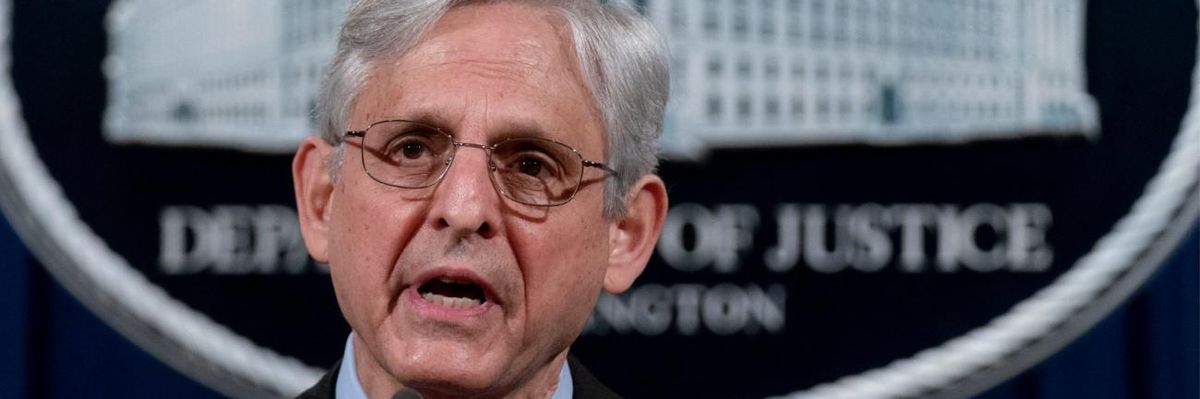
Attorney General Merrick Garland speaks about a jury's verdict in the case against former Minneapolis Police Officer Derek Chauvin in the death of George Floyd, at the Department of Justice on April 21, 2021 in Washington, D.C. (Photo: Andrew Harnik / POOL / AFP via Getty Images)
To Confront 'Systemic Failures,' DOJ Announces Federal Probe Into Minneapolis Police Department
"Yesterday's verdict in the state criminal trial does not address potentially systemic policing issues in Minneapolis. Public safety requires public trust."
Announcing a federal probe into policing in Minneapolis, U.S. Attorney General Merrick Garland said Wednesday that the conviction of former police officer Derek Chauvin for the murder of George Floyd is not the equivalent of addressing systemic racism and violence by officers--echoing the recent calls of racial justice advocates and progressive lawmakers including Rep. Alexandria Ocasio-Cortez.
Less than 24 hours after Chauvin was found guilty, Garland announced to the press that officials in the DOJ's Civil Rights Division have opened a probe into the Minneapolis Police Department (MPD) to determine whether the agency has a "pattern or practice of unconstitutional or unlawful policing."
"Yesterday's verdict in the state criminal trial does not address potentially systemic policing issues in Minneapolis," Garland told reporters. "Public safety requires public trust."
The attorney general said that DOJ officials have already begun contacting community members and organizations to interview them about their interactions with the MPD, and will also speak with officers at the department about the training they receive.
The probe will focus on whether the agency uses excessive force--including at protests like the racial justice demonstrations which erupted last year following Floyd's murder--and whether it engages in discriminatory conduct, and treats residents with behavioral health disabilities unlawfully.
"The Department of Justice will be unwavering in its pursuit of equal justice under law."
--Attorney General Merrick Garland
The investigation could result in a civil lawsuit, with the Justice Department calling on a federal court to order the MPD to change its practices.
The DOJ intends to "look beyond individual incidents to address systemic failures," Garland said, and officials will review the MPD's policies, training, and use-of-force investigations. Prior to Floyd's violent arrest last May, during which Chauvin knelt on his neck for nearly nine minutes, the MPD has long been accused of excessive use of force, particularly against Black residents.
A New York Times analysis last year found that the department used force against Black people at seven times the rate of white people. The killings of Jamar Clark in 2015 and Thurman Blevins in 2018 by Minneapolis officers made national news, as did the fatal shooting of a white woman named Justine Damond after she called 911.
Family members of Black residents killed in the Minneapolis area recently--including the family of Daunte Wright, who was fatally shot by an officer in Brooklyn Center on April 11--have previously called for a federal investigation into policing.
"I don't want to feel helpless. I need my son to have justice along with everybody else's son, daughters, people who are murdered by the police," Wright's mother, Katie Wright, said last week.
Garland's announcement gave hope to racial justice advocates who have expressed outrage in recent days at the prevalence of police killings of civilians including Wright; 13-year-old Adam Toledo in Chicago; and 16-year-old Ma'Khia Bryant, who was shot by an officer in Columbus, Ohio on Tuesday afternoon--just before the verdict in the Chauvin case was announced.
"The Department of Justice will be unwavering in its pursuit of equal justice under law," said Garland.
We are at a crossroads
This country and this world are at a monumental crossroads. In a few short weeks, US voters will have an opportunity to beat back the forces of fascism and confront the billionaires who are rigging the economy, our media system, and our democracy, making it increasingly impossible for ordinary people to get by. We’re not just talking about the election. We’re talking about what must be done once these fascist elements are vanquished from power. We need a bolder set of solutions than what either major party has so far been willing to offer and a working-class movement ready to fight like hell for it. Trump didn't emerge from nowhere. The conditions that fueled MAGA authoritarianism were created by decades of radical neoliberal economic policies and a corrupt political system dominated by corporate interests. They slashed taxes on the super-rich, promising that the benefits would trickle down. They said giveaways to the corporate titans would make life more affordable for the rest of us. It was all bullshit. And when a bitter, betrayed populace searches for someone to blame, right-wing demagogues have little trouble finding scapegoats. People know when they're being lied to, but you won't hear any of this from the corporate media. Only independent journalism—powered and funded by people who believe in building a better world—can deliver truly trustworthy daily news. Our Fall Campaign is underway, and we need your help. To power our newsroom through the rest of the year, we need to raise $125,000 by midnight on October 31. So if you share our vision, please contribute whatever you can to sustain our work. |
Announcing a federal probe into policing in Minneapolis, U.S. Attorney General Merrick Garland said Wednesday that the conviction of former police officer Derek Chauvin for the murder of George Floyd is not the equivalent of addressing systemic racism and violence by officers--echoing the recent calls of racial justice advocates and progressive lawmakers including Rep. Alexandria Ocasio-Cortez.
Less than 24 hours after Chauvin was found guilty, Garland announced to the press that officials in the DOJ's Civil Rights Division have opened a probe into the Minneapolis Police Department (MPD) to determine whether the agency has a "pattern or practice of unconstitutional or unlawful policing."
"Yesterday's verdict in the state criminal trial does not address potentially systemic policing issues in Minneapolis," Garland told reporters. "Public safety requires public trust."
The attorney general said that DOJ officials have already begun contacting community members and organizations to interview them about their interactions with the MPD, and will also speak with officers at the department about the training they receive.
The probe will focus on whether the agency uses excessive force--including at protests like the racial justice demonstrations which erupted last year following Floyd's murder--and whether it engages in discriminatory conduct, and treats residents with behavioral health disabilities unlawfully.
"The Department of Justice will be unwavering in its pursuit of equal justice under law."
--Attorney General Merrick Garland
The investigation could result in a civil lawsuit, with the Justice Department calling on a federal court to order the MPD to change its practices.
The DOJ intends to "look beyond individual incidents to address systemic failures," Garland said, and officials will review the MPD's policies, training, and use-of-force investigations. Prior to Floyd's violent arrest last May, during which Chauvin knelt on his neck for nearly nine minutes, the MPD has long been accused of excessive use of force, particularly against Black residents.
A New York Times analysis last year found that the department used force against Black people at seven times the rate of white people. The killings of Jamar Clark in 2015 and Thurman Blevins in 2018 by Minneapolis officers made national news, as did the fatal shooting of a white woman named Justine Damond after she called 911.
Family members of Black residents killed in the Minneapolis area recently--including the family of Daunte Wright, who was fatally shot by an officer in Brooklyn Center on April 11--have previously called for a federal investigation into policing.
"I don't want to feel helpless. I need my son to have justice along with everybody else's son, daughters, people who are murdered by the police," Wright's mother, Katie Wright, said last week.
Garland's announcement gave hope to racial justice advocates who have expressed outrage in recent days at the prevalence of police killings of civilians including Wright; 13-year-old Adam Toledo in Chicago; and 16-year-old Ma'Khia Bryant, who was shot by an officer in Columbus, Ohio on Tuesday afternoon--just before the verdict in the Chauvin case was announced.
"The Department of Justice will be unwavering in its pursuit of equal justice under law," said Garland.
Announcing a federal probe into policing in Minneapolis, U.S. Attorney General Merrick Garland said Wednesday that the conviction of former police officer Derek Chauvin for the murder of George Floyd is not the equivalent of addressing systemic racism and violence by officers--echoing the recent calls of racial justice advocates and progressive lawmakers including Rep. Alexandria Ocasio-Cortez.
Less than 24 hours after Chauvin was found guilty, Garland announced to the press that officials in the DOJ's Civil Rights Division have opened a probe into the Minneapolis Police Department (MPD) to determine whether the agency has a "pattern or practice of unconstitutional or unlawful policing."
"Yesterday's verdict in the state criminal trial does not address potentially systemic policing issues in Minneapolis," Garland told reporters. "Public safety requires public trust."
The attorney general said that DOJ officials have already begun contacting community members and organizations to interview them about their interactions with the MPD, and will also speak with officers at the department about the training they receive.
The probe will focus on whether the agency uses excessive force--including at protests like the racial justice demonstrations which erupted last year following Floyd's murder--and whether it engages in discriminatory conduct, and treats residents with behavioral health disabilities unlawfully.
"The Department of Justice will be unwavering in its pursuit of equal justice under law."
--Attorney General Merrick Garland
The investigation could result in a civil lawsuit, with the Justice Department calling on a federal court to order the MPD to change its practices.
The DOJ intends to "look beyond individual incidents to address systemic failures," Garland said, and officials will review the MPD's policies, training, and use-of-force investigations. Prior to Floyd's violent arrest last May, during which Chauvin knelt on his neck for nearly nine minutes, the MPD has long been accused of excessive use of force, particularly against Black residents.
A New York Times analysis last year found that the department used force against Black people at seven times the rate of white people. The killings of Jamar Clark in 2015 and Thurman Blevins in 2018 by Minneapolis officers made national news, as did the fatal shooting of a white woman named Justine Damond after she called 911.
Family members of Black residents killed in the Minneapolis area recently--including the family of Daunte Wright, who was fatally shot by an officer in Brooklyn Center on April 11--have previously called for a federal investigation into policing.
"I don't want to feel helpless. I need my son to have justice along with everybody else's son, daughters, people who are murdered by the police," Wright's mother, Katie Wright, said last week.
Garland's announcement gave hope to racial justice advocates who have expressed outrage in recent days at the prevalence of police killings of civilians including Wright; 13-year-old Adam Toledo in Chicago; and 16-year-old Ma'Khia Bryant, who was shot by an officer in Columbus, Ohio on Tuesday afternoon--just before the verdict in the Chauvin case was announced.
"The Department of Justice will be unwavering in its pursuit of equal justice under law," said Garland.