

SUBSCRIBE TO OUR FREE NEWSLETTER
Daily news & progressive opinion—funded by the people, not the corporations—delivered straight to your inbox.
5
#000000
#FFFFFF
To donate by check, phone, or other method, see our More Ways to Give page.
Daily news & progressive opinion—funded by the people, not the corporations—delivered straight to your inbox.
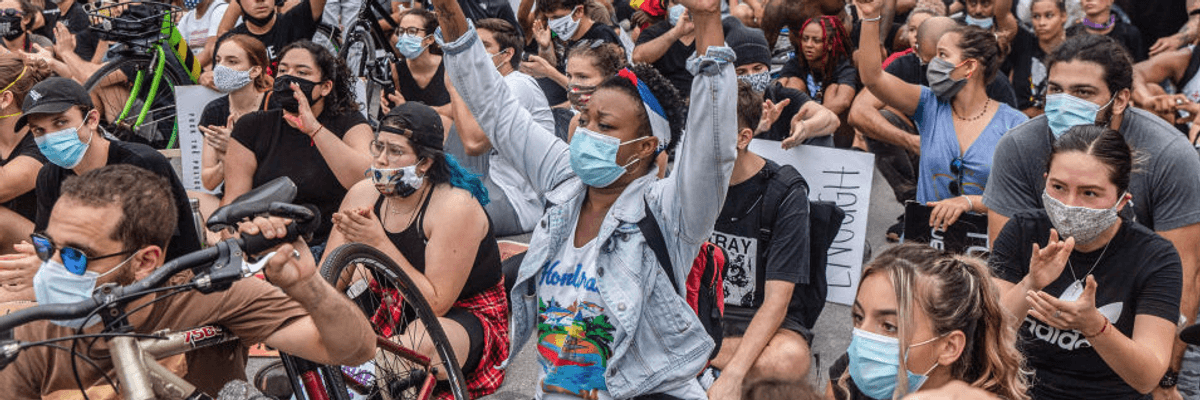
Demonstrators at a peaceful Black Lives Matter protest in Miami, Florida on June 6, 2020. (Photo: LightRocket/Getty Images)
Civil rights and free speech advocates on Friday decried the advancement in the Florida Senate of a controversial bill that the ACLU says "aims to silence, criminalize, and penalize Floridians for exercising their First Amendment right to protest."
"We still have a chance to stop this bill and we, along with thousands of Floridians, call on the full Senate to stop this bill."
--Micah Kubic,
ACLU of Florida
The appropriations committee of the GOP-controlled Florida Senate voted Friday to approve House Bill 1 (pdf), which was first proposed by Republican Gov. Ron DeSantis last September in the wake of Black Lives Matter and other racial justice protests that followed the police killing of unarmed Black people including George Floyd in Minneapolis and Breonna Taylor in Louisville.
If passed, the bill would classify certain demonstrations as felonies and impose harsh penalties on some protesters. The Florida House of Representatives voted last month along party lines to approve H.B. 1. The ACLU of Florida warned at the time that:
H.B. 1 would send people to prison for up to 15 years for pulling down a Confederate flag or other shrines to white supremacy. It would subject any person present at any gathering that became violent through no fault of their own to felony charges, potentially leading up to five years in prison and the loss of their voting rights, even if the individual did not engage in any violent and disorderly conduct, among other provisions. It would also protect violent counter-protesters from civil liability for injuring or killing a protester with their vehicle.
The entire Florida Senate will now vote on the bill. On Friday, state Senate Minority Leader Gary Farmer (D-34) told the Sarasota Herald-Tribune that the bill "is so broadly worded, so badly defined, so potentially harmful to the right of free speech that... you could have peaceful protesters prosecuted simply for being present while someone near them... breaks the law."
Micah Kubic, executive director of the ACLU of Florida, said in a statement Friday that "H.B. 1 is a direct attack on the First Amendment. It is designed to stifle Floridians' right to peacefully assemble and seek change in their democracy."
"For these past several weeks, legislators have been hearing opposition to these harmful bills from Floridians of all walks of life," Kubic added. "Nearly everyone who has testified has strongly opposed this bill for an array of reasons."
Itohan Ighodaro, a Black woman from Broward County in South Florida, told the Florida Phoenix she opposes the bill because she fears it will be used to target minorities.
"H.B. 1 is harmful legislation that will have a long-term devastating impact on marginalized communities," said Ighodaro. "The Florida Senate has the ability to prevent this dangerous bill from becoming law."
"Peaceful protest has been and is still the organizing mechanism [and] cultural tool Black Americans have used to continue to fight for our freedom," she added. "This bill was pushed by a governor who did not bother to include a racial and ethnic impact study, even with prior knowledge of the demographic of Floridians who protest."
Advocacy groups also strongly oppose the measure. Keshia Morris Desir, mass incarceration project manager at Common Cause, said in a statement that "students of history know that our country would not have been formed without protests."
"The most famous protest--the Boston Tea Party--led eventually to the First Continental Congress," Morris Desir said. "Protest was such an important part of our country's early history that our Constitution enshrines the right in the First Amendment."
"Students of history also know that our country would not have moved forward without protests," she added. "Women's suffrage. Ending child labor. The 40-hour work week. Voting rights for people of color. Environmental protection laws. Workplace safety laws. All of these changes--and others--came only after people assembled and petitioned our government for the redress of grievances. Now some Florida legislators want to ignore that history and violate Floridians' right to protest."
The ACLU's Kubic remained optimistic that H.B. 1 could still be defeated.
"Though it is disappointing the bill has passed this committee today, we will not stay silent," he said. "We will not allow politicians to meddle with Floridians' constitutional rights. We still have a chance to stop this bill and we, along with thousands of Floridians, call on the full Senate to stop this bill."
Dear Common Dreams reader, It’s been nearly 30 years since I co-founded Common Dreams with my late wife, Lina Newhouser. We had the radical notion that journalism should serve the public good, not corporate profits. It was clear to us from the outset what it would take to build such a project. No paid advertisements. No corporate sponsors. No millionaire publisher telling us what to think or do. Many people said we wouldn't last a year, but we proved those doubters wrong. Together with a tremendous team of journalists and dedicated staff, we built an independent media outlet free from the constraints of profits and corporate control. Our mission has always been simple: To inform. To inspire. To ignite change for the common good. Building Common Dreams was not easy. Our survival was never guaranteed. When you take on the most powerful forces—Wall Street greed, fossil fuel industry destruction, Big Tech lobbyists, and uber-rich oligarchs who have spent billions upon billions rigging the economy and democracy in their favor—the only bulwark you have is supporters who believe in your work. But here’s the urgent message from me today. It's never been this bad out there. And it's never been this hard to keep us going. At the very moment Common Dreams is most needed, the threats we face are intensifying. We need your support now more than ever. We don't accept corporate advertising and never will. We don't have a paywall because we don't think people should be blocked from critical news based on their ability to pay. Everything we do is funded by the donations of readers like you. When everyone does the little they can afford, we are strong. But if that support retreats or dries up, so do we. Will you donate now to make sure Common Dreams not only survives but thrives? —Craig Brown, Co-founder |
Civil rights and free speech advocates on Friday decried the advancement in the Florida Senate of a controversial bill that the ACLU says "aims to silence, criminalize, and penalize Floridians for exercising their First Amendment right to protest."
"We still have a chance to stop this bill and we, along with thousands of Floridians, call on the full Senate to stop this bill."
--Micah Kubic,
ACLU of Florida
The appropriations committee of the GOP-controlled Florida Senate voted Friday to approve House Bill 1 (pdf), which was first proposed by Republican Gov. Ron DeSantis last September in the wake of Black Lives Matter and other racial justice protests that followed the police killing of unarmed Black people including George Floyd in Minneapolis and Breonna Taylor in Louisville.
If passed, the bill would classify certain demonstrations as felonies and impose harsh penalties on some protesters. The Florida House of Representatives voted last month along party lines to approve H.B. 1. The ACLU of Florida warned at the time that:
H.B. 1 would send people to prison for up to 15 years for pulling down a Confederate flag or other shrines to white supremacy. It would subject any person present at any gathering that became violent through no fault of their own to felony charges, potentially leading up to five years in prison and the loss of their voting rights, even if the individual did not engage in any violent and disorderly conduct, among other provisions. It would also protect violent counter-protesters from civil liability for injuring or killing a protester with their vehicle.
The entire Florida Senate will now vote on the bill. On Friday, state Senate Minority Leader Gary Farmer (D-34) told the Sarasota Herald-Tribune that the bill "is so broadly worded, so badly defined, so potentially harmful to the right of free speech that... you could have peaceful protesters prosecuted simply for being present while someone near them... breaks the law."
Micah Kubic, executive director of the ACLU of Florida, said in a statement Friday that "H.B. 1 is a direct attack on the First Amendment. It is designed to stifle Floridians' right to peacefully assemble and seek change in their democracy."
"For these past several weeks, legislators have been hearing opposition to these harmful bills from Floridians of all walks of life," Kubic added. "Nearly everyone who has testified has strongly opposed this bill for an array of reasons."
Itohan Ighodaro, a Black woman from Broward County in South Florida, told the Florida Phoenix she opposes the bill because she fears it will be used to target minorities.
"H.B. 1 is harmful legislation that will have a long-term devastating impact on marginalized communities," said Ighodaro. "The Florida Senate has the ability to prevent this dangerous bill from becoming law."
"Peaceful protest has been and is still the organizing mechanism [and] cultural tool Black Americans have used to continue to fight for our freedom," she added. "This bill was pushed by a governor who did not bother to include a racial and ethnic impact study, even with prior knowledge of the demographic of Floridians who protest."
Advocacy groups also strongly oppose the measure. Keshia Morris Desir, mass incarceration project manager at Common Cause, said in a statement that "students of history know that our country would not have been formed without protests."
"The most famous protest--the Boston Tea Party--led eventually to the First Continental Congress," Morris Desir said. "Protest was such an important part of our country's early history that our Constitution enshrines the right in the First Amendment."
"Students of history also know that our country would not have moved forward without protests," she added. "Women's suffrage. Ending child labor. The 40-hour work week. Voting rights for people of color. Environmental protection laws. Workplace safety laws. All of these changes--and others--came only after people assembled and petitioned our government for the redress of grievances. Now some Florida legislators want to ignore that history and violate Floridians' right to protest."
The ACLU's Kubic remained optimistic that H.B. 1 could still be defeated.
"Though it is disappointing the bill has passed this committee today, we will not stay silent," he said. "We will not allow politicians to meddle with Floridians' constitutional rights. We still have a chance to stop this bill and we, along with thousands of Floridians, call on the full Senate to stop this bill."
Civil rights and free speech advocates on Friday decried the advancement in the Florida Senate of a controversial bill that the ACLU says "aims to silence, criminalize, and penalize Floridians for exercising their First Amendment right to protest."
"We still have a chance to stop this bill and we, along with thousands of Floridians, call on the full Senate to stop this bill."
--Micah Kubic,
ACLU of Florida
The appropriations committee of the GOP-controlled Florida Senate voted Friday to approve House Bill 1 (pdf), which was first proposed by Republican Gov. Ron DeSantis last September in the wake of Black Lives Matter and other racial justice protests that followed the police killing of unarmed Black people including George Floyd in Minneapolis and Breonna Taylor in Louisville.
If passed, the bill would classify certain demonstrations as felonies and impose harsh penalties on some protesters. The Florida House of Representatives voted last month along party lines to approve H.B. 1. The ACLU of Florida warned at the time that:
H.B. 1 would send people to prison for up to 15 years for pulling down a Confederate flag or other shrines to white supremacy. It would subject any person present at any gathering that became violent through no fault of their own to felony charges, potentially leading up to five years in prison and the loss of their voting rights, even if the individual did not engage in any violent and disorderly conduct, among other provisions. It would also protect violent counter-protesters from civil liability for injuring or killing a protester with their vehicle.
The entire Florida Senate will now vote on the bill. On Friday, state Senate Minority Leader Gary Farmer (D-34) told the Sarasota Herald-Tribune that the bill "is so broadly worded, so badly defined, so potentially harmful to the right of free speech that... you could have peaceful protesters prosecuted simply for being present while someone near them... breaks the law."
Micah Kubic, executive director of the ACLU of Florida, said in a statement Friday that "H.B. 1 is a direct attack on the First Amendment. It is designed to stifle Floridians' right to peacefully assemble and seek change in their democracy."
"For these past several weeks, legislators have been hearing opposition to these harmful bills from Floridians of all walks of life," Kubic added. "Nearly everyone who has testified has strongly opposed this bill for an array of reasons."
Itohan Ighodaro, a Black woman from Broward County in South Florida, told the Florida Phoenix she opposes the bill because she fears it will be used to target minorities.
"H.B. 1 is harmful legislation that will have a long-term devastating impact on marginalized communities," said Ighodaro. "The Florida Senate has the ability to prevent this dangerous bill from becoming law."
"Peaceful protest has been and is still the organizing mechanism [and] cultural tool Black Americans have used to continue to fight for our freedom," she added. "This bill was pushed by a governor who did not bother to include a racial and ethnic impact study, even with prior knowledge of the demographic of Floridians who protest."
Advocacy groups also strongly oppose the measure. Keshia Morris Desir, mass incarceration project manager at Common Cause, said in a statement that "students of history know that our country would not have been formed without protests."
"The most famous protest--the Boston Tea Party--led eventually to the First Continental Congress," Morris Desir said. "Protest was such an important part of our country's early history that our Constitution enshrines the right in the First Amendment."
"Students of history also know that our country would not have moved forward without protests," she added. "Women's suffrage. Ending child labor. The 40-hour work week. Voting rights for people of color. Environmental protection laws. Workplace safety laws. All of these changes--and others--came only after people assembled and petitioned our government for the redress of grievances. Now some Florida legislators want to ignore that history and violate Floridians' right to protest."
The ACLU's Kubic remained optimistic that H.B. 1 could still be defeated.
"Though it is disappointing the bill has passed this committee today, we will not stay silent," he said. "We will not allow politicians to meddle with Floridians' constitutional rights. We still have a chance to stop this bill and we, along with thousands of Floridians, call on the full Senate to stop this bill."

