SUBSCRIBE TO OUR FREE NEWSLETTER
Daily news & progressive opinion—funded by the people, not the corporations—delivered straight to your inbox.
5
#000000
#FFFFFF
To donate by check, phone, or other method, see our More Ways to Give page.
Daily news & progressive opinion—funded by the people, not the corporations—delivered straight to your inbox.
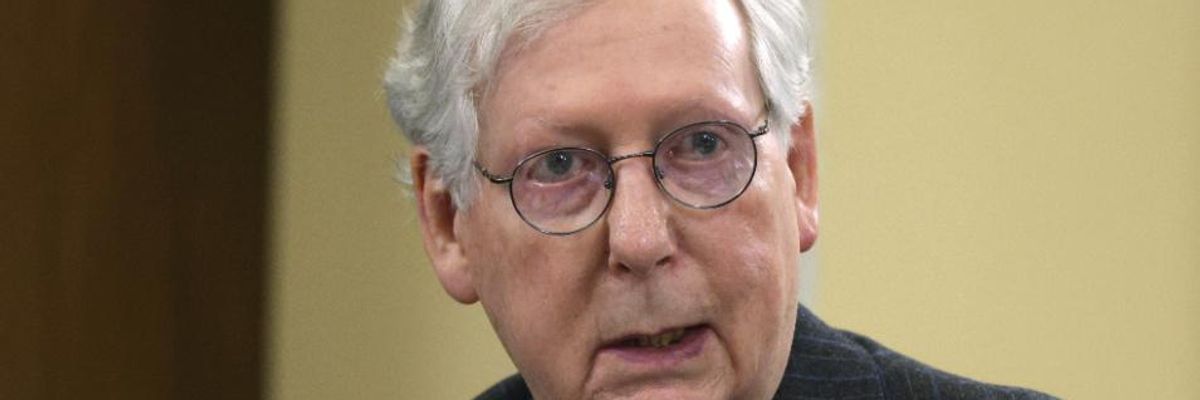
Senate Minority Leader Mitch McConnell (R-Ky.) speaks during a hearing before Senate Rules and Administration Committee at Russell Senate Office Building March 24, 2021 on Capitol Hill in Washington, D.C. (Photo: Alex Wong/Getty Images)
After spending much of his decades-long career raking in corporate cash and combating efforts to limit money in politics, Republican Senate Minority Leader Mitch McConnell on Monday suddenly claimed to be deeply concerned by the political influence of "powerful and wealthy people" who have spoken out against the Georgia state GOP's sweeping assault on voting rights.
"In 2020, Mitch McConnell's allied super PAC raised more than any other super PAC in existence--$475 million--from corporate CEOs and even corporations themselves, like Chevron, Mountaire Corp, and Koch Industries."
--Robert Maguire, Citizens for Responsibility and Ethics in Washington
In a statement, the Kentucky Republican warned corporations that they will face unspecified "consequences" if they "become a vehicle for far-left mobs to hijack our country from outside the constitutional order," a far-fetched portrayal of corporate America's largely tepid and belated response to the Georgia GOP's new voter suppression law.
"Businesses must not use economic blackmail to spread disinformation and push bad ideas that citizens reject at the ballot box," said McConnell, who has previously defended massive corporate spending on political campaigns as a legitimate exercise of "constitutional freedom" and argued in favor of more money in politics.
"My advice to the corporate CEOs of America is to stay out of politics," McConnell said during a press conference in Kentucky on Monday.
Critics did not hesitate to point out the irony of McConnell's outrage over what he called "a coordinated campaign by powerful and wealthy people" given his history of defending--and taking full advantage of--America's corporate-friendly campaign finance system.
"If this means Mitch wants CEOs to stop donating millions of dollars to political campaigns, I welcome it," Rep. Ilhan Omar (D-Minn.) tweeted in response to McConnell's comments. "But I have a feeling he thinks advocating for fair access to the ballot box is the only political act CEOs shouldn't be engaged in."
Robert Maguire, research director at Citizens for Responsibility and Ethics in Washington (CREW), noted late Monday that "in 2020, Mitch McConnell's allied super PAC raised more than any other super PAC in existence--$475 million--from corporate CEOs and even corporations themselves, like Chevron, Mountaire Corp, and Koch Industries."
"The largest donor to the super PAC, giving more than $85 million, was a dark money group that's run by the same people out of the same office as the super PAC. It receives loads of money from CEOs and companies, with the added benefit of not disclosing them to the public," Maguire added. "Someone should ask McConnell if he thinks these corporations and CEOs should 'stay out of politics.'"
Dear Common Dreams reader, It’s been nearly 30 years since I co-founded Common Dreams with my late wife, Lina Newhouser. We had the radical notion that journalism should serve the public good, not corporate profits. It was clear to us from the outset what it would take to build such a project. No paid advertisements. No corporate sponsors. No millionaire publisher telling us what to think or do. Many people said we wouldn't last a year, but we proved those doubters wrong. Together with a tremendous team of journalists and dedicated staff, we built an independent media outlet free from the constraints of profits and corporate control. Our mission has always been simple: To inform. To inspire. To ignite change for the common good. Building Common Dreams was not easy. Our survival was never guaranteed. When you take on the most powerful forces—Wall Street greed, fossil fuel industry destruction, Big Tech lobbyists, and uber-rich oligarchs who have spent billions upon billions rigging the economy and democracy in their favor—the only bulwark you have is supporters who believe in your work. But here’s the urgent message from me today. It's never been this bad out there. And it's never been this hard to keep us going. At the very moment Common Dreams is most needed, the threats we face are intensifying. We need your support now more than ever. We don't accept corporate advertising and never will. We don't have a paywall because we don't think people should be blocked from critical news based on their ability to pay. Everything we do is funded by the donations of readers like you. When everyone does the little they can afford, we are strong. But if that support retreats or dries up, so do we. Will you donate now to make sure Common Dreams not only survives but thrives? —Craig Brown, Co-founder |
After spending much of his decades-long career raking in corporate cash and combating efforts to limit money in politics, Republican Senate Minority Leader Mitch McConnell on Monday suddenly claimed to be deeply concerned by the political influence of "powerful and wealthy people" who have spoken out against the Georgia state GOP's sweeping assault on voting rights.
"In 2020, Mitch McConnell's allied super PAC raised more than any other super PAC in existence--$475 million--from corporate CEOs and even corporations themselves, like Chevron, Mountaire Corp, and Koch Industries."
--Robert Maguire, Citizens for Responsibility and Ethics in Washington
In a statement, the Kentucky Republican warned corporations that they will face unspecified "consequences" if they "become a vehicle for far-left mobs to hijack our country from outside the constitutional order," a far-fetched portrayal of corporate America's largely tepid and belated response to the Georgia GOP's new voter suppression law.
"Businesses must not use economic blackmail to spread disinformation and push bad ideas that citizens reject at the ballot box," said McConnell, who has previously defended massive corporate spending on political campaigns as a legitimate exercise of "constitutional freedom" and argued in favor of more money in politics.
"My advice to the corporate CEOs of America is to stay out of politics," McConnell said during a press conference in Kentucky on Monday.
Critics did not hesitate to point out the irony of McConnell's outrage over what he called "a coordinated campaign by powerful and wealthy people" given his history of defending--and taking full advantage of--America's corporate-friendly campaign finance system.
"If this means Mitch wants CEOs to stop donating millions of dollars to political campaigns, I welcome it," Rep. Ilhan Omar (D-Minn.) tweeted in response to McConnell's comments. "But I have a feeling he thinks advocating for fair access to the ballot box is the only political act CEOs shouldn't be engaged in."
Robert Maguire, research director at Citizens for Responsibility and Ethics in Washington (CREW), noted late Monday that "in 2020, Mitch McConnell's allied super PAC raised more than any other super PAC in existence--$475 million--from corporate CEOs and even corporations themselves, like Chevron, Mountaire Corp, and Koch Industries."
"The largest donor to the super PAC, giving more than $85 million, was a dark money group that's run by the same people out of the same office as the super PAC. It receives loads of money from CEOs and companies, with the added benefit of not disclosing them to the public," Maguire added. "Someone should ask McConnell if he thinks these corporations and CEOs should 'stay out of politics.'"
After spending much of his decades-long career raking in corporate cash and combating efforts to limit money in politics, Republican Senate Minority Leader Mitch McConnell on Monday suddenly claimed to be deeply concerned by the political influence of "powerful and wealthy people" who have spoken out against the Georgia state GOP's sweeping assault on voting rights.
"In 2020, Mitch McConnell's allied super PAC raised more than any other super PAC in existence--$475 million--from corporate CEOs and even corporations themselves, like Chevron, Mountaire Corp, and Koch Industries."
--Robert Maguire, Citizens for Responsibility and Ethics in Washington
In a statement, the Kentucky Republican warned corporations that they will face unspecified "consequences" if they "become a vehicle for far-left mobs to hijack our country from outside the constitutional order," a far-fetched portrayal of corporate America's largely tepid and belated response to the Georgia GOP's new voter suppression law.
"Businesses must not use economic blackmail to spread disinformation and push bad ideas that citizens reject at the ballot box," said McConnell, who has previously defended massive corporate spending on political campaigns as a legitimate exercise of "constitutional freedom" and argued in favor of more money in politics.
"My advice to the corporate CEOs of America is to stay out of politics," McConnell said during a press conference in Kentucky on Monday.
Critics did not hesitate to point out the irony of McConnell's outrage over what he called "a coordinated campaign by powerful and wealthy people" given his history of defending--and taking full advantage of--America's corporate-friendly campaign finance system.
"If this means Mitch wants CEOs to stop donating millions of dollars to political campaigns, I welcome it," Rep. Ilhan Omar (D-Minn.) tweeted in response to McConnell's comments. "But I have a feeling he thinks advocating for fair access to the ballot box is the only political act CEOs shouldn't be engaged in."
Robert Maguire, research director at Citizens for Responsibility and Ethics in Washington (CREW), noted late Monday that "in 2020, Mitch McConnell's allied super PAC raised more than any other super PAC in existence--$475 million--from corporate CEOs and even corporations themselves, like Chevron, Mountaire Corp, and Koch Industries."
"The largest donor to the super PAC, giving more than $85 million, was a dark money group that's run by the same people out of the same office as the super PAC. It receives loads of money from CEOs and companies, with the added benefit of not disclosing them to the public," Maguire added. "Someone should ask McConnell if he thinks these corporations and CEOs should 'stay out of politics.'"