SUBSCRIBE TO OUR FREE NEWSLETTER
Daily news & progressive opinion—funded by the people, not the corporations—delivered straight to your inbox.
5
#000000
#FFFFFF
To donate by check, phone, or other method, see our More Ways to Give page.
Daily news & progressive opinion—funded by the people, not the corporations—delivered straight to your inbox.
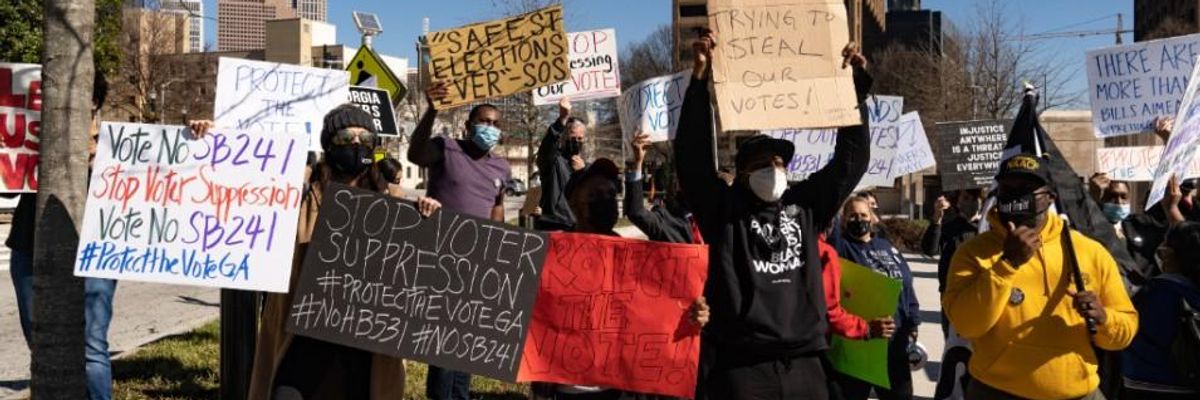
Demonstrators stand outside of the Georgia Capitol building to oppose H.B. 531, a recently passed bill that seeks to add voting restrictions to the state's upcoming elections including restricting ballot drop boxes, requiring an ID requirement for absentee voting, and limiting weekend early voting days, on March 3, 2021 in Atlanta. (Photo: Megan Varner/Getty Images)
As Georgia state Republicans enacted a "dangerous" voter suppression law, a broad coalition of racial justice and civil rights advocates on Thursday applauded a recent executive order signed by Presisdent Joe Biden to improve voting access, while urging his administration and the federal government to "act aggressively" to accomplish the directive's goals.
"The Anchor Collaborative commends this executive order's commitment to promoting equitable access to voter education and registration while centering Indigenous voting rights and ensuring those in federal custody have ample information to exercise their right to vote."
--Racial Equity Anchor Collaborative
The Racial Equity Anchor Collaborative, which calls itself "the foremost diverse coalition of national racial justice and civil rights organizations representing and serving more than 53 million people in the United States," issued a statement hailing Biden's order.
"The Anchor Collaborative commends this executive order's commitment to promoting equitable access to voter education and registration while centering Indigenous voting rights and ensuring those in federal custody have ample information to exercise their right to vote, where possible," the statement said.
Biden issued his order on March 7, the 56th anniversary of "Bloody Sunday." On that day in 1965, hundreds of civil rights acivists setting out on a 50-mile march from Selma to Montgomery were viciously attacked by Alabama state troopers at the Edmund Pettus Bridge. The late Rep. John Lewis (D-Ga.)--then chair of the Student Nonviolent Coordinating Committee (SNCC)--was beaten nearly to death while helping to lead the peaceful demonstration for voting rights.
Congress passed, and then-President Lyndon B. Johnson signed, the landmark Voting Rights Act of 1965--which banned the racist disenfranchisement of Black Americans that was still rampant throughout the South--five months later.
This year's Bloody Sunday commemoration was the first without Lewis, who died last July after battling pancreatic cancer at the age of 81.
While introducing his executive order, Biden noted "significant obstacles" to the polls, including "discriminatory policies" affecting Black voters.
"It is our duty to ensure that registering to vote and the act of voting be made simple and easy for all those eligible to do so," he said.
The Anchor Collaborative called Biden's order "just a first step in the pursuit of a vision of democracy that honors and protects every American's right to vote." The coalition urged Biden to "ensure that federal agencies act aggressively to achieve the aims" of his order.
The collaborative's statement urged the U.S. government to ensure that:
"We further call upon Congress to continue the fight to eliminate barriers to voting by affirmative voting acts, and a modern Native American Voting Rights Act," the coalition added.
Noting the gradual erosion of the Voting Rights Act in recent decades, and that "barriers to the ballot, far from being bygone relics of our history, are indeed alive and well in 2021," the collaborative urged Biden's administration to "follow steps for robust implementation of this order to fulfill his promise of ensuring that registering to vote and voting are simple and easy for all eligible voters, and to develop clear metrics on voter registration, voter intimidation, language access, and turnout among voters of color."
Dear Common Dreams reader, It’s been nearly 30 years since I co-founded Common Dreams with my late wife, Lina Newhouser. We had the radical notion that journalism should serve the public good, not corporate profits. It was clear to us from the outset what it would take to build such a project. No paid advertisements. No corporate sponsors. No millionaire publisher telling us what to think or do. Many people said we wouldn't last a year, but we proved those doubters wrong. Together with a tremendous team of journalists and dedicated staff, we built an independent media outlet free from the constraints of profits and corporate control. Our mission has always been simple: To inform. To inspire. To ignite change for the common good. Building Common Dreams was not easy. Our survival was never guaranteed. When you take on the most powerful forces—Wall Street greed, fossil fuel industry destruction, Big Tech lobbyists, and uber-rich oligarchs who have spent billions upon billions rigging the economy and democracy in their favor—the only bulwark you have is supporters who believe in your work. But here’s the urgent message from me today. It's never been this bad out there. And it's never been this hard to keep us going. At the very moment Common Dreams is most needed, the threats we face are intensifying. We need your support now more than ever. We don't accept corporate advertising and never will. We don't have a paywall because we don't think people should be blocked from critical news based on their ability to pay. Everything we do is funded by the donations of readers like you. When everyone does the little they can afford, we are strong. But if that support retreats or dries up, so do we. Will you donate now to make sure Common Dreams not only survives but thrives? —Craig Brown, Co-founder |
As Georgia state Republicans enacted a "dangerous" voter suppression law, a broad coalition of racial justice and civil rights advocates on Thursday applauded a recent executive order signed by Presisdent Joe Biden to improve voting access, while urging his administration and the federal government to "act aggressively" to accomplish the directive's goals.
"The Anchor Collaborative commends this executive order's commitment to promoting equitable access to voter education and registration while centering Indigenous voting rights and ensuring those in federal custody have ample information to exercise their right to vote."
--Racial Equity Anchor Collaborative
The Racial Equity Anchor Collaborative, which calls itself "the foremost diverse coalition of national racial justice and civil rights organizations representing and serving more than 53 million people in the United States," issued a statement hailing Biden's order.
"The Anchor Collaborative commends this executive order's commitment to promoting equitable access to voter education and registration while centering Indigenous voting rights and ensuring those in federal custody have ample information to exercise their right to vote, where possible," the statement said.
Biden issued his order on March 7, the 56th anniversary of "Bloody Sunday." On that day in 1965, hundreds of civil rights acivists setting out on a 50-mile march from Selma to Montgomery were viciously attacked by Alabama state troopers at the Edmund Pettus Bridge. The late Rep. John Lewis (D-Ga.)--then chair of the Student Nonviolent Coordinating Committee (SNCC)--was beaten nearly to death while helping to lead the peaceful demonstration for voting rights.
Congress passed, and then-President Lyndon B. Johnson signed, the landmark Voting Rights Act of 1965--which banned the racist disenfranchisement of Black Americans that was still rampant throughout the South--five months later.
This year's Bloody Sunday commemoration was the first without Lewis, who died last July after battling pancreatic cancer at the age of 81.
While introducing his executive order, Biden noted "significant obstacles" to the polls, including "discriminatory policies" affecting Black voters.
"It is our duty to ensure that registering to vote and the act of voting be made simple and easy for all those eligible to do so," he said.
The Anchor Collaborative called Biden's order "just a first step in the pursuit of a vision of democracy that honors and protects every American's right to vote." The coalition urged Biden to "ensure that federal agencies act aggressively to achieve the aims" of his order.
The collaborative's statement urged the U.S. government to ensure that:
"We further call upon Congress to continue the fight to eliminate barriers to voting by affirmative voting acts, and a modern Native American Voting Rights Act," the coalition added.
Noting the gradual erosion of the Voting Rights Act in recent decades, and that "barriers to the ballot, far from being bygone relics of our history, are indeed alive and well in 2021," the collaborative urged Biden's administration to "follow steps for robust implementation of this order to fulfill his promise of ensuring that registering to vote and voting are simple and easy for all eligible voters, and to develop clear metrics on voter registration, voter intimidation, language access, and turnout among voters of color."
As Georgia state Republicans enacted a "dangerous" voter suppression law, a broad coalition of racial justice and civil rights advocates on Thursday applauded a recent executive order signed by Presisdent Joe Biden to improve voting access, while urging his administration and the federal government to "act aggressively" to accomplish the directive's goals.
"The Anchor Collaborative commends this executive order's commitment to promoting equitable access to voter education and registration while centering Indigenous voting rights and ensuring those in federal custody have ample information to exercise their right to vote."
--Racial Equity Anchor Collaborative
The Racial Equity Anchor Collaborative, which calls itself "the foremost diverse coalition of national racial justice and civil rights organizations representing and serving more than 53 million people in the United States," issued a statement hailing Biden's order.
"The Anchor Collaborative commends this executive order's commitment to promoting equitable access to voter education and registration while centering Indigenous voting rights and ensuring those in federal custody have ample information to exercise their right to vote, where possible," the statement said.
Biden issued his order on March 7, the 56th anniversary of "Bloody Sunday." On that day in 1965, hundreds of civil rights acivists setting out on a 50-mile march from Selma to Montgomery were viciously attacked by Alabama state troopers at the Edmund Pettus Bridge. The late Rep. John Lewis (D-Ga.)--then chair of the Student Nonviolent Coordinating Committee (SNCC)--was beaten nearly to death while helping to lead the peaceful demonstration for voting rights.
Congress passed, and then-President Lyndon B. Johnson signed, the landmark Voting Rights Act of 1965--which banned the racist disenfranchisement of Black Americans that was still rampant throughout the South--five months later.
This year's Bloody Sunday commemoration was the first without Lewis, who died last July after battling pancreatic cancer at the age of 81.
While introducing his executive order, Biden noted "significant obstacles" to the polls, including "discriminatory policies" affecting Black voters.
"It is our duty to ensure that registering to vote and the act of voting be made simple and easy for all those eligible to do so," he said.
The Anchor Collaborative called Biden's order "just a first step in the pursuit of a vision of democracy that honors and protects every American's right to vote." The coalition urged Biden to "ensure that federal agencies act aggressively to achieve the aims" of his order.
The collaborative's statement urged the U.S. government to ensure that:
"We further call upon Congress to continue the fight to eliminate barriers to voting by affirmative voting acts, and a modern Native American Voting Rights Act," the coalition added.
Noting the gradual erosion of the Voting Rights Act in recent decades, and that "barriers to the ballot, far from being bygone relics of our history, are indeed alive and well in 2021," the collaborative urged Biden's administration to "follow steps for robust implementation of this order to fulfill his promise of ensuring that registering to vote and voting are simple and easy for all eligible voters, and to develop clear metrics on voter registration, voter intimidation, language access, and turnout among voters of color."