SUBSCRIBE TO OUR FREE NEWSLETTER
Daily news & progressive opinion—funded by the people, not the corporations—delivered straight to your inbox.
5
#000000
#FFFFFF
To donate by check, phone, or other method, see our More Ways to Give page.
Daily news & progressive opinion—funded by the people, not the corporations—delivered straight to your inbox.
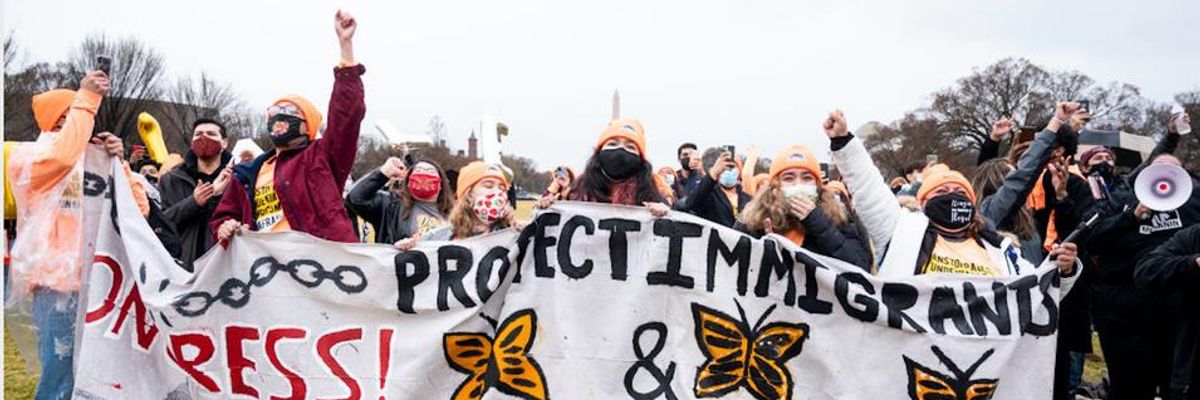
Activists from the immigrant advocacy groups United We Dream, CASA, and other organizations celebrate the House passage of the Dream and Promise Act of 2021 on March 18, 2021 in Washington, D.C. (Photo: Bill Clark/CQ-Roll Call, Inc. via Getty Images)
The House of Representatives on Thursday passed a pair of landmark immigration reform bills that would pave a pathway to citizenship for millions of so-called "Dreamers"--a move that numerous immigrant rights advocates hailed, but that others criticized for excluding many people with criminal histories--as well as over a million agricultural workers and their families.
"We are celebrating the passage of the Dream and Promise Act in the House, and we urge the Senate to meet this critical step with urgency and courageous action."
--Marielena Hincapie,
NILC
H.R. 6, the Dream and Promise Act of 2021, passed by a vote of 228-197. In addition to the approximately 2.5 million Dreamers--undocumented migrants brought into the United States as children--the proposed legislation would allow nearly 400,000 people with Temporary Protected Status (TPS) to apply for U.S. citizenship, according to the Migration Policy Institute.
The bill, co-authored by Reps. Lucille Roybal-Allard (D-Calif.) and Yvette Clarke (D-N.Y.), would grant conditional permanent residency to Dreamers and TPS beneficiaries for 10 years and remove the threat of deportation if certain requirements are met. These include being in the United States on or before January 1, 2020, being no older than 18 years of age at the time of entry into the country, and having no felony and less than three misdemeanor convictions. It contains several misdemeanor waivers, including for simple marijuana possession.
Roybal-Allard welcomed Thursday's vote as "a major step in ending the veil of fear and uncertainty that has plagued the lives of our Dreamers for far too long."
Indeed, many Dreamers--who lived with constant fear and uncertainty under former President Donald Trump's xenohobic immigration policies--breathed a sigh of hopeful relief after the bill's passage, even while acknowledging that the legislation faces an uphill battle in the Senate. They were joined by immigrant rights groups, who urged the Senate to pass the measure without delay.
"We are celebrating the passage of the Dream and Promise Act in the House, and we urge the Senate to meet this critical step with urgency and courageous action," said National Immigration Law Center (NILC) executive director Marielena Hincapie in a statement. "We must enact the Dream and Promise Act quickly as we continue to work to provide a pathway to citizenship for all 11 million undocumented people living in the U.S., as part of our efforts to set our country on a path to a just recovery that lifts us all."
However, other advocates expressed disappointment over what the ACLU called the bill's imposition of "the injustices of the criminal legal system," which could pose an insurmountable roadblock on the pathway to citizenship for some Dreamers.
"The addition of harsh criminalization provisions in this version of the Dream Act is cause for serious concern," warned Jacinta Gonzalez, senior campaign organizer at Mijente. "If we learned anything in 2020, it's that the policing and mass incarceration systems in this country are fundamentally rigged against Black and Latinx people, and the American Dream and Promise Act is no exception."
"Criminalization born of a racist system cannot be the measure by which we determine who belongs and who goes," added Gonzalez.
Hot on the heels of H.R. 6's passage came a 247-174 House vote in favor of H.R. 1603, the Farm Workforce Modernization Act of 2021, sponsored by Reps. Zoe Lofgren (D-Calif.) and Dan Newhouse (R-Wash.). If passed by the Senate, the bipartisan bill will offer a path to citizenship for agricultural workers while amending the H-2A temporary agricultural worker visa program. The proposed legislation would allow an estimated one million undocumented farmworkers and their children to gain legal status in the United States.
H.R. 1603 "will give farmworkers and their families a roadmap to citizenship, easing the fears of those who put their lives at risk to feed America," tweeted the Leadership Conference on Civil and Human Rights following the bill's passage. "If anyone meets the definition of essential work, it's them. They deserve the right to apply for legal status."
President Joe Biden backs both bills passed by the House on Thursday.
Dear Common Dreams reader, It’s been nearly 30 years since I co-founded Common Dreams with my late wife, Lina Newhouser. We had the radical notion that journalism should serve the public good, not corporate profits. It was clear to us from the outset what it would take to build such a project. No paid advertisements. No corporate sponsors. No millionaire publisher telling us what to think or do. Many people said we wouldn't last a year, but we proved those doubters wrong. Together with a tremendous team of journalists and dedicated staff, we built an independent media outlet free from the constraints of profits and corporate control. Our mission has always been simple: To inform. To inspire. To ignite change for the common good. Building Common Dreams was not easy. Our survival was never guaranteed. When you take on the most powerful forces—Wall Street greed, fossil fuel industry destruction, Big Tech lobbyists, and uber-rich oligarchs who have spent billions upon billions rigging the economy and democracy in their favor—the only bulwark you have is supporters who believe in your work. But here’s the urgent message from me today. It's never been this bad out there. And it's never been this hard to keep us going. At the very moment Common Dreams is most needed, the threats we face are intensifying. We need your support now more than ever. We don't accept corporate advertising and never will. We don't have a paywall because we don't think people should be blocked from critical news based on their ability to pay. Everything we do is funded by the donations of readers like you. When everyone does the little they can afford, we are strong. But if that support retreats or dries up, so do we. Will you donate now to make sure Common Dreams not only survives but thrives? —Craig Brown, Co-founder |
The House of Representatives on Thursday passed a pair of landmark immigration reform bills that would pave a pathway to citizenship for millions of so-called "Dreamers"--a move that numerous immigrant rights advocates hailed, but that others criticized for excluding many people with criminal histories--as well as over a million agricultural workers and their families.
"We are celebrating the passage of the Dream and Promise Act in the House, and we urge the Senate to meet this critical step with urgency and courageous action."
--Marielena Hincapie,
NILC
H.R. 6, the Dream and Promise Act of 2021, passed by a vote of 228-197. In addition to the approximately 2.5 million Dreamers--undocumented migrants brought into the United States as children--the proposed legislation would allow nearly 400,000 people with Temporary Protected Status (TPS) to apply for U.S. citizenship, according to the Migration Policy Institute.
The bill, co-authored by Reps. Lucille Roybal-Allard (D-Calif.) and Yvette Clarke (D-N.Y.), would grant conditional permanent residency to Dreamers and TPS beneficiaries for 10 years and remove the threat of deportation if certain requirements are met. These include being in the United States on or before January 1, 2020, being no older than 18 years of age at the time of entry into the country, and having no felony and less than three misdemeanor convictions. It contains several misdemeanor waivers, including for simple marijuana possession.
Roybal-Allard welcomed Thursday's vote as "a major step in ending the veil of fear and uncertainty that has plagued the lives of our Dreamers for far too long."
Indeed, many Dreamers--who lived with constant fear and uncertainty under former President Donald Trump's xenohobic immigration policies--breathed a sigh of hopeful relief after the bill's passage, even while acknowledging that the legislation faces an uphill battle in the Senate. They were joined by immigrant rights groups, who urged the Senate to pass the measure without delay.
"We are celebrating the passage of the Dream and Promise Act in the House, and we urge the Senate to meet this critical step with urgency and courageous action," said National Immigration Law Center (NILC) executive director Marielena Hincapie in a statement. "We must enact the Dream and Promise Act quickly as we continue to work to provide a pathway to citizenship for all 11 million undocumented people living in the U.S., as part of our efforts to set our country on a path to a just recovery that lifts us all."
However, other advocates expressed disappointment over what the ACLU called the bill's imposition of "the injustices of the criminal legal system," which could pose an insurmountable roadblock on the pathway to citizenship for some Dreamers.
"The addition of harsh criminalization provisions in this version of the Dream Act is cause for serious concern," warned Jacinta Gonzalez, senior campaign organizer at Mijente. "If we learned anything in 2020, it's that the policing and mass incarceration systems in this country are fundamentally rigged against Black and Latinx people, and the American Dream and Promise Act is no exception."
"Criminalization born of a racist system cannot be the measure by which we determine who belongs and who goes," added Gonzalez.
Hot on the heels of H.R. 6's passage came a 247-174 House vote in favor of H.R. 1603, the Farm Workforce Modernization Act of 2021, sponsored by Reps. Zoe Lofgren (D-Calif.) and Dan Newhouse (R-Wash.). If passed by the Senate, the bipartisan bill will offer a path to citizenship for agricultural workers while amending the H-2A temporary agricultural worker visa program. The proposed legislation would allow an estimated one million undocumented farmworkers and their children to gain legal status in the United States.
H.R. 1603 "will give farmworkers and their families a roadmap to citizenship, easing the fears of those who put their lives at risk to feed America," tweeted the Leadership Conference on Civil and Human Rights following the bill's passage. "If anyone meets the definition of essential work, it's them. They deserve the right to apply for legal status."
President Joe Biden backs both bills passed by the House on Thursday.
The House of Representatives on Thursday passed a pair of landmark immigration reform bills that would pave a pathway to citizenship for millions of so-called "Dreamers"--a move that numerous immigrant rights advocates hailed, but that others criticized for excluding many people with criminal histories--as well as over a million agricultural workers and their families.
"We are celebrating the passage of the Dream and Promise Act in the House, and we urge the Senate to meet this critical step with urgency and courageous action."
--Marielena Hincapie,
NILC
H.R. 6, the Dream and Promise Act of 2021, passed by a vote of 228-197. In addition to the approximately 2.5 million Dreamers--undocumented migrants brought into the United States as children--the proposed legislation would allow nearly 400,000 people with Temporary Protected Status (TPS) to apply for U.S. citizenship, according to the Migration Policy Institute.
The bill, co-authored by Reps. Lucille Roybal-Allard (D-Calif.) and Yvette Clarke (D-N.Y.), would grant conditional permanent residency to Dreamers and TPS beneficiaries for 10 years and remove the threat of deportation if certain requirements are met. These include being in the United States on or before January 1, 2020, being no older than 18 years of age at the time of entry into the country, and having no felony and less than three misdemeanor convictions. It contains several misdemeanor waivers, including for simple marijuana possession.
Roybal-Allard welcomed Thursday's vote as "a major step in ending the veil of fear and uncertainty that has plagued the lives of our Dreamers for far too long."
Indeed, many Dreamers--who lived with constant fear and uncertainty under former President Donald Trump's xenohobic immigration policies--breathed a sigh of hopeful relief after the bill's passage, even while acknowledging that the legislation faces an uphill battle in the Senate. They were joined by immigrant rights groups, who urged the Senate to pass the measure without delay.
"We are celebrating the passage of the Dream and Promise Act in the House, and we urge the Senate to meet this critical step with urgency and courageous action," said National Immigration Law Center (NILC) executive director Marielena Hincapie in a statement. "We must enact the Dream and Promise Act quickly as we continue to work to provide a pathway to citizenship for all 11 million undocumented people living in the U.S., as part of our efforts to set our country on a path to a just recovery that lifts us all."
However, other advocates expressed disappointment over what the ACLU called the bill's imposition of "the injustices of the criminal legal system," which could pose an insurmountable roadblock on the pathway to citizenship for some Dreamers.
"The addition of harsh criminalization provisions in this version of the Dream Act is cause for serious concern," warned Jacinta Gonzalez, senior campaign organizer at Mijente. "If we learned anything in 2020, it's that the policing and mass incarceration systems in this country are fundamentally rigged against Black and Latinx people, and the American Dream and Promise Act is no exception."
"Criminalization born of a racist system cannot be the measure by which we determine who belongs and who goes," added Gonzalez.
Hot on the heels of H.R. 6's passage came a 247-174 House vote in favor of H.R. 1603, the Farm Workforce Modernization Act of 2021, sponsored by Reps. Zoe Lofgren (D-Calif.) and Dan Newhouse (R-Wash.). If passed by the Senate, the bipartisan bill will offer a path to citizenship for agricultural workers while amending the H-2A temporary agricultural worker visa program. The proposed legislation would allow an estimated one million undocumented farmworkers and their children to gain legal status in the United States.
H.R. 1603 "will give farmworkers and their families a roadmap to citizenship, easing the fears of those who put their lives at risk to feed America," tweeted the Leadership Conference on Civil and Human Rights following the bill's passage. "If anyone meets the definition of essential work, it's them. They deserve the right to apply for legal status."
President Joe Biden backs both bills passed by the House on Thursday.