SUBSCRIBE TO OUR FREE NEWSLETTER
Daily news & progressive opinion—funded by the people, not the corporations—delivered straight to your inbox.
5
#000000
#FFFFFF
To donate by check, phone, or other method, see our More Ways to Give page.
Daily news & progressive opinion—funded by the people, not the corporations—delivered straight to your inbox.

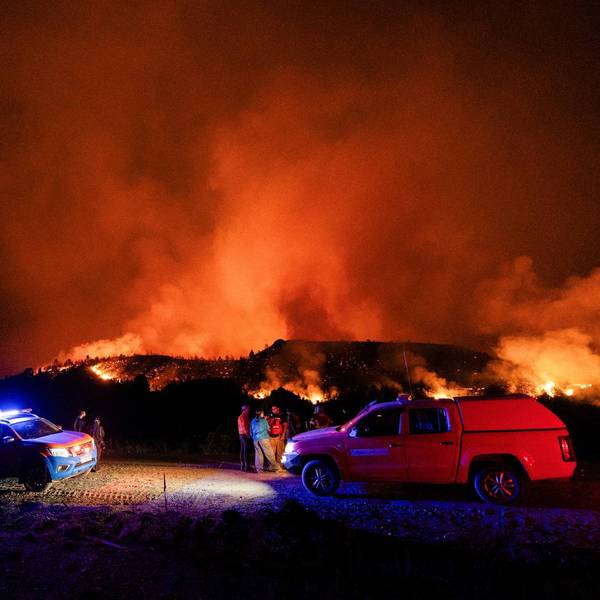
Aerial view shows smoke billowing from a patch of forest being cleared with fire in the surroundings of Boca do Acre, a city in Amazonas State, in the Amazon basin in northwestern Brazil, on August 24, 2019. (Photo: Lula Sampaio/AFP/Getty Images)
While recent research has raised alarm that tropical forests including the Amazon could soon stop serving as carbon sinks, a first-of-its-kind study from 30 experts that takes into account other greenhouse gases suggests the world's largest rainforest may already be contributing to the warming of the planet.
The new analysis, published Thursday in the journal Frontiers in Forests and Global Change, considers not only carbon dioxide (CO2) and its impact on the global climate but also that of methane (CH4), nitrous oxide (N20), black carbon, biogenic volatile organic compounds (BVOCs), aerosols, evapotranspiration, and albedo.
"What the authors do that's important is to expand the conversation beyond carbon dioxide, which is what 90% of public conversation is centered around," Patrick Megonigal, associate director of research at the Smithsonian Environmental Research Center, told National Geographic.
"CO2 is not a lone actor," added Megonigal, who was cited in but not involved with the research, which was funded by the National Geographic Society. "When you consider the whole cast of other characters, the outlook in the Amazon is that the impacts of human activities will be worse than we realize."
As 15-year-old climate activist Alexandria Villasenor put it in a tweet about the study: "We're destroying our life-support systems. We're running out of time."
The study notes that "after a transient period of reduced deforestation and increased optimism, rising agricultural conversion and illegal logging activities are again accelerating Amazonian forest loss. This resurgence has renewed concerns that the region is rapidly approaching a catastrophic 'tipping point.'"
Data from the Rainforest Foundation Norway revealed Monday that human activities have destroyed 34% of old-growth tropical rainforests and degraded 30% worldwide. Over half of that destruction since 2002 has been in the Amazon and neighboring South American rainforests. Under Brazilian President Jair Bolsonaro--whose country is home to the majority of the Amazon--deforestation hit a 12-year high in 2020.
"Cutting the forest is interfering with its carbon uptake; that's a problem," Kristofer Covey, lead author of the new study and a professor of environmental studies at Skidmore College, told National Geographic. "But when you start to look at these other factors alongside CO2, it gets really hard to see how the net effect isn't that the Amazon as a whole is really warming global climate."
The study says that despite some uncertainty, "we conclude that current warming from non-CO2 agents (especially CH4 and N2O) in the Amazon Basin largely offsets--and most likely exceeds--the climate service provided by atmospheric CO2 uptake. We also find that the majority of anthropogenic impacts act to increase the radiative forcing potential of the basin."
"Given the large contribution of less-recognized agents," the paper continues--noting that Amazonian trees alone emit about 3.5% of all global CH4--focusing strictly on carbon uptake and storage "is incompatible with genuine efforts to understand and manage the biogeochemistry of climate in a rapidly changing Amazon Basin."
Covey and his colleagues told National Geographic that reversing the damage that's already been done will require halting emissions from fossil fuels around the world and reining in Amazon deforestation, "along with reducing dam building and increasing efforts to replant trees."
The Amazon is among the most biodiverse places on the planet. The ongoing coronavirus pandemic has highlighted the importance of conserving and restoring rainforests not only because of the climate emergency but also to prevent future zoonotic disease outbreaks.
As the pandemic--officially declared a year ago Thursday--has killed more than 2.6 million people and sickened over 119 million worldwide, experts from across the globe have repeatedly called on humanity to heal its "broken relationship with nature."
Dear Common Dreams reader, It’s been nearly 30 years since I co-founded Common Dreams with my late wife, Lina Newhouser. We had the radical notion that journalism should serve the public good, not corporate profits. It was clear to us from the outset what it would take to build such a project. No paid advertisements. No corporate sponsors. No millionaire publisher telling us what to think or do. Many people said we wouldn't last a year, but we proved those doubters wrong. Together with a tremendous team of journalists and dedicated staff, we built an independent media outlet free from the constraints of profits and corporate control. Our mission has always been simple: To inform. To inspire. To ignite change for the common good. Building Common Dreams was not easy. Our survival was never guaranteed. When you take on the most powerful forces—Wall Street greed, fossil fuel industry destruction, Big Tech lobbyists, and uber-rich oligarchs who have spent billions upon billions rigging the economy and democracy in their favor—the only bulwark you have is supporters who believe in your work. But here’s the urgent message from me today. It's never been this bad out there. And it's never been this hard to keep us going. At the very moment Common Dreams is most needed, the threats we face are intensifying. We need your support now more than ever. We don't accept corporate advertising and never will. We don't have a paywall because we don't think people should be blocked from critical news based on their ability to pay. Everything we do is funded by the donations of readers like you. When everyone does the little they can afford, we are strong. But if that support retreats or dries up, so do we. Will you donate now to make sure Common Dreams not only survives but thrives? —Craig Brown, Co-founder |
While recent research has raised alarm that tropical forests including the Amazon could soon stop serving as carbon sinks, a first-of-its-kind study from 30 experts that takes into account other greenhouse gases suggests the world's largest rainforest may already be contributing to the warming of the planet.
The new analysis, published Thursday in the journal Frontiers in Forests and Global Change, considers not only carbon dioxide (CO2) and its impact on the global climate but also that of methane (CH4), nitrous oxide (N20), black carbon, biogenic volatile organic compounds (BVOCs), aerosols, evapotranspiration, and albedo.
"What the authors do that's important is to expand the conversation beyond carbon dioxide, which is what 90% of public conversation is centered around," Patrick Megonigal, associate director of research at the Smithsonian Environmental Research Center, told National Geographic.
"CO2 is not a lone actor," added Megonigal, who was cited in but not involved with the research, which was funded by the National Geographic Society. "When you consider the whole cast of other characters, the outlook in the Amazon is that the impacts of human activities will be worse than we realize."
As 15-year-old climate activist Alexandria Villasenor put it in a tweet about the study: "We're destroying our life-support systems. We're running out of time."
The study notes that "after a transient period of reduced deforestation and increased optimism, rising agricultural conversion and illegal logging activities are again accelerating Amazonian forest loss. This resurgence has renewed concerns that the region is rapidly approaching a catastrophic 'tipping point.'"
Data from the Rainforest Foundation Norway revealed Monday that human activities have destroyed 34% of old-growth tropical rainforests and degraded 30% worldwide. Over half of that destruction since 2002 has been in the Amazon and neighboring South American rainforests. Under Brazilian President Jair Bolsonaro--whose country is home to the majority of the Amazon--deforestation hit a 12-year high in 2020.
"Cutting the forest is interfering with its carbon uptake; that's a problem," Kristofer Covey, lead author of the new study and a professor of environmental studies at Skidmore College, told National Geographic. "But when you start to look at these other factors alongside CO2, it gets really hard to see how the net effect isn't that the Amazon as a whole is really warming global climate."
The study says that despite some uncertainty, "we conclude that current warming from non-CO2 agents (especially CH4 and N2O) in the Amazon Basin largely offsets--and most likely exceeds--the climate service provided by atmospheric CO2 uptake. We also find that the majority of anthropogenic impacts act to increase the radiative forcing potential of the basin."
"Given the large contribution of less-recognized agents," the paper continues--noting that Amazonian trees alone emit about 3.5% of all global CH4--focusing strictly on carbon uptake and storage "is incompatible with genuine efforts to understand and manage the biogeochemistry of climate in a rapidly changing Amazon Basin."
Covey and his colleagues told National Geographic that reversing the damage that's already been done will require halting emissions from fossil fuels around the world and reining in Amazon deforestation, "along with reducing dam building and increasing efforts to replant trees."
The Amazon is among the most biodiverse places on the planet. The ongoing coronavirus pandemic has highlighted the importance of conserving and restoring rainforests not only because of the climate emergency but also to prevent future zoonotic disease outbreaks.
As the pandemic--officially declared a year ago Thursday--has killed more than 2.6 million people and sickened over 119 million worldwide, experts from across the globe have repeatedly called on humanity to heal its "broken relationship with nature."
While recent research has raised alarm that tropical forests including the Amazon could soon stop serving as carbon sinks, a first-of-its-kind study from 30 experts that takes into account other greenhouse gases suggests the world's largest rainforest may already be contributing to the warming of the planet.
The new analysis, published Thursday in the journal Frontiers in Forests and Global Change, considers not only carbon dioxide (CO2) and its impact on the global climate but also that of methane (CH4), nitrous oxide (N20), black carbon, biogenic volatile organic compounds (BVOCs), aerosols, evapotranspiration, and albedo.
"What the authors do that's important is to expand the conversation beyond carbon dioxide, which is what 90% of public conversation is centered around," Patrick Megonigal, associate director of research at the Smithsonian Environmental Research Center, told National Geographic.
"CO2 is not a lone actor," added Megonigal, who was cited in but not involved with the research, which was funded by the National Geographic Society. "When you consider the whole cast of other characters, the outlook in the Amazon is that the impacts of human activities will be worse than we realize."
As 15-year-old climate activist Alexandria Villasenor put it in a tweet about the study: "We're destroying our life-support systems. We're running out of time."
The study notes that "after a transient period of reduced deforestation and increased optimism, rising agricultural conversion and illegal logging activities are again accelerating Amazonian forest loss. This resurgence has renewed concerns that the region is rapidly approaching a catastrophic 'tipping point.'"
Data from the Rainforest Foundation Norway revealed Monday that human activities have destroyed 34% of old-growth tropical rainforests and degraded 30% worldwide. Over half of that destruction since 2002 has been in the Amazon and neighboring South American rainforests. Under Brazilian President Jair Bolsonaro--whose country is home to the majority of the Amazon--deforestation hit a 12-year high in 2020.
"Cutting the forest is interfering with its carbon uptake; that's a problem," Kristofer Covey, lead author of the new study and a professor of environmental studies at Skidmore College, told National Geographic. "But when you start to look at these other factors alongside CO2, it gets really hard to see how the net effect isn't that the Amazon as a whole is really warming global climate."
The study says that despite some uncertainty, "we conclude that current warming from non-CO2 agents (especially CH4 and N2O) in the Amazon Basin largely offsets--and most likely exceeds--the climate service provided by atmospheric CO2 uptake. We also find that the majority of anthropogenic impacts act to increase the radiative forcing potential of the basin."
"Given the large contribution of less-recognized agents," the paper continues--noting that Amazonian trees alone emit about 3.5% of all global CH4--focusing strictly on carbon uptake and storage "is incompatible with genuine efforts to understand and manage the biogeochemistry of climate in a rapidly changing Amazon Basin."
Covey and his colleagues told National Geographic that reversing the damage that's already been done will require halting emissions from fossil fuels around the world and reining in Amazon deforestation, "along with reducing dam building and increasing efforts to replant trees."
The Amazon is among the most biodiverse places on the planet. The ongoing coronavirus pandemic has highlighted the importance of conserving and restoring rainforests not only because of the climate emergency but also to prevent future zoonotic disease outbreaks.
As the pandemic--officially declared a year ago Thursday--has killed more than 2.6 million people and sickened over 119 million worldwide, experts from across the globe have repeatedly called on humanity to heal its "broken relationship with nature."