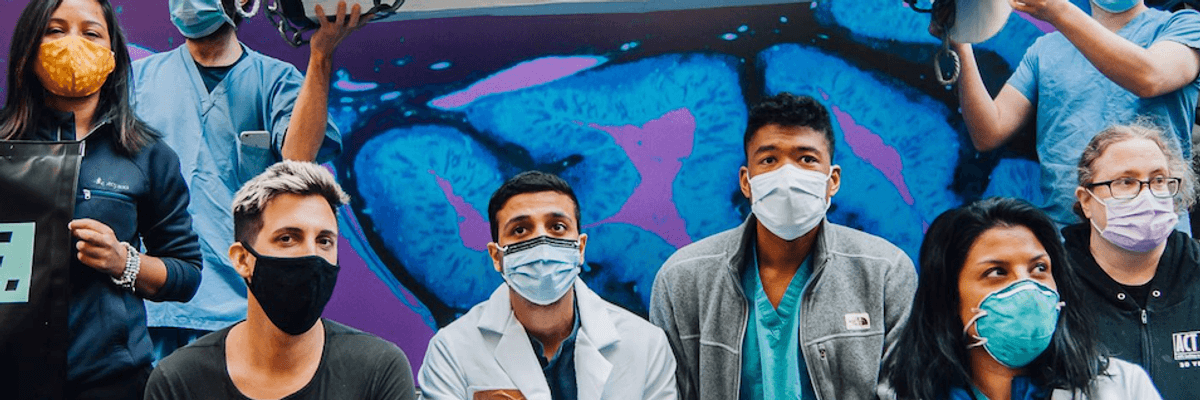
Activists rally outside Pfizer headquarters in New York City on March 11, 2021. (Photo: Steve Frances Kong)
#PeoplesVaccine Day of Action Calls for Big Pharma to 'Drop the Patents'
"The pandemic has made clear that we are connected to people around the world, and our futures are tied to theirs," said Ben Levenson of People's Action Justice is Global campaign.
Public health advocates and progressive activists rallied outside the headquarters of major pharmaceutical companies Thursday to amplify their demands for a waiver of the World Trade Organization's intellectual property rights to boost manufacturing capacity of Covid-19 vaccines and for Big Pharma to share vaccine knowledge--measures the protesters say will advance equitable vaccine access and put human lives over corporate profit.
"A #PeoplesVaccine is past due," tweeted Health Global Access Project (Health GAP), one of the groups taking part in the actions.
"We demand: no patents in a pandemic. No vaccine apartheid. No @POTUS enabling pharma profiteers," the group said.
The protests, which took place exactly one year after the WHO declared the coronavirus outbreak a pandemic, represented a call to "free the vaccine" and took place in locations across the globe including outside Pfizer headquarters in New York City, Moderna headquarters in Cambridge, Massachusetts, PhRMA headquarters in Washington, D.C., and Pfizer headquarters near Philadelphia.
Organizers included People's Action, Health GAP, and the People's Vaccine Alliance.
"The pandemic has made clear that we are connected to people around the world, and our futures are tied to theirs," said Ben Levenson, deputy director of People's Action Justice is Global campaign.
"But pharmaceutical companies like Pfizer and Moderna are blocking access to lifesaving vaccines and the Biden administration is dragging its feet," which ultimately "jeopardizes millions of lives, perpetuates vaccine apartheid, and threatens the entire global economy," he said. "We need to end this pandemic together, and that means pushing President [Joe] Biden to commit to a just, global vaccine distribution."
The U.S., pushed by lobbying from drug-industry funded groups, is among the wealthy nations blocking a proposal from India and South Africa for the WTO to temporarily lift the Trade-Related Aspects of Intellectual Property (TRIPS) agreement, which would allow other manufacturers to make vaccine. People's Action says (pdf) that the U.S. "has been one of the key roadblocks, apparently in order to protect the pharmaceutical industry's profits."
At a Wednesday WTO meeting, the patent waiver effort failed again after richer member states blocked it, as Reuters reported:
In its eighth discussion on the topic since it was first raised in October, the WTO's TRIPS Council spent three hours debating, but failed to agree. Proposals need backing by a consensus of the WTO's 164 members to pass.
They did at least agree to discuss the matter twice again in April before the next scheduled TRIPS Council meeting on June 8-9.
Biden did join the global vaccination effort known as COVAX in January, but social justice advocates say that was not enough to prevent "vaccine apartheid." According to NBC News:
While the rollout in the U.S. has been troubled, there has still been about 20 vaccinations per 100 people so far. COVAX is months behind, with more than 100 of the world's poorest countries having yet to administer a single dose.
COVAX did finally begin its rollout this week, with Ghana becoming the first country Wednesday to receive 600,000 doses of the AstraZeneca-Oxford University vaccine. And officials remain optimistic they will soon start closing the gap. But many experts are skeptical it will hit its target of delivering 1.8 billion vaccinations to low-and-middle-income countries this year. [...]
some of the new administration's policies are the same ones that COVAX officials blame for fueling the inequality we see today. That's because the central problem here is not about money at all, but supply.
COVAX could have all the cash in the world, but so few vaccine vials are being made that the shots are not available to buy. Those that have trickled out of the spigot have mostly been snapped up by rich countries first--and in this sense, Biden's White House is little different.
With the need for increased supply, public health health experts say the patent waiver is crucial.
"These provisions are there for use in emergencies," WHO chief Tedros Adhanom Ghebreyesus said last week. "If now is not a time to use them, then when?"
South African activist Fatima Hassan, founder and director of Health Justice Initiative, had a similar message, telling Democracy Now! Thursday that "it is disingenuous for them to say that intellectual property is actually not the block and is not the obstacle. Right now that is the current largest obstacle."
"If the patents were to be relaxed, if the intellectual property protections were to be relaxed, and they were to either be done on a voluntary basis or through a compulsory mechanism, then, certainly," said Hassan, "we believe that we would be in a different situation in the next few months."
The direct actions came a day after a virtual "Rally for a People's Vaccine."
Among those giving remarks at the event was U.S. Sen. Bernie Sanders (I-Vt.), who said, "Our government has invested enormous sums of taxpayer dollars into the production of these technologies."
"All people should benefit, not just a few already obscenely wealthy CEOs and shareholders in the wealthiest country on Earth," said Sanders. "We need a People's Vaccine, not a Profit Vaccine."
We are at a crossroads
This country and this world are at a monumental crossroads. In a few short weeks, US voters will have an opportunity to beat back the forces of fascism and confront the billionaires who are rigging the economy, our media system, and our democracy, making it increasingly impossible for ordinary people to get by. We’re not just talking about the election. We’re talking about what must be done once these fascist elements are vanquished from power. We need a bolder set of solutions than what either major party has so far been willing to offer and a working-class movement ready to fight like hell for it. Trump didn't emerge from nowhere. The conditions that fueled MAGA authoritarianism were created by decades of radical neoliberal economic policies and a corrupt political system dominated by corporate interests. They slashed taxes on the super-rich, promising that the benefits would trickle down. They said giveaways to the corporate titans would make life more affordable for the rest of us. It was all bullshit. And when a bitter, betrayed populace searches for someone to blame, right-wing demagogues have little trouble finding scapegoats. People know when they're being lied to, but you won't hear any of this from the corporate media. Only independent journalism—powered and funded by people who believe in building a better world—can deliver truly trustworthy daily news. Our Fall Campaign is underway, and we need your help. To power our newsroom through the rest of the year, we need to raise $125,000 by midnight on October 31. So if you share our vision, please contribute whatever you can to sustain our work. |
Public health advocates and progressive activists rallied outside the headquarters of major pharmaceutical companies Thursday to amplify their demands for a waiver of the World Trade Organization's intellectual property rights to boost manufacturing capacity of Covid-19 vaccines and for Big Pharma to share vaccine knowledge--measures the protesters say will advance equitable vaccine access and put human lives over corporate profit.
"A #PeoplesVaccine is past due," tweeted Health Global Access Project (Health GAP), one of the groups taking part in the actions.
"We demand: no patents in a pandemic. No vaccine apartheid. No @POTUS enabling pharma profiteers," the group said.
The protests, which took place exactly one year after the WHO declared the coronavirus outbreak a pandemic, represented a call to "free the vaccine" and took place in locations across the globe including outside Pfizer headquarters in New York City, Moderna headquarters in Cambridge, Massachusetts, PhRMA headquarters in Washington, D.C., and Pfizer headquarters near Philadelphia.
Organizers included People's Action, Health GAP, and the People's Vaccine Alliance.
"The pandemic has made clear that we are connected to people around the world, and our futures are tied to theirs," said Ben Levenson, deputy director of People's Action Justice is Global campaign.
"But pharmaceutical companies like Pfizer and Moderna are blocking access to lifesaving vaccines and the Biden administration is dragging its feet," which ultimately "jeopardizes millions of lives, perpetuates vaccine apartheid, and threatens the entire global economy," he said. "We need to end this pandemic together, and that means pushing President [Joe] Biden to commit to a just, global vaccine distribution."
The U.S., pushed by lobbying from drug-industry funded groups, is among the wealthy nations blocking a proposal from India and South Africa for the WTO to temporarily lift the Trade-Related Aspects of Intellectual Property (TRIPS) agreement, which would allow other manufacturers to make vaccine. People's Action says (pdf) that the U.S. "has been one of the key roadblocks, apparently in order to protect the pharmaceutical industry's profits."
At a Wednesday WTO meeting, the patent waiver effort failed again after richer member states blocked it, as Reuters reported:
In its eighth discussion on the topic since it was first raised in October, the WTO's TRIPS Council spent three hours debating, but failed to agree. Proposals need backing by a consensus of the WTO's 164 members to pass.
They did at least agree to discuss the matter twice again in April before the next scheduled TRIPS Council meeting on June 8-9.
Biden did join the global vaccination effort known as COVAX in January, but social justice advocates say that was not enough to prevent "vaccine apartheid." According to NBC News:
While the rollout in the U.S. has been troubled, there has still been about 20 vaccinations per 100 people so far. COVAX is months behind, with more than 100 of the world's poorest countries having yet to administer a single dose.
COVAX did finally begin its rollout this week, with Ghana becoming the first country Wednesday to receive 600,000 doses of the AstraZeneca-Oxford University vaccine. And officials remain optimistic they will soon start closing the gap. But many experts are skeptical it will hit its target of delivering 1.8 billion vaccinations to low-and-middle-income countries this year. [...]
some of the new administration's policies are the same ones that COVAX officials blame for fueling the inequality we see today. That's because the central problem here is not about money at all, but supply.
COVAX could have all the cash in the world, but so few vaccine vials are being made that the shots are not available to buy. Those that have trickled out of the spigot have mostly been snapped up by rich countries first--and in this sense, Biden's White House is little different.
With the need for increased supply, public health health experts say the patent waiver is crucial.
"These provisions are there for use in emergencies," WHO chief Tedros Adhanom Ghebreyesus said last week. "If now is not a time to use them, then when?"
South African activist Fatima Hassan, founder and director of Health Justice Initiative, had a similar message, telling Democracy Now! Thursday that "it is disingenuous for them to say that intellectual property is actually not the block and is not the obstacle. Right now that is the current largest obstacle."
"If the patents were to be relaxed, if the intellectual property protections were to be relaxed, and they were to either be done on a voluntary basis or through a compulsory mechanism, then, certainly," said Hassan, "we believe that we would be in a different situation in the next few months."
The direct actions came a day after a virtual "Rally for a People's Vaccine."
Among those giving remarks at the event was U.S. Sen. Bernie Sanders (I-Vt.), who said, "Our government has invested enormous sums of taxpayer dollars into the production of these technologies."
"All people should benefit, not just a few already obscenely wealthy CEOs and shareholders in the wealthiest country on Earth," said Sanders. "We need a People's Vaccine, not a Profit Vaccine."
Public health advocates and progressive activists rallied outside the headquarters of major pharmaceutical companies Thursday to amplify their demands for a waiver of the World Trade Organization's intellectual property rights to boost manufacturing capacity of Covid-19 vaccines and for Big Pharma to share vaccine knowledge--measures the protesters say will advance equitable vaccine access and put human lives over corporate profit.
"A #PeoplesVaccine is past due," tweeted Health Global Access Project (Health GAP), one of the groups taking part in the actions.
"We demand: no patents in a pandemic. No vaccine apartheid. No @POTUS enabling pharma profiteers," the group said.
The protests, which took place exactly one year after the WHO declared the coronavirus outbreak a pandemic, represented a call to "free the vaccine" and took place in locations across the globe including outside Pfizer headquarters in New York City, Moderna headquarters in Cambridge, Massachusetts, PhRMA headquarters in Washington, D.C., and Pfizer headquarters near Philadelphia.
Organizers included People's Action, Health GAP, and the People's Vaccine Alliance.
"The pandemic has made clear that we are connected to people around the world, and our futures are tied to theirs," said Ben Levenson, deputy director of People's Action Justice is Global campaign.
"But pharmaceutical companies like Pfizer and Moderna are blocking access to lifesaving vaccines and the Biden administration is dragging its feet," which ultimately "jeopardizes millions of lives, perpetuates vaccine apartheid, and threatens the entire global economy," he said. "We need to end this pandemic together, and that means pushing President [Joe] Biden to commit to a just, global vaccine distribution."
The U.S., pushed by lobbying from drug-industry funded groups, is among the wealthy nations blocking a proposal from India and South Africa for the WTO to temporarily lift the Trade-Related Aspects of Intellectual Property (TRIPS) agreement, which would allow other manufacturers to make vaccine. People's Action says (pdf) that the U.S. "has been one of the key roadblocks, apparently in order to protect the pharmaceutical industry's profits."
At a Wednesday WTO meeting, the patent waiver effort failed again after richer member states blocked it, as Reuters reported:
In its eighth discussion on the topic since it was first raised in October, the WTO's TRIPS Council spent three hours debating, but failed to agree. Proposals need backing by a consensus of the WTO's 164 members to pass.
They did at least agree to discuss the matter twice again in April before the next scheduled TRIPS Council meeting on June 8-9.
Biden did join the global vaccination effort known as COVAX in January, but social justice advocates say that was not enough to prevent "vaccine apartheid." According to NBC News:
While the rollout in the U.S. has been troubled, there has still been about 20 vaccinations per 100 people so far. COVAX is months behind, with more than 100 of the world's poorest countries having yet to administer a single dose.
COVAX did finally begin its rollout this week, with Ghana becoming the first country Wednesday to receive 600,000 doses of the AstraZeneca-Oxford University vaccine. And officials remain optimistic they will soon start closing the gap. But many experts are skeptical it will hit its target of delivering 1.8 billion vaccinations to low-and-middle-income countries this year. [...]
some of the new administration's policies are the same ones that COVAX officials blame for fueling the inequality we see today. That's because the central problem here is not about money at all, but supply.
COVAX could have all the cash in the world, but so few vaccine vials are being made that the shots are not available to buy. Those that have trickled out of the spigot have mostly been snapped up by rich countries first--and in this sense, Biden's White House is little different.
With the need for increased supply, public health health experts say the patent waiver is crucial.
"These provisions are there for use in emergencies," WHO chief Tedros Adhanom Ghebreyesus said last week. "If now is not a time to use them, then when?"
South African activist Fatima Hassan, founder and director of Health Justice Initiative, had a similar message, telling Democracy Now! Thursday that "it is disingenuous for them to say that intellectual property is actually not the block and is not the obstacle. Right now that is the current largest obstacle."
"If the patents were to be relaxed, if the intellectual property protections were to be relaxed, and they were to either be done on a voluntary basis or through a compulsory mechanism, then, certainly," said Hassan, "we believe that we would be in a different situation in the next few months."
The direct actions came a day after a virtual "Rally for a People's Vaccine."
Among those giving remarks at the event was U.S. Sen. Bernie Sanders (I-Vt.), who said, "Our government has invested enormous sums of taxpayer dollars into the production of these technologies."
"All people should benefit, not just a few already obscenely wealthy CEOs and shareholders in the wealthiest country on Earth," said Sanders. "We need a People's Vaccine, not a Profit Vaccine."