

SUBSCRIBE TO OUR FREE NEWSLETTER
Daily news & progressive opinion—funded by the people, not the corporations—delivered straight to your inbox.
5
#000000
#FFFFFF
To donate by check, phone, or other method, see our More Ways to Give page.
Daily news & progressive opinion—funded by the people, not the corporations—delivered straight to your inbox.
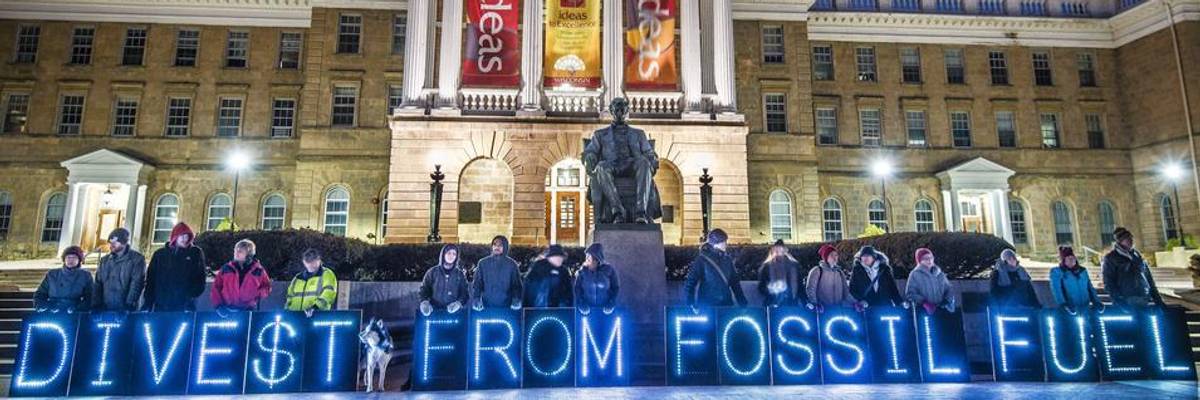
Climate activists stage a divestment rally on April 4, 2014 in Madison, Wisconsin. (Photo: depthandtime/flickr/cc)
Climate campaigners on Tuesday welcomed the announcement that Rutgers University will become the latest U.S. academic institution to commit to divesting from fossil fuels in a bid to combat the climate crisis.
" Divestment is the necessary first step in an economic transition rooted in racial and environmental justice."
-- Naomi Klein,
Rutgers University
Rutgers Today reports the move by New Jersey's largest state university follows a recommendation by the school's Ad Hoc Committee on Divestment and approval by its board of governors and board of trustees. The committee--which is composed of students, faculty, and staff--was acting on a request from the student-led Endowment Justice Collective.
Rutgers' divestment plan consists of:
According to Rutgers Today, around 5% of the university's $1.6 billion endowment is currently invested in fossil fuels.
"This decision aligns with Rutgers' mission to advance public health and social justice," said university president Jonathan Holloway. "While the university has taken steps recently to limit investments in this area, approving a policy of divestment from fossil fuels is a significant expression of the values of our institution and our broader community."
Board of governors chair Mark Angelson said that "we are doing our part to ensure a sustainable environment for future generations of students, while continuing their access to an affordable education."
Zunaira Wasim, a junior at Rutgers University-New Brunswick and one of four students on the committee, told Rutgers Today that "divesting from fossil fuels aligns with our scarlet values and with the university leadership on important issues that students rightfully expect from Rutgers."
"Students like me have expressed our desires to see the university rapidly decrease its carbon footprint and will be proud to see Rutgers taking this step," Wasim added.
Author Naomi Klein, Rutgers' Gloria Steinem endowed chair in Media, Culture, and Feminist Studies, said in a statement that "this powerful decision by Rutgers University sends an unequivocal market message that the era of fossil fuels is finally coming to an end and that our collective future rests with clean, renewable energy."
"Divestment is the necessary first step in an economic transition rooted in racial and environmental justice," added Klein, "a process that must bring good green jobs, as well as safe, renewable energy, to the most impoverished and polluted communities in our state."
I love teaching at #Rutgers University and now I'm extra proud to be part of this amazing community: after years of student and faculty activism, Rutgers if finally divesting from fossil fuels! https://t.co/n3OLERhXsm
-- Naomi Klein (@NaomiAKlein) March 9, 2021
Climate campaigners around the country applauded news of Rutgers' divestment. Bill McKibben, co-founder of 350.org, called the move "a big, big deal."
"After years of hard work from students, faculty, and alumni, the administration is now acknowledging that it makes neither financial nor moral sense to try and profit off the destruction of the climate system," said McKibben, according to Insider NJ. "One of America's foremost educational institutions is making it clear that it stands with the future."
Rutgers joins the growing list of colleges and universities in the U.S. and around the world to choose divestment as a method of fighting the worsening climate emergency. Last May, the University of California became the nation's largest university system to sell off all its fossil fuel investments.
Dear Common Dreams reader, It’s been nearly 30 years since I co-founded Common Dreams with my late wife, Lina Newhouser. We had the radical notion that journalism should serve the public good, not corporate profits. It was clear to us from the outset what it would take to build such a project. No paid advertisements. No corporate sponsors. No millionaire publisher telling us what to think or do. Many people said we wouldn't last a year, but we proved those doubters wrong. Together with a tremendous team of journalists and dedicated staff, we built an independent media outlet free from the constraints of profits and corporate control. Our mission has always been simple: To inform. To inspire. To ignite change for the common good. Building Common Dreams was not easy. Our survival was never guaranteed. When you take on the most powerful forces—Wall Street greed, fossil fuel industry destruction, Big Tech lobbyists, and uber-rich oligarchs who have spent billions upon billions rigging the economy and democracy in their favor—the only bulwark you have is supporters who believe in your work. But here’s the urgent message from me today. It's never been this bad out there. And it's never been this hard to keep us going. At the very moment Common Dreams is most needed, the threats we face are intensifying. We need your support now more than ever. We don't accept corporate advertising and never will. We don't have a paywall because we don't think people should be blocked from critical news based on their ability to pay. Everything we do is funded by the donations of readers like you. When everyone does the little they can afford, we are strong. But if that support retreats or dries up, so do we. Will you donate now to make sure Common Dreams not only survives but thrives? —Craig Brown, Co-founder |
Climate campaigners on Tuesday welcomed the announcement that Rutgers University will become the latest U.S. academic institution to commit to divesting from fossil fuels in a bid to combat the climate crisis.
" Divestment is the necessary first step in an economic transition rooted in racial and environmental justice."
-- Naomi Klein,
Rutgers University
Rutgers Today reports the move by New Jersey's largest state university follows a recommendation by the school's Ad Hoc Committee on Divestment and approval by its board of governors and board of trustees. The committee--which is composed of students, faculty, and staff--was acting on a request from the student-led Endowment Justice Collective.
Rutgers' divestment plan consists of:
According to Rutgers Today, around 5% of the university's $1.6 billion endowment is currently invested in fossil fuels.
"This decision aligns with Rutgers' mission to advance public health and social justice," said university president Jonathan Holloway. "While the university has taken steps recently to limit investments in this area, approving a policy of divestment from fossil fuels is a significant expression of the values of our institution and our broader community."
Board of governors chair Mark Angelson said that "we are doing our part to ensure a sustainable environment for future generations of students, while continuing their access to an affordable education."
Zunaira Wasim, a junior at Rutgers University-New Brunswick and one of four students on the committee, told Rutgers Today that "divesting from fossil fuels aligns with our scarlet values and with the university leadership on important issues that students rightfully expect from Rutgers."
"Students like me have expressed our desires to see the university rapidly decrease its carbon footprint and will be proud to see Rutgers taking this step," Wasim added.
Author Naomi Klein, Rutgers' Gloria Steinem endowed chair in Media, Culture, and Feminist Studies, said in a statement that "this powerful decision by Rutgers University sends an unequivocal market message that the era of fossil fuels is finally coming to an end and that our collective future rests with clean, renewable energy."
"Divestment is the necessary first step in an economic transition rooted in racial and environmental justice," added Klein, "a process that must bring good green jobs, as well as safe, renewable energy, to the most impoverished and polluted communities in our state."
I love teaching at #Rutgers University and now I'm extra proud to be part of this amazing community: after years of student and faculty activism, Rutgers if finally divesting from fossil fuels! https://t.co/n3OLERhXsm
-- Naomi Klein (@NaomiAKlein) March 9, 2021
Climate campaigners around the country applauded news of Rutgers' divestment. Bill McKibben, co-founder of 350.org, called the move "a big, big deal."
"After years of hard work from students, faculty, and alumni, the administration is now acknowledging that it makes neither financial nor moral sense to try and profit off the destruction of the climate system," said McKibben, according to Insider NJ. "One of America's foremost educational institutions is making it clear that it stands with the future."
Rutgers joins the growing list of colleges and universities in the U.S. and around the world to choose divestment as a method of fighting the worsening climate emergency. Last May, the University of California became the nation's largest university system to sell off all its fossil fuel investments.
Climate campaigners on Tuesday welcomed the announcement that Rutgers University will become the latest U.S. academic institution to commit to divesting from fossil fuels in a bid to combat the climate crisis.
" Divestment is the necessary first step in an economic transition rooted in racial and environmental justice."
-- Naomi Klein,
Rutgers University
Rutgers Today reports the move by New Jersey's largest state university follows a recommendation by the school's Ad Hoc Committee on Divestment and approval by its board of governors and board of trustees. The committee--which is composed of students, faculty, and staff--was acting on a request from the student-led Endowment Justice Collective.
Rutgers' divestment plan consists of:
According to Rutgers Today, around 5% of the university's $1.6 billion endowment is currently invested in fossil fuels.
"This decision aligns with Rutgers' mission to advance public health and social justice," said university president Jonathan Holloway. "While the university has taken steps recently to limit investments in this area, approving a policy of divestment from fossil fuels is a significant expression of the values of our institution and our broader community."
Board of governors chair Mark Angelson said that "we are doing our part to ensure a sustainable environment for future generations of students, while continuing their access to an affordable education."
Zunaira Wasim, a junior at Rutgers University-New Brunswick and one of four students on the committee, told Rutgers Today that "divesting from fossil fuels aligns with our scarlet values and with the university leadership on important issues that students rightfully expect from Rutgers."
"Students like me have expressed our desires to see the university rapidly decrease its carbon footprint and will be proud to see Rutgers taking this step," Wasim added.
Author Naomi Klein, Rutgers' Gloria Steinem endowed chair in Media, Culture, and Feminist Studies, said in a statement that "this powerful decision by Rutgers University sends an unequivocal market message that the era of fossil fuels is finally coming to an end and that our collective future rests with clean, renewable energy."
"Divestment is the necessary first step in an economic transition rooted in racial and environmental justice," added Klein, "a process that must bring good green jobs, as well as safe, renewable energy, to the most impoverished and polluted communities in our state."
I love teaching at #Rutgers University and now I'm extra proud to be part of this amazing community: after years of student and faculty activism, Rutgers if finally divesting from fossil fuels! https://t.co/n3OLERhXsm
-- Naomi Klein (@NaomiAKlein) March 9, 2021
Climate campaigners around the country applauded news of Rutgers' divestment. Bill McKibben, co-founder of 350.org, called the move "a big, big deal."
"After years of hard work from students, faculty, and alumni, the administration is now acknowledging that it makes neither financial nor moral sense to try and profit off the destruction of the climate system," said McKibben, according to Insider NJ. "One of America's foremost educational institutions is making it clear that it stands with the future."
Rutgers joins the growing list of colleges and universities in the U.S. and around the world to choose divestment as a method of fighting the worsening climate emergency. Last May, the University of California became the nation's largest university system to sell off all its fossil fuel investments.

