SUBSCRIBE TO OUR FREE NEWSLETTER
Daily news & progressive opinion—funded by the people, not the corporations—delivered straight to your inbox.
5
#000000
#FFFFFF
To donate by check, phone, or other method, see our More Ways to Give page.
Daily news & progressive opinion—funded by the people, not the corporations—delivered straight to your inbox.
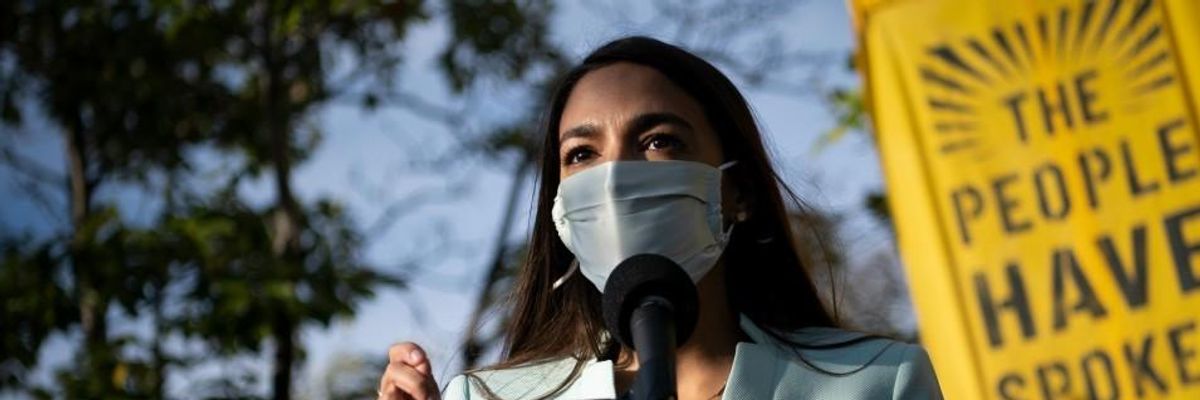
Rep. Alexandria Ocasio-Cortez (D-N.Y.) speaks during a news conference outside of the Democratic National Headquarters in Washington, D.C. on Thursday, November 19, 2020. (Photo: Caroline Brehman/CQ-Roll Call, Inc via Getty Images)
Congresswoman Alexandria Ocasio-Cortez on Wednesday strongly pushed back against a move by Senate Democrats and President Joe Biden to further restrict the number of people who will receive direct payments under the emerging coronavirus aid package, warning the new eligibility structure would deny direct relief to people who received checks during Donald Trump's presidency.
"I don't understand the political or economic wisdom in allowing Trump to give more people relief checks than a Democratic administration. People went far too long without relief last year," the New York Democrat told the Washington Post's Jeff Stein. "If anything we should be more generous, not more stingy."
"I don't understand the political or economic wisdom in allowing Trump to give more people relief checks than a Democratic administration."
--Rep. Alexandria Ocasio-Cortez
"It's also an insensitive compromise for the roughly 80% of Americans that live in urban areas, which are known for higher costs of living," Ocasio-Cortez added.
According to the Institute on Taxation and Economic Policy (ITEP), the new eligibility framework pushed by conservative Senate Democrats and accepted by the party leadership and the president would result in around 12 million fewer adults and five million fewer children receiving direct payments compared to the eligibility structure proposed by the House.
"We have a responsibility to show people in this country what a Democratic majority can do for working people," Ocasio-Cortez added. "That means more generous relief checks, $15 min wage, ending the filibuster to protect our democracy. It's a once-in-generation shot, and we need to legislate like it."
Under Senate Democrats' newly adopted framework, individuals earning $75,000 per year or less and married couples earning $150,000 or less--based on either 2019 or 2020 income--would still receive full $1,400 payments, but the checks would phase out more quickly for people whose earnings exceed those thresholds.
The new plan would completely deny payments to individuals earning more than $80,000 annually and married couples earning more than $160,000.
As the New York Times reported, "the change in the upper limit being discussed in the Senate, if adopted, would mean that some people who got a check during the Trump administration would not get one under Mr. Biden."
"Nearly nine million households that would have received at least some amount of payment under the House bill would not receive any payment at all," the Times noted, citing an estimate from tax modeling specialist Kyle Pomerleau of the American Enterprise Institute, a right-wing think tank.
Pomerleau said the eligibility change would slash around $15 to $20 billion off the top-line cost of the relief legislation, a small fraction of the $1.9 trillion total.
Brian Beutler, editor-in-chief of Crooked Media, called the eligibility rollback "an absurd, stupid decision," echoing Ocasio-Cortez's concern about the possible political consequences of millions of people being denied direct relief payments under Biden and a Democratic Congress after receiving checks under Trump.
"It should be pretty straightforward to tabulate the number of Democratic voters in Georgia who will not get their supplemental $1,400 checks under this plan, and compare it to the vote margins in the Ossoff and Warnock races," Beutler tweeted, referring to the two senators whose electoral victories in January handed Democrats control of the Senate.
"Or to be more precise," Beutler added, "the number of voters who will be getting no supplemental check at all who were supposed to get one somewhere on the sliding scale."
The change to the eligibility framework comes despite loud progressive warnings that excessively means testing direct relief amid a pandemic and economic crisis would be politically, economically, and morally foolish. Some analysts have argued Congress should approve universal checks and tax high earners on the back end, a proposal that Democratic lawmakers never put on the table.
"Further 'targeting' or 'tightening' eligibility means taking survival checks away from millions of families who got them last time," Rep. Pramila Jayapal (D-Wash.), chair of the Congressional Progressive Caucus, tweeted earlier this week. "That's bad policy and bad politics, too."
Dear Common Dreams reader, It’s been nearly 30 years since I co-founded Common Dreams with my late wife, Lina Newhouser. We had the radical notion that journalism should serve the public good, not corporate profits. It was clear to us from the outset what it would take to build such a project. No paid advertisements. No corporate sponsors. No millionaire publisher telling us what to think or do. Many people said we wouldn't last a year, but we proved those doubters wrong. Together with a tremendous team of journalists and dedicated staff, we built an independent media outlet free from the constraints of profits and corporate control. Our mission has always been simple: To inform. To inspire. To ignite change for the common good. Building Common Dreams was not easy. Our survival was never guaranteed. When you take on the most powerful forces—Wall Street greed, fossil fuel industry destruction, Big Tech lobbyists, and uber-rich oligarchs who have spent billions upon billions rigging the economy and democracy in their favor—the only bulwark you have is supporters who believe in your work. But here’s the urgent message from me today. It's never been this bad out there. And it's never been this hard to keep us going. At the very moment Common Dreams is most needed, the threats we face are intensifying. We need your support now more than ever. We don't accept corporate advertising and never will. We don't have a paywall because we don't think people should be blocked from critical news based on their ability to pay. Everything we do is funded by the donations of readers like you. When everyone does the little they can afford, we are strong. But if that support retreats or dries up, so do we. Will you donate now to make sure Common Dreams not only survives but thrives? —Craig Brown, Co-founder |
Congresswoman Alexandria Ocasio-Cortez on Wednesday strongly pushed back against a move by Senate Democrats and President Joe Biden to further restrict the number of people who will receive direct payments under the emerging coronavirus aid package, warning the new eligibility structure would deny direct relief to people who received checks during Donald Trump's presidency.
"I don't understand the political or economic wisdom in allowing Trump to give more people relief checks than a Democratic administration. People went far too long without relief last year," the New York Democrat told the Washington Post's Jeff Stein. "If anything we should be more generous, not more stingy."
"I don't understand the political or economic wisdom in allowing Trump to give more people relief checks than a Democratic administration."
--Rep. Alexandria Ocasio-Cortez
"It's also an insensitive compromise for the roughly 80% of Americans that live in urban areas, which are known for higher costs of living," Ocasio-Cortez added.
According to the Institute on Taxation and Economic Policy (ITEP), the new eligibility framework pushed by conservative Senate Democrats and accepted by the party leadership and the president would result in around 12 million fewer adults and five million fewer children receiving direct payments compared to the eligibility structure proposed by the House.
"We have a responsibility to show people in this country what a Democratic majority can do for working people," Ocasio-Cortez added. "That means more generous relief checks, $15 min wage, ending the filibuster to protect our democracy. It's a once-in-generation shot, and we need to legislate like it."
Under Senate Democrats' newly adopted framework, individuals earning $75,000 per year or less and married couples earning $150,000 or less--based on either 2019 or 2020 income--would still receive full $1,400 payments, but the checks would phase out more quickly for people whose earnings exceed those thresholds.
The new plan would completely deny payments to individuals earning more than $80,000 annually and married couples earning more than $160,000.
As the New York Times reported, "the change in the upper limit being discussed in the Senate, if adopted, would mean that some people who got a check during the Trump administration would not get one under Mr. Biden."
"Nearly nine million households that would have received at least some amount of payment under the House bill would not receive any payment at all," the Times noted, citing an estimate from tax modeling specialist Kyle Pomerleau of the American Enterprise Institute, a right-wing think tank.
Pomerleau said the eligibility change would slash around $15 to $20 billion off the top-line cost of the relief legislation, a small fraction of the $1.9 trillion total.
Brian Beutler, editor-in-chief of Crooked Media, called the eligibility rollback "an absurd, stupid decision," echoing Ocasio-Cortez's concern about the possible political consequences of millions of people being denied direct relief payments under Biden and a Democratic Congress after receiving checks under Trump.
"It should be pretty straightforward to tabulate the number of Democratic voters in Georgia who will not get their supplemental $1,400 checks under this plan, and compare it to the vote margins in the Ossoff and Warnock races," Beutler tweeted, referring to the two senators whose electoral victories in January handed Democrats control of the Senate.
"Or to be more precise," Beutler added, "the number of voters who will be getting no supplemental check at all who were supposed to get one somewhere on the sliding scale."
The change to the eligibility framework comes despite loud progressive warnings that excessively means testing direct relief amid a pandemic and economic crisis would be politically, economically, and morally foolish. Some analysts have argued Congress should approve universal checks and tax high earners on the back end, a proposal that Democratic lawmakers never put on the table.
"Further 'targeting' or 'tightening' eligibility means taking survival checks away from millions of families who got them last time," Rep. Pramila Jayapal (D-Wash.), chair of the Congressional Progressive Caucus, tweeted earlier this week. "That's bad policy and bad politics, too."
Congresswoman Alexandria Ocasio-Cortez on Wednesday strongly pushed back against a move by Senate Democrats and President Joe Biden to further restrict the number of people who will receive direct payments under the emerging coronavirus aid package, warning the new eligibility structure would deny direct relief to people who received checks during Donald Trump's presidency.
"I don't understand the political or economic wisdom in allowing Trump to give more people relief checks than a Democratic administration. People went far too long without relief last year," the New York Democrat told the Washington Post's Jeff Stein. "If anything we should be more generous, not more stingy."
"I don't understand the political or economic wisdom in allowing Trump to give more people relief checks than a Democratic administration."
--Rep. Alexandria Ocasio-Cortez
"It's also an insensitive compromise for the roughly 80% of Americans that live in urban areas, which are known for higher costs of living," Ocasio-Cortez added.
According to the Institute on Taxation and Economic Policy (ITEP), the new eligibility framework pushed by conservative Senate Democrats and accepted by the party leadership and the president would result in around 12 million fewer adults and five million fewer children receiving direct payments compared to the eligibility structure proposed by the House.
"We have a responsibility to show people in this country what a Democratic majority can do for working people," Ocasio-Cortez added. "That means more generous relief checks, $15 min wage, ending the filibuster to protect our democracy. It's a once-in-generation shot, and we need to legislate like it."
Under Senate Democrats' newly adopted framework, individuals earning $75,000 per year or less and married couples earning $150,000 or less--based on either 2019 or 2020 income--would still receive full $1,400 payments, but the checks would phase out more quickly for people whose earnings exceed those thresholds.
The new plan would completely deny payments to individuals earning more than $80,000 annually and married couples earning more than $160,000.
As the New York Times reported, "the change in the upper limit being discussed in the Senate, if adopted, would mean that some people who got a check during the Trump administration would not get one under Mr. Biden."
"Nearly nine million households that would have received at least some amount of payment under the House bill would not receive any payment at all," the Times noted, citing an estimate from tax modeling specialist Kyle Pomerleau of the American Enterprise Institute, a right-wing think tank.
Pomerleau said the eligibility change would slash around $15 to $20 billion off the top-line cost of the relief legislation, a small fraction of the $1.9 trillion total.
Brian Beutler, editor-in-chief of Crooked Media, called the eligibility rollback "an absurd, stupid decision," echoing Ocasio-Cortez's concern about the possible political consequences of millions of people being denied direct relief payments under Biden and a Democratic Congress after receiving checks under Trump.
"It should be pretty straightforward to tabulate the number of Democratic voters in Georgia who will not get their supplemental $1,400 checks under this plan, and compare it to the vote margins in the Ossoff and Warnock races," Beutler tweeted, referring to the two senators whose electoral victories in January handed Democrats control of the Senate.
"Or to be more precise," Beutler added, "the number of voters who will be getting no supplemental check at all who were supposed to get one somewhere on the sliding scale."
The change to the eligibility framework comes despite loud progressive warnings that excessively means testing direct relief amid a pandemic and economic crisis would be politically, economically, and morally foolish. Some analysts have argued Congress should approve universal checks and tax high earners on the back end, a proposal that Democratic lawmakers never put on the table.
"Further 'targeting' or 'tightening' eligibility means taking survival checks away from millions of families who got them last time," Rep. Pramila Jayapal (D-Wash.), chair of the Congressional Progressive Caucus, tweeted earlier this week. "That's bad policy and bad politics, too."