SUBSCRIBE TO OUR FREE NEWSLETTER
Daily news & progressive opinion—funded by the people, not the corporations—delivered straight to your inbox.
5
#000000
#FFFFFF
To donate by check, phone, or other method, see our More Ways to Give page.
Daily news & progressive opinion—funded by the people, not the corporations—delivered straight to your inbox.
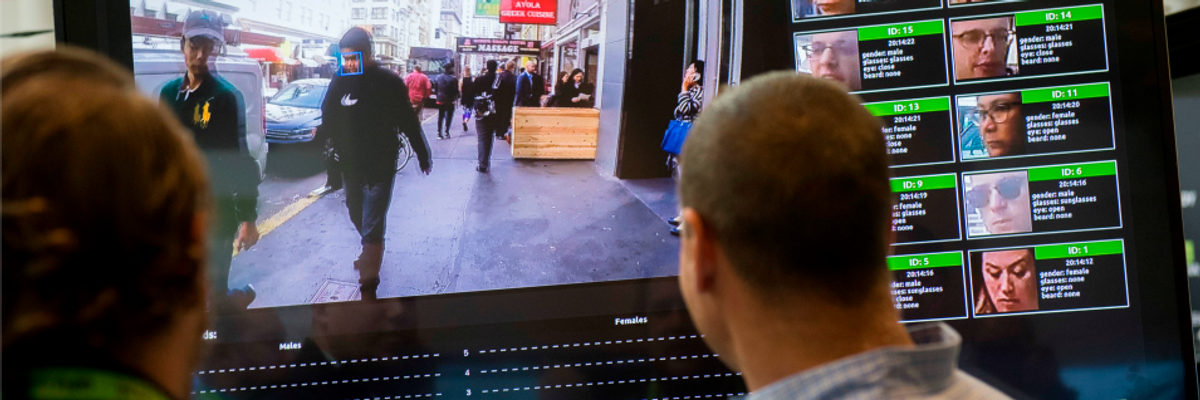
A display shows a facial recognition system for law enforcement during a conference in Washington, D.C. on November 1, 2017. (Photo: Saul Loeb/AFP via Getty Images)
A coalition of more than 40 advocacy groups is calling on President Joe Biden to take executive action imposing a moratorium on U.S. government use of facial recognition and other biometric technology, block state and local governments from using federal funds for such tools, and support related legislation introduced in Congress last year.
The organizations--including the ACLU, Access Now, Amnesty International USA, Center for Constitutional Rights, Electronic Frontier Foundation, Fight for the Future, Free Press Action, and the Leadership Conference on Civil and Human Rights--sent Biden a lengthy letter Tuesday laying out how the use facial recognition technology (FRT) "in policing, public housing, schools, and other areas of public life poses profound and unprecedented threats to core civil rights and civil liberties."
"Facial recognition technology is a threat to civil rights and civil liberties when it works, and when it doesn't. It disproportionately misidentifies people of color, women, trans people, and other marginalized groups, but its ability to track our movements across space and time would be dangerous even if it worked perfectly," said Kate Ruane, senior legislative counsel for the ACLU, in a statement Wednesday.
"Multiple Black men have been arrested and incarcerated for crimes they didn't commit after facial recognition technology falsely identified them, and its use will continue to disproportionately harm marginalized communities, especially Black and Brown people," Ruane added. "In keeping with President Biden's commitment to racial equity, he must immediately take this important first step."
The letter notes that study after study has shown facial recognition technology "exhibits particularly disturbing accuracy and bias issues against people with darker skin, LGBTQ people, women--especially women of color--and youth." It also highlights the impact of such flaws by pointing to some specific stories of people who have been harmed by misidentification.
For example, in January 2020, Robert Williams, a Black man, was wrongfully arrested on his front lawn while his wife and young daughters watched, then detained for nearly 30 hours, after software owned by Michigan State Police misidentified him as a shoplifting suspect. Williams, who lives outside of Detroit, has since spoken out against police using FRT.
Stories like Williams' have fueled calls for barring law enforcement at all levels from using such tools. While noting with alarm that "the FBI and other federal law enforcement agencies have been using FRT for years and without explicit authorization or guidance from Congress," the letter also makes clear that government use of the tech is far more sweeping.
"FRT is extraordinarily dangerous to core freedoms even when it works exactly as advertised," the groups warn. "Never before has the government possessed a technology that purportedly enables it to keep a running record of every person's every public movement, habit, and association--until now."
"If the government can track everyone who goes to a place of worship, attends a political rally, or seeks healthcare for reproductive health or substance use," the letter says, "we lose our freedom to speak our minds, freely criticize the government, pray to the god we want, and access healthcare in private."
Emphasizing that "these are not hypothetical dangers," the groups point out that "the authoritarian government in China is deploying FRT to control and oppress the religious minority Uighur population, to devastating effect."
The letter applauds activists and elected officials for enacting FRT restrictions and bans across the country--from San Francisco to Boston--but also notes that "local and state governments are largely powerless to control the way the FBI and other federal agencies use this technology in our communities."
"At present, decisions about how to use this dangerous technology are being made by unelected officials, behind closed doors," the letter to Biden says. "We respectfully urge you to bring democratic control over this dangerous, biased technology by swiftly signing an executive order that halts the federal government's use of FRT so long as bias pervades these systems and as long as Congress has not acted to authorize the use of the technology in specific circumstances and with sufficient safeguards to protect our privacy and the public interest, and prevent harm."
In addition to limiting the ability of state and local governments to use federal money for FRT, the groups ask Biden to support the Facial Recognition and Biometric Technology Moratorium Act. The bill, introduced by Sen. Ed Markey (D-Mass.), would codify the federal moratorium and impose limits on federal funding of biometric tools.
Some groups that signed on to the letter have called for governments to go even further. In a statement Wednesday, Access Now reiterated its support for "a full ban on FRT and other biometric technologies that enable mass surveillance because they inherently undermine human and civil rights."
"Facial recognition technology is extremely harmful," said Jennifer Brody, U.S. advocacy manager at Access Now. "It is increasingly used to identify, surveil, and make life-altering decisions about people. Yet, the technology remains biased against communities of color, particularly Black people and Black women."
"While a ban is preferable because safeguards can never fully address the technology's harms," she said, "a moratorium is better than nothing."
Dear Common Dreams reader, It’s been nearly 30 years since I co-founded Common Dreams with my late wife, Lina Newhouser. We had the radical notion that journalism should serve the public good, not corporate profits. It was clear to us from the outset what it would take to build such a project. No paid advertisements. No corporate sponsors. No millionaire publisher telling us what to think or do. Many people said we wouldn't last a year, but we proved those doubters wrong. Together with a tremendous team of journalists and dedicated staff, we built an independent media outlet free from the constraints of profits and corporate control. Our mission has always been simple: To inform. To inspire. To ignite change for the common good. Building Common Dreams was not easy. Our survival was never guaranteed. When you take on the most powerful forces—Wall Street greed, fossil fuel industry destruction, Big Tech lobbyists, and uber-rich oligarchs who have spent billions upon billions rigging the economy and democracy in their favor—the only bulwark you have is supporters who believe in your work. But here’s the urgent message from me today. It's never been this bad out there. And it's never been this hard to keep us going. At the very moment Common Dreams is most needed, the threats we face are intensifying. We need your support now more than ever. We don't accept corporate advertising and never will. We don't have a paywall because we don't think people should be blocked from critical news based on their ability to pay. Everything we do is funded by the donations of readers like you. When everyone does the little they can afford, we are strong. But if that support retreats or dries up, so do we. Will you donate now to make sure Common Dreams not only survives but thrives? —Craig Brown, Co-founder |
A coalition of more than 40 advocacy groups is calling on President Joe Biden to take executive action imposing a moratorium on U.S. government use of facial recognition and other biometric technology, block state and local governments from using federal funds for such tools, and support related legislation introduced in Congress last year.
The organizations--including the ACLU, Access Now, Amnesty International USA, Center for Constitutional Rights, Electronic Frontier Foundation, Fight for the Future, Free Press Action, and the Leadership Conference on Civil and Human Rights--sent Biden a lengthy letter Tuesday laying out how the use facial recognition technology (FRT) "in policing, public housing, schools, and other areas of public life poses profound and unprecedented threats to core civil rights and civil liberties."
"Facial recognition technology is a threat to civil rights and civil liberties when it works, and when it doesn't. It disproportionately misidentifies people of color, women, trans people, and other marginalized groups, but its ability to track our movements across space and time would be dangerous even if it worked perfectly," said Kate Ruane, senior legislative counsel for the ACLU, in a statement Wednesday.
"Multiple Black men have been arrested and incarcerated for crimes they didn't commit after facial recognition technology falsely identified them, and its use will continue to disproportionately harm marginalized communities, especially Black and Brown people," Ruane added. "In keeping with President Biden's commitment to racial equity, he must immediately take this important first step."
The letter notes that study after study has shown facial recognition technology "exhibits particularly disturbing accuracy and bias issues against people with darker skin, LGBTQ people, women--especially women of color--and youth." It also highlights the impact of such flaws by pointing to some specific stories of people who have been harmed by misidentification.
For example, in January 2020, Robert Williams, a Black man, was wrongfully arrested on his front lawn while his wife and young daughters watched, then detained for nearly 30 hours, after software owned by Michigan State Police misidentified him as a shoplifting suspect. Williams, who lives outside of Detroit, has since spoken out against police using FRT.
Stories like Williams' have fueled calls for barring law enforcement at all levels from using such tools. While noting with alarm that "the FBI and other federal law enforcement agencies have been using FRT for years and without explicit authorization or guidance from Congress," the letter also makes clear that government use of the tech is far more sweeping.
"FRT is extraordinarily dangerous to core freedoms even when it works exactly as advertised," the groups warn. "Never before has the government possessed a technology that purportedly enables it to keep a running record of every person's every public movement, habit, and association--until now."
"If the government can track everyone who goes to a place of worship, attends a political rally, or seeks healthcare for reproductive health or substance use," the letter says, "we lose our freedom to speak our minds, freely criticize the government, pray to the god we want, and access healthcare in private."
Emphasizing that "these are not hypothetical dangers," the groups point out that "the authoritarian government in China is deploying FRT to control and oppress the religious minority Uighur population, to devastating effect."
The letter applauds activists and elected officials for enacting FRT restrictions and bans across the country--from San Francisco to Boston--but also notes that "local and state governments are largely powerless to control the way the FBI and other federal agencies use this technology in our communities."
"At present, decisions about how to use this dangerous technology are being made by unelected officials, behind closed doors," the letter to Biden says. "We respectfully urge you to bring democratic control over this dangerous, biased technology by swiftly signing an executive order that halts the federal government's use of FRT so long as bias pervades these systems and as long as Congress has not acted to authorize the use of the technology in specific circumstances and with sufficient safeguards to protect our privacy and the public interest, and prevent harm."
In addition to limiting the ability of state and local governments to use federal money for FRT, the groups ask Biden to support the Facial Recognition and Biometric Technology Moratorium Act. The bill, introduced by Sen. Ed Markey (D-Mass.), would codify the federal moratorium and impose limits on federal funding of biometric tools.
Some groups that signed on to the letter have called for governments to go even further. In a statement Wednesday, Access Now reiterated its support for "a full ban on FRT and other biometric technologies that enable mass surveillance because they inherently undermine human and civil rights."
"Facial recognition technology is extremely harmful," said Jennifer Brody, U.S. advocacy manager at Access Now. "It is increasingly used to identify, surveil, and make life-altering decisions about people. Yet, the technology remains biased against communities of color, particularly Black people and Black women."
"While a ban is preferable because safeguards can never fully address the technology's harms," she said, "a moratorium is better than nothing."
A coalition of more than 40 advocacy groups is calling on President Joe Biden to take executive action imposing a moratorium on U.S. government use of facial recognition and other biometric technology, block state and local governments from using federal funds for such tools, and support related legislation introduced in Congress last year.
The organizations--including the ACLU, Access Now, Amnesty International USA, Center for Constitutional Rights, Electronic Frontier Foundation, Fight for the Future, Free Press Action, and the Leadership Conference on Civil and Human Rights--sent Biden a lengthy letter Tuesday laying out how the use facial recognition technology (FRT) "in policing, public housing, schools, and other areas of public life poses profound and unprecedented threats to core civil rights and civil liberties."
"Facial recognition technology is a threat to civil rights and civil liberties when it works, and when it doesn't. It disproportionately misidentifies people of color, women, trans people, and other marginalized groups, but its ability to track our movements across space and time would be dangerous even if it worked perfectly," said Kate Ruane, senior legislative counsel for the ACLU, in a statement Wednesday.
"Multiple Black men have been arrested and incarcerated for crimes they didn't commit after facial recognition technology falsely identified them, and its use will continue to disproportionately harm marginalized communities, especially Black and Brown people," Ruane added. "In keeping with President Biden's commitment to racial equity, he must immediately take this important first step."
The letter notes that study after study has shown facial recognition technology "exhibits particularly disturbing accuracy and bias issues against people with darker skin, LGBTQ people, women--especially women of color--and youth." It also highlights the impact of such flaws by pointing to some specific stories of people who have been harmed by misidentification.
For example, in January 2020, Robert Williams, a Black man, was wrongfully arrested on his front lawn while his wife and young daughters watched, then detained for nearly 30 hours, after software owned by Michigan State Police misidentified him as a shoplifting suspect. Williams, who lives outside of Detroit, has since spoken out against police using FRT.
Stories like Williams' have fueled calls for barring law enforcement at all levels from using such tools. While noting with alarm that "the FBI and other federal law enforcement agencies have been using FRT for years and without explicit authorization or guidance from Congress," the letter also makes clear that government use of the tech is far more sweeping.
"FRT is extraordinarily dangerous to core freedoms even when it works exactly as advertised," the groups warn. "Never before has the government possessed a technology that purportedly enables it to keep a running record of every person's every public movement, habit, and association--until now."
"If the government can track everyone who goes to a place of worship, attends a political rally, or seeks healthcare for reproductive health or substance use," the letter says, "we lose our freedom to speak our minds, freely criticize the government, pray to the god we want, and access healthcare in private."
Emphasizing that "these are not hypothetical dangers," the groups point out that "the authoritarian government in China is deploying FRT to control and oppress the religious minority Uighur population, to devastating effect."
The letter applauds activists and elected officials for enacting FRT restrictions and bans across the country--from San Francisco to Boston--but also notes that "local and state governments are largely powerless to control the way the FBI and other federal agencies use this technology in our communities."
"At present, decisions about how to use this dangerous technology are being made by unelected officials, behind closed doors," the letter to Biden says. "We respectfully urge you to bring democratic control over this dangerous, biased technology by swiftly signing an executive order that halts the federal government's use of FRT so long as bias pervades these systems and as long as Congress has not acted to authorize the use of the technology in specific circumstances and with sufficient safeguards to protect our privacy and the public interest, and prevent harm."
In addition to limiting the ability of state and local governments to use federal money for FRT, the groups ask Biden to support the Facial Recognition and Biometric Technology Moratorium Act. The bill, introduced by Sen. Ed Markey (D-Mass.), would codify the federal moratorium and impose limits on federal funding of biometric tools.
Some groups that signed on to the letter have called for governments to go even further. In a statement Wednesday, Access Now reiterated its support for "a full ban on FRT and other biometric technologies that enable mass surveillance because they inherently undermine human and civil rights."
"Facial recognition technology is extremely harmful," said Jennifer Brody, U.S. advocacy manager at Access Now. "It is increasingly used to identify, surveil, and make life-altering decisions about people. Yet, the technology remains biased against communities of color, particularly Black people and Black women."
"While a ban is preferable because safeguards can never fully address the technology's harms," she said, "a moratorium is better than nothing."